Author Archives: Van Rental

Bigger, better & 47mpg? New Renault Trafic & Vauxhall Vivaro break cover

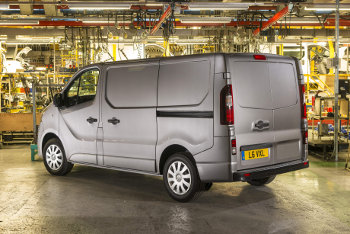
New 2014 Vauxhall Vivaro rearVauxhall and Renault have released the first pictures of their latest collaboration, the new Trafic and Vivaro vans.
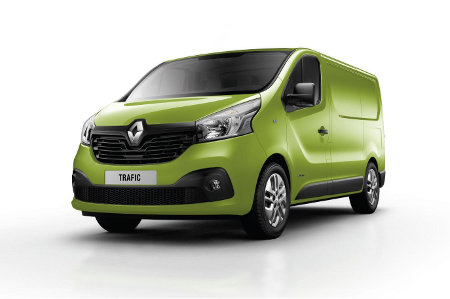
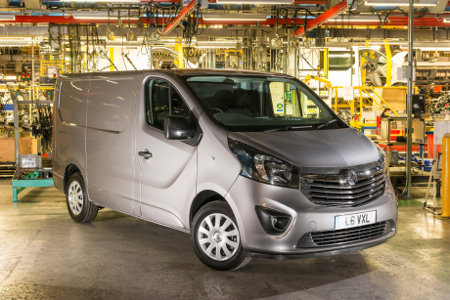
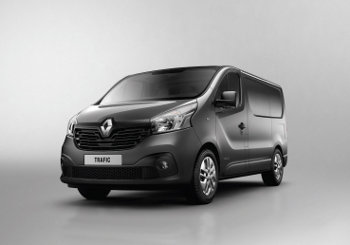
Although an all-new model, the external styling is a clear evolution of the outgoing models, with the biggest changes taking place around the front of the van, where the lights, air intake, bonnet and windscreen have all been altered.

Both vans will be powered by a Renault-designed 1.6-litre diesel engine, with two variants available — a single, variable geometry turbo and a twin-turbo model, which the manufacturers’ early tests suggest could return 47mpg. Both engines offer improved low-end torque and better pick-up, giving a sharper, more responsive feel, according to Renault and Vauxhall.

Two lengths, two heights

The outgoing model was always available in two wheelbases and with a high roof option, but these were never very popular, despite their practical appeal. The new Trafic/Vivaro has grown, as new models are apt to do, and will be come in two lengths — 4,998 and 5,398 mm.

New 2014 Renault Trafic

The new 2014 Renault Trafic

There will be a high roof model, as well as passenger-carrying double cab and Combi variants, and, a little later, as a platform cab.

New 2014 Vauxhall Vivaro front

The new 2014 Vauxhall Vivaro

The vans will be built in a several places, as far as I can tell from the initial press releases. Vauxhall says that all of the standard roof models will be built at its Luton plant, which also has a conversion centre for ex-factory conversions, such as platform cabs.

Meanwhile, Renault says that it has invested more than €230m in moving production to France, suggesting that Renault-badged models and perhaps some Vauxhall-badged variants will be coming from the firm’s Sandouville factory.

More details, including interior pictures, to follow, when they become available.


Northgate trading in line with expectations; slow but steady growth

Northgate Vehicle Hire logoB2B van hire specialist Northgate issued a trading update for the last three months this morning, reporting slow but steady growth in its UK van rental division. The company had 47,000 vehicles on hire as of 12 March, a 1,100 increase since the end of October.

Northgate said that it experienced the usual seasonal dip during November and December, with vehicles on hire dropping by 2,000 during this period, but that the fall had been smaller than during the same period in 2012, when vehicles on hire dropped by 2,900.

The firm’s fleet utilisation averaged 87% over the last three months, compared to 88% the previous year, but its fleet size has continued to grow, rising to 53,200 from 52,800 at the end of October — an increase of less than 1%, following the 5.8% increase seen during the previous quarter. Taken together, these figures suggest to me that Northgate needs a strong spring/summer/autumn — or its fleet expansion could start to look premature.

Financial update: Stock market followers will note that UK van rental specialist Northgate plc (LON:NTG) took something of a bath following its latest update today. The firm’s share price was down by around 6.5% in late trading, but this has to be seen in the context of its 122% gain over the last two years — a pause for breath was definitely overdue, given the firm’s pedestrian growth prospects.

Northgate says that it is trading in line with expectations, which suggest earnings per share of 33p for the year to 30 April 2014, leaving the firm’s shares on a forecast P/E of around 16, with a prospective yield of 1.6% — definitely not cheap, when its 98% gearing is taken into account.

Age is no barrier to used van demand, says Manheim

Manheim logoThe recent upturn in new van registrations may be a welcome relief for UK van dealers, but many van operators are continuing to run vans to much higher ages and mileages than previously seen, according to vehicle auctioneers Manheim — echoing the long-running trend reported by their competitors, BCA.

Nearly half of all used vans hitting the market in February were over seven years old, according to the firm — 36% of car-derived vans, 46% of small panel vans and 45% of large panel vans (>3t). This shortage is attributed to two, related, factors — the dramatic fall in new van registrations since 2008/9, and the causal fact that many businesses have been delaying fleet renewal as long as possible in the light of tightened circumstances and questionable availability of credit — two facts which have helped support and buoy business for long-term and daily van rental companies during the same period.

Matthew Davock, head of light commercial vehicles at Manheim, says he believes the tide is turning:

“These older vans are, without doubt, the tail end of extensions and deferred replacement programmes resulting from the economic downturn. Anything sub four years in auction today is seeing significant interest, from both online and physical buyers. Fewer than three in 10 vans sold in February fell into this age bracket.”

One side effect of this has been to support the value of used vans — in an automotive market led by the UK’s obssession for new cars, constrained circumstances have forced van buyers to appreciate the value offered by older models, according to Mr Davock:

“This is not bad news for the market. Older and higher mileage vans will always find homes as they are at an attractive price point and represent excellent value. Mileage is now seemingly less of a mental barrier in retail buyers’ minds; this is likely against a backdrop of modern reliability and a comprehensive maintenance history.”

Small vans in particular have benefited from this trend — Manheim’s price data shows that the average hammer price for small vans has risen by 22% over the last year, from £3,957 a year ago to £4,846 in February 2014.

Looking ahead, based on this year’s remarkably strong start, Manheim believes that the market for used vans will remain stable for the next few months. Overall they believe the wholesale market has hit a price ceiling; while there is a chronic shortage of quality used vans at auction, conversion rates and bidding activity will remain high.

Ford rivals feel chill as blue oval bags double win in Arctic Van Test

The new Ford Transit was the class winner in this year's Arctic Van Test

The new Ford Transit was the class winner in this year’s Arctic Van Test.

Ford’s new Transit and Transit Connect vans have earned an unprecedented double win in this year’s Arctic Van Test, which pits production models of all popular vans against each other in the Arctic conditions of winter in northern Finland.

The all-new Ford Transit and the all-new Ford Transit Connect finished first in their respective classes after competing in the punishing five-day ordeal that subjects vehicles and drivers to extreme challenges in ice, cold and snow, in the frozen north of Finland – where temperatures can drop as low as -50 C.

Expert drivers from six European commercial vehicle magazines drove all the vans taking part in the Arctic Van Test and rated the two Transits winners to deliver Ford’s first double victory in the event’s 23-year history. From slaloming across a frozen airfield, to tackling a torturous 700 kilometre route of icy, rutted roads, the Ford Transit vans won for their overall performance across categories that included fuel efficiency, load carrying, and handling.

The challenge also tests engine starting, and heating and demister operation, after vehicles have been left outside overnight in sub-freezing conditions. To see the vans in action, take a look at this video:

The all-new Ford Transit was rated top or joint-top in nine out of 13 categories against rival vehicles from Mercedes-Benz, Vauxhall and Volkswagen. The smaller all-new Ford Transit Connect was ranked top or joint-top in seven categories, and particularly impressed for its handling and stability in icy conditions, against rivals from Citroen, Renault and Volkswagen.

“The Ford vans were clear winners in very slippery conditions – a great advantage when frozen roads can be found anywhere, and not just found on the test track,” said Heikki Laurell of Auto Tekniikka ja Kuljetus magazine in Finland, which organises the annual event. “Our tests push vans to the limit, and can be quite a shock if you are not used to a Scandinavian winter.”

The all-new Ford Transit is on sale now with over 7,500 orders already taken in the UK, suggesting that it will beat the opening-year total of more than 10,000 logged by its smaller brother, the Transit Custom, in 2013.

Used van prices hit new record in February

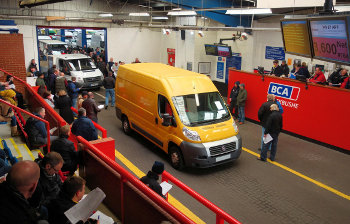
BCA commercial vehicle auction saleAverage used van prices hit a new record of £5,345 in February, leaving them 11% higher than one year ago, according to the latest sales figures from vehicle auctioneers BCA.

Despite the continued increase in average age and mileage, demand for used vans remains greater than supply, pushing up prices massively ahead of inflation, as these figures show:

All vans Avg Age (mnths) Avg Mileage Avg Value Sale vs CAP
Feb 2013 58.55 78,770 £4,789 103.05%
Feb 2014 60.73 81,346 £5,345 102.57%

Data courtesy of BCA (www.british-car-auctions.co.uk)

BCA’s General Manager – Commercial Vehicles, Duncan Ward, commented:

“As BCA has been reporting for many months, demand remains high for used light commercials, reflecting the improving economic messages from a variety of sources. Many small and medium-sized enterprises (SMEs) in the UK are now upbeat about their growth prospects this year and this sector is a big buyer of used light commercials. In fact, demand remains strong across the board, from car sized vans through to large panel vans and there is plenty of competition for any van presented in ready-to-retail condition.”

“This time of the year also typically sees an uplift in the building and construction industries.  As a lot of building activity was curtailed due to the wettest winter on record, we expect to see even more interest in tippers and drop sides as the weather improves in the weeks ahead.”

Recent strong growth in new van registrations should eventually feed through to the used market, but it could be 12 months or more until this really becomes apparent, suggesting that secondary market demand will remain very strong through the spring and summer of 2014.

Thrifty Car & Van Rental opens Bolton branch

Thrifty Car & Van Rental logoThrifty Car and Van Rental has opened a new branch in Bolton, offering a full selection of cars and vans for hire, including automatic and manual models.

Thrifty offers a comprehensive range of vans, including economy (e.g. MINI Clubvan), compact (e.g. Ford Transit Connect), short and long wheelbase panel vans (e.g. Ford Transit), extra-long wheelbase vans (e.g. Mercedes Sprinter XLWB) and luton box vans with tail lifts.

The new branch is situated on Raikes Lane which is just off Set Peter’s Way (A666), on the south side of Bolton town centre.

The full address is:

Unit 1B,
Raikes Lane,
Bolton,
BL13 1RP

You can find full details of the new branch, including sat nav coordinates and a map, on our Bolton Thrifty branch page.

British firm Cartwright unveils new ambulance design

Iveco - Cartwright ambulance demonstrator

The new Iveco – Cartwright ambulance

No sooner do I write an article about German supremacy in the UK ambulance market, than a competing British firm announces that it has launched a new ambulance body that is designed to be mounted on an Italian van chassis!

Iveco and Cartwright have teamed up to launch a new accident & emergency (A&E) ambulance, which is being made available for trials with NHS Ambulance Trusts and private ambulance operators across the UK and Ireland.

The body has been designed and developed within Cartwright’s 38-acre manufacturing site in Altrincham, Cheshire, using materials proven in aerospace and motorsport environments, combined with cutting edge metallurgy and the company’s 62 years of experience in vehicle body design. Cartwright says the body is unique in the marketplace for being easily transferable onto a second chassis, of any make, during a projected 15 year minimum service life.

The launch vehicle is based on an Iveco Daily 50C17 chassis, which is popular with blue light operators throughout Europe. Key features include its truck-style chassis frame which guarantees structural rigidity, fatigue resistance and long-term durability, combined with an impressive turning circle and a chassis offering maximum bodybuilding flexibility.

The bodywork comprises a unique combination of high strength fibre-reinforced plastic (FRP) laminates, high density structural foam core, special plastics manufactured by VEKA and high strength aluminium extrusions. The FRP laminate offers 90 per cent of the tensile strength of carbon fibre but at a cost acceptable within price driven arenas. Body joints are fully bonded; avoiding the localised stress raisers of welded, bolted or rivet joints by spreading the joint surface over the full contact area.

Key to the body’s modular nature is Cartwright’s decision to mount the lightweight body structure onto a reinforced substructure to provide a strong, rigid mounting point for battery lockers, step wells, steps and tail-lift. Unlike existing ambulance bodies in the UK, this allows fleets the option to remount the body onto a different chassis and wheelbase in the future – ensuring the base vehicle can be replaced after approximately seven or eight years in service, in line with current industry standards.

Wes Linton, Blue Light Development Engineer at Cartwright Group, says:

“Ambulance electrical systems are worked extremely hard with constant parasitic communications loads combined with regular high current requirements for the tail-lift. For this new body, we have developed what we are confident is the most advanced electrical system of its type in the blue-light sector.”

This sees a DC-DC step-up charger providing 100A continuous charge current capacity to feed the split-charge system. The split-charge system is monitored and controlled using the actual battery bank state-of-charge, operating to charge the individual banks at predefined precedence and within adjustable thresholds to ensure the battery banks are kept at their maximum charge.

The electrical control system has been designed from the outset to utilise CAN signals where possible and integrate directly with telematics systems. Utilising twin CAN networks the Intellitec iPLC based control system has direct control over all aspects of base vehicle interfaces, battery management and charge control, systems control and event logging.

The demonstrator model is powered by a 3.0 litre FPT Industrial diesel engine which is capable of producing up to 170 hp between 3,000 and 3,500 rev/min, combined with a maximum output of 400 Nm of torque between 1,250 and 2,600 rev/min. This ensures sufficient power to meet the rapid response times demanded in the blue light sector.

UK van market gains 28% in February

Van registrations rose by 28.2% in February, compared to February 2013, according to the latest figures from the SMMT.

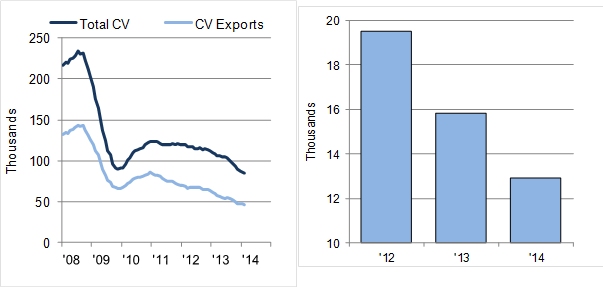
The gains in the light commercial vehicle sector build on January’s gains and mean that total commercial vehicle registrations rose by 17.5% last month, despite a 27.3% fall in truck registrations, as the heavy goods market continues to sag after last year’s pre-Euro VI sales boost.

UK commercial vehicle registrations Jan 2010 - Feb 2014

UK commercial vehicle registrations Jan 2010 – Feb 2014 (courtesy of SMMT)

The growth in van registrations means that UK van sales have risen by 18.5% so far this year, compared to the same period in 2013.

UK van and truck registrations: 2014 and % change on 2013

February % change Year-to-date % change Rolling year % change
Vans 11,731 28.2% 29,853 18.5% 275,728 13.8%
Trucks 1,589 -27.3% 3,406 -32.8% 54,555 22.4%
Total 13,320 17.5% 33,259 9.9% 330,283 15.1%

Data courtesy of SMMT (www.smmt.co.uk)

Gains in the van market were concentrated in the 2.0t – 2.5t (up 111%) and 2.5t – 3.5t (up 23.8%) categories, as these figures show:

Month Feb-14 Feb-13 % change
Pickups 943 1,047 -9.9%
4x4s 170 131 29.8%
Vans <= 2.0t 1,499 1,494 0.3%
Vans > 2.0 – 2.5t 2,664 1,262 111.1%
Vans > 2.5 – 3.5t 6,455 5,215 23.8%
All vans to 3.5t 11,731 9,149 28.2%

Data courtesy of SMMT

 These gains are encouraging, as medium and large vans are the workhorses of the economy — businesses in all sectors will experience a rise in demand for such vehicles as the economy picks up. 

Mike Hawes, chief executive of the SMMT, says that he expects more of the same as the year continues:

“Growing van registrations supported the February vehicle market as middle and heavy-weight vans enjoyed healthy rises, reflecting improving economic activity,” said Mike Hawes SMMT Chief Executive. “Registrations of trucks over six tonnes continued to decline as the market adjusts to new Euro-6 legislation. We anticipate this rebalancing act to be a factor for some months yet, while van volumes should remain on an upward trend.”


Volkswagen Multivan Alltrack concept offers 4×4 luxury

Volkswagen Multivan Alltrack concept vehicle

Volkswagen Multivan Alltrack is still a concept vehicle at this stage.

The all-wheel drive option has always been a popular choice with Volkswagen commercial vehicle buyers, and the German firm says that 20% of the commercial vehicles it sells in Europe are ordered with all-wheel drive.

Obviously this slice of the market includes the Amarok pick-up, but the firm’s 4MOTION all-wheel drive system has always been a popular option on its vans and cars, and does add unique versatility to these models.

I’ve always been a fan of VW’s all-wheel drive van offerings, but the firm’s latest concept model, the Multivan Alltrack, takes the concept further than ever before, blurring the boundaries between SUV, van, people carrier and campervan in a direct nod to the popularity of vehicles such as the BMW X5, Volkswagen Touareg and Range Rover Sport.

Volkswagen says that the Multivan Alltrack ‘combines stylish nautical design with rugged off-road features’. I’m not sure which elements are nautical — other than the vehicle’s suitability for towing a boat, something VW is keen to emphasise — but the rugged off-road features are there for all to see in the form of 19-inch wheels, black plastic wheel arch extensions and rubbing strips, underbody protection and 4MOTION all-wheel drive system.

Interior of Volkswagen Multivan Alltrack

Inside the Multivan Alltrack are independently movable leather seats, along with a removable kitchen module that includes cooking facilities, a fridge and a water tank and tap.

Under the bonnet, the high-spec theme continues: the Multivan is powered by VW’s range-topping 2.0 TDI (132 kW/180 PS) engine, the power from which is transferred to a Haldex multi-plate coupling mounted to the rear axle. It has an approach angle of 21° and a departure angle of 15°.

Inside, it’s more of the same — Volkswagen’s floor track system allows the individual leather seats to be moved independently, while a removable kitchen module means that you won’t have any problem brewing up (or keeping the champagne cold).

I doubt the Multivan Alltrack will make it into production in its current format, but it showcases the potential of the Transporter/Caravelle model, at a time when competition from the new Ford Transit Custom and Vito in the mainstream van/minibus market is intensifying.


Will the Nissan e-NV200 electrify the UK van market?

Nissan e-NV200 electric van

The Nissan e-NV200 electric van goes on sale in the UK in June

Nissan’s e-NV200 electric van goes on sale in June.

The company is hoping that it will be the first electric van to break through to the mainstream market, and Nissan has spent a lot of time and effort preparing the ground for this launch.

Large fleet operators have enjoyed a high level of access to the e-NV200, thanks to a number of long-term operational trials aimed at proving the commercial and operational viability of the van.

Companies that have participated in the UK include FedEx and British Gas, which aimed to make a substantial part of its fleet electric by 2015. Further afield, names such as Coca-Cola, DHL, IKEA, EDF and the Japan Post Office have also been involved in trialling the e-NV200 in everyday operational use.

The basics

Nissan says that the electric version of the NV200 has been re-engineered where necessary, to ensure that it is not simply a converted NV200, but a well-designed van in its own right. According to the firm, the e-NV200 has a unique part count of more than 30% — i.e. 30% of its parts are made specially for this model and are not common with the conventional NV200.

Nissan e-NV200 interior

The dashboard and controls in the e-NV200 have been designed to be as similar as possible to a conventional van, in order to aid drivers who have to switch between vans regularly.

The e-NV200’s homologated NEDC [official] range of 170km is greater than the average 100km daily driving distance required by more than half of the fleets who use this size van, says Nissan, while its payload and cargo area (4.2 cubic metres) are the same as the standard NV200.

The battery can be recharged overnight using a domestic 16-amp single-phase 3.3 kW supply which reduces to four hours if a 6.6kW/32-amp supply is used. A dedicated CHAdeMO DC 50 kW quick charger can recharge the battery from 0-80 percent in just 30 minutes or less if the battery is already partially charged. More than 1000 public CHAdeMO quick chargers are now installed across Europe, in addition a number of companies have installed their own dedicated quick charging facilities at their home depots or offices.

Will it work?

I have believed for several years that the big opportunity for mainstream adoption of electric vehicles is in the light commercial vehicle sector.

Nissan e-NV200 electric van being used by florist

Many vans do less than 60 miles a day and never venture outside the city — the ideal usage scenario for electric vehicles.

Nissan shares this view and has made a big commitment to electric vehicles, in both car form (the LEAF) and through the e-NV200. What’s needed now is for a few major van operators and forward-looking looking SMEs to bite the bullet and commit to operating a significant slice of its fleet on electricity.

I believe this is both possible and increasingly likely, and for my money, Nissan has the best chance of any manufacturer yet of delivering an electric vehicle that gains mainstream acceptance.

Watch this space.