
Tag Archives: Sprinter

Volkswagen Launches New Crafter Van

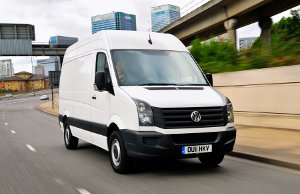
Volkswagen Crafter vanVolkswagen has just launched the new version of its Crafter van. The Crafter is VW’s largest van and has never been as popular in the UK as the Mercedes-Benz Sprinter, despite the two vans being built in the same factory and being very nearly identical, except for having different engines.

The engine appears to be the biggest difference again – VW has replaced the 2.5TDi engine that was previously used in the Crafter with the same 2.0l, 4-cylinder engine that is used in the VW Transporter.

VW says that the engine has been retuned for use in the Crafter so that it provides more torque at lower engine speeds, reducing wear and tear and improving the driving experience. The new engine will be available with approximately the same power levels as the 2.5l unit it replaces – 109PS, 136PS, 143PS and 163PS.

Despite this, the engine will meet not just Euro V emissions standards but the EEV (Enhanced Environmentall Friendly Vehicles) standard, which is something of a halfway house between Euro V and Euro VI. VW says that in Bluemotion trim, the Crafter’s CO2 emissions will start from just 199g/km, very impressive for a large van.

Fleet News was impressed with the new Crafter when they drove it recently and it will be interesting to see if it makes any further headway against the Sprinter, especially in the van rental market.

VW’s official fuel consumption figures look impressive; the 109PS engine is expected to be the most popular and should provide an 11% improvement in fuel consumption on the outgoing model, according to VW’s figures for the combined cycle. Whether it will gain market share against the Sprinter and Iveco Daily is another question.
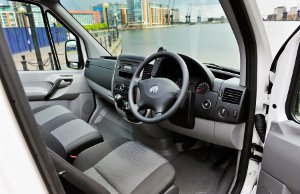
Volkswagen Crafter cab interior

The new Crafter's cab - a very nice place to spend time

Mercedes has a powerful brand advantage – the Sprinter’s reputation is legendary, as is the mileage some Sprinter engines reach. One concrete advantage the Sprinter has always had has been its low maintenance chain cam engine.

VW has always favoured a cambelt-driven engines meaning that the belt requires periodic replacement, as with most car engines. However, maintenance intervals keep getting longer on all vehicles and VW says that owners can opt to run the new Crafter on LongLife oil – meaning service intervals of up to 25,000 miles or 24 months, depending on how the van is used.

Update: In what is perhaps a deliberate move to try and break into the 3.5t fleet market currently dominated by the Sprinter, VW has announced that it will be making 80 Crafters available to large fleet customers for an extended six-month ‘try before you buy’ demo period. These vehicles will be in addition to VW dealer’s regular demo vans. Full details on Fleet News.
All-Electric Mercedes Sprinter Goes On Trial

Fifty all-electric Mercedes-Benz Sprinter vans are to go on trial in Germany, in a government-funded deal worth around €9m. The vans are development models that will be used to gather data about the performance of the li-ion battery system in real world conditions and to investigate infrastructure requirements for such vehicles.

The aim of the trial is to reach a point where such vans can be sold at a price point and with performance that will make them attractive to commercial operators. Vans used for urban deliveries are proving to be one of the ripest markets for electric vans – their low mileage, defined routes and stop-start driving is ideal for getting the most from an electric drivetrain with regenerative braking. Coincidentally, such conditions are the least efficient and most polluting for internal combustion engines, adding to the appeal of an alternative.

The first vans are due for delivery to trial partners in 2010. Mercedes describes its trial customers as “primarily fleet operators and public bodies conducting transport operations in environmentally sensitive areas. The main emphasis here is on short-range operating profiles with frequent stops in inner-city areas.”

Save £2,000 On A New Merc Van & LDV Latest

‘Swappage’ – No Trade-in required

For van owners, the problem with the government’s scrappage scheme was that there aren’t many vans over 10 years old on the roads. Furthermore, the scheme prevented anyone taking part who intended to finance the van using an ‘off balance sheet’ method – an approach favoured by many van operators.

Mercedes-Benz has decided to help these poor souls potential customers out by offering its own ‘Swappage’ scheme – where buyers can get £2,000 off the price of a new Sprinter 311CDi – the most popular model – regardless of how they finance it or whether they have anything to trade in.

Mercedes is meeting the cost of this itself, as it doesn’t qualify for governement scrappage payments, and is offering three finance/acquisition methods for potential buyers – operating lease, contract purchase and regular finance.

For more details, see the RoadTransport.com report here.

LDV Going Down The Pan?

It seemed like they might have had (yet another) saviour, but with the news that Malaysian company Weststar has pulled out of a deal to purchase LDV, the future looks bleak for the Birmingham-based company.

While I don’t like to see manufacturing (or any other) jobs disappearing in the UK, it’s hard to avoid the conclusion that LDV just doesn’t deserve to be saved. They haven’t made a profit since time began, and their vans are, frankly, a little bit cheap and cheerful and behind the times.

To be honest, I’d rather that the money the government might spend on LDV is invested in other, already successful van enterprises – like Modec, Smith Electric Vehicles and even Vauxhall, if necessary.

Better still, I’d rather the government didn’t prop up every loss making automotive company unless there was a good reason to.

Ford Transit Headed For US Market & Going Electric

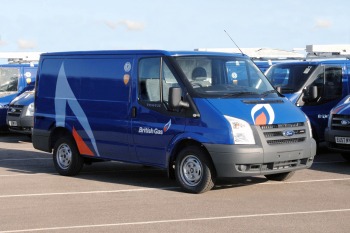
Ford Transit in British Gas liveryIt looks like the European Ford Transit will be joining its smaller cousin, the Transit Connect, in being sold to the US market.
The Transit is scheduled to be introduced to the US market in summer 2009 and Ford CEO Alan Mulally has now admitted that the European model will form the basis of Ford’s promised electric van, due to appear in 2010.

The lightweight, front-wheel drive Transit makes a far more sensible base vehicle for an electric, urban van than Ford’s heavyweight US van, the rear-wheel drive E-Series. The Transit also offers a more modern design and drivetrain than the well-established E-Series.

The introduction of the Transit to the US market is just part of a growing trend in the light commercial vehicle sector – the last few years have also seen the successful introduction of the Ford Transit Connect and the Mercedes-Benz Sprinter (badged as a Dodge) to the US market.

Perhaps the time has come for the automotive divide between the US and Europe to start disappearing, with fewer different models sold across more markets.

Mercedes-Benz Releases ECO-Start Sprinter Demo Fleet

I mentioned recently that the new Mercedes-Benz ECO-Start system was being fitted to a number of new Sprinter vans supplied to van hire giant Northgate plc.

Mercedes appear to be pushing had to promote this fuel-saving technology and to ensure that everyone gets a chance to try it out have now put into a service a demo fleet of 50 vans. There is at least one ECO-Start Sprinter at every Mercedes-Benz van dealer in the UK – so if you want to give one a try, you shouldn’t have far to travel.

Thanks to TNN for the tip.

Mercedes Launch LNG Sprinter With 1200km Range

Mercedes-Benz have launched a natural gas-powered version of its popular Sprinter van. The van, which Mercedes Sprinter XLWBhas a supercharged 1.8 litre petrol engine, generates 156hp and can run on petrol, LNG or CNG. Drivers can switch between natural gas and petrol power and the combination of a full petrol tank and a full gas tank will give the van an impressive 1200km range, according to Mercedes.

Mercedes claim that the Euro 4-compliant, gas-powered Sprinter will have operating costs up to 30% below those of diesel-powered Sprinters and the vehicle has been successfully trialled by Deutsche Post, DHL and UPS in Germany. Compressed natural gas is especially popular in Germany, as the fuel benefits from a reduced tax rate that will last until at least 2018, offering van operators guaranted savings over diesel during that period.

Although Mercedes have offered natural gas conversions of Sprinters before, this is the first purpose built gas/petrol Sprinter van. The van should be available for sale anytime now, although I’m not sure how the price will compare to diesel models.

Mercedes Aims To Banish Idling With Eco-Start

I’ve written about the Mercedes-Benz Eco-Start system before – it’s a system available with new Sprinter vans that stops the vehicle’s engine when it’s stationary and idling and automatically restarts it as soon as you put the clutch down to engage a gear.

Previous trials by Motor Transport magazine in London rush hour traffic resulted in a 10% fuel saving. While this is obviously an extreme case, there is no doubt that the technology helps save fuel, and it has built-in safeguards to prevent repeated cold starts or overheating.

The system has been a cost option available on manual Sprinters and Atego 7.5t trucks only to date, but Mercedes are now confident that Eco-Start is ready for prime time. The German giant has decided to kick-start more widespread adoption of the technology by making it standard fitment on Atego models and by relaunching it with the Sprinter at the Commercial Vehicle Show later this year.

At the other end of the size spectrum Mercedes is also introducing Eco-Start to its A-Class and B-Class car models – and as I noted here, other major manufacturers are also introducing similar systems.

Note: According to this article on Transport News Network, adding Eco-Start to a Mercedes Sprinter will cost £545. This includes an uprated battery and alternator, necessary to ensure that the battery remains suitably charged through frequent starts/stops.