Signs of hope from October CV manufacturing figures?

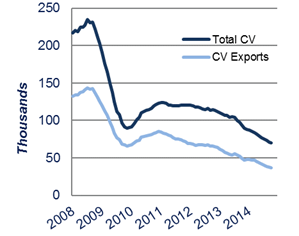
UK CV output graph, 2008-2014

That lost production ain’t never coming back: UK commercial vehicle manufacturing, rolling year total 2008 – 2014 (courtesy of SMMT)

UK commercial vehicle production fell by 31% in September, and by 23% during the first six months of 2014.In that context, October’s 8.9% decline looks pretty encouraging — especially as it masks a 14.6% increase in production for the UK market, compared to the same period last year.

The reason total production declined is that export demand, primarily to the EU, remains weak, and fell by 30.6% last month, taking the year-to-date decline in export production to 27.9%.

The enfeebled state of the eurozone economy is no surprise: it is reassuring, however, to see that UK demand for home-produced vehicles may be picking up. The SMMT figures don’t provide a breakdown, but I’m fairly sure that a significant part of last months’ climb — if not all of it — was due to the introduction of the new Vauxhall Vivaro, which is built at GM’s Luton plant.

This would also explain why the increase wasn’t mirrored in export figures: the Renault Trafic, for example (the same vehicle, badge engineered) is built in one of Renault’s plants in France, and will be the default choice for many French and Iberian buyers.

Here’s how last months’ figures look:

CV manufacturing Oct-13 Oct-14 % Change YTD-13 YTD-14 % Change
Total 7,939 7,235 -8.9% 75,826 57,981 -23.5%
Home 3,816 4,372 14.6% 35,416 28,846 -18.6%
Export 4,123 2,863 -30.6% 40,410 29,135 -27.9%
% export 51.9% 39.6% 53.3% 50.2%

Data courtesy of SMMT (www.smmt.co.uk)

Commenting on the figures, Mike Hawes, SMMT chief executive, said that EU demand remained uncertain, but that UK demand was now expected to stabilise:

“The heavy fall seen in UK commercial vehicle manufacturing over the past year is now levelling off as the effects of last year’s restructuring only apply to year-to-date figures. With new models now being produced in UK plants, production for the home market grew for the first time since June 2013. It remains to be seen if the recent growth in EU demand will continue, but the indications are of greater stability in the months to come.”

There’s a lot of media focus on how UK car production has risen to record levels in recent years, and that’s certainly good news. However, what seems to be less well understood is the catastrophic decline in UK CV production since 2008. Output has fallen from a peak of about 230,000 per year to around 75,000 per year — a 67% decline! In fact, SMMT has stopped including rolling 12-month figures in its monthly updates (e.g. the table above), presumably because they are so depressing.

If you don’t believe me, just take a look at the graph at the top of this article.
Worried about driving a minibus? Don’t be: they drive “like a luxury car” says one taxi firm boss

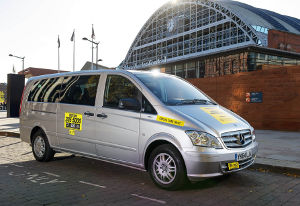
Cresta Cars Mercedes-Benz Vito taxi

One of Cresta Cars’ new Mercedes-Benz Vito 8-seater taxis

If you’re thinking about hiring a minibus but are worried about having to drive one, then the comments of Manchester taxi firm boss Julian Barnes, who runs 350-vehicle firm Cresta Taxis, suggest you needn’t be.

Mr Barnes recently added five new 8-seater Mercedes-Benz Vito minibuses to Cresta’s fleet, and says that they drive “more like a luxury car than a van”, with good handling and manoeuvrability.

Mr Barnes also commented that fuel economy was impressive for a large vehicle — Cresta’s Vitos are bigger than usual, as the firm chose the extra-long body option in order to allow for plenty of luggage room as well as flexible seating space.

Merc’s legendary brand image is also having an effect: according to Mr Barnes, the new Vitos have already generated new business and are “so smart they’re effectively acting as mobile advertisements for themselves”. I’ve commented on the power of the Mercedes brand before: the Stuttgart firm’s commercial vehicles inspire incredible loyalty in some operators.

What about larger minibuses?

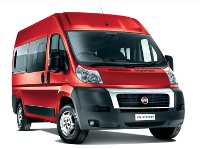
New Fiat Ducato minibusOf course, an 8-seater is a relatively small minibus, as a minibus is defined as a vehicle with between 8 and 16 passenger seats. At the larger end of the scale, 12, 15 and 17-seater minibuses (including the driver in this seat count) are definitely more van-like, but are still far easier to drive than many hire customers expect.
This is because over the last few years, van and minibus manufacturers have gone to a lot of effort to make their vehicles more like cars: all current models have modern, dash-mounted gear sticks, smaller steering wheels with power steering, excellent mirrors and comfortable driving positions.

When driving, you’ll also notice that modern minibus brakes are very effective, while the current generation of diesel engines are very powerful and easy to drive, with plenty of power for any situation and reasonable fuel economy.

The only thing that hasn’t changed is the size — these are still fairly large vehicles, but to help you adjust to this we’ve produced a simple guide to driving a van for the first time that’s also completely relevant for minibuses.

Finally, if you do need to hire a minibus before Christmas, I’d recommend booking soon: the hectic Christmas and New Year party season can mean that availability becomes limited once we hit December. To get started, click here to compare self-drive minibus hire prices in your area.

Citroën tweaks Berlingo to deliver fuel efficiency boost

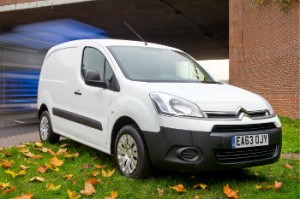
The 2014 Citroën BerlingoCitroën has announced that subtle modifications to the Berlingo will increase the popular small van’s fuel efficiency, with the changes taking place from November production onwards.

According to the French firm, the November changes will see the HDi 75 powered Berlingo vans’ combined cycle fuel consumption figure improve to 56.5mpg (previously 55.4mpg) and CO2 emissions reduced to 131g/km from 133g/km.

Similarly, the Berlingo LX e-HDi 90 manual micro-hybrid sees its CO2 emissions reduced to 120g/km from 125g/km and its combined cycle fuel consumption figure improve to 61.4mpg (previously 58.9mpg).

The Berlingo is Citroën’s best-selling van, and the firm is clearly keen to stay on top of the competition. Jeremy Smith, Citroën’s Head of Commercial Vehicles & Business Sector Operations, commented:

“These latest changes will help to maintain the Berlingo’s strong sales performance. In the first three quarters of this year, the Berlingo showed a year-on-year sales growth of 14% to 12,283. We expect that this popular model will deliver one of its best-ever sales results in 2014, reflecting its strong appeal to businesses both large and small.”

The Berlingo range includes a wide range of models and a full choice of drivetrain technologies — full-electric, petrol, diesel and diesel micro-hybrid (perhaps Chivas should have looked outside the Vauxhall stable, which is far more limited).

Berlingos are available with a factory built choice of L1 and L2 panel vans, 5-seat crew vans, enhanced traction vans and platform cabs for special bodywork. The Berlingo panel van is also the only model in its sector to be supplied as standard with Teletrac satellite navigation and Trackstar stolen vehicle tracking.

Exclusive: SAVE up to 10% on SIXT van rental [EXPIRED]

Moving house before Christmas? Last minute DIY needed to get your house sorted before the big day? Perhaps you’ve having a new kitchen or bathroom.

Whatever you’re doing, hiring a van could save time and money — especially as we’ve teamed up with hire giants SIXT van rental to offer vanrental.co.uk visitors an exclusive discount.

Courtesy of the good people at Sixt UK, you can save up to 10% on van hire for bookings made between 10 November 2014 and 16 November 2014.

Here are the details:

*THIS OFFER HAS NOW EXPIRED*

Offer: Save up to 10% on SIXT van rental 

Valid from: 10 November 2014

Expires: 16 November 2014


Terms & conditions may apply, see Sixt website for details.

Used van buyers are “insatiable”, says Manheim’s Davock

Manheim logoUsed van buyers just can’t get enough decent quality vans to meet demand — that’s the conclusion of Manheim’s head of LCV, Matthew Davock, who says:
“”This October we’ve witnessed the highest average van sale price since our records began. There is an insatiable appetite for good quality stock.”

Mr Davock also commented that older, higher mileage vans, which had been fading away from auction entries, are re-emerging in each major segment — especially the key large panel van segment, where 38% of vans over 3 tonnes sold in October had an average age of 87 months and 120,140 miles, while 40% of car-derived vans were more than five years old.

The run-up to Christmas always sees peak demand for large vans, as couriers take on extra staff to meet demand for Christmas deliveries. Manheim believes supplies of used vans may currently be contracting, saying that the volume of vans sold by a representative sample of vendors fell by 13% in October, compared to the same period in 2013.

Record prices

The average price of large panel vans over 3 tonnes rose by £312 to £5,647 in October, compared to September. Average milsage was 99,962, up by 6,437 from September.

A similar trend was seen with small panel vans, where the average value rose to £4,986 in October, 5% higher than in September, despite the average mileage rising by 5,706 to 86,366.

It all adds up to a possible portion of humble pie for me, especially if Mr Davock’s forecast for next year proves to be correct:

“I’m not convinced that van de-fleet volumes will increase over the next 12 months, so this landscape is likely to remain the norm for some time to come.”

Demand for used vans is almost certain to remain strong in the run-up to Christmas — we’ll have to wait until February to see what the New Year brings.

45% would rather admit to watching porn than drink driving

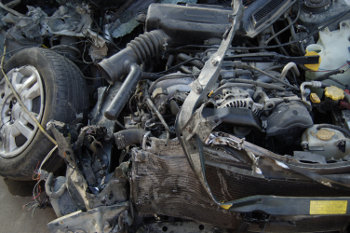
Crashed carFifty years ago, the government launched the UK’s first ever anti-drink drive campaign.
Back then, drink driving was widely accepted — if not taken for granted: a 1979 survey found that half of male drivers and nearly two-thirds of young male drivers admitted drink driving on a weekly basis.

Today, drink driving is still a problem, but social acceptance of drink driving has fallen, to the extent that new research from THINK! has found that 88% of people say they would think badly of someone who drinks and drives, and 45% of people would rather tell their partner they watch porn regularly than admit to having been caught drink driving.

In a similar vein, 61% of those questioned would prefer to reveal their internet search history to their employer than admit to a drink drive conviction. Completing this not-so-sexy trio of statistics is the interesting finding that 24% of people would rather tell their partner they’ve had a sexually transmitted infection, than admit to having been caught drink driving.

There’s no doubt social acceptance of drink driving has changed, but frankly, I also think that these figures say as much about changing social attitudes to sex and pornography as they do about drink driving, which is still too widely accepted, in my opinion.

Still a problem

In 2012, the most recent year for which figures are available, 230 people were killed by drunk drivers, and 1,200 were seriously injured.

Admittedly that’s a big improvement on 1967, when 1,640 people died as a result of drink driving, but it’s still too many, given that unlike sober road traffic collisions, crashes caused by drink driving are effectively caused deliberately by the driver who chose to drink. If they hadn’t, the collision — and death — would probably have been avoided.

Drink driving is still a regular occurrence for many, and while it’s not so openly approved of, I know from personal experience that there are still many drivers who think it’s ok, as long as you’re not actually drunk. This misses the point that even a small amount of alcohol impairs the highly complex and rapid motor skills needed to drive safely on today’s busy roads.

Limit too high

The UK’s archaic 80mg limit practically encourages a culture of drink driving, as it permits a surprising amount of alcohol to be drunk legally before driving. The EU’s recommended 50mg limit would be better, but far better still would be for us to adopt the 20mg limit used in Sweden, Poland and Greece, amongst others.

It’s for this reason that vanrental.co.uk is a long-standing supporter of Brake and the THINK! campaign: far too many personal tragedies are caused by dangerous and uneccessary behaviour on our roads.

Finally, for a touch of nostalgia, check out the UK’s first ever road safety video — from when men did the driving and women did the nagging (strangely, that situation hasn’t changed as much as you might think — today, men account for 77% of drink drive casualties):

Drink Drive Office Party from BFI on Vimeo.

Van registrations climb 18% in October, but rigid truck registrations rise by 122% — here’s why

New van registrations rose by 18.2% to 26,570 units in October, while the truck market staged a dramatic comeback, with new registrations rising by 65.7% to 8,457 units, according to the latest figures from the Society of Motor Manufacturers and Traders (SMMT).

On a rolling 12 month basis, new van registrations are up by 19.1% this year, while truck registrations are now 12.1% higher:

UK van and truck registrations: 2014 and % change on 2013

October % change Year-to-date % change Rolling year % change
Vans 26,570 18.2% 268,641 18.1% 312,237 19.1%
Trucks 8,457 65.7% 35,842 -9.2% 52,603 12.1%
Total 35,027 27.0% 304,483 14.1% 364,840 18.0%

Source: Data courtesy of SMMT

What’s behind the changes?

Van sales have been strong all year, and October’s figures suggest that strength is likely to persist until the end of the year. Underlying economic growth must be one of the factors contributing to this year’s strong performance, but I believe there are others, too, namely:

  • Fleet renewals that were delayed during the recession but can not economically be delayed any further
  • Strong used van prices and improved finance availability means that buying new may make more sense than buying used; I’ve written at length about the massive increase in used prices over the last two years and the poor availability of nearly-new models — although this situation may be starting to change.

As for trucks, sales have declined steadily this year, following a surge of sales ahead of the introduction of Euro 6 emissions rules. The distortion caused by Euro 6 now seems to be dropping out of the figures, although as Mike Hawes, the SMMT’s chief executive, explains, we should be careful not to read too much into one month’s figures:

“October marks the first month of 2014 in which truck registrations have seen positive growth, given the paucity of demand following the introduction of Euro-6. While encouraging, we should treat such a sharp percentage increase with caution, owing to a relatively small total market and new type approval regulations coming into force at the end of the month.”

I’ll come back to Mr Hawes’ comments about type approval in a second, but first, let’s take a look at how these new registrations break down.

What’s selling, what’s not?

As always, there were significant differences in new registrations across the different segments of the van and truck market.

In the van market, the big volume gains were seen in the 2.0-2.5t and 2.5-3.5t segments, where sales rose by 48.2% and 12.5% respectively. The 2.5-3.5t segment is by far the largest in the LCV sector, and accounted for 15,123 of the 26,570 sales in October.

In the truck market, the differences were even more pronounced — and lend support to Mr Hawes’ comments about reserving judgement on this month’s figures. Here’s why: sales of rigid trucks between 6t and 16t rose by 114% in October, compared to the same month last year, while sales of rigids over 16t rose by a massive 174%!

At the same time, sales of 2-axle artics fell by 14.7% and 3-axle artics (standard for most UK work) rose by a more measured 10.4%.

These figures do suggest to me that there is an underlying reason for the sudden surge in truck sales, which may not be repeated next month: I suspect that the type approval deadline triggered a surge of discounted sales of new trucks which would not have been compliant after the introduction of the new rules.

This is why: rigid trucks typically have bodies supplied and fitted by third parties, and so bodybuilding companies which have failed to get type approval for their products will have been keen to push as many out of the door last month as possible. Similarly, truck buyers may be pre-purchasing rigid truck chassis so that they can evade the type approval registrations by having new bodies fitted post registration (a workaround I’ve discussed previously that’s obviously being pursued by some buyers).

We’ll have to wait until next month to find out, but I’d be very surprised if truck registrations are maintained at this level next month, although the outlook for vans should remain similar — especially with pre-Christmas demand from couriers for 3.5t models likely to be strong.

Vauxhall makes it a double with new fleet order, but buyer Chivas misses opportunity to cut emissions

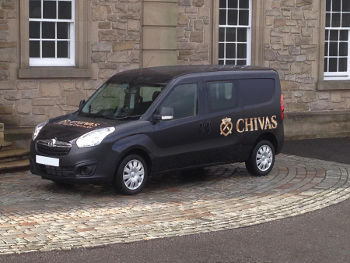
Chivas Brothers Vauxhall Combo Crew Van site vehicle

One of Chivas Brothers new Vauxhall Combo Crew Vans for site use, powered by diesel, sadly, not petrol or electric.

Whisky and gin maker Chivas Brothers has opted to renew its existing fleet of Vauxhall Combo site vehicles with new model Combo Crew Vans.

The 15 Vauxhalls will be used by Chivas’ warehousing teams as site vehicles. They will remain on the fleet for the next five years, covering an average of 2,000 miles per year travelling between warehouses to load and unload casks at the beginning and end of the whisky maturation process.

The Combo vans Chivas has purchased are powered by Vauxhall’s standard 1.3 CDTi 16v engine, for which the official specification suggests fuel consumption of 57.6mpg and CO2 emissions of 129g/km.

These models are in ecoFLEX spec and benefit from Start/Stop technology, but while they are likely to be an improvement on the outgoing vans, the idea that these emissions and fuel consumption figures are realistic for low mileage site use is laughable — although I suspect the CO2 figure played a role in the purchase choice. A petrol engine, although more suitable for low mileage use, would, on paper at least, have emitted more CO2.

Still, that’s the inevitable result of the government’s myopic focus on CO2 emissions, to the exclusion of all else: diesels aren’t really that environmentally friendly, especially when they’re cold, and with the vans expected to average just over 5 miles per day, these engines are never likely to warm up fully or deliver the benefits they do offer for high-mileage users.

Not only would faster-warming petrol engines (available in Combos) be more suitable for such low mileage work, they would probably be less troublesome, too — but really, this is a classic example of an application that is perfectly suited to electric vans.

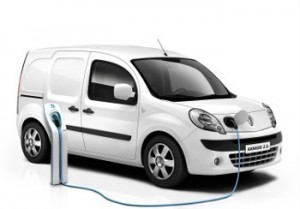
By sticking with Vauxhall, which doesn’t offer any electric vans, Chivas has missed an opportunity. For similar money, after allowing for the government’s plug-in grant, the spirits firm could have purchased Renault Kangoo Z.E. or Nissan e-NV200 electric vans, and reduced on-site emissions to zero.

French posties set environmental example with 5,000 Renault electric vans

Renault Kangoo Z.E.Renault has been one of the most enthusiastic advocates of electric power in the European car and van market, and as you’d expect, the organs of French government have backed this — in this case through France’s state-owned postal service, La Poste, which operates nearly 25,000 means of electric transport out of a total fleet of 69,000 vehicles.

Among La Poste’s electric fleet are 5,000 light vans, 1,000 electric quad bikes, 18,000 electrically-assisted bicycles and — most recently — 100 STABY electric three wheelers. Of course, as this is France, all these vehicles are supplied and built by French companies — Renault for the vans, Ligier for the quads and three wheelers and Cycleurop and Arcade for the bikes.

Looking at these figures, you can only draw two possible conclusions: electric vehicles are a collosal white elephant, or that we are on the verge of seeing electric vans and delivery vehicles join the mainstream.

As I’ve written many times before, my money is on the latter: while electric cars remain impractical for many drivers, electric vans make perfect sense for a great many organisations. Take Royal Mail, for example, which is continuing its love affair with diesel: all the Royal Mail sorting offices I’ve ever seen have secure off-road parking for all of their vans, which are only used during the day, mostly on regular, low-mileage routes that are well within the 70km daily range La Poste claims to get from its Renault electric vehicles — and an ideal setup for overnight charging.

On 31 October, La Poste took delivery of the 5,000th Renault Kangoo Z.E. to roll off Renault’s production lines, and the two firms’ chief executives signed a new partnership, aimed at extending their cooperation on eco-mobility solutions. The two groups will conduct a watch, carry out tests, and dialogue on new vehicles measuring up to 17 m3 for mail use and in respect of competition law. Several new ideas have already emerged, including in the 8 m3 segment, the “service” vehicle segment and the small urban vehicle segment.

Citroën earns green awards for LCV range

Citroën Relay 35 L3H2 (l) and L1H1 (r)

Citroën has been awarded the GreenFleet LCV Manufacturer of the Year Award in recognition of the environmental credentials of its LCV range.

The largest van in Citroën’s range is the recently-updated Relay, for which fuel economy figures have improved by up to 15% – with combined cycle fuel economy in the 37.7-42.8mpg range. These are impressive figures a large panel van in the up to 3.5 tonne gvw sector.  Citroën  has also cut CO2 emissions with the new Relay, and has managed to get CO2 emissions under 200g/km for all models up to 3.5 tonnes.

Emissions will be helped by the specification of a six-speed gearbox on all new Relay models and by the specification of Stop & Start on many models.

Citroën is also taking a more holistic approach to cutting emissions, specifying all new Relay panel vans (and their small Berlingo and Dispatch siblings) as standard with sophisticated Teletrac satellite navigation and stolen vehicle tracking systems.  The use of this advanced telematics platform significantly improves vehicle productivity and efficiency, as well as cutting unnecessary mileage, reducing driver stress levels and improving safety.