
Author Archives: Van Rental

European Van Hire? You Need This 5-Point Checklist

EU flagTaking a hire van across the Channel (or North Sea) to Europe is surprisingly popular — a lot of people come to vanrental.co.uk looking for our European van hire page.
However, there are a few things you need to do to keep it legal and safe — and while most reputable hire companies will ensure you are properly prepared, it is always good to know what’s required for yourself.

In addition, if you are not familiar with driving on the wrong side of the road — especially in a van — then you need to take extra care.

Here’s a simple 5-point checklist to run through when arranging European van hire:

1. To use a hire van abroad, you need a VE103B Vehicle On Hire certificate, which proves that you have the hire company’s permission to take it out of the UK. You must have one of these and it must be an original — not a copy. More info here.

You will also need to know the van’s dimensions (height and length) when booking your ferry — make sure you ask the hire company.

2. You may also need extra insurance — check with the van hire company that their insurance provides cover in the countries you plan to visit. Most rental companies provide European breakdown cover as they don’t want their vans stranded abroad, but check — you may need to pay for it yourself. If the van doesn’t have a modern EU-style licence plate with the blue GB section, you will need a GB sticker (click  here for details).

3. Be aware of country-specific requirements. These include the need to carry a basic breathalyser in France and two reflective warning triangles in Spain. Many European countries require you to carry reflective yellow vests (hi viz) for use if you are forced to exit the vehicle after a breakdown or accident.

For a full, up-to-date guide, check the AA’s guide to compulsory equipment when driving in Europe.

4. Make sure you have maps or a sat nav that cover the areas you will be driving through. Remember that speed detectors and speed camera POIs on sat navs are illegal in some European countries. Leave your speed camera detector at home and switch off your sat nav POIs.

Don’t overestimate how far you can get in one day — driving distances tend to be longer than in the UK. Google Maps and The AA provide good European route planners.

5. Finally, take care when your are driving abroad. Make sure mirrors are adjusted carefully as this will help compensate for the different visibility you get when driving on the ‘wrong’ side of the road. Remember at all times you should be driving on the right: although it’s not difficult, it’s all too easy to get this wrong in a moment of carelessness.

The secret is concentration and what I call ‘driving deliberately’ – your driver’s autopilot might be ok in the UK, but it won’t work in Europe. Never just hop into the van and scoot away whilst carrying on a conversation or thinking about something else. Stop for a second, visualise your path onto the road/across the junction, and drive deliberately into the right position on the road.

After all of that, try to enjoy the experience — driving in Europe is generally more fun than driving in the UK and you can often see some amazing scenery on much less congested roads!

Volkswagen Adds New Models To Caddy & Transporter Ranges

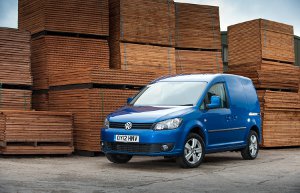
Volkswagen Caddy Highline

Volkswagen Caddy Highline

Volkswagen has added Highline and Trendline models to its Transporter (medium van) and Caddy (small van) ranges. The main benefit of this is that you get a bundle of attractive options at less than the individual list price for the options.

The Trendline is the lower spec of the two and comes includes the following extras.

Caddy Trendline: Bluetooth connectivity, an upgraded CD/radio with ParkPilot display for rear parking sensors, cruise control, electric windows, height adjustable passenger seat, heated and electrically operated door mirrors, storage compartments under the front seats, vanity mirrors in the sun visors and a cover for the dashboard centre storage compartment.

Externally, the Trendline is enhanced with wheel trims and body-coloured bumpers, door mirrors and door handles.

The Caddy Trendline includes specification worth up to £1,555 (plus VAT), but only costs £900 (plus VAT) more than the standard model.

Transporter Trendline: Upgraded CD/radio with ParkPilot display and AUX-IN socket, Bluetooth, trip computer and multifunction display, cruise control, full bulkhead (panel van), driver’s seat armrests, Comfort pack and Premium dashboard, Tasamo cloth upholstery, wheel trims, rear parking sensors and body-coloured bumpers, door mirrors and door handles.  Kombi Trendline models also have privacy glass plus armrests and height and lumbar adjustment for single passenger seat.

The Transporter Trendline costs an additional £1,100 for the panel or £1,250 for the kombi, representing savings of £750 and £800 respectively against the actual value of the added specification.

Highline models: The Highline spec for both Caddy and Transporter includes all the Trendline enhancements, plus Climatic air conditioning, a leather-covered steering wheel and gear knob, alloy wheels, front fog lights and an alarm (Thatcham approved on the Transporter).

Trendline and Highline will no doubt be popular with owner-drivers as they represent a good value way to get a fully-loaded spec.

UK Van Manufacturing Slumps 20% In September

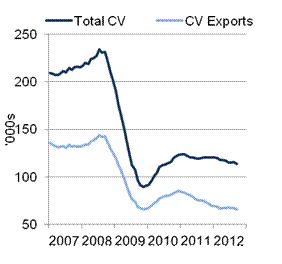
UK commercial vehicle output fell by 20.2% in September, as export demand fell by 26%, accelerating this year’s decline in output.

UK van manufacturing fell by 20.2% in September and is down by 7.5% so far this year, according to the latest figures from the Society of Motor Manufacturers and Traders (SMMT).

A 26% drop in export demand coupled with a 12.5% drop in domestic demand lay behind the drop. Falling export demand has been a continuous trend since the start of 2011, as this graph shows:

SMMT UK CV manufacturing Sept 2012

Commercial vehicle manufacturing 2007-2012

Car Output Falls

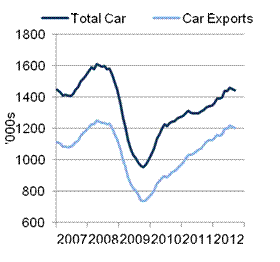
For most of the last three years, car manufacturing output has proved far more resilient than commercial vehicle output, rising steadily from its nadir in 2009 to be above 2007 levels earlier this year.

However, last month saw export demand for British-made cars fall by 8.9%. Since 80% of the UK’s car manufacturing is exported, this made a big dent in the monthly output figures that wasn’t cancelled out by a 9% rise in domestic demand for British-made cars.

SMMT UK car manufacturing output 2007-2012

The good news is that UK car manufacturing output is still up by 10.2% so far this year despite September’s fall. A total of 1,083,276 cars were  exported from the UK in the first nine months of 2012.

European crisis

September’s fall in demand and ongoing weakness in commercial vehicle demand is mostly due to the eurozone crisis, according to Paul Everitt, SMMT Chief Executive:

“Declining demand for cars and vans across the major European markets impacted UK vehicle and engine production in September.

Everitt stressed that long-term structural damage to the motor industry could result if the crisis is not brought under control soon:

European governments must focus on securing financial stability and economic growth or they risk long-term damage to key industries.”

Despite this, leopards don’t change their spots and so far, Europe’s politicians have done everything possible to drag out the crisis. Every step forwards is agreed reluctantly and at the last minute, and measures are often watered-down or compromised. Greece, Portugal, Spain and probably Italy all appear to be locked into a spiral of deepening recession with no ability to reignite growth.

We can only hope that the UK’s motor manufacturing industry can hold out through the crisis — as a major UK employer, any substantial downturn in this area would be bad news indeed.

Nissan Vans Keep Thieves At Bay

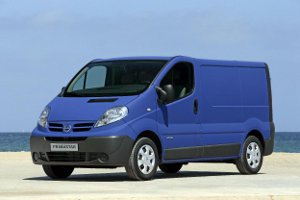
Nissan Primastar van

The Nissan Primastar won the heavy van security category, beating the Renault Trafic and Vauxhall Vivaro.

Nissan has won the Best Van Manufacturer award at the British Insurance Vehicle Security Awards.

Nissan won two awards for its van range at the recent British Insurance Vehicle Security Awards (BIVSA) 2012.

The highlight was the van manufacturer award which saw Nissan’s extensive six vehicle range (NV200, Primastar, NV400, Cabstar, Navara and Pathfinder Van) beat stiff competition from the rest of the light commercial industry.

The award recognises the work Nissan has done across its van range to protect vehicles from being stolen or being broken into which ultimately helps insurers reduce premiums for operators.

In addition the Nissan Primastar, which has an alarm fitted as standard, won the heavy van category for the second year running beating the Renault Trafic, Ford Transit and Vauxhall Vivaro.

This is all the more impressive considering that the Primastar is a rebadged version of the Trafic/Vivaro — obviously Nissan’s contribution to the Primastar adds real value in terms of security.

“Insurance is a major outlay for all van operators and Nissan has spent years improving all aspects of its van security across its extensive vehicle range,” said Andy Connell. Category Manager for LCVs at Nissan Motor (GB) Limited.

Thatcham Chief Executive Peter Shaw said:

“Congratulations to Nissan. For many commercial vehicle owners any potential threat to their vehicle is not only an inconvenience, but can also represent a genuine threat to their livelihood. Strong vehicle security is imperative and in winning the Best Van Manufacturer award, Nissan has demonstrated a real focus in this area across its commercial vehicle range.”

Nissans are not the most widely chosen vans in the van hire industry, but these awards show that the company’s contribution to its NV400 and Primastar vans does make a real difference.

Hiring A Van? You Need This 5-Point Checklist

Are you hiring a van for the first time? This checklist will help you avoid costly problems.

Although renting a van is pretty similar to hiring a car, there are a few extra pitfalls you need to watch out for. We’ve put together a 5-point checklist based on our long experience of van hire to help you avoid problems that could be costly — or even dangerous.

1. Tall and wide

Vans are higher and wider than cars and if you aren’t used to it, you can get caught out. A particular problem in the UK is height restrictions on car parks. Finding somewhere to park in a town centre isn’t normally difficult in a car, but you may be surprised how many car parks are off limits to vans, even quite modestly-sized models. Anything over 2m high is generally dodgy, but check the car park’s height barrier as they aren’t all the same. Make sure you know how high your van is — or be very cautious.

2. Tyres

Make sure your van’s tyres are correctly inflated before you load it — and then check again afterwards. A tyre that looks correctly inflated when the van is empty can turn out to be almost flat once the van is fully loaded. This has happened to me more than once — I suspect that many rental companies don’t check tyre pressures very often, they just have a quick look to see if any tyres look flat. The trouble is that this doesn’t work when you’ve got a few hundred kilos of extra gear in the back.

Underinflated tyres are far more likely to puncture or blow out — not fun at 70mph on the motorway (or any other time, really). What’s more, most van hire companies will charge you for replacement tyres unless the damage is due to “normal wear and tear”, which is hard to prove with a blowout.

3. Loaded down

Make sure you don’t overload your van. Depending on the size of van and the load you are moving, this is easy/hard to do. Paper (of any kind) and liquids (e.g. wine and beer) are both surprisingly heavy and a large load of either can easily overload a typical rental van. Building materials are also surprisingly heavy if you need more than a very small amount.

If in doubt, ask the van hire company what the van’s payload is and work out what your load is likely to be. If you are stopped while driving and found to be overloaded, you will probably be prevented from continuing until the load has been reduced and may even be prosecuted.

4. Security

Luton vans can be a particular problem for security. The rear roller shutters do not normally have locks. You will need to provide your own padlock.

Similarly, if you are hiring a panel van, check whether it has central locking and make sure it actually works, especially if the van is an older model.

5. Eddie Stobart, not Eddie Irvine*

When driving a hire van, slow and steady is the name of the game, especially when you go round corners. It’s easy to forget that all of your worldly goods are being hurled from one side of the van to the other — until you open the door and find them in pieces…

When loading your van, start from the front and load right up to the bulkhead. Make sure nothing can shift forwards or from side to side and don’t hesitate to tie/strap things down if they can move. Likewise, if the van isn’t full all the way to the back, then use a strap/rope/plank of wood/etc to make sure that things can’t slide backwards too easily.

Finally, remember that van speed limits are lower than car speed limits — click here for our van speed limit guide.

*Apologies to F1 fans too young to know who Eddie Irvine is

Volkswagen Adds Bluemotion To Transporter Range

Volkswagen Transporter BlueMotion

The Volkswagen Transporter BlueMotion

Volkswagen has introduced BlueMotion versions of its Transporter range.

The Transporter BlueMotion models provide improved fuel efficiency and lower emissions than equivalent standard models. Two of Volkswagen’s main rivals in this category — the Vauxhall Vivaro and the Ford Transit — have long since been available in low-emission spec, so it’s good to see that VW has now joined the party.

The efficiency of the BlueMotion Technology models is achieved by using low rolling resistance tyres, Stop/Start and battery regeneration systems as well as cruise control.

The BlueMotion model also has a tyre pressure warning light to avoid tyres becoming under-inflated and increasing fuel consumption.

The table below shows the difference between standard and BlueMotion models of the Transporter 84PS, 102PS and 114PS models:

Transporter with low (standard) roof 84 PS 84 PS BlueMotion Technology 102 PS 114 PS BlueMotion Technology 114 PS BlueMotion
Urban (mpg)

Extra-urban

Combined

29.1

44.8

37.7

32.8

46.3

40.4

29.1

44.8

37.7

32.8

46.3

40.4

37.7

50.4

44.8

0-62 (mph) 19.7 19.7 15.3 14.8 14.8
Emissions (g/km) 198 184 198 184 166

Transporter BlueMotion and BlueMotion Technology models are available with prices starting from £18,770 (plus VAT) and £17,290 (plus VAT) respectively. For full details of the Volkswagen Commercial Vehicles’ range of vans and people carriers, or to find a local Volkswagen Van Centre, visit www.volkswagen-vans.co.uk

Toyota Reveals ProAce Panel Van – Hiace Replacement

Toyota has released details of a new medium panel van, the ProAce. This will provide a replacement for the discontinued Hiace model.

Toyota ProAce

The Toyota ProAce is based on the Peugeot Expert/Citroen Dispatch and goes on sale in the UK in Spring 2013

As I reported in July, the ProAce will be a rebadged PSA Peugeot Citroën. Toyota will use a rebadged Peugeot Expert / Citroën Dispatch as the basis for the ProAce, which will go on sale in the UK in Spring 2013.

According to Toyota, the ProAce will feature bespoke Toyota design details and branding. It will be available in two lengths and heights, giving load capacities of 5m3. 6m3 or 7m3, according to the configuration chosen. This should make it competitive in the medium van market, which will soon become tougher than ever, with the introduction of the new Transit Custom.

Payloads up to 1,200kg can be carried and ProAce will be able to tow up to two tonnes. ProAce can also be specified as a panel van, glass van or crew cab.

To achieve the best usability and capability, two sliding side doors can be specified, and customers can choose between a top-hinged tailgate and dual side-hinged rear doors that open to 270 degrees.

The ProAce will be available with a range of efficient, Euro 5-compliant diesel engines. The 89bhp 1.6-litre engine produces 180Nm of torque and is matched to a five-speed manual transmission. Two 2.0-litre diesel units are offered, with outputs of 126 and 161bhp and peak torque figures of 320 and 340Nm respectively. Both of these engines come with a six-speed manual transmission.

These sound like the standard engines fitted to the Peugeot and Citroën versions of the van, so I assume Toyota will be using the PSA engines to avoid having to find a Euro 5 engine of its own that fits — common sense, really.

Toyota ProAce cab interior

Inside the new Toyota ProAce

Used Van Prices Rise In September But Fall On Year

BCA Commercial vehicle auctionDespite the increase, used vans are cheaper than they were in September 2011.

According to BCA’s latest Pulse Report, average used LCV values improved by £149 (3.6%) to £4,224 in September compared to August, although year-on-year figures lagged behind for the first time this year.  Average age fell slightly to just under 58 months while average mileage increased to nearly 79,000.

Values increased in all three sectors, with the dealer part-exchange average values reaching record levels.  Performance against CAP average improved over the month by nearly two points to 100.7% but remains much lower than in September 2011, when average prices were 105.93% of CAP price.

Year-on-year, September 2012 was £185 behind the same month in 2011, with both average age and average mileage increasing this year.

Year-on-year table: All vans

All vans Avg Age Avg Mileage Avg Value Sale vs CAP
Sept 2011 55.10 77,503 £4,409 105.93%
Sept 2012 57.93 78,805 £4,224 100.72%

(Courtesy of BCA)

Used van prices have weakened in recent months as the average mileage and age of second vans has continued to increase. However, despite last month’s increase, the table above shows that used van values are now falling in year-on-year terms.

BCA Used Van Prices 2010-2012 (courtesy of BCA)

BCA Used Van Prices 2010-2012 (courtesy of BCA)

Duncan Ward, BCA’s General Manager – Commercial Vehicles, said:

“The market bounced back in September following the quieter summer period.  Much of this improvement is seasonally driven as trade buying activity rises to meet the needs of small businesses that often look to change their vehicles in the autumn months.”

“However, we are yet to see any significant uplift in vans from corporate fleet sources and demand is still outstripping supply which is keeping values firm.”

“Many buyers are looking at older, higher mileage vehicles if they are in good condition and as a direct consequence we have seen values rise in the dealer P/X sector, while demand for the very few late year, low mileage LCV’s remains intense.  Some astute rental operators are selling stock to take advantage of the demand in the sub-two year old van market and are reaping the rewards as a result.  There is also interest in poorer condition vans if they are valued sensibly.”

“Even so, we expect to see some pressure on values as volumes rise in the wholesale sector and retail demand softens in the run-up to the year end.”

It all adds up to a market that is weak in terms of supply and demand — but with demand slightly exceeding supply and keeping prices firm.

Europcar Adds Van Hire At Major Airports

Europcar van hireEuropcar van hire is now available from the company’s branches at five major UK airport — Heathrow, Stansted, Newcastle, Luton and Birmingham

The decision to add airport locations to the Europcar Van network has been prompted by an increasing demand from both businesses and leisure customers for vans at these key commercial hubs.  It also reflects the growth in logistics business originating from airports.

“In the last year we have seen significant growth in van rental by logistics companies”, explained Ken McCall, Managing Director, Europcar UK Group.  “We believe this is largely due to the huge upturn in online and home shopping over the last year or so.  But we think it’s also attributable to the fact that logistics companies want the flexibility of van rental – rather than ownership – so that costs are matched to demand. In addition, these new airport locations increase accessibility of vans for our leisure customers.”

Europcar Vans are now available at the company’s Heathrow Airport, Luton Airport, Stansted Airport, Birmingham Airport and Newcastle Airport locations.

“This is all about choice”, added Ken McCall.  “We know that there a number of businesses operating in and around these airport locations.  Therefore, by adding vans to our fleet at those branches, we are simply giving these businesses the same range of choice as organisations operating down-town.

“We also understand that consumers want easy access to hire vans, which is why opening at these airport locations, with their extended opening hours and easy transport links, is a perfect fit for our customers”

All Europcar vehicles are less than twelve months old, making it the youngest van fleet in the country. The vans are also fully maintained to manufacturer standards, ensuring they run efficiently and Europcar’s corporate customers benefit from a fleet they can rely on.

Van Registrations Up 1% In September – Stability?

Van registrations edged up by 1.1% in September, according to the latest figures from the Society of Motor Manufacturers and Traders (SMMT). So does this represent a return of stability to the market?

SMMT chief executive Paul Everitt certainly thought so, commenting:

“The September plate change provided enough of a boost to stabilise van demand in a challenging economic environment. Continuing the trend seen so far this year, light rigids performed strongly in the month growing 23.4%, while light vans and pickups reversed recent declines, recording rises of 8.8% and 17.2% respectively.”

However, I’m not entirely sure I feel as optimistic as Mr. Everitt. A 1.1% increase on last September’s figures is hardly a reversal of the 6.3% decline in van registrations for the year to date (compared to the first 9 months of 2011). Nor does it complete reverse the rolling year decline of 2.6%, although it’s certainly a move in the right direction.

My feeling is that if the plate change only delivered a 1.1% boost, we are likely to be back into flat or negative territory by the end of this month — although I would be very happy to be proved wrong!

SMMT commercial vehicle registration figures

SMMT commercial vehicle registration figures (courtesy of SMMT)

Big Vans vs. Little Vans

Interestingly, the mix of different types of light commercial vehicles continues to change. This year has seen fewer sub-2t and 2.5t-3.5t van sales, as this SMMT graph shows:

Light commercial vehicle registrations by type

Light commercial vehicle registrations by type (courtesy of SMMT)

Truckin’ Ahead

For those that are interested, truck sales have continued to perform more strongly than van sales, especially in the light rigid (3.5t – 6.0t) category, where new registrations were up by 23.4% on the same period last year and are up 48.6% for the year to date.

Registrations of larger rigids have also grown strongly and are up 28% (6.0t – 16t) and 26% (>16t) on the year to date, although >16t recorded an 18% fall in registrations in September compred to September last year.

Truck registrations by type 2012 YTD vs 2011 YTD

Truck registrations for 2011 and 2012 YTD, divided into rigid and artics -- rigids have gained strongly this year (courtesy of SMMT)

Artic sales are flagging and are down 6.2% on the year to date, although sales of 3-axle artics (by far the most popular), rose by 3% last month, perhaps because of the plate change effect.