Author Archives: Van Rental

How To Cut Van Fleet Fuel Costs By Up To 45%

Evolution of Van: Efficiency and Fleet Operation

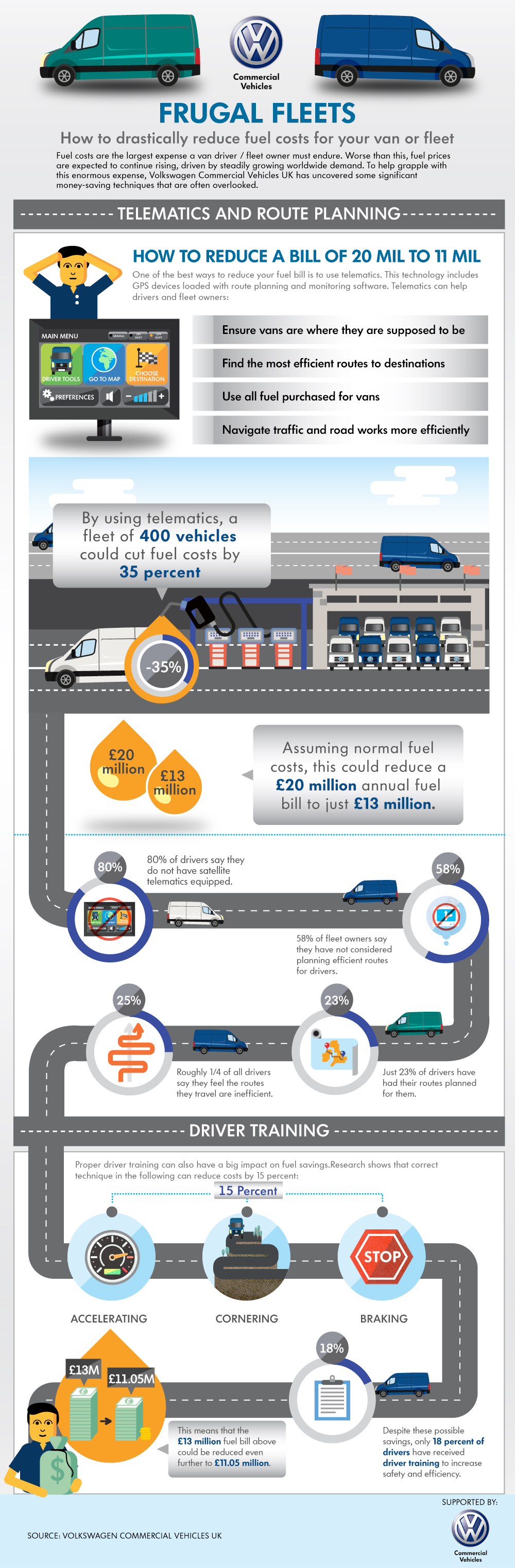
Volkswagen Frugal Fleets infographic - click to enlarge

Fuel bills are one of the biggest costs faced by van operators — and with diesel looking stuck around the £1.35 – £1.40 range (at least where I live), that isn’t going to change anytime soon.

Despite this, there are several things van operators can do to reduce their fuel bills by a significant amount — but new research by Volkswagen suggests that many van operators aren’t doing this and could cut their fuel bills by 45%!

Pull the other one!

I’m not kidding. Simple things make a big difference and the changes Volkswagen suggests fall into two categories.

Telematics & Route Planning

Drivers traditionally complain about satellite tracking, telematics and being told which route to take, but the reality is that all of these things save money. Not all drivers have the skills or inclination to do these things for themselves — and route planning for a big fleet needs centralised coordination to maximise efficiency.

Computerised route planning, satellite navigation to avoid traffic bottlenecks and telematics to record and report excessive idling, harsh acceleration and braking and other bad driving techniques will all result in a reduction in fuel costs.

Volkswagen’s research, which was conducted by commercial vehicle independent consultant Robin Dickson, found that using telematics could cut fuel consumption for a 400 vehicle fleet by as much as 35%.

Telematics are becoming much more common in large HGV fleets, but according to VW’s research, van fleets are lagging behind:

  • 80% of van drivers surveyed say that they do not have telematics fitted to their vans.
  • 58% of fleet owners say they have not considered planning efficient routes for drivers
  • 25% of drivers say they feel their routes are inefficient
  • Only 23% of drivers have their routes planned for them

Driver Training

The other element to maximising fuel efficiency is driver training. Volkswagen has identified three elements that if corrected can reduce fuel consumption by as much as 15%. Certainly, I know from my own experience that increasing or decreasing fuel consumption by 10% is pretty easy.

Here are the three factors highlighted by Volkswagen (my comment in italics):

  • Acceleration: Smooth, moderate and looking ahead – don’t accelerate to join the back of a queue
  • Cornering: Aim for smooth, controlled cornering at manageable speeds. As you approach a corner, lift off the accelerator before you start braking; this saves a noticeable amount of fuel.
  • Braking: Excessive braking and acceleration wastes fuel because you are constantly burning fuel to speed up, only to slow straight down again. Look further ahead when driving to spot slowing traffic — if you see it, just lift off the accelerator and let your speed come down without touching the brakes. 

Volksagen says that despite the proven benefits of driver training, just 18% of drivers have received training to improve their safety and efficiency.

I suspect that part of the problem is that vans can normally be driven on car driving licences — so van drivers have never had any formal driver training, except the basic training required to pass their car tests. The fact that their licences aren’t are not subject to any additional oversight (unlike HGV and PSV licences) probably doesn’t help either.

Whatever the case, the UK’s van fleet operators seem to be missing a trick here. Volkswagen’s 45% figure is perhaps a little optimistic, but I suspect that savings of 15% – 25% could be achieved quite easily in many cases. What’s not to like?

You can download the full Volkswagen fleet white paper, “Evolution of Van: Efficiency and Fleet Operation”, here.

Anglian Water To Take 500 New Vauxhalls In 2012

Anglian Water fleet manager Nigel Allen with Anglian's new Vauxhall vans

Anglian Water fleet manager Nigel Allen with some of Anglian's new Vauxhall vans

Anglian Water is the largest water and wastewater service in England and Wales by geographic area. It has relied Vauxhall vehicles for over a decade and cars and vans from the Luton-based manufacturer currently form around 90 per cent of its 2,000-strong fleet.

Anglian Water serves a region stretching from the Humber north of Grimsby to the Thames estuary in the south, and from Buckinghamshire in the west to Lowestoft in the east. Its operators have to service 80,000km of water and wastewater pipes over an area of 27,500 square kilometres, so the demands on its fleet vehicles are significant.

Talking about the company’s current vehicles, Nigel Allen, Anglian Water’s Fleet Manager said:

“Put simply, our current fleet is the best, most cost-effective solution we’ve ever had. Vauxhall has worked closely with us to help us get to where we are today and there’s always someone on the end of the phone. We’ve been constantly impressed with the vehicles’ prices, maintenance costs and residual values.

The two major drivers for our fleet decisions are whole life costs and CO2 emissions, both from an environmental and financial point-of-view. The whole life costs of all our Vauxhall vehicles – both cars and vans – are incredibly impressive and we also see the benefit of the ecoFLEX models in our fleet, including the New Combo and Vivaro ecoFLEX.”

Anglian Water’s fleet of 2,000 vehicles includes 1,200 light commercial vehicles, 600 cars and 200 trucks and heavy vans. Around 90 per cent of the car fleet is comprised of Vauxhalls including Corsa, Astra and Insignia, and Vauxhall commercial vehicles make up more than 95 per cent of the van fleet, including New Combo, Vivaro and Movano models. Having taken delivery of 500 Vauxhalls in 2011, Anglian Water will take on a similar number of new vehicles in 2012.

Nigel continued:

“Our fleet vehicles are owned by us for four or five years. We sell the cars on once they clock up 100,000 miles and the vans when they reach 120,000 miles. Given the mileage involved, it’s important our fleet is not only efficient and cost-effective to run, but absolutely dependable.”

When any new parts are required, Anglian Water benefits from next-day delivery through Vauxhall Trade Club, which not only provides the most affordable solution, but reduces downtime as all parts are supplied under warranty and are genuine, quality Vauxhall parts that will fit first time.

In addition to the low emissions afforded particularly by Vauxhall’s ecoFLEX models, Anglian Water’s commitment to reducing environmental impact extends to its vehicle fixtures and fittings.

“Several years ago, we asked our supplier, Bott, about refitting equipment into new vehicles and they came up with a solution,” said Nigel Allen. “Today, fitting out our new models with fittings and fixtures from de-fleeted vehicles provides us with a 25 per cent cost saving, as well as the environmental benefit of not having new equipment manufactured.”

James Taylor, Vauxhall Fleet Sales Director, said:

“We are delighted to continue the long-established relationship between Vauxhall and Anglian Water. We have worked hard to provide solutions to the varying demands of the company’s fleet, from its operational support and service vans through to its business cars. Vauxhall’s relationship with Anglian Water perfectly demonstrates our capability to deliver a complete fleet solution, from a wide range of flexible and efficient vehicles through to responsive and cost-effective aftersales.”

For more information visit www.vauxhall.co.uk or www.anglianwater.co.uk.

Speed Limiters Should Be Standard – FTA

Most new vans can be specified with a speed limiter and 70mph is a common choice, as there is no logical reason a van operator should expect its drivers to ever need to go faster than that.

Of course, we all know that in the real world things aren’t so black and white, but perhaps they should be. The Freight Transport Association certainly thinks so and its Van Excellence Governance Group has appealed to van manufacturers to supply vehicles with a speed limiter set at 70 miles per hour as a no-cost option.

Following a recent meeting of the group, it was unanimously agreed that, despite recent press reports trailing Government plans to increase motorway speed limits to 80mph, manufacturers should be called upon to help play their part in managing van top speeds and to continue to restrict their vans to 70mph.

The group felt that aside from the legal implications, restricting van top speeds would also see significant fuel economy benefits. There are many other demonstrable benefits to be had by limiting vehicle speed.  Repair and maintenance bills are often reduced and lowered driver stress levels are frequently cited as an unexpected bonus.

Gary Whittam, Chairman says:

“We find it impossible to justify why any conscientious van operator would allow its vans to operate above the national speed limit.

Simply put, a van travelling at 80mph will be using significantly more fuel than one at 70.  You don’t need a calculator to work out that at over £7 per gallon, that’s just burning money.

Without exception manufacturers can easily limit the top speed of their vans.  So the question is, why don’t they make limitation the default standard or at the very least a no-cost option?”

Operators that use 70mph speed limiters have reported very little detriment to their journey times and as Rory Morgan, GM National Logistics at Iron Mountain puts it:

“How can any business depend on drivers breaking the law to meet schedules?  In these days of corporate responsibility it’s just not acceptable.”

At the risk of sounding like a boring old fart, I have to agree.

What do you think? Leave a comment below and let me know.

New Van Registrations Up In May – First Rise Of 2012

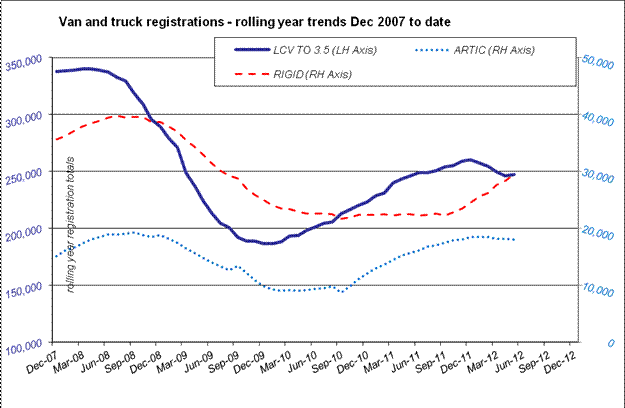
Throughout this year, new van registrations have been falling, despite strong increases in truck (>3.5t) registrations.

In May, that trend finally changed, with the latest figures from the SMMT showing that van registrations rose by 6.7% to 21,303 units, when compared to May 2011. This was small beer compared to the 31.5% increase in truck registrations, but it is at least an improvement. It’s too early to say whether the turnaround in the van market signify’s a new trend — I have my doubts, given the state of the economy — but it’s a good start.

Paul Everitt, SMMT Chief Executive, commented:

“The truck market continued its strong progress, up 31.5% in May and there was a welcome return to growth for the van market, its first rise of 2012. It’s too early to know if the change in fortunes for the van market is a sign of things to come, but coupled with the strong truck performance, it is a welcome signal of increased confidence across the commercial vehicle sector.”

Small Vans Top Sales

In terms of vans, the biggest growth was in the sub-2.0t sector, where sales were 11.6% higher than in May 2011. However, these lightweight vans have seen the biggest falls so far this year, with new registrations down by 21.9% to date, so perhaps van operators are making up for lost time.

The same story seems to apply in the heavy (2.5t-3.5t) weight category; sales were 9.1% higher than at the same time last year but are still down 9.7% on the year to date.

In the middle weight sector (2.0t – 2.5t), the situation is slightly different, with sales only just keeping their head above water last month with a 0.7% increase in last May. However, across the year to date, sales in this category — which includes many variants of popular vans like the Citroen Berlingo and Volkswagen Caddy — are only down by 2.3%, the smallest fall in any weight category.

As I’ve observed before this may be due to the fact that popular small vans like the Berlingo have got heavier — whereas all models used to be sub-2.0t, now only the lighter payload models are. The heavier payload and long wheelbase models all have gross weights over 2,000kg, which I assume places them in a different weight category in the SMMT’s statistics.

SMMT Van & Truck Registrations May 2012

Graph courtesy of SMMT

Rigids Up, Artics Down

As we’ve seen in previous months, the strongest growth was reserved for the rigid truck sector, with a 113% increase in sales of 3.5t – 6.0t rigids, a category that is up 58% over the year to date. At the other end of the weight scale, artic volumes were down slightly for the fourth consecutive month and are now down 6% on the year to date.

The growth in sales of light rigids is interesting, especially as they are limited to 56mph like larger lorries these days. Based purely on the vehicles I see out and about, I wonder if a lot of distributors and parcel delivery firms are scaling down from 7.5t – 12t lorries to this lighter, smaller and cheaper category. It would be interesting to know.

A Minibus With Limousine Luxury? VW Thinks So

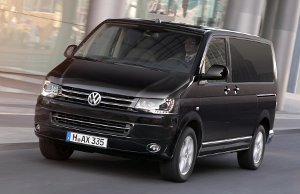
Volkswagen Caravelle BusinessThe Volkswagen Caravelle has been around for decades — and its predecessor, the Samba, is considerably older than I am.

It’s never been the last word in luxury, though — until now. Volkswagen has just launched a new version of its evergreen seven seater minibus, the Caravelle Business.

Seating has been cut down to four rear passengers plus one front passenger (ideal for your secretary…) and the driver, but luxury has been cranked up to full executive transport levels. According to VW, it’s “designed to be a mobile conference room with state of the art technology, including Wi-Fi internet connectivity and Bluetooth”.

The rear lounge configuration includes four individual seats and an adjustable table.  Like every Caravelle, the two middle seats swivel to face forwards or backwards, but the Business is upgraded with the full ‘wood and leather’ treatment. The upholstery is Nappa leather and the usual rear bench seat is replaced by an twin seat console which is multi-adjustable and heated with an integrated fridge between the seats.
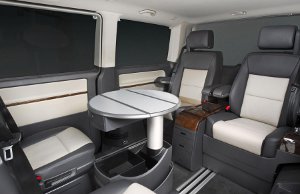
Volkswagen Caravelle Business interiorThe interior of the Caravelle Business is enhanced with elegant burr wood inserts in the rear passenger compartment, plus the added safety of curtain airbags, while for the driver’s convenience there is cruise control, satellite navigation with 6.5 in colour screen and 30GBhard drive, a leather multi-function steering wheel, lane change assist to warn of vehicles in the driver’s blind spot, and a programmable heater to ensure the interior can always be ready at the desired temperature.

A second battery with cut-off relay ensures the rear seating area can be powered independently.

Externally, Volkswagen describes the Caravelle Business as “discreet yet stylish”. In other words, it has the pimped look that’s so popular these days: privacy glass, 17in alloy wheels, darkened rear light clusters, electrically folding door mirrors and a laminated windscreen for improved noise damping.

More practically, it also has front and rear parking sensors with reversing camera and Xenon headlights with automatic activation, LED daytime running lights, headlamp washer system and heated front washer jets, while electric sliding side doors provide easy access and exit for rear passengers.

Naturally, a vehicle like this needs a decent engine, and VW is not short of fast diesel engines. The Caravelle Business is powered by the company’s most powerful 2.0-litre 180PS bi-turbo TDI engine.  This Euro 5 engine delivers 400 Nm of torque from 1,500 rpm, has DSG (automated) transmission as standard and will manage 34.9 mpg on the combined cycle with Co2 emissions of 214 g/km.

The Caravelle Business is now on sale with retail prices starting from £53,856 (plus VAT), or £56,069 (plus VAT) with 4MOTION transmission.

Unlike a big people carrier, this vehicle can actually carry five people plus luggage in comfort — so it sounds tasty, especially if you operate at the top end of the private hire market and need to be able to transport four passengers in one vehicle at a time, with luggage space.

For more information, visit www.volkswagen-vans.co.uk.

Used Van Values Climb – But Only Just

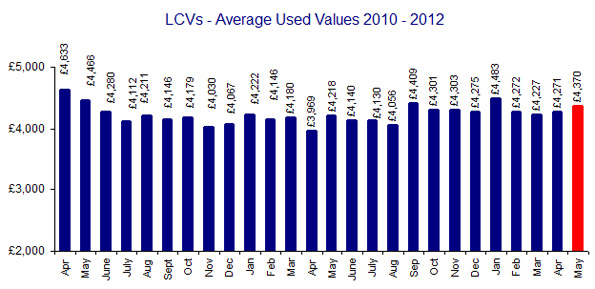
The latest used van auction sale figures from BCA, the UK’s largest vehicle auctioneer, show that used van values were higher in May 2012 than May 2011 — but only just.

Used LCV values improved across the board for the second month running in May, rising by £99 (2.3%) compared to April to reach £4,370.  Average age and mileage fell slightly month on month, while CAP performance declined by nearly a point to 98.19%.  There was a marginal increase in fleet & lease values, while part-exchange values reached record levels.

Year-on-year, May 2012 was £152 (3.6%) ahead of the same month in 2011, despite the average age climbing by six months and average mileage increasing by 6,300 to 77,000.  Performance against CAP also improved year-on-year, up by more than two points.

Year-on-year figures, all sizes of vans:

All vans Avg Age Avg Mileage Avg Value Sale vs CAP
May 2011 50.78 70,977 £4,218 96.00%
May 2012 56.82 77,334 £4,370 98.19%
BCA Used Van Values 2010-2012
Graph courtesy of BCA

Average values have been relatively higher since last September and reached a 20-month high in January.   May saw values rise in all three sectors – fleet/lease, dealer part-exchange and nearly new – but supply and demand remains finely balanced.

Duncan Ward BCA’s General Manager – Commercial Vehicles commented:

“There is steady demand for the best examples in the wholesale arena, but sellers need to be aware that buyer confidence is quite fragile despite the relative shortage of stock.  Buyers are sensitive to mileage and condition, and excessive mileage or damage will significantly impact the price performance.

The best prices are paid for vans in good colours with a high specification and any rare or unusual vehicles will generate the most attention.  Sellers also need to manage the supply of similar makes and models, because it can have a direct impact on price performance – even for attractive retail-quality vans.”

Ward added:

“Now is the time for volume sellers to really get back to basics and ensure their vans are given the best opportunity to sell the first time they are offered.  This means full documentation and service histories for vehicles being sold, pre-sale preparation and presentation, valuing stock in line with market sentiment and effective sale day representation to make swift decisions on provisional sales.  Make it an easy choice for buyers to purchase your vans!”

Van News In Brief: Isuzu, Red Bull F1 & Nissan

Nissan To Supply Red Bull Vans

Nissan vans and Red Bull F1Nissan’s contract to supply the Red Bull Formula One team with light commercial vehicles has been extended for the remainder of the 2012 season.

To support the transportation needs of Red Bull Racing at their factory in Milton Keynes and for all operations throughout the 2012 Formula One season, Nissan will supply a fleet of over 30 vehicles, including the award-winning Nissan NV200 and the Nissan NV400 large van.

The choice is unsurprising, as Nissan’s premium brand Infiniti (equivalent to Toyota’s Lexus brand) is one of the team’s main sponsors. Indeed, I believe that Red Bull’s Renault engines are branded as Infiniti, as a result of the long-standing high-level partnership between Nissan and Renault.

Red Bull will use Nissan’s  NV200 and NV400 vans to support the team. The NV200 is Nissan’s own design, but the NV400 is of course a rebadged Renault Master – see here (NV400) and here (Master).

For more information visit www.redbullracing.com or www.nissan.co.uk.

New Isuzu Dealer In Preston

New Isuzu D-Max Pick-Up driving through waterIsuzu UK has added a new dealer to its network, Browns, in Preston, Lancashire. Browns is a family-run business with a strong presence in the local agricultural market, so it expects Isuzu’s new D-Max pick-up to be well received.

Browns Dealer Principal, Roy Brown, commented:

“With a strong local history in agriculture, we are experienced in tailoring our services to meet the needs of individual customers and commercial buyers alike, I believe the Isuzu brand will prove to be a very appealing prospect.  The all-new Isuzu D-Max, with its outstanding load-lugging capacity and all-terrain capabilities, means we’ll have the perfect vehicle to meet the needs of outdoor workers in this area,” he added.

William Brown, General Manager of Isuzu UK, said:

“Browns joins the Isuzu network at a very exciting time for our brand.  Isuzu has doubled its UK pick-up sales in the last three years and has reinforced its reputation as a supplier of dependable, rugged and highly capable pick-ups.  We have just launched the all-new Isuzu D-Max, further raising the bar for refinement, performance and efficiency in the sector, backed by Isuzu’s unique-in-class five year, 120,000 mile warranty.  Browns is ideally placed to capitalise on this new product launch in this important location for Isuzu.”

The all-new Isuzu D-Max is available in three body styles – single, extended and double cab – with prices starting from £14,499 (CVOTR) for the entry-level single cab 4×2, rising to £21,499 (CVOTR) for the top-of-the-range Utah double cab 4×4 Automatic.  All new Isuzu pick-ups are available with the company’s recently-launched, class-leading, five-year, 120,000 mile warranty.  The Isuzu D-Max is fitted with a completely re-engineered, 2.5-litre twin-turbo diesel engine, producing 163 ps and 400 Nm of torque, available with a six-speed manual or five-speed automatic transmission.

For more information visit www.isuzu.co.uk.

Travel Business Class With Citroën Vans

Citroen's four year business class warranty promotion

Citroen's 4 Year 'Business Class' Warranty deal...

Citroën vans are now available with a new no-cost ‘Upgrade to Business Class’ extended four year warranty, servicing and Citroën Assistance package.

This is an attractive upgrade to the standard Citroën van package, which is made up of a two year unlimited mileage manufacturer’s warranty and a no-fee customer option of one year’s dealer provided 100,000 mile warranty.

The fourth year of warranty will be an insurance product providing cover up to 120,000 miles — so not suitable for high mileage users but very attractive for tradesmen and others employed on local work.

Participating Citroën dealers and Business Centres are offering the no-cost ‘Upgrade to Business Class’ package on any Euro 5 Citroën Nemo, Berlingo, Dispatch or Relay ordered by qualifying customers and delivered by 31 July 2012.

The no-cost Citroën ‘Upgrade to Business Class’ package includes:

  • 4 years/60,000 mile servicing (whichever comes first), allowing customers to have their LCVs serviced annually over this period
  • 4 years Citroën Assistance (provided by the AA), with Roadside Assistance, At Home Assistance, Recovery, Onward Travel and European cover
  • Warranty extension to 4 years/120,000 miles (whichever comes first)

Scott Michael, Citroën’s Commercial Vehicle Operations Manager, commented;

“Prior to the introduction of the  ‘Upgrade to Business Class’ programme we carried out extensive consultation with our dealers to develop the optimum package to meet the needs of our LCV customers – particularly small and medium enterprises (SMEs).  Now, with ‘Upgrade to Business Class’, Citroën customers are able to purchase not just competitively priced, well-equipped LCVs with class-leading fuel efficiency and low emissions, but they can also take advantage of all the benefits of a comprehensive four year motoring package.”

The ‘Upgrade to Business Class’ package can also be used by Citroën LCV customers in conjunction with a Citroën Finance Lease product. This is a popular finance solution for many business users including partnerships, limited companies, self-employed and sole traders. With Citroën Finance Lease, the customer pays a monthly rental on an LCV for the contract period, which can be up to 60 months.

Hertz Joins Van Excellence Scheme

Hertz UK is to become the first van hire company in the UK to promote the Freight Transport Association‘s award-winning Van Excellence Code (VEC).

Some of the UK’s largest van operators, including Sainsbury’s, DHL, City Link and Carillion, have already signed up to the scheme and Hertz’s participation will focus on its Owner Driver Van Hire Scheme customers. This scheme serves the needs of large numbers of self-employed van drivers who provide distribution services on a sub-contract basis for the express parcels industry. The SME sector accounts for most of the three million vans on the road in the UK and is where Hertz can play a key role in helping to promote the new VEC standard.

The VEC is aimed at establishing a comprehensive and realistic code of conduct for van operators which will benefit businesses, the environment and all road users. It sets standards in three primary areas: vehicle maintenance, driver competence and behaviour, and environmental impact. Following its tradition for leading innovation and excellence, Hertz will be the first vehicle rental company to endorse the VEC and promote the benefits of Van Excellence accreditation amongst its van hire customers.

Mark Cartwright, Head of Vans and LCV’s at FTA, commented:

“It is a pleasure to welcome Hertz into our association. The success of any initiative on such a large scale requires the support of all the biggest players in the industry. With a reputation for exceptional services and a large customer base, we have no doubt that our relationship with Hertz will be a great asset in our efforts to set the standard for future working practices in the van sector.”

Michel Taride, President of Hertz International, said:

“As one of the world’s leading provider of transport solutions, we are committed to the development of all sectors of the transport industry and have always implemented rigorous standards in all our operations.  As vans are one of the fastest growing sectors in the UK and also critical to the small and medium business economies, it is extremely crucial to have high standards such as the voluntary Van Excellence Code. Combining our strengths with the expertise, knowledge and services of the FTA, we are confident of the success of Van Excellence and are proud to support the FTA in this initiative.”

To find out more about the Van Excellence Code, visit www.vanexcellence.co.uk

Toyota Hilux Sold Down The River

Toyota Hilux belonging to The Broads Authority

The Broads Authority has chosen Toyota Hilux pickups for its rangers and construction teams

The Toyota Hilux has an enviable and global reputation as a supremely capable and tough off-road vehicle — so it should come as no surprise to find that it was the first choice of The Broads Authority, a member of the National Park family, when it came time to buy nine new pick-ups to add to its fleet for use by rangers and construction maintenance teams across its sites around the Broads.

The Norfolk and Suffolk Broads is Britain’s largest protected wetland and third largest inland waterway. Holding national park status it is home to some of the rarest plants and animals in the UK.

The Broads Authority was set up in 1989 and holds responsibility for conservation, planning, recreation and waterways.

With a real need for reliable, excellent off road robust vehicles that meet the requirements of the Broads onsite teams, the organisation favoured the outright purchase of the Toyota Hilux HL2Double Cabs from Dingles Toyota in Norwich.

The cars will be used by rangers in their bid to patrol the Broads sites and maintain the surrounding countryside. They will carry equipment for countryside management and attend events to tell people about the Broads and the work of the Authority. The construction and maintenance team undertake a variety of duties, from dredging mud to maintaining the moorings, and so again need vehicles that can accommodate tools with a good towing capacity.

Rob Holman, Director of Resources at The Broad Authority, commented: “The Authority is striving to reduce its CO2 emissions at every opportunity and these vehicles will help us achieve that – and save money.

“Our Rangers and Construction & Maintenance Teams need vehicles that have a good towing and carrying capacity, together with the ability to ‘rough it’ off road. The new Toyota Hilux met all our operational requirements and will cut the equivalent of their own weight in CO2 emissions in a year compared to some of our existing vehicles.

“They are much more fuel efficient and buying them, as opposed to leasing our current fleet, will save us a significant sum within a few years. It goes to show that going green is not always more expensive.”

The model chosen, the 4WD Toyota Hilux HL2 Double Cab costs £18,290 on the road and has a 144bhp 2.5-litre D-4D engine with a combined fuel consumption figure of 38.7mpg. Features include air conditioning, Auto Disconnecting Differential, rear locking differential, remote central locking and heated electrically adjustable door mirrors.