Author Archives: Van Rental

National’s New Accident Rescue Service Cuts Costs

A common question when hiring a van or car is “what do I do if I have an accident or breakdown?”

The answer for breakdowns is normally to call the breakdown service whose details are provided in the vehicle – a tried, tested and generally efficient solution.

Accidents, however, can be a different solution, requiring time-consuming specialist handling and claims management. National Car and Van Rental have recently decided to outsource this function to a specialist company, First Call.

National customers are provided with a freephone number to call in the event of an accident. First Call will then handle the entire accident assistance process for the customer. National say that during its first four months of operation, the First Call scheme has cut the company’s claims costs in half – which if sustained will mean a saving of £1.5m per year.

For National customers, the scheme should mean a consistent, knowledgeable service for dealing with accidents – has anyone had any experience of First Call service with National? Feel free to leave a comment below if you have, it would be interesting to know more.

GPS Units Available With National Van Rentals

A recent visitor to our forums asked whether any van hire companies provided satellite navigation units with their hire vans.

I replied that they were sometimes available as an optional extra, but hadn’t yet become  standard. National Van Rental, for example, now offers GPS sat nav units for hire at a selection of their UK, USA and Canada branches.

In the UK, the locations from which GPS units are available are:National Car & Van Rental

  • Heathrow Airport
  • Gatwick Airport
  • Oxford
  • Kings Cross
  • Marble Arch

It’s worth noting that vans are not available to hire from airport locations – so for van hire customers only the last three locations apply.

Hydrogen-Powered Vans Hitting UK Roads

Emission-free hydrogen-powered vans may be a reality on UK roads sooner than you think, thanks to a new partnership between two of the leading players in the drive to bring hydrogen to the automotive world.

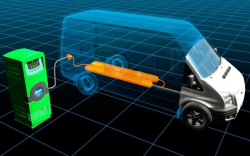
Hydrogen power fuelled vanITM Power and Roush Technologies have formed a partnership to trial hydrogen-powered commercial vehicles in the UK. Roush Technologies are an automotive engineering company with considerable experience of the commercial vehicle sector. Roush will be responsible for modifying existing vehicles to run on hydrogen and for researching new types of hydrogen power units.

Meanwhile, ITM Power will provide the essential and hitherto missing link – a viable hydrogen refuelling solution. Over the last year, ITM have perfected a standalone hydrogen generation facility that will allow vehicle operators to generate their own hydrogen, on site.

ITM and Roush hope that their integrated, comprehensive solution will convince commercial operators that hydrogen is feasible and attractive as a commercial vehicle fuel – ITM CEO Jim Heathcote says that the two companies “are committed to bringing practical hydrogen power into the automotive market place within a dramatically reduced timeframe.”

ITM’s electrolyser has been patented and is due to enter production at their Sheffield facility later in 2008. Once it’s installed, all that the electolyser requires to generate hydrogen fuel is electricity and water – both readily available through an established distribution network! The obvious question, given what we already know about hydrogen fuel is just how much electricty and water does it need?

The electrolysis process used to produce hydrogen vehicle fuel is noted for its high energy requirements – for ITM’s solution to be both financially and environmentally viable it will need to generate a smaller carbon footprint and have lower running costs than the equivalent diesel vehicles.

If successful, this technology has the potential to provide an easily-depoloyed, national network of hydrogen filling stations – so the dream of zero emissions (from vehicles, if not power stations) could yet be a reality.

Biodiesel – UK Producers Under The Cosh From US Subsidy Manipulation

I wrote recently about the problems associated with biodiesel – but today’s Guardian has uncovered a trend that makes a mockery of any supposed environmental benefits of biofuel.

In two articles here and here the newspaper explains how unscrupulous biodiesel producers are shipping biodiesel to the US, blending it with 1% mineral diesel and then shipping it to the Europe, where it can be sold more cheaply than fuels blended in Europe. This wheeze is known as ‘splash and dash’ and is thought to account for as much as 10% of fuel imports from the US to Europe.

The reason for this is the 11p per litre US government subsidy available on biodiesel that’s blended in the US. By shipping cheap biodiesel to the US and blending it there, agricultural trading companies can reap a massive windfall on a tanker full of biodiesel, which is then shipped back to Europe and sold below market prices, undercutting the more environmentally-responsible UK biodiesel producers – some of whom are now struggling to stay in business.

It’s inevitable that big businesses will try to exploit the subsidies and price differences available in a global marketplace (a technique known as arbitrage), but you’d think that the UK government might be interested in stopping this.

Consider: the RTFO scheme becomes a legal requirement this month – fuel suppliers are required to include 2.5% biodiesel in all of the forecourt petrol and diesel. At the same time, the government appears to be completely unconcerned about where all this biodiesel is coming from – and at what environmental cost.

Ship it twice across the Atlantic for a subsidy dodge and threaten to put responsible UK biodiesel producers out of business – no problems.

Chop down a few thousand acres of rainforest in Brazil to grow biofuel crops – nevermind.

It doesn’t seem like joined-up government, does it?

Peugeot Partner Gets Back To Origins

To coincide with the launch of the Peugeot ‘New Partner’ van and the Peugeot Bipper, the existing Peugeot Partner model is being renamed the Partner Origin. It will continue to be available with 600kg and 800kg payloads as at present but will only be offered in the basic ‘L’ specification.

Despite the advantages of the New Partner model (marginally higher payload, extra creature comforts and choice of updated engines), the Partner Origin offers a cost-effective, reliable and thoroughly capable small van solution that’s been tried and tested and has sold over 61,000 units in the UK alone.

Now might be a good time to grab a bargain, as the model will eventually be discontinued.

Mercedes Aims To Banish Idling With Eco-Start

I’ve written about the Mercedes-Benz Eco-Start system before – it’s a system available with new Sprinter vans that stops the vehicle’s engine when it’s stationary and idling and automatically restarts it as soon as you put the clutch down to engage a gear.

Previous trials by Motor Transport magazine in London rush hour traffic resulted in a 10% fuel saving. While this is obviously an extreme case, there is no doubt that the technology helps save fuel, and it has built-in safeguards to prevent repeated cold starts or overheating.

The system has been a cost option available on manual Sprinters and Atego 7.5t trucks only to date, but Mercedes are now confident that Eco-Start is ready for prime time. The German giant has decided to kick-start more widespread adoption of the technology by making it standard fitment on Atego models and by relaunching it with the Sprinter at the Commercial Vehicle Show later this year.

At the other end of the size spectrum Mercedes is also introducing Eco-Start to its A-Class and B-Class car models – and as I noted here, other major manufacturers are also introducing similar systems.

Note: According to this article on Transport News Network, adding Eco-Start to a Mercedes Sprinter will cost £545. This includes an uprated battery and alternator, necessary to ensure that the battery remains suitably charged through frequent starts/stops.

Portsmouth Introduces 20mph Limit In Residential Areas

When I first saw this story about Portsmouth City Council introducing a 20mph speed limit to most residential streets, I have to confess that my immediate reaction was that it was a bit silly and would just result in increased CO2 emissions – 20mph isn’t a very fuel-efficient speed for modern vehicles.

However, I soon changed my hastily formed judgement – because having read through Portsmouth Council’s press release, I think it seems quite a good, carefully-planned idea.

Here’s why. I live in an old town too – and on my street and most of the ones around it, anything greater than 20mph is definitely unnecessary and usually unsafe. Portsmouth City Council hasn’t reduced the limits on any of the more major roads – so once you’re out of your street you can progress through the city at the usual 30/40mph limit.

The other reason it seems sensible is that none of the 1,200 streets affected had an average speed above 24mph anyway – so it’s not much of a loss.

If you live in Portsmouth (or anywhere else with 20mph limits), how have you found them? Have they been applied inappropriately and without consultation, or have the local council been intelligent and thoughtful about it? Leave a comment below with your thoughts and experiences.

20mph speed limits are clearly here to stay in the UK, and are getting more popular by the day. Let’s just hope that councils don’t succumb to the temptation to use them in combination with speed cameras to raise tax revenue…

Are Hydrogen Fuel Cells A Serious Contender?

Fancy a fuel that only emits water and is abundantly available in nature?

How about one that can be used both to power internal combustion engines and to generate electricity – just by combining it with oxygen?

Hydrogen offers the potential to be the fuel that will solve our carbon emission problems – if we can get it right.

The situation at the moment is that it works well in vehicles, but:

  1. There’s pretty much no distribution network in any country
  2. The process of making hydrogen gas currently generates CO2 and uses a lot of energy – defeating the purpose of having a zero emission fuel.
  3. Hydrogen fuel cells are currently extremely expensive to produce and require precious (expensive) metals for their manufacture.

However, history teaches us that logistical and engineering problems like those above are often solvable – meaning that hydrogen could have real potential as a fuel of the future.

Not everyone agrees, however. Jamie Beevor, from the Energy Saving Trust, believes that future fuels are likely to be a combination of existing and emerging technologies – “there is unlikely to be a silver bullet.”

Beevor also thinks that it’s possible that “with battery and electric vehicle technology rapidly progressing, battery electric vehicles could steal a march on hydrogen.”

So the jury is still out on hydrogen. At least two major motor manufacturers – BMW and Honda – have invested heavily in developing hydrogen-fuelled vehicles that are now commercially available (just!).

Honda’s FCX Clarity uses hydrogen fuel cells to power and electric motor, while BMW’s Hydrogen 7 has a regular petrol engine that can run on hydrogen or petrol. It’s technically a hybrid, but that’s primarily because there are so few places where you can fill up with hydrogen.

I’d love to see hydrogen succeed – if only because it would be a boyhood science fiction concept come true – but I wouldn’t be surprised if electric power wins over most other types of fuel in coming years. It already is developing fast and offers the twin advantages of mature , global distribution networks and centralised generation.

UK Biofuel Policy “Insane” – Senior Government Scientist

On the 1st April, 2008, the addition 2.5% of biodiesel to petrol and diesel becomes UK law.

Under the terms of the Renewable Transport Fuels Obligation (RTFO), fuel suppliers have to be able to prove that 2.5% of the fuel they sell is from ‘renewable’ sources – which means biofuels.

In 2010, this obligation will rise to 5% and it is scheduled to rise to 10% by 2020.

So what’s the problem?

Well, as I’ve hinted at before, the problem with biofuels is that there is growing evidence that they result in an increase in our carbon footprint – not a decrease. And it’s not just me. This week, two leading UK scientists (both current or former government scientists) have warned that there is growing evidence that the production of biofuels is creating serious problems.

The two scientists concerned are Professor Robert Watson, the chief scientific adviser to the Department for Environment, Food and Rural Affairs (DEFRA) and Sir David King, the former chief scientific officer to the government.

Discussing the new biofuel policy in an interview on BBC Radio 4 this week, Watson said that “It would obviously be insane if we had a policy to try and reduce greenhouse gas emissions through the use of biofuels that’s actually leading to an increase in the greenhouse gases from biofuels.”

King backed Watson’s comments, saying that “What is absolutely desperately needed within government are people of integrity who will state what the science advice is under whatever political pressure or circumstances” and suggesting that policy decisions are delayed until the results of a biofuels review commissioned by the government are published.

Watson’s concerns are twofold:

  1. Different types of biofuel have considerably different carbon footprints. We need to differentiate between them.
  2. The global commercial appetite for biofuels means that areas of rainforest are being cleared to grow commercial crops and agricultural land formerly used for food production is being switched over to fuel crop production.

The combination of these two factors means that in many cases biofuels may be contributing to an increase in our carbon footprint when compared to using oil-based fuels – not a decrease.

For example, deforestation in countries such as Brazil and Indonesia is increasing to make way for lucrative biofuel crops. This is resulting in a devastating loss of natural habitat and an 17-420 times increase in carbon emissions compared to the savings from not using fossil fuels, according to a new study published in the leading US journal Science.

Biofuel production is also widely accepted to have played a role in pushing up food prices over the last year, especially as a result of US government policy favouring production of bioethanol-type fuels.

It all adds up to a big question mark? Can biofuels help reduce carbon emissions? Is the environmental cost of salving our oil-drenched consciences with biofuel too high to pay?

Hiring A Van Doesn’t Protect You From Speeding Fines

Drivers are increasingly learning that driving a hired van or car doesn’t provide any protection from speeding fines, the London Congestion Charge or any other type of penalty fee, according to the latest figures from National Car Rental, one of the UK’s largest car and van hire companies.

For anyone who isn’t familiar with the law, it is an offence to fail to identify the driver of a vehicle where a traffic offence has been committed. This means that van rental companies are legally obliged to identify drivers caught by traffic cameras or Traffic Wardens.

National Car Rental believes that this message is finally hitting home – in the last quarter of 2007, they saw a 52% reduction in the number of speeding fines awarded to drivers of National hire vehicles. This dramatic fall followed falls of more than 25% in the preceding two quarters – a great improvement for the company.

National also reported similar falls in the numbers of fines received for driving in bus lanes, failing to pay the London Congestion Charge and parking illegally.

National Car Rental’s Operations Director, David Alexander, said that he thought that the growing understanding that offences were always traced back to drivers of hired vehicles was “acting as a powerful deterrent”.

The figures are also good news for companies whose employees drive hired cars and vans for business purposes – the introduction of the Corporate Manslaughter Act in April 2008 means that companies will be prosecuted in cases were a fatality results from a failure of the company to meet its health and safety obligations – including road safety.