Category Archives: Van News

News and articles about UK vans – especially information relevant to the van hire market. Coverage of new van model launches from all the major manufacturers – Ford, Mercedes, Volkswagen, Peugeot, Fiat and Citroen.

New Citroën Relay & Peugeot Boxer revealed ahead of CV Show

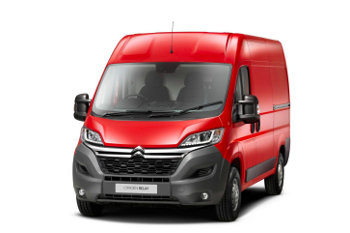
New 2014 Citroen Relay

The new Citroen Relay will be unveiled at the 2014 CV Show.

Citroën has revealed details of its new Relay van ahead of its official CV Show debut next week (29 April – 1 May).

The new Relay, which will also be sold as the Peugeot Boxer, will be available in 3.0, 3.3, 3.5 & 4.005 tonne gvw formats, as well as in chassis cab format. Citroën’s Relay Specialist pre-built conversion range will be continued, enabling buyers to order Relay tippers, dropsides and Lutons direct from Citroën  dealers.

Peugeot will offer a similar range, along with its ‘back-to-back’ model — two cabs without chassis delivered as pairs for specialist conversions requiring a different chassis. These are typically used for removals vans and large motorhomes, which use larger, lower chassis platforms than conventional conversions.

As is increasingly the trend with large vans, the Relay will be powered by a single engine, a 2.2HDi, which will be available in three power outputs, 110, 130 and 150PS. Peugeot is opting for a slightly different approach, and while the same 2.2HDi engine, in 110, 130 and 150PS formats will power the bulk of Boxer vans, it is retaining a 3.0-litre HDi 180 model for buyers who are looking for a good long-distance, heavyweight performer.

Both firms will market the new panel van models in four lengths, ranging from L1 (8.0 mand 2.67m load length) to L4 (4.07m load length and up to 17m3 capacity). Three roof heights, H1, H2 and H3 will be available, although as with payload options, not all combinations will be possible.
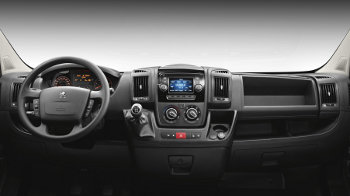
New Peugeot Boxer cab interior

Inside the cab of the new Peugeot Boxer, whose sister van, the Citroen Relay, will be unveiled at the CV Show 2014.

The new vans will be front-wheel drive only, but will be available with Intelligent Traction Control/Grip Control, the PSA electronic limited slip differential system that helps provide additional traction in slippery conditions. Electronic Stability Control will be standard on all models, while a Lane Departure Warning System and Hill Descent Control will be optional extras.

Finally, both vans will boast extended service intervals of up to 30,000 miles/two years, although in my opinion, only high mileage users should even consider this: my view is that extended service intervals are one of the reasons that modern diesels suffer so many expensive problems once they get out of warranty.

I also believe that from a safety perspective, all vehicles should have an annual service: honestly, what kind of business can’t schedule half a day downtime for each of its vans, once a year, in the name of safety, reliability and durability (not to mention resale value)?


Ford reveals details of all-new Transit Courier small van

Ford van range 2014

The all-new Transit Courier will go on sale this summer, completing Ford’s new range of Transit vans.

Ford has confirmed the specification of its all-new Transit Courier small van, which the firm hopes will take market share from the Peugeot Bipper/Citroen Nemo/Fiat Fiorino model, which is made by the French PSA group.

The Transit Courier goes on sale this summer, and is the final model to be added to Ford’s all-new four-van range, following the Transit Connect, Transit Custom and Transit.

Engine room

Transit Courier will be available with three engine choices, all of which promise outstanding fuell efficiency and low emissions:

  • 95PS 1.6-litre Duratorq TDCi diesel: 76.3mpg / 97 g/km CO2
  • 1.0-litre EcoBoost petrol: 54.3mpg / 119g/km CO2
  • 75PS 1.5-litre diesel: 72.4mpg / 103g/km CO2

All of these figures are for vans specified with Ford’s optional Auto-Start-Stop system and in some cases a 100 km/h speed limiter, but they promise impressive fuel consumption nonetheless.

Ford Transit Courier

The new Ford Transit Courier

All powertrains offer extended one-year/20,000 mile service intervals and the vehicle design has been optimised for ease of serviceability and repair.

A multi-piece rear bumper, rugged body-side protection and high-mounted front and rear lights help to reduce the cost of accident damage and lead to lower insurance premiums. Expensive fuelling errors are avoided by the unique, standard-fit, Ford Easy Fuel system.

Load up

In the load department, the Transit Courier promises a lot, too. The van will have a maximum payload of 660kg and can hold a standard Euro pallet, while the load compartment will include a number of features that should make it attractive to fleet buyers and tradesmen:

  • Longer load length at floor level of 1.62m, and easier loading of bulky items via optional sliding rear side doors (width 453mm with bulkhead)
  • Full-height, full-width steel bulkhead (glazed or unglazed), fully compliant with the internationally-recognised standards for load restraints DIN and ISO
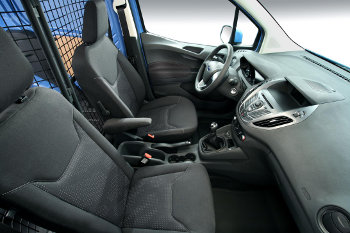
  • Ford Transit Courier interior

    Inside the new Ford Transit Courier

    Optional folding mesh bulkhead (DIN- and ISO-compliant) and fold-dive passenger seat for longer items up to 2.59m, and maximum load volume of 2.6m3 (SAE)

  • Six cargo tie-down points (DIN- and ISO-compliant), including four rear side-mounted points to avoid obstruction of the floor area
  • Multiple pre-installed bodyside fixing points to mount racking or framework
  • Optional ultra-bright LED loadspace lighting for the van bodystyle

Safety first

Finally, Ford continues to raise the bar in terms of safety — traditionally a weak spot for many vans.

Customers can specify Ford SYNC with Emergency Assistance, the latter of which assists the occupants to call the local emergency services operator in the event of an accident, as well as Speed Limiters and a Tyre Pressure Monitoring System. The standard Electronic Stability Control system features Hill Start Assist, Traction Control and Roll-Over Mitigation.

The passenger-carrying Kombi model (effectively a crew cab) also offers side curtain airbags, knee airbags and second-row seat beltminders, in addition to cab area driver, passenger and side airbags.

As with Ford’s other new Transit models, it’s hard to see the new Transit Courier failing — Ford’s cars and vans are amongst the best in the world at the moment, and while it may lack the cachet of the German brands, Ford’s new vehicles don’t want for anything in terms of quality, driveability, practicality or safety.

UK van parc up 29% as lorry numbers decline

The number of vans on UK roads rose by 29% to 3.3m between 2002 and 2012, with the biggest rise in the north east, where van numbers rose by 82.5% over the ten-year period.

A new report commissioned by the RAC Foundation found that every tenth vehicle on UK roads is now a light commercial vehicle, but said that over the same period, car numbers had risen by just 11% to 28.7m.

Interestingly, the number of lorries on British roads fell by 5% to 460,000 between 2002 and 2012 — suggesting that perhaps some lorry traffic has moved into vans, either for reasons of load efficiency, or more worryingly, because the van sector is very lightly regulated compared to the heavy goods sector, and drivers are cheaper to employ, are not required to have an additional driving licence, and are not required to use a tachograph to monitor their working hours.

Here is the full table, showing the changing number of vans on UK roads between 2002 and 2012:

REGION Number of vans – 2002 Number of vans – 2012 % change 2012 on 2002
North East

77,300

141,000

82.5%

South West

270,100

391,100

44.8%

Wales

124,400

176,000

41.4%

Scotland

174,600

241,500

38.3%

South East

388,700

526,400

35.4%

Yorks & Humber

182,000

246,000

35.2%

East Midlands

220,600

278,000

26%

West Midlands

307,900

382,000

24.1%

East

274,000

330,300

20.6%

London

194,000

203,000

4.7%

North West

282,500

294,500

4.2%

GREAT BRITAIN

2,542,300

3,280,600

29%

(Source: Department for Transport)

The RAC report concluded that while an increase in internet shopping and home deliveries was one possible contributing factor to the increasing number of vans on our roads, there wasn’t sufficient data to draw a definite conclusion — in other words, the reports authors didn’t have any idea why van numbers have shot up so fast.

All-new Vauxhall Vivaro — first interior pictures

Vauxhall has released more pictures of its all-new Vivaro model, which will be launched in the UK later this year. The van’s lines are very similar to the old model, but with an updated front end that brings the same style seen on the Insignia car to the Vivaro, plus an updated and equally car-like interior.

You can see the previous pictures I published by clicking here, but here are a few more detailed images that have been released by Vauxhall today:

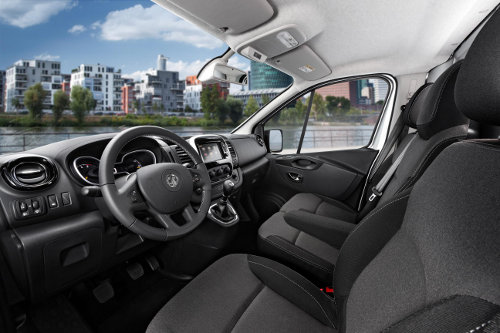
New Vauxhall Vivaro interior

The interior of the new Vauxhall Vivaro is a more car-like and sophisticated evolution of the current model’s interior.

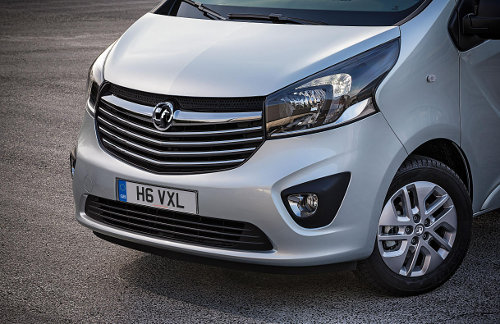
Front end of new Vauxhall Vivaro

The front end of the new Vauxhall Vivaro appears to be derived from the front end of the Insignia car, and suggest that Vauxhall is echoing Ford’s approach in creating a front-end style that’s consistent and recognisable across all of its vehicles.


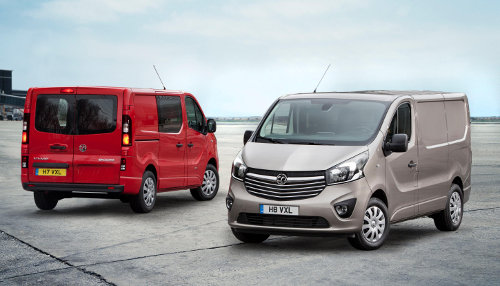
New Vauxhall Vivaro front and rear views

Front and rear views of the new Vivaro.

Has the used van market reached a turning point?

Manheim logoThe last three years have seen the average age of used vans at auction rise steadily, as fleet operators extended their replacement cycles in an effort to defer capital expenditure and new debt commitments.

I’ve commented many times on the ever-rising prices seen at BCA LCV auctions — most recently yesterday — but today, some figures from Manheim, another auctioneer (or ‘remarketing specialist’), have dropped into my inbox, shedding some additional light on the rising age profile of vans at auction.

At Manheim’s March auctions, 48% of large panel vans sold (> 3.0t) were more than five years old, a proportion that increased to 53% for panel vans under 3.0t, and 64% of small vans. James Davis, Manheim’s head of commercial vehicles, believes that the extended replacement cycles seen over the last couple of years could become the new norm, as they don’t seem to have caused any problems for operators:

I believe it will be two to three years before the pre-recessionary age profile potentially returns to the wholesale market. The big question is: have first life operators, as a consequence of extending replacement cycles, enjoyed the reliability of modern day vans and decided to run their newly acquired vans longer?

If the average age at which fleet vans are injected into the used market does remain above historic averages, then logically this should trigger falls in used values, especially as new sales rise. Matthew Davock, head of LCVs at Manheim, tentatively suggests that we might have reached a turning point:

We believe this likely represents an important watershed moment in the wholesale market, signalling what might be the final major tranche of older, extended vans entering the used marketplace. Looking ahead, we predict we will see similar age and mileage profiles, albeit in lower volumes. These older lower mileage vans are good news as they are an attractive price point”

Although it’s always difficult to call the top or bottom of a market, it’s worth remembering that change usually catches most people by surprise. Therefore the fact that the market has now become used to paying more for older vehicles, and expects this situation to continue, could be a sign that things are about to start changing.

Watch this space.

New Iveco Daily to launch June 2014

New Iveco Daily will launch June 2014

The new Iveco Daily will be launched to the press in June 2014

Just three short years ago, Iveco launched the current version of its Daily large van. That’s about to be consigned to van history, as the company prepares the third-generation Daily for its press launch in June this year.

Iveco says that the latest Daily is ‘entirely new’, but will retain the existing van’s classic ladder frame chassis structure, which has always helped to make it one of the most robust, flexible and truck-like vans in its class.

The new model will be made in both panel van and chassis cab formats, and Iveco says that the van model has benefited from improved use of space that has optimised load volumes and improved the accessibility of the cargo bed, by lowering the load deck by 55mm for single-wheel models.

The van’s capacity has been improved through the reassessment of the relationship between wheelbase, overall length, and the length of the cargo bed. This gives way to the | (best in class for volume) and the 11 m3 model (best in class for cargo efficiency – an index that measures the relationship between the length of the loading compartment with the total length of the vehicle).

One distinctive characteristic of the rear-wheel drive Daily has always been its extended rear overhang, but this looks likely to have been moderated, as Iveco says the new models have longer wheelbases and a shorter rear overhang, to improve the compromise between driveability and manoeuvrability.

Fuel consumption has also been a target, and the new model is said to deliver a 5% saving compared to previous models, combined with an improvement in the total cost of ownership (TCO). Inside, driver comfort has been addressed with improved soundproofing, better air conditioning and a more car-like driving position and feel.

The new Daily will go up against Ford’s all-new two-tonne Transit, which promises to be formidable competition for both the Daily and the Sprinter. It will be interesting to see if either Transit or Daily can dent the dominance of the Sprinter in the heavy-duty large van market.

The van’s capacity has been improved through the reassessment of the relationship between wheelbase, overall length, and the length of the cargo bed. This gives way to the new 18 and 20 m3 models (best in class for volume) and the 11 m3 model (best in class for cargo efficiency – an index that measures the relationship between the length of the loading compartment with the total length of the vehicle).

Used van values hit new record as prices rise 14% in twelve months

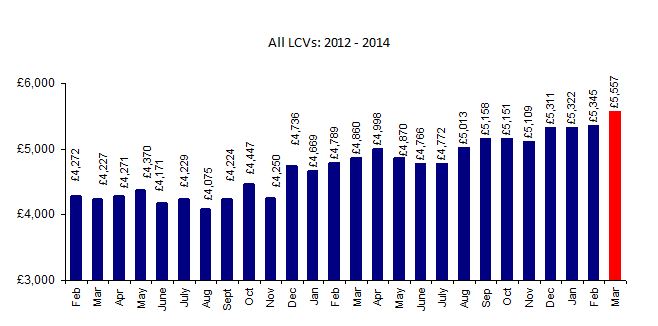
Surging demand for new vans hasn’t put a dampener on the record prices being achieved in the used van market, according to the latest figures from auctioneers BCA , which showed that average used van prices at auction hit a new record of £5,557 in March — a rise of 3.9% since February.

I suppose we should be grateful that inflation in the wider economy isn’t running at this rate, but I’m glad I’ve not been in the market for a used van over the last year or so, during which average prices have risen by 14%:

BCA LCV values March 2014

Used LCV values Feb 2012 – March 2014 (courtesy of BCA)

Year-on-year values remain well ahead, up by £697 (14.3%) over the twelve month period.  Compared to a year ago, age has risen by nearly two months to over 60 months, while mileage has decreased by around 3,000 miles on average over the same period.  Average CAP performance improved by half a point compared to March 2013.

All vans Avg Age (mnths) Avg Mileage Avg Value Sale vs CAP
Mar 2013 58.88 80,853 £4,860 103.32%
Mar 2014 60.41 77,816 £5,557 104.03%

(Data courtesy of BCA)

The figures suggest that the UK economy is recovering, but Duncan Ward, BCA’s General Manager – Commercial Vehicles, sounded a note of caution, despite recent strong demand:

“There can be little doubt that the improving economic background is giving a boost to the used LCV market, particularly as demand increases from the building and construction industries.  Small and medium-sized enterprises (SMEs) remain positive about prospects this year, but cashflow is a problem for some and that may impact any decision on replacing their workhorse vans.”

“We expect demand to remain strong in April, but post-Easter, we know from experience that values typically soften over the late spring and early summer months.”

Business is clearly very good for BCA, but perhaps some used buyers are holding back in the hope that used values will soften before they are forced to buy?

Van demand steps up 14.6% in March on 14-plate change

The March and September registration plate changes typically account for a surprising third of the annual van market, and van registrations rose by 14.6% in March to 50,064.

The increase takes the total increase in new van registrations so far this year to 16%, compared to the same period last year, according to the latest figures from the Society for Motor Manufacturers and Traders (SMMT).

UK van and truck registrations: 2014 and % change on 2013

March % change Year-to-date % change Rolling year % change
Vans 50,064 14.6% 79,917 16.0% 282,108 14.3%
Trucks 4,168 -16.5% 7,574 -24.7% 53,732 23.0%
Total 54,232 11.4% 87,491 10.8% 335,840 15.6%

Data courtesy of SMMT (www.smmt.co.uk)

Mike Hawes, the SMMT Chief Executive, says March’s van market outperformance was expected and even the stagnant, post Euro 6 truck market saw some benefit from the plate change:

“The new 14-plate drove van numbers up, pushing the overall commercial vehicle market 11.4% ahead of 2013 to more than 54,000 units. Registration plate changes always prove popular with van buyers, so March and September numbers are typically more than double the average month, a trend continued this March as volumes rose 14.6% to above 50,000 units.

Truck demand remained subdued as the influence of Euro-6 legislation continues to be felt across the sector, but the level of impact has lessened steadily since January and should be minimal by mid-year.”

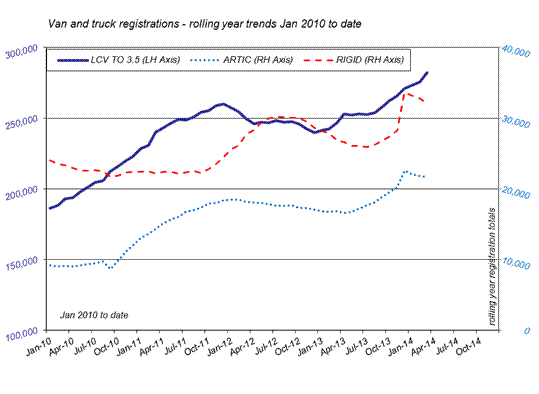
As the graph below shows, van demand has really started to lift off over the last six months, suggesting that the UK recovery may be the genuine item:

SMMT van and truck registrations March 14

Truck registrations have stalled following a spurt of sales ahead of the introduction of Euro 6 emissions rules, but demand for new vans has been rising steadily since October, suggesting the market may be returning to health (graph courtesy of SMMT)

The rise in van registations is being led by larger models, too — while registrations of smaller, sub-2.0t vans fell by 18.5% in March, compared to the same period in 2013, demand for models between 2.0t and 2.5t rose by 55%, while registrations of vans between 2.5t and 3.5t rose by 16.9%, to 27,460 — more than half of all vans registered in March.

Used van prices could fall by Christmas, says CAP

The rise and rise of used van values

The price of a typical SWB Transit has risen by 48% since 2010 — but CAP believes prices may go into reverse later this year (image courtesy of CAP Automotive)

I’ve commented on the seemingly unending rise of used van values many times over the last couples of years.

After all, when the average value of a used van at auction rises by 24% in two years, despite an increase in average mileage and age, something must be out of balance, in terms of supply and demand.

What’s more, imbalances like this can only continue for a limited period before something happens to correct them — in this case, a rise in supply that should finally start to satisfy strong demand.

Tim Cattlin, a commercial vehicles forecast values expert at automotive information specialist CAP Automotive, has stuck his neck out and suggested that the boom in used values is likely to slow by the end of 2014. Since CAP publishes the price guides used in the trade to value vehicles, his predictions might be worth more than most.

Cattlin says that the rise in values for used vans was sparked by the collapse in new van sales when Britain fell into recession. This led to a dramatic reduction in the number of used vans available in the market and as economic recovery began to gather pace, demand quickly outstripped supply.

Since September 2010 the CAP Red Book independent benchmark value of a 3 year old short wheelbase Ford Transit, with 60,000 miles, has rocketed from £4,800 to £7,100 – an increase of 48%:

“Nobody in the industry, including ourselves, anticipated the rate at which demand has increased”, says Cattlin. “Economic recovery has therefore unleashed serious pent up demand into the auction halls and onto the trader’s pitch.”

Now Cattlin believes the recovery of new van registrations in 2011 spells an impending end to the rise in van values as early as the end of 2014. A growing number of these vehicles will begin to return to the used market and help to rebalance supply and demand:

“We believe the market for used light commercial vehicles will remain buoyant for the next few months but values will begin to ease later in the year.

“Quite how pronounced this softening will be, remains to be seen, but a pivotal point may well be the typically quiet period over Christmas. We will therefore be watching particularly carefully to see if the normally strong recovery in January is as pronounced as usual.”

We will be watching too, and will publish the latest data here as soon as they become available.

Citroën conversion programme recognised with industry award

Citroen Ready to Run range

Citroën’s Ready To Run range has won the VansA2Z One-Stop Shop Award for the second consecutive year.

Citroën’s ‘Ready to Run’ specialist vehicle programme has won the VansA2Z ‘One-Stop Shop’ award for the second consecutive year.

Ready to Run enables Citroën customers to buy readybuilt conversions, directly from Citroën dealers.

The firm’s programme is the most comprehensive in the UK market, and enables businesses to purchase conversions for Nemo, Berlingo, Dispatch and Relay vans, including:

  • Dropside trucks (Relay)
  • Luton vans (Relay)
  • Temperature-controlled (chiller/freezer) vans (Nemo, Berlingo, Dispatch & Relay)
  • Tippers (Relay)
  • Glass carrying vans (Berlingo, Dispatch & Relay)
  • High-cube, low-loading vans (Relay)
  • Minibuses (Relay)

Jeremy Smith, Citroën’s Head of Commercial Vehicles & Business Sector Operations, says that the Ready to Run programme:

“continues to attract new Citroën LCV customers, particularly in the Small, Medium Enterprise (SME) sector.”

This makes sense — while larger companies might prefer to arrange for bulk orders to their specifications from commercial bodybuilders, for smaller companies, the cost and time of doing this isn’t so attractive, and they won’t be able to benefit from volume discounts, either.