
Tag Archives: vans

Renault Launches Kangoo Van Maxi & Updated Trafic

Renault has announced the launch of a new, extended-wheelbase variant of the Kangoo van – the Kangoo Van Maxi. It’s nearly 40cm longer than the current Kangoo van and complements the other variant of the Kangoo, the Kangoo Compact, which is shorter than the regular Kangoo.
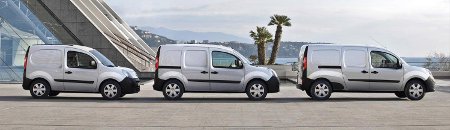
Renault Kangoo Compact, Van & Kangoo Van Maxi

Smallest, small and not so small - the Renault Kangoo range

All of this Kangoo goodness comes in a low roof (1.82m), short wheelbase package that ensures that the Kangoo Van Maxi remains well suited for urban use and won’t have its progress impeded by car park height barriers, unlike slightly larger alternatives. It has an overall length of 4.6m with a load length of 2.1m (2.9m with the passenger seat folded down), a payload of 800kg and a load volume of 4.6 cubic metres – a full cubic metre more than the regular Kangoo van.

The Kangoo Van Maxi will go on sale in the UK on 4th June – more details nearer the time.

Trafic Phase III

The Trafic has sold more than 1.1 million units since its introduction in 2001 and remains very popular. It should be no surprise, therefore, that the Trafic Phase III is a definite case of evolution, not revolution. That said, it contains a number of desirable updates to the existing model that should appeal to Renault’s target market for these vans, described by the company as “tradesmen and traders”.

On the outside, it looks pretty much identical. Most of the updates seem to have been inside the cab and under the bonnet. Here’s a comparison of the new Trafic dashboard area with that of the outgoing model:
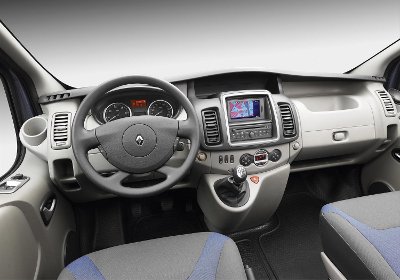
Renault Trafic Phase III updated cab

The updated cab in the phase III Trafic - replacing the one below
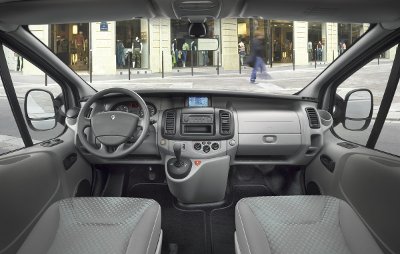
The cab of the phase II Renault Trafic

The dashboard layout of the outgoing phase II Renault Trafic

Changes to the updated Trafic include:

  • In-dash Carminat TomTom satellite navigation, including TomTom’s IQ Routes software, which aims to use real-world traffic data (recorded by other TomTom users) to calculate the best route for your journey at that time of day.
  • Automatic climate control
  • Improved dashboard storage facilities plus a redesigned instrument console to improve “visibility and legibility of the information display”
  • A new range of audio systems including USB and Bluetooth connectivity
  • Cruise control and speed limiter with steering wheel controls
  • Improved fuel consumption and lower CO2 emissions

Renault claim to have improved both fuel consumption and emissions on the Trafic, while leaving the range of engine and power choices unchanged. The same two engines will be available, a 2.0dCi (90hp or 115hp) and a 2.5dCi (150hp). Both 2.0 litre models now boast CO2 emissions of less than 200g/km and Renault claims that it has improved the fuel consumption of the 115hp model by 4.2mpg and reduced its CO2 emissions by 19g/km, to just 195g/km for the manual gearbox.

All have six-speed manual gearboxes as standard but both the 115hp and 150hp models are both available with Renault’s automated manual transmission, Quickshift. In both cases, this promises both lower fuel consumption and lower CO2 emissions than the equivalent manual models – in keeping with the promises made for this type of gearbox.
Van Leasing Survey Reveals Most Reliable Vans

A recent survey of van leasing companies by Fleet News has uncovered the UK’s most reliable vans. The survey covered the UK’s 50 largest fleet companies – with a combined fleet of 183,000 cars and vans.

At the top of the list for the third year running was the Ford Transit. In second place was the Vauxhall Astravan with Ford’s smaller Transit Connect taking third place. Rounding out the top 5 were the Mercedes Sprinter and Volkswagen Transporter – all good, high-quality choices. Reliability was measured based on breakdowns per 100 vans of each model.

Interestingly, there are no Fiat, Renault, Peugeot or Citroen vans in the top 5 – despite the vast numbers that are in circulation. Peugeot did manage to scrape into the top 5 most reliable manufacturers, in 5th place behind Ford, Mercedes-Benz, Volkswagen and Vauxhall.

If you’re interested in learning more about van leasing or in getting a free, no-strings quote on a lease van, check out our Van Leasing page for more information.

LDV In Trouble As Vauxhall Launches Van Cashback Deal

LDV Needs £25m Government Loan To Survive

Today brings news that the mystery automotive factory threatened with closure is in fact the Russian-backed tentative success story that is LDV.

Although its Maxus van appears to have been a success (indeed, LDV has just won an £11m contract to supply Maxus-based vehicles to the Jewson and Graham chains of builders merchants), LDV is in trouble and in need of government support.

According to today’s Guardian, LDV is in need of a £25m loan from the government if it is to survive. Apparently, LDV’s Russian owner, Oleg Deripaska, has been hit hard by the credit crunch and cannot finance the van maker. The short-term, emergency loan is needed to fund a management buy-out of the company, aimed at turning it into Europe’s first green van firm. Not sure what that means.

Update 1830 23/02/09: The government has ruled out a taxpayer-funded rescue for LDV, leaving its future somewhat uncertain and up to 6,000 jobs at risk. The Times has the latest update.

Vauxhall Offers 5% Cashback to New Van Customers

As LDV hits the buffers, Vauxhall has come up with a rather novel way to encourage people to start buying new vans.

The company is offering van buyers who put down a 20% deposit on new vans a cheque back for 5% of the total amount financed (i.e. a maximum of 4% of the purchase price). Although cashback deals aren’t new in the automotive world, the scale of this offer is larger than usual and reflects Vauxhall’s desperate need to start shifting new vans – even if they don’t make much money on them.

In this, however, they are no different to most car manufacturers – who collectively have around 500,000 unsold new vehicles sitting around in Europe at present. At least Vauxhall are trying to do something about it – although I suspect that used vehicles will continue to be more attractive to many buyers, as the UK’s vehicle auctioneers are finding.

75.17 Reasons Why Hiring A Van Is Better Than Owning One

A new survey by automotive warranty specialists Warranty Direct has found that the average cost of a mechanic is now £75.17 per hour.

And that’s only the average – rates at franchised dealers averaged £94.70 for every hour of spanner-wielding time…

Independents came in notably cheaper at £55.63 per hour, but even at this rate, costs will still add up fast if you need a few hours’ work doing.

The upshot of this is that owning a vehicle can be an expensive liability – especially if anything goes wrong. Many van users – both private and business – only need their vans occasionally. The rest of the time they either get used as cars or, even worse, just sit idle.

If you fall into this category then it might be worth crunching the numbers and working out whether you would be better off selling your van and just hiring a van when you need it.

This approach has a number of potential benefits:

  • No responsibility for servicing or repair costs
  • No insurance or road tax to pay
  • Renting allows you to choose different-sized vans when needed
  • Avoid owning a depreciating asset you don’t use much
  • Own a cheaper, more practical vehicle for everyday use

In addition to these specific benefits, in my experience vehicles that sit unused most of the time suffer at least as many mechanical problems (if not more) than vehicles that are regularly used.

Let’s look at an example:

Ford Transit LWB, used as a van for two weekdays a month.

Rental costs with easyVan

£47.55 per day = £95.10 per month (rental costs valid at time of writing)

Total annual costs: £1,141.20 (excluding fuel)

Ownership Costs

Ownership costs vary so widely it would be pointless for me to try and estimate them here. However, I’ve produced a checklist below for you to work out the cost of owning you van for one year.

  • Road Tax
  • Insurance
  • Servicing & Repairs (perhaps use last year as a guide)
  • Finance/Lease/Contract Hire payments
  • Depreciation – if you own your van, how much less will it be worth in a year’s time?
  • Finally… think about the cost in money and inconvenience of your van suffering a breakdown or being stolen at the wrong time.

Once you’ve calculated this, work out how much a hire van would cost you.

It may be cheaper – it may not. Hiring isn’t a perfect solution but it does have a lot of advantages for occasional users, as long as you can plan your requirements a few days in advance.

CO2 emissions of new vans to be published – Soon…

It looks like the BVRLA’s ongoing campaign to persuade van manufacturers to publish their vans’ CO2 emissions may be nearing a triumph.

Back in January I reported on the BVRLA’s (British Vehicle Rental and Leasing Association) plans to create a public database of van emissions, similar to that which is already available for cars. From 1st January, 2008, manufacturers have had to give their new vans a CO2 rating – but they aren’t yet required to disclose them.

This has made it difficult for fleet buyers whose businesses may have set emission reduction targets or who may simply wish to try and do their bit for the environment. However, it now appears that the manufacturers have agreed to publish the CO2 ratings of new vans and the Society of Motor Manufacturers & Traders (SMMT) is now in discussion with the Department of Transport to bring this about in an effective way – probably “via the Vehicle Certification Agency“, according to BVRLA Director General John Lewis.

The decision has come none too soon; according to the Department for Transport (DfT), vans are now the fastest growing source of CO2 emissions on our roads. With 340,000 new vans hitting the roads last year, it’s not hard to imagine why.

The SMMT is keen to point out that these figures are far from perfect. Unlike cars, whose profile and payload rarely varies significantly, vans can nearly double in weight when loaded and can be typically be specified with different roof heights, for example. Both of these options will affect a van’s CO2 emissions and since CO2 ratings are currently calculated based on rolling road tests with no payload, we can expect the manufacturers’ ratings to be somewhat optimistic for many van users.

The European Commission is planning a consultation exercise to try and work out how to bring more realism to these figures, but this could take years. In the meantime, hats off to the BVRLA, as their six-month campaign has finally bore fruit, providing van operators with some much needed data!

85% of Van Drivers Don’t Know Van Speed Limits

I wrote a while ago about the common mistakes drivers make with van speed limits – it seems the problem is not getting any better.

A new survey by Vauxhall has found that as many as 85% of van drivers don’t know the correct speed limits for their vans, according to this RoadTransport.com article.

Vauxhall found that many van drivers assume that the limits are the same as for cars. In fact, all vans over 2 tonnes maximum gross weight are subject to separate speed limits for goods vehicles up to 7.5 tonne.

Only car-derived vans with a maximum weight of under 2 tonnes are subject to the same speed limits as cars. In other words, all Transit-sized vans (and some smaller ones) are subject to a different set of speed limits to cars.

Here are the correct speed limits for most vans:

  • Single carriageways: 50mph (72% didn’t know this)
  • Dual Carriageways: 60mph (52% got this wrong)
  • Motorways: 70mph (56% got this wrong)

As the figures in brackets show, a great many van drivers don’t know (or perhaps don’t care) about the correct speed limits for their vans. Police forces around the country are tightening up on these breaches and van drivers can expect to be ticketed if caught.

How Do I Know Which Speed Limits Apply To My Hire Van?

The easiest solution is to ask your hire company when you pickup the vehicle. All but the smallest, lightest vans have a maximum gross weight over 2 tonnes, so the chances are yours will too.

Examples of vans that fit into the car speed limit category are:

Vauxhall Astravan and Corsavan, Ford Fiesta Van

Examples of smaller vans with a max weight over 2 tonnes and lower speed limits are:

Ford Transit Connect, Peugeot Expert, Citroen Dispatch, Ford Transit SWB, Vauxhall Vivaro SWB

Small Van Buyers Guide

The excellent Fleet News website has published a guide to the small van market on their website today.

You can find the (illustrated) guide here. It includes information about the following vans:

  • Citroen Berlingo
  • Fiat Doblo Cargo
  • Ford Transit Connect
  • Nissan Kubistar
  • Peugeot Partner
  • Renault Kangoo
  • Vauxhall Combo
  • Vauxhall Astravan
  • Volkswagen Caddy

It’s well worth a look if you’re in the market for a small van or need to learn more about this popular sector of the van world before hiring one.

Hydrogen-Powered Vans Hitting UK Roads

Emission-free hydrogen-powered vans may be a reality on UK roads sooner than you think, thanks to a new partnership between two of the leading players in the drive to bring hydrogen to the automotive world.

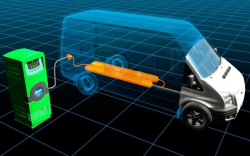
Hydrogen power fuelled vanITM Power and Roush Technologies have formed a partnership to trial hydrogen-powered commercial vehicles in the UK. Roush Technologies are an automotive engineering company with considerable experience of the commercial vehicle sector. Roush will be responsible for modifying existing vehicles to run on hydrogen and for researching new types of hydrogen power units.

Meanwhile, ITM Power will provide the essential and hitherto missing link – a viable hydrogen refuelling solution. Over the last year, ITM have perfected a standalone hydrogen generation facility that will allow vehicle operators to generate their own hydrogen, on site.

ITM and Roush hope that their integrated, comprehensive solution will convince commercial operators that hydrogen is feasible and attractive as a commercial vehicle fuel – ITM CEO Jim Heathcote says that the two companies “are committed to bringing practical hydrogen power into the automotive market place within a dramatically reduced timeframe.”

ITM’s electrolyser has been patented and is due to enter production at their Sheffield facility later in 2008. Once it’s installed, all that the electolyser requires to generate hydrogen fuel is electricity and water – both readily available through an established distribution network! The obvious question, given what we already know about hydrogen fuel is just how much electricty and water does it need?

The electrolysis process used to produce hydrogen vehicle fuel is noted for its high energy requirements – for ITM’s solution to be both financially and environmentally viable it will need to generate a smaller carbon footprint and have lower running costs than the equivalent diesel vehicles.

If successful, this technology has the potential to provide an easily-depoloyed, national network of hydrogen filling stations – so the dream of zero emissions (from vehicles, if not power stations) could yet be a reality.

Fleet Purchases: Peugeot Help EDF Energy Cut CO2 Emissions

EDF Energy has recently taken delivery of nearly 250 Peugeot vans (a mixture of 207, Partner and Expert models). The energy company is one of the UK’s largest and operates a 3,500 vehicle fleet.

EDF is targeting a 20% cut in its CO2 emissions by 2012, and the Peugeot vans are the latest step towards this. Not only do they feature the French company’s latest HDi diesel engines but these vans have not been shuttled around the country having extras fitted before delivery – as might have been the case in the past.

Peugeot have been able to offer EDF a one-stop shop – making all pre-delivery modifications at its regional distribution centre before delivering the vans directly to their end users – EDF. This saves considerably on transport costs and carbon emissions – helping EDF towards its target of lower emissions.

This kind of thing does seem to be a growing trend at present – more and more manufacturers are offering buyers the option of having their chassis vans pre-converted before delivery – where before a specialst body builder would have been used to build or modify the body after the vehicle left the factory.