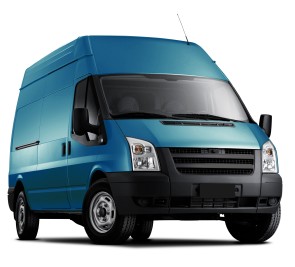
Long-Term Van Hire: Monthly Rental & Other Tips

vanrental.co.uk vanMany van hire customers only need a van occasionally for a few days — that’s why they choose to rent, not own a van.

However, there is another group of users who need — or choose — to hire a van for a month or more. Hiring offers a number of advantages over buying a van, not least that the hirer usually has no maintenance costs, and can hand the van back and stop paying for it whenever they no longer need it.

The good news is that long-term van hire is an attractive business for van hire companies, too, and many companies now offer this service.

In this article, I’m going to take a closer look at the long-term hire options provided by the major companies listed on vanrental.co.uk, to see how they compare, and whether there are any significant differences.

Europcar

Europcar’s Month+ service is available for hires of more than 28 days. There’s no requirement to hire a van for complete months — as long as you want it for more than 28 days, you can keep it for as long as you want. The terms and conditions of the service are broadly similar to standard daily rental and Month+ can be booked directly through Europcar’s website using its standard booking engine.

A simple, flexible choice.

National

Long-term van hire can be booked through National’s standard website booking system. There’s no mention on the firm’s website of any special deals for long-term hire, but the sample quotes I tried came out exactly the same as those I got with Europcar — perhaps unsurprisingly, as they are the same company in the UK.

Sixt

Sixt offers a long-term van hire service called Flexi Rent, but it appears to be available only to business customers, and Sixt says that deals are typically for 52 weeks, although it doesn’t specify whether this is a minimum requirement.

Sixt’s online booking system only allows you to book van rentals up to 28 days — anything longer than this and you need to get in touch with the firm directly at a branch or by phone.

Hertz

Hertz offers a van rental plan aimed specifically at long-term hire customers. Named the Hertz 28+ Plan, it includes a minimum of 2,000 inclusive miles per month and includes servicing and roadside assistance. You don’t have to pay upfront and there are no early return penalties after the first 28 days.

As an added bonus, the 28+ Plan includes complimentary Gold membership of the Hertz #1 Club, so you can bypass branch queues when collecting and dropping-off vehicles. Free delivery and collection is also included, as are a free monthly valet and up to 5,000 Nectar bonus points. Visit www.hertz28.co.uk for full details — this service isn’t available through Hertz’s standard website booking engine.

Thrifty

Thrifty also has a dedicated plan aimed at long-term car and van rental customers. This service is available online and enables you to specify van type or monthly budget, term (minimum 1 month/28 days) and monthly mileage, before providing you with a quote for each 28-day period.

The rates I saw looked pretty competitive to me, but do note that hirers have to provide their own comprehensive insurance. Hirers wanting rates including insurance can book at Thrifty’s standard daily rates, which are considerably higher. Click here for full details.

Argus Car Hire

As a broker, Argus offers the best rates available from individual hire companies’ daily rental services. It offers a good choice for long-term van hire bookings, but you should be able to find better prices by using a dedicated long-term hire service, such as those offered by Thrifty, Europcar and Hertz.

Conclusions

Hertz, Europcar, Thrifty and Sixt stand out as offering dedicated long-term hire services aimed at business customers needing hire vans for more than a month. It’s worth noting that many smaller, independent hire firms offer this service too, and that the biggest savings are for customers who can provide their own insurance — as with the Thrifty long-term van hire programme.

Although some of these companies do allow you to book long-term van hire online, this is probably a case where it is worth ringing round different companies and finding out exactly what they offer, and what, if any, the restrictions are. Make sure you understand any terms and conditions relating to mileage, usage, insurance, cross-border use and anything else that might apply to you, before working out which company offers the best overall package.

This article is part of a series looking at additional services that are available to van hire customers. To learn more, check out the following articles:

All figures and details were checked at the time of writing in September 2013, but they may be subject to change. vanrental.co.uk and the author take no responsibility for any errors, omissions or future changes. Please check yourself before booking.

New Ford Transit Connect Is ‘International Van Of The Year 2014’

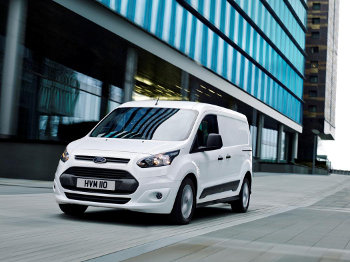
Ford Transit Connect

The new Ford Transit Connect is International Van of the Year 2014

Having bagged the International Van of the Year trophy in 2001 (Transit), 2003 (Transit Connect), 2007 (Transit) and 2013 (Transit Custom), Ford has made it five by winning the International Van of the Year 2014 award at the COMTRANS commercial vehicle exhibition in Moscow.

If the new Transit Connect is anything like as good as the Transit Custom — and we can safely assume it is — then the award isn’t really surprising.

Ford has consistently upped the ante with its small and medium vans over the last decade, and I have high expectations that next year’s full-size 2-tonne Transit model will take the fight to the Sprinter in the same way.

A few interesting statistics for van award followers; Ford is first single manufacturer to win the award for two years in a row, and its fifth award gives it the joint record for the most number of wins.

A jury of 24 journalists awards Transit Connect 130 points from a maximum possible 163, placing it ahead of the Mercedes-Benz Sprinter and Renault Kangoo. The judges singled out the Transit Connect’s fuel economy, design, driveability, load-carrying and safety for praise, and Pieter Wieman, chairman of the “International Van of the Year” jury, said:

“Ford has succeeded in building a light van with a strong accent on economics – the vehicle is a good answer to the needs of small operators as well as big fleets to reduce the cost of transport of goods. The loading space offers several innovative aspects, such as load-through hatch in the bulkhead, fold-up front passenger seat and a sliding side door in the long-wheelbase model which enables a Europallet to be loaded.

The new Transit Connect is also the first van in its class to offer features such as Active City Stop, which helps to prevent rear-end shunts in heavy traffic conditions — a common type of collision.

The all-new Transit Connect is now available to order for delivery in late 2013.

E-Up! Lad, That Must Be An E-Load Up! You’re Driving

Volkswagen e-load up! electric van

The Volkswagen e-load up! electric van is still a concept, but VW says a van version of the up! could make it into production if there’s enough demand.

One of the most ‘wrong’ posts I’ve ever written was one suggesting that small car-derived vans like the Fiesta Van had had their day.

The post was triggered by the news that Peugeot was to discontinue its 207 Van model, but since then, a number of new car-derived vans have hit the market — not least the gorgeous and desirable MINI Clubvan.

Volkswagen has now upped the ante with a suggestion that it might put a van version of its up! small car into production. To tantalise would-be buyers, its put an electric-powered concept model on display at the current IAA motor show in Frankfurt.

Catchily named the ‘e-load up!’ (they might need to work on that…), the e-load up! is aimed at the city courier, technician and pizza delivery market. Volkswagen says that the up! van would be suitable for all types of drive system and thus could be made available as a regular diesel-powered van, too.

The idea is simple, and very apt, given today’s sky-high fuel prices: a small van that’s full can operate more efficiently than a larger van that isn’t full.

Volkswagen has already prepared an electric production version of the up!, called the e-up!, so converting this to a van wasn’t a massive challenge and it certainly could work well.

Compared to the passenger model, the cargo capacity of the load up! rises from 951 litres to more than 1,400 litres. Maximum payload is 306 kg, which should be ample for the kind of load and usage it is likely to get in a city environment. The electric power train is slick and impressive, according to Autocar, which has tested a pre-production e-up!, and should have a range of in excess of 100 miles.

This isn’t the first electric concept van Volkswagen has rolled out at a motor show, but something tells me that the up! van might make it into production. Volkswagen says that given the right level of demand, a commercial vehicle version of the up!, such as the e-load up!, could be available soon. Watch this space.

A14 Bypass Could Cut Journey Times For Van Drivers

Busy motorway at twilightThe Highways Agency has today announced plans for a major upgrade of the A14 between Cambridge and Huntingdon.
If you travel in this area regularly, you will know it is a notorious bottleneck and is very prone to major delays, so in principle at least, this is good news.

As always, however, the devil will be in the detail. Will we end up with another underused, privately-operated toll road like the M6 Toll, while the majority of traffic continues to pound the non-toll, taxpayer-funded road into submission?

A public consultation will run from Monday 9 September to Sunday 13 October, with public exhibitions planned in the Cambridge and Huntingdon area from Tuesday 17 September, but here’s an overview of the Highway Agency’s proposed solution:

  • A new Huntingdon Southern Bypass, with junctions at Ellington, at Brampton (where the A14 would meet the A1), at Godmanchester, and on the existing A14 at Swavesey. Proposals under consideration include this section of bypass being tolled.
  • The A14 through Huntingdon would be de-trunked. The A14 viaduct over the mainline railway in Huntingdon would be demolished, enabling the existing A14 to be tied into local roads, greatly improving traffic flows in the town and accessing sites for possible new development.
  • The A14 will be widened from Swavesey to Milton (the section between Girton Interchange and Histon will be widened earlier as part of a separate improvement scheme. Work is due to start in early 2014).
  • A new single carriageway access road will be built alongside the improved A14 between Fen Drayton and Girton and is intended for local use.
  • Girton and Milton junctions will be upgraded to improve traffic flow and to add more capacity, with improvements to other junctions along the route.
  • Two new junctions will be constructed at Bar Hill and Swavesey to maintain existing access to the trunk road and to connect with the new local road network
  • The A1 will be widened between Brampton and Alconbury in order to provide the additional capacity needed to cope with traffic linking to the A1 from the new Huntingdon Southern Bypass.

The A14 is one of the busiest routes in the country, as it links the M1, A1 and West Midlands to major East Coast ports such as Felixstowe. Nearly 85,000 vehicles per day travel on this road, so it would be good if a solution was found that was both cost-effective for the taxpayer and beneficial to  the majority of road users.

As the Freight Transport Agency pointed out today, road users expect accountability and value for money, and should be entitled to minimum service levels in the event that the new road is tolled:

Any contract to manage and charge for a new road must be accompanied by minimum standards of service, including route availability in severe weather, breakdown recovery and assistance times, minimum transit times and parking and rest facilities.  Freight companies will expect value for money and compensation when service falls short of promised standards.

The scheme has initially been priced at £1.5bn and work is due to get underway in late 2016 (subject to statutory processes and continued value for money), with completion expected in 2019/20.

For full details, visit:

http://www.highways.gov.uk/roads/road-projects/a14-cambridge-to-huntingdon-improvement-scheme/

Van Hire Trade Association Warns Customers To ‘Look For The Logo’

vanrental.co.uk vanThe British Vehicle Rental & Leasing Association (BVRLA) is warning car and van hire customers to ‘look for the logo’ when hiring a car or van.

The BVRLA is the UK’s trade association for vehicle rental companies, and to help customers understand the benefits of hiring from a BVRLA member firm, the organisation has published a new leaflet entitled “Why use a BVRLA member?”

According to the new leaflet, which is available on the BVRLA’s website, BVRLA has more than 500 members operating more than 2.75m cars, vans and trucks all over the UK.

BVRLA members are required to follow a Code of Conduct which requires members to provide safe and roadworthy vehicles, provide clear and accurate information about their services and offer a complaint resolution service. You might think that all of these requirements are standard for any car or van hire company, but sadly, there are all too many tales out there of companies whose vehicles did not meet the required standards, some of whom are outright fraudsters.

Member companies rental vehicles are required to pass a 44-point checklist before being rented out, while even more stringent checks apply to goods vehicles over 3.5 tonnes — and companies are subject to random inspections periodically, to ensure they are up to scratch.

Virtually all of the companies whose services we include on vanrental.co.uk are BVRLA members, and while there are reputable companies who aren’t members (mostly small, local independent firms), what I’d recommend is that if you are not familiar with the reputation of a firm, then make sure it’s a BVRLA member.

Used Van Values Hit New Record As Supply Crunch Bites

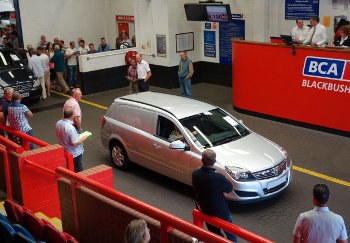
Vauxhal Astravan being sold at BCA LCV AuctionUsed van values fell in May and June and flatlined in July, but August saw a return to normal — values moved firmly higher to hit a new record of £5,013 despite an increase in average age and mileage.
According to auction specialists BCA, who supplied the figures, record values were achieved in the fleet & lease and dealer part-exchange sectors, while nearly-new values were the second highest on record.

The underlying cause of the rising prices is the shortfall in new van registrations that we’ve seen since 2008, something I highlighted in a post yesterday.

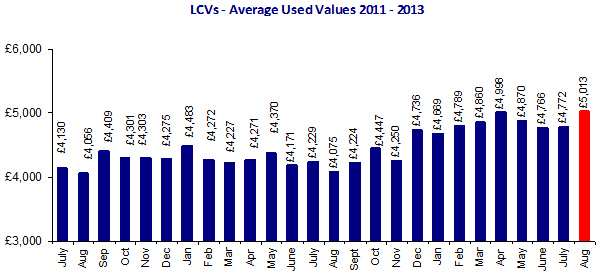
Van operators aren’t willing or able to buy new vans, but they still need to replace existing vehicles, which has led to a supply crunch in the used markets that has driven up auction prices from an average of £4,075 in August 2012 to £5,013 in August 2013 — a 23% increase in one year:

All vans Avg Age (mnths) Avg Mileage Avg Value Sale vs CAP
August 2012 58.31 78,167 £4,075 99.04%
August 2013 58.53 80,621 £5,013 102.81%

The level of demand for decent used vans can be judged by the fact that while average prices have risen by 23%, the average mileage and age of used vans sold at auction have risen slightly over the same period; buyers are definitely not getting more for their money, and are now paying an average of 102% of CAP (book) price, up from 99% last August.

LCV average used values 2011-2013 (August 2013)

Average used LCV values July 2011 – August 2013 (courtesy of BCA)

Commenting on the results, Duncan Ward, who is BCA’s General Manager for commercial vehicles, said:

“Demand has been right across the board during August, from older higher mileage vans through to younger ex-fleet and lease vehicles, while the few late-plate light commercials on offer can make exceptional values.  As always, good condition is the key and vans with a nice specification and in an attractive retail colour are very desirable.”

“The outlook for September is more of the same, as stock remains in very short supply and, with retail LCV activity expected to pick up during the month, the market is experiencing a double whammy.   BCA has already recorded some exceptional results in light commercial sales during the early days of September, so there is every chance that average values could climb yet again this month.”

Will used van prices break another record in September? I’ll be back in a month’s time to let you know.

New VW Caddy BlueMotion Delivers 800-Mile Range

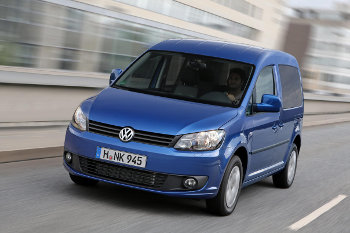
The new Volkswagen Caddy BlueMotion

The new Volkswagen Caddy BlueMotion boasts fuel consumption of 62.8mpg and an 800-mile range.

Volkswagen has released details of the latest version of its popular Caddy small van, which will make its official debut at the the IAA Show in Frankfurt, which opens on September 12.

The new Caddy boasts official fuel consumption of 4.5 litres per 100km, which equates to 62.8mpg (in Europe, l/100km is the standard measure of fuel consumption).

At the heart of the new Caddy BlueMotion is the familiar 1.6-litre TDI with common rail direct injection and 75 kW / 102 PS which has a maximum torque of 250 Newton metres. Compared to the already very fuel-efficient Caddy 1.6-litre TDI with BlueMotion Technology, fuel consumption was further reduced by 0.5 litres per 100 km.

Compared to the Caddy without fuel-saving technology, it is a full 1.1 litres per 100 km better. As a result, the commercial version of the versatile urban delivery vehicle consumes just 4.5 litres per 100 km, which equates to 117 g/km of CO2. Values for the passenger-carrying version are 4.6 litres and 119 g/km. Thanks to its 60 litre fuel tank, the Caddy BlueMotion therefore has a theoretical range of over 1,300 km (over 800 miles).

The vehicle’s low fuel consumption values were made possible by a combination of aerodynamic and engineering measures such as an engine stop-start function, low rolling resistance tyres, recovery of braking energy (battery regeneration), ride height lowered by 27 mm and efficient engine control.

A Caddy BlueMotion with a short wheelbase is available in four equipment versions: as a panel van and kombi as well as in passenger-carrying versions. Equipment features such as standard hill hold assist, cruise control system, exclusive seat upholstery and air vent surrounds in high-gloss black (passenger version) are all standard.

Merc Citan Wins Sales With Unlimited Mileage Warranty

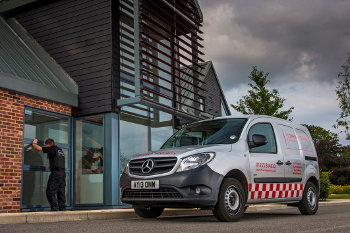
Tower Security's new Mercedes-Benz Citan

Tower Security’s new Mercedes-Benz Citan (plus a man trying to get through a locked door)

The Mercedes-Benz Citan is winning buyers thanks to its expected combination of two classic Merc virtues; high-mileage reliability and premium economy and performance.

Miles Hill, who is Managing Director of Essex-based Tower Security, needed a new van to operate roving security controls to clients’ premises and homes. The van will operate 24 hours a day and is expected to cover 100,000 miles a year, and faced with this demanding usage cycle, some competitors came up short, as Hill explains:

“We were on the verge of buying another make of van which was a bit cheaper ‘up front’ – until I asked for a price to cover three years’ servicing. Because of the high mileage we cover it was hugely expensive, and the vehicle would have been out of warranty after the first year.

“By contrast,” he continues, “the Citan’s servicing costs from Colchester dealer Orwell Truck & Van were very competitive. And it came with a three-year, unlimited mileage warranty, which says a great deal about the confidence that Mercedes-Benz has in its product.

Tower Security’s Citan is a long-bodied 109 CDI BlueEFFICENCY model that’s powered by an economical 90 hp diesel engine and equipped with a series of clever BlueEFFICIENCY measures designed to further reduce fuel consumption.

These include the ECO start/stop function – which turns off the engine whenever the vehicle is stopped in traffic, then restarts it as soon as the driver depresses the clutch – low rolling resistance tyres and optimised alternator and battery management systems. The result is a market-leading economy figure of up to 65.7 mpg and CO2 emissions as low as 112 g/km.

Mr Hill continues:

“The Citan is using a lot less fuel than our other vans and represents a huge step forward for us in terms of quality. Mercedes-Benz also has a great brand image and our new van looks a lot more professional when we’re visiting clients’ premises.”

“The manufacturer’s warranty was worth the purchase price premium on its own. But once we’d also factored in the Citan’s servicing costs and fuel efficiency it really was an easy decision – our new Mercedes-Benz will save us a fortune in the long run.”

Tower Security offers a fully manned and comprehensive service which operates 24 hours a day, seven days a week, and includes everything from key holding to static guards, dog handlers, and event security.

Van Registrations Up 11.1% In August

New van registrations rose by 11.1% to 10,344 in August, taking the total gain for the year so far to 9.4%, according to the latest figures from the Society of Motor Manufacturers and Traders (SMMT).

A rise in truck registrations (goods vehicles over 3.5t) helped cancel out losses in the first half of this year and means that total commercial vehicle registrations so far in 2013 are up by 7% on the same period in 2012:

August % change Year-to-date % change Rolling year % change
Vans 10,344 11.1% 161,938 9.4% 253,572 2.6%
Trucks 3,107 29.0% 28,221 -4.8% 44,279 -7.3%
Total 13,451 14.8% 190,159 7.0% 297,851 1.0%

Data courtesy of SMMT (www.smmt.co.uk)

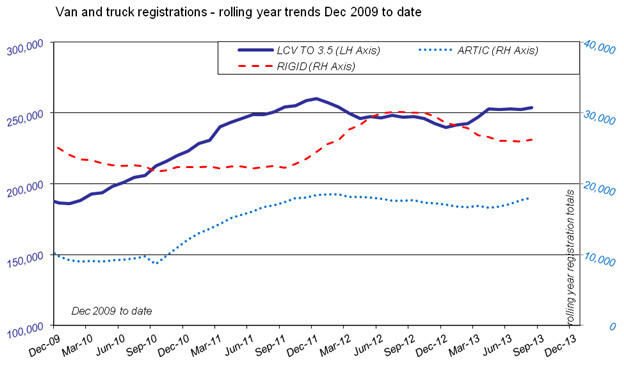
The graph below shows how van, rigid truck and artic sales have changed since the end of 2009. The picture presented by this graph is fairly positive … :

SMMT CV registrations August 2013

Truck and van registrations 2009 to August 2013 (courtesy of SMMT)

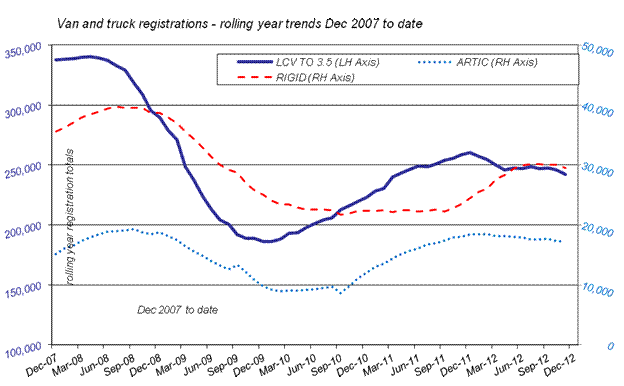
… but SMMT appears to have fallen victim to the temptation to put a positive spin on its statistics. Until a few months ago, the graph above, which is issued every month, included van and truck registrations from the end of 2007. These have now been removed, and a glance at the graph below suggests why this is.

In this graph from November 2012, we can see that van registrations remain approximately 30% below 2007/8 levels at the moment, while rigid truck registrations are down by around 25% from their 2008 peak. Artic registrations have remained more robust, but the picture is still concerning, as it suggests that smaller business — typical users of vans and light trucks — have struggled to survive and grow, something which is likely to inhibit wider economic growth and recovery:

SMMT van and truck registrations Dec 2007 - Nov 2012

Van and truck registrations Dec 2007 – Nov 2012 (courtesy of SMMT)

Despite the poor comparisons with pre-recession levels of van registrations, iIt is certainly good news that van registrations rose by 11.1% in August, and that truck sales started to recover from the falls we have seen so far this year.

What’s more, SMMT Commercial Vehicle Manager Nigel Base believes there is more good news to come during the second half of this year:

“The commercial vehicle industry can take heart from a respectable performance in August with customers boosting registrations by almost 15%. For vans, August is always a quieter month ahead of the September plate-change but the 9.4% year-to-date rise in volumes is set to be maintained through to year end. We predicted a turn-around in truck fortunes through the second half of this year and the robust performance in August is a signal that volumes should catch and pass 2012 totals.”

Let’s hope so.

Sixt Van Hire from just £25 per Day

Sixt van hire from £25 per dayGerman car and van rental firm Sixt is one of the biggest hire operators in the UK. With 20 branches in London alone — as well as a comprehensive national network of locations, you’re rarely far away from a Sixt branch.

Anyone needing to hire a van at the moment can benefit from Sixt’s great hire rates, which start from just £25 per day.

Click here for a list of all Sixt’s UK branches, or click on the advert on the left to get started with a Sixt quote.

Sixt’s UK van rental fleet includes the following sizes of van:

  • Small van (e.g. Volkswagen Caddy)
  • Medium van (e.g. Ford Transit SWB, Volkswagen Transporter SWB)
  • Large van (e.g. Ford Transit LWB, VW Crafter, Mercedes-Benz Sprinter)
  • Extra-long wheelbase vans (e.g. Ford Transit Jumbo, Mercedes-Benz Sprinter XLWB)
  • Luton vans (e.g. Ford Transit Luton)
  • 3.5t Dropside and Tipper vans (e.g. Ford Transit Tipper/Dropside)

Sixt’s fleet is one of the most comprehensive offered by the main consumer van hire companies in the UK, so you should be able to find what you need, in your area.