Van Hire in Harrow, Ruislip & Pinner – Jafvans

I’m delighted to welcome our newest advertiser, Jafvans of Harrow, to the vanrental.co.uk directory. Jafvans offers van hire, minibus hire and 7.5 tonne box van hire from its three branches in the London area:

Jafvans offers a comprehensive range of vehicles, including:

  • 7, 9, 12 & 15-seater MPVs and minibuses
  • Small vans  (e.g. Citroen Berlingo)
  • Transit panel vans (SWB, LWB and Jumbo)
  • Luton box vans (including models with an extended body – ideal for house moves)
  • 3.5t dropside and tipper vans
  • 7.5 tonne box vans with tail lifts
  • 3.5 tonne refrigerated vans

Jafvans is a family-run firm that was founded by John Arthur Fisher in 1959. He ran the company until his retirement in 1997, when he sold it to his general manager Stephen Blake, who had worked for him since 1973. Since then, Jafvans has expanded steadily and now consists of three branches, all of which offer a full range of hire services.

Contact Jafvans:

  • Quote & Book online at www.jafvans.net
  • Telephone: 020 8864 2650 (Harrow) / 020 8868 6734 (Pinner) / 01895 623 038 (Ruislip)
  • Email: info@jafvans.co.uk

If you’d like to see your van hire company listed on vanrental.co.uk, click here for details of our advertising options.

UK-Spain Ferry News – P&O Service To End

For Brits moving to and from Spain, the P&O Ferries Portsmouth-Bilbao ferry service has always been a popular option – instead of a long slog driving through France, you can enjoy a mini-cruise down the coast of France with two night’s rest in a proper cabin. Once you reach Bilbao, many popular Spanish destinations can be reached within a day’s driving.

However, that’s all set to change. The 27th September 2010 will be the last day that the P&O Portsmouth-Bilbao service runs – it is being stopped. (You can read the official P&O news release here.)

Luckily, there is an alternative and more attractive option for ferries from UK-Spain. Brittany Ferries runs a service to Santander, which sails from both Portsmouth and Plymouth (alternately). This service is actually faster – only taking around 24 hours – and uses newer ships than the P&O service.

Click here for a quote from Brittany Ferries if you’re planning a trip to or from Spain.

Aberystwyth Van Hire – AV Self Drive Hire

I’m delighted to welcome our newest advertiser to the vanrental.co.uk directory. AV Self Drive Hire is a family-run business based in the Welsh town of Aberystwyth. Established more than seven years ago, AV Self Drive Hire offers a range of vans to suit most requirements:

  • Short and long wheelbase panel vans
  • Luton vans
  • Long and short-term hire
  • European use available
  • Cars and minibuses also available

AV Self Drive Hire is based on the Glanyrafon Industrial Estate in Aberystwyth (postcode SY23 3JQ for sat nav users) and can be contacted via the company’s website or by telephone or email.

If you’d like to see your van hire company listed on vanrental.co.uk, click here for details of our advertising options.

2010’s What Van? Award Winners Are Here

If you’re thinking of buying a new van this year but are not sure where to start – or are simply looking for an alternative to the flexible and trustworthy Ford Transit – then the What Van? 2010 awards might be a good place to start.

Journalists are never happy to leave a good thing alone, and the What Van? judges have scoured the van market for all possible contenders, choosing a completely new van model as their Van of the Year 2010. The Nissan NV200 is based on the same platform as a Nissan Micra but manages to squeeze a load length of just over 2m into an overall length of only 4.4m – considerably shorter than most short wheelbase panel vans.

Other interesting category winners include the little-known van versions of the Citroen C-Crosser/Mitsubishi Outlander in the 4×4 van category and the Ford Transit in the Minibus category. The Iveco Daily won the Large Panel Van category, its larger range of engines and weight choices helping it to pip the Mercedes Sprinter to the post.

Both large vans contenders offer some of the cleanest engines ever seen in this sector – all Sprinter models are now compliant with Euro 5 and some Daily engines go one further, complying with the voluntary EEV (Enhanced Environmentally-friendly Vehicle) standard, which is designed as an intermediate step between Euro 5 and Euro 6.

For a full list of the What Van? 2010 Award winners and the judges’ thoughts on them, click here to visit the What Van? website.

High-Mileage Vans Prompt Review of MOT Testing System

Changes to the current MOT testing requirements for vans could be introduced over the next few years, following the announcement by the government of a review of all vehicle testing requirements.

One of the government’s main concerns is that low-mileage, well-maintained cars are tested too often, while high-mileage vans are tested too little, relative to the mileage they cover.

The current rules require all Class 4 and Class 7 (vans between 3t and 3.5t) vehicles to be tested annually after they reach three years old. However, high-mileage vans can have annual mileages in excess of 50,000 miles; such a van will have covered more than 150,000 miles by the time its first MOT test comes round. Until that time, there are no rules in place to ensure that such vehicles are monitored for safety issues.

I don’t believe there are inherent safety risks in high mileage vans, as long as they are properly maintained. However, it’s clear that many vans are not being properly maintained – unpublished DVLA figures obtained by Fleet News show that the first-time MOT failure rate for Class 7 vans (vans with a gross weight of between 3,000kg and 3,500kg)  reached 50% in the 2009/10 financial year*. This does seem to suggest that some van operators are not taking enough care with maintenance.

The obvious solution to this problem would be to introduce annual MOT testing from new for Class 7 vehicles. This would be in line with the regulations for lorries, buses and coaches. Whether this would help reduce accident numbers – the ultimate goal of MOT testing – is another question.

*Source – Fleet News

Coventry Van Hire from TRS Self Drive

I am very pleased to welcome our newest advertiser, TRS Self Drive of Coventry, to the vanrental.co.uk directory. TRS provides a full range of hire vans to customers in Coventry as well as further afield in Leamington Spa and Warwick.

TRS Self Drive offers the following types of van for hire:

  • Small vans (e.g. Peugeot Partner)
  • SWB panel vans (e.g. Vauxhall Vivaro)
  • LWB panel vans (e.g. Vauxhall Movano)
  • Luton box vans
  • 3.5t tippers

Great deals are available on weekly hire – TRS is currently running an offer where customers get seven days hire for the price of four.

If you’d like to see your van hire company listed on vanrental.co.uk, click here for details of our advertising options.

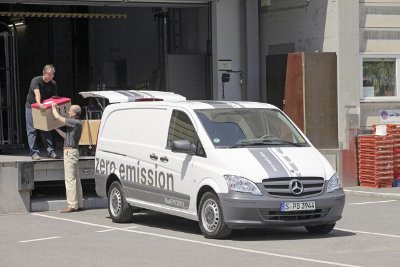
Mercedes-Benz Launches Vito E-CELL Electric Van

Mercedes-Benz has just launched the Vito E-CELL, an all-electric version of the popular Vito van. The company says that the E-Cell is the first electric van to be produced on a manufacturer’s standard production lines – the Vito E-CELL will be made in Merc’s Vitoria factory, in northern Spain.

Mercedes-Benz Vito E-CELL electric van

The electric Vito will only be available in LWB format due to the space required for the batteries

One hundred Vito E-CELLs are planned for this year, which will go to pre-arranged fleet trials in Berlin and Stuttgart. However, proper series production is planned from 2011, when Mercedes aims to produce 2,000 electric Vitos.

The van itself is based on the long-wheelbase Vito and has a gross weight of 3,050kg and a payload of around 900kg. Unlike other Vitos, it is front-wheel drive. The reason for this is simple – the space under the van floor that’s usually occupied by the propshaft and fuel tank is taken up with batteries, so front-wheel drive makes sense. It also saves weight, improving payload and reducing power consumption. Maximum torque is a healthy 280Nm – pretty similar to an equivalent diesel engine and possibly even more impressive to drive, thanks to the instant availability of maximum torque that is a characteristic of electric motors.

Maximum range is said to be 130km and charging takes up to six hours with a special three-phase charging station or up to 12 hours from a standard 230V mains socket. The van is (obviously) designed for urban or short range use and its top speed will be limited to 80km/h to preserve battery life.

There don’t seem to be any details on price yet, but you can check out the van in action in the video below:

Company Van Drivers Paying 4 Times More Tax For Private Use

Drivers who use their company vans for personal use are paying four times as much tax as they were two years ago, according to new figures unearthed by accountancy firm UHY Hacker Young. In 2006/7, the HMRC only collected £10m in tax payments for drivers who used company vans for private mileage. In 2008/9, that figure was £40m, thanks to a change in the rules that came into effect in 2007.

What Changed?

In 2007, the rules on private use of company vans changed. Previously, private use of vans was given a benefit-in-kind value of £500 (£350 for vans over four years old). This meant that van drivers using their company vans for personal use only had to pay tax on £500 – for people on the standard 22% rate of income tax, this meant a charge of £110 per year.

In 2007, the benefit-in-kind value for private use of a company van was increased sixfold, rising from £500 to £3,000 (plus a further £500 if fuel is also provided). This meant that standard rate tax payers who used company vans for private mileage now had to pay an additional £660 per year – or £770 if their employer also paid for fuel for private use.

That Seems Unfair, Doesn’t It?

Such a big hike in tax over one year may seem unfair, but I think it’s pretty reasonable, really. Here’s why:

  1. £770 a year is still a lot cheaper than having to buy and run another car. You are getting the benefit of using someone else’s van for personal use, after all. You aren’t paying maintenance, road tax or insurance charges for it (unless you are self-employed…).
  2. Under the new system, van drivers pay a similar amount to company car drivers for the private use of their vehicles. Previously, van drivers paid much less than drivers of company cars, as a general rule.

Have you been hit by the increase in tax? Do you think it’s reasonable? Let me know in the comments below…

Minibus Hire – Who Can Drive A Rented Minibus?

If you want to drive a self-drive hired minibus, the first thing to check is whether you have category D1 on your driving licence.

If you passed your car driving test before the 1st January, 1997, then you should have D1 on your licence and can drive minibuses with up to 17 seats.

If you passed your car test after that date, you probably won’t have D1 entitlement, unless you have taken an additional minibus driving test since then.

Despite this, the law does allow people without D1 entitlement to drive minibuses up to 17 seats under certain circumstances.

The problem is that most minibus hire companies require drivers to have D1 entitlement – even if they might be legally allowed to drive the minibus without it. The only possible solution to this problem is to ring around local, independent hire companies who might be more flexible.

The other choice, if you want to drive minibuses regularly – for a sports or social club, perhaps – is to take your minibus driving test and have category D1 added to your licence.

New Shell FuelSave Fuels Promise Improved Efficiency

Shell has just launched two new fuels to replace its standard (regular) pump fuels. Shell FuelSave Unleaded and FuelSave Diesel contain new ingredients that promise to provide fuel savings of 1 litre per 50 litre fill up (the marketing is aimed at family car drivers!).

The new fuels have been in development for five years and will replace regular unleaded, regular diesel and Diesel Extra at all Shell filling stations in the UK. Pricing will be exactly the same as the old fuels. This isn’t a premium fuel – the V-Power lineup will continue unchanged – it’s a normal fuel for normal drivers to use in all types of petrol and diesel vehicles.

Obviously the diesel fuel will be most relevant to van drivers, but for anyone who is interested, here is the technical story behind the new fuels.

FuelSave Diesel

Diesel engines are around 30% efficient – that is, 30% of the energy created by burning the fuel is used to drive the vehicle forwards. The rest is wasted in the form of heat, noise and so on.

Shell’s scientists identified irregular injector spray and slow ignition as two key factors affecting diesel engine efficiency. Shell’s existing diesel already contained detergents to help prevent dirty injectors (and hence irregular spray patterns) but what is new in FuelSave Diesel is an “Efficiency Improver” that increases the speed of fuel ignition. Shell claims that this improves combustion efficiency and helps reduce fuel consumption.

FuelSave Unleaded

As anyone who has driven both petrol and diesel-engined vehicles in winter will know, the heaters in petrol-engined vehicles always warm up faster than those in diesels. The reason for this is that petrol engines are even more inefficient than diesels – just 20%-25% of the energy created when the petrol is combusted gets turned into forward motion – petrol engines get hotter, faster, than diesels.

When it came to improving the efficiency of petrol engines, Shell’s scientists identified a different area to target – lubrication. They found that the top of the cylinder and the piston heads were often inconsistently coated with oil – resulting in greater friction. The solution they came up with was focused on improving the lubrication of the piston rings. The new unleaded formula contains a lubrication agent that coats the top of the pistons when fuel is injected into the cylinders, reducing friction and thus improving combustion efficiency.

Does It Work?

Shell has had extensive independent testing done on its new FuelSave fuels and claims that they work from the first tankfull, saving up to 1 litre of fuel per 50 litre fill. I’m going to try and test this out for myself with my Transit but it could be difficult to work out a way of doing it scientifically enough – I don’t have an accurate way of measuring fuel used (other than by brimming the tank) or the ability to drain the tank of one fuel and refill it with another. If I do manage to reach any conclusions, you can be sure I’ll post them here.

In the meantime, if you try FuelSave Diesel or Unleaded and reach any conclusions of your own, leave a comment below – I’d be really interested to hear from you. Remember that if you fill up at a Shell station from Wednesday 21st July, you’ll be filling up with FuelSave (unless you use V-Power).

Shell is also running a competition for drivers to win a year’s supply of FuelSave fuel – sorry, this has now closed.