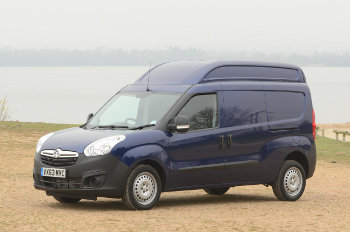
Vauxhall introduces jumbo-sized Combo

Vauxhall Combo L2H2 - long and high

The Vauxhall Combo L2H2 – it’s long and high and if Fiat hadn’t done so already with the Doblo, it might be called the Combo XL!

Few vehicles define everyday practicality better than the Vauxhall Combo, and the Luton-based firm has now added to the versatility of this popular model by introducing the L2H2 panel van, which provides a maximum load height of over five feet.

The Combo L2H2 (catchy name) made its show debut at the CV Show in Birmingham this week. It’s a high-roof, long-wheelbase version of Vauxhall’s popular Combo van, which Vauxhall says has been designed to meet increasing demand for this type of commercial vehicle (demand that must hitherto have been satisfied by the Fiat Doblo XL, the Combo’s twin sister).

Offering an extra 245mm of additional height over the H1 specification, the L2H2 is available with a choice of two 1.6-litre diesel engines with 90PS or 105PS. Both engines come with Start/Stop technology as standard.

The extra length and height now gives the Combo an impressive cargo capacity of 5.0m3, combining an overall height of 2125mm and an overall length of 4740mm making it even more spacious than before, while the L2H2 still boasts the same one tonne class-leading payload as its shorter H1 siblings.

The L2H2 has been carefully designed with the end user in-mind; with a width of 1230mm between each wheel arch it is capable of carrying a Europallet with ease:
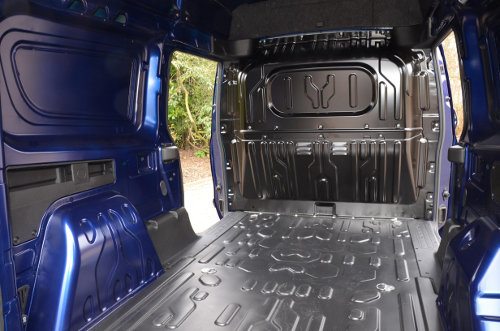
Vauxhall Combo L2H2 loadspace

This is what five cubic metres of loadspace looks like inside a Vauxhall Combo

“The inclusion of this new high roof long wheelbase version to the Combo range demonstrates our commitment to satisfy customer demand,” said Steve Bryant, Brand Manager, Vauxhall Commercial Vehicles.

“Today’s market means that customers are increasingly demanding a wide variety of commercial vehicles to choose from and we are confident there is now a Combo for every application.”
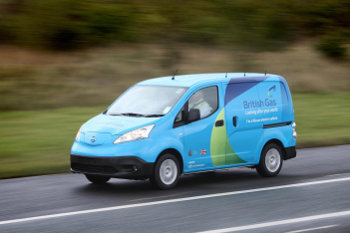
British Gas orders 100 Nissan e-NV200 electric vans following winter trial

Nissan e-NV200 British Gas trial van

One of the Nissan e-NV200 electric vans trialled by British Gas over the last winter.

It’s all going to plan for Nissan: the e-NV 200 electric van has come through a series of well-publicised long-term operational trials with flying colours and has now received a 100-van order from trial partner British Gas, ahead of the e-NV200’s official launch in June.

The order was announced at the start of the CV Show in Birmingham today, and is part of British Gas’ wider commitment to electrify 10% of its 13,000-strong fleet by 2017. British Gas will receive 50 vans as soon as possible and a further 50 by the end of 2014.

As I have been saying for many years, the logical opportunity for mainstream adoption of electric vans isn’t the private car market, where usage is often inconsistent and unpredictable, it’s the van market — many vans operate on fixed routes and schedules which make range anxiety and charging requirements irrelevant.

British Gas’ winter trial of the e-NV200 was the UK’s largest electric van evaluation to date, and saw 28 e-NV200s cover in excess of 60,000 miles between them, to verify how the vans performed in winter conditions, during typical British Gas home services daily usage patterns. Proof of the trial’s success was that some drivers were reluctant to hand back their vans.

Colin Marriott, general manager, fleet at British Gas said:

“We have been extremely impressed with the performance of the Nissan e-NV200 during our winter trial. The feedback from our engineers speaks for itself, with the majority saying they would be happy to keep the van permanently.

“Taking on 100 of these vehicles on a permanent basis demonstrates our continued commitment to leading the adoption of this technology amongst large vehicle fleets in the UK.  With technology and infrastructure improving all the time, we look forward to expanding this number in the coming years.”

The e-NV200 will be available to purchase from June 2014.

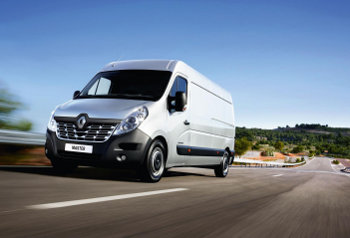
New Renault Master unveiled: more power, less fuel

2014 New Renault Master

The new Renault Master goes on sale in June 2014

As expected, Renault has announced details of its updated Renault Master van today, to coincide with the opening of the CV Show 2014, where the updated Master has been unveiled to the world’s press.

More power please

Perhaps the biggest change is the updated range of engine choices. The 2.3 dCi engine remains, but has been updated to provide more power with lower fuel consumption and emissions.

Four power levels will be available, 110hp, 125hp, 135hp and 165hp, replacing the previous range which offered choices from 100hp to 150hp.

According to Renault, the 110hp and 125hp versions are designed to provide an attractive trade-off between price and fuel consumption, while the 135hp and 165hp will use the company’s Twin Turbo technology to provide superior performance and fuel efficiency.

Cutting fuel costs

Naturally, these Twin Turbo models will cost a little more than the basic engines, but for high mileage operators the fuel savings are likely to be worthwhile. Renault says that the 165hp version will provide a fuel-consumption saving of up to 7.3 mpg, despite delivering 15 extra horsepower and 10Nm of additional torque.

This will bring the fuel consumption of the L2H2 165hp version of the new Master up to 40.9 mpg / 180g of CO2/km.

Master for long-distance couriers?

The new Master will continue to be available in front and rear-wheel drive, but two new versions will be available — L4H2 and L4H3 models with single rear wheels.

Translated into English, this means the extra-long models will be available with a long final drive ratio and single rear wheels (rather than the rear-wheel drive model’s standard twin rear wheels). These models are designed to provide good fuel efficiency and to maximise pallet-carrying ability — attributes needed to compete directly with the Transit Jumbo and Sprinter XLWB and compete in the long-distance and courier markets.

Keeping it under control

Elsewhere, Renault has  introduced a new Trailing Swing Assist system, which automatically alternately applies the brakes and limits the delivery of engine torque when it detects excessive trailer swaying, helping to bring the trailer under control and prevent a rollover or jackknife scenario.

Finally, the van’s electronic safety systems have been updated, and all Masters now come with the latest-generation ESC with Load Adapative Control as standard, as well as optional Hill Start Assist and Grip Xtend, which optimises grip in difficult conditions, such as snow, mud and sand.

Van Rental from just £22 per day with Hertz + collect Nectar Points

Hertz logoHertz Van Rental is currently running a promotion offering van rental from just £22 per day and the chance to collect Nectar points on your hire — remember these can be used for payment or part-payment when shopping at Sainsbury’s and Homebase.

Offer details: 5% Off and Van Rental from £22 per day with Hertz – collect Nectar Points too

Valid from: Ongoing

Promotion Code: 778636

Click here to visit the Hertz website


Terms and conditions apply, see Hertz website for details.

Nissan NV400 van gets higher spec, lower emissions

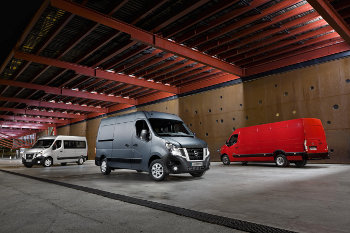
Nissan NV400 rangeNissan has announced improvements to its NV400 range including a low emission Euro 5 engine and a number of specification upgrades on both panel vans and factory-built conversions.
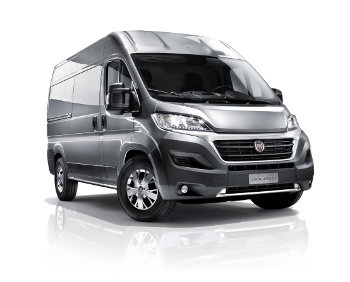
The four versions of the chassis, tipper and dropside turbo engine have been replaced with a single 2.3 litre turbodiesel engine which boasts an improvement in fuel economy and sees the NV400’s CO2 emissions fall by 8g/km.

The updated variants maintain their nimble performance and generous load space, with the improvements meaning the NV400 becomes an increasingly viable option to businesses looking to reduce the emissions of their fleet.

Additional specification now included on the E grade panel van as standard includes deadlock, power mirrors, front electric windows, FM audio system with MP3 / iPod compatibility, USB / AUX socket input and Bluetooth connectivity, cargo floor load mounting hooks and immobiliser and alarm.

All panel van, crew van, tipper and dropside conversions now have a Thatcham approved Category 1 alarm and SE grade panel van, crew van and Crew Bus SE derivatives now have remote control locking with a three-button key, while the Crew Bus also has a standard immobiliser and pre-wiring for alarm.

All rear wheel drive panel vans, crew vans and chassis now come with twin rear wheels.

Nissan corporate sales director Barry Beeston commented:

“The improvements to the NV400 will further increase its appeal to businesses both large and small. Its comfort and reliability on long journeys is now matched by the efficiency of a high performance engine which will deliver tangible cost savings.

“The extra security features on both the E and the SE models will also provide drivers and fleet operators with extra peace of mind that their vehicles and loads will be safe and secure when left unattended.”

As the Nissan NV400 is a rebadged Renault Master (a van also sold as the Vauxhall Movano), then I wouldn’t be surprised to see similar updates from Renault and Vauxhall in the near future

New Fiat Ducato beats Relay & Boxer with higher GVW and auto gearbox

Revised 2014 Fiat Ducato

The revised 2014 Fiat Ducato

Fiat has released details of its new Ducato van, one day later than its PSA partners Citroën and Peugeot, who published details of their new Relay and Boxer models yesterday.

As with previous models, all three vans are essentially the same vehicle, but also as with previous models, Fiat has chosen to put its own spin on the Ducato, resulting in some distincitive differences that could make the difference for certain groups of buyers.

The biggest change — which affects all buyers of the Ducato — is that Fiat will continue to offer its own 2.3-litre Multi Jet diesel engines, rather than the Peugeot/Citroën 2.2HDi engine. The 2.3-litre engine will be available in 110hp, 130hp and 150hp versions, and the engine range is topped with a 180hp, 3.0-litre model. (Peugeot also offers a 3.0-litre option, so perhaps it’s using the Fiat 3.0-litre Multi Jet engine too?)

The second thing that makes the Ducato stand out, especially in the European motorhome market, where it dominates all other manufacturers, is that Fiat offers its ComfortMatic automated manual transmission as an option with all engines, except the entry-level 110hp 2.3l unit. As far as I can tell, neither Peugeot nor Citroën offers an auto gearbox option for the Relay/Boxer.

The final difference between the Ducato and the Boxer/Relay is that Fiat has beefed up the suspension a little more and the heaviest Ducato model has a maximum GVW of 4.25 tonnes — 200kg more than the 4.05 tonnes on offer from the Peugeot/Citroën ranges. According to Fiat, the new Ducato will boast the best Gross Vehicle Weight (up to 4.25 tonnes); best weight on the rear axle (up to 2.5 t) and best van payload (up to 2.1 t) of the ‘single wheel’ segment.

In truth, I suspect that both the auto gearbox option and the 4.25 tonne weight option are mostly aimed at specialist conversion markets, such as the motorhome, ambulance and minibus sectors, where the extra weight will be useful and automatic gearboxes are a much more popular choice. Most van operators will be reluctant to operate vans at 4.25 tonnes, unless they really need the extra weight over a 3.5t van, as it will mean that drivers are required to use a tachograph and work to much more stringent and complex working hours regulations.

New Citroën Relay & Peugeot Boxer revealed ahead of CV Show

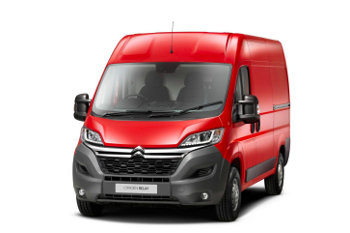
New 2014 Citroen Relay

The new Citroen Relay will be unveiled at the 2014 CV Show.

Citroën has revealed details of its new Relay van ahead of its official CV Show debut next week (29 April – 1 May).

The new Relay, which will also be sold as the Peugeot Boxer, will be available in 3.0, 3.3, 3.5 & 4.005 tonne gvw formats, as well as in chassis cab format. Citroën’s Relay Specialist pre-built conversion range will be continued, enabling buyers to order Relay tippers, dropsides and Lutons direct from Citroën  dealers.

Peugeot will offer a similar range, along with its ‘back-to-back’ model — two cabs without chassis delivered as pairs for specialist conversions requiring a different chassis. These are typically used for removals vans and large motorhomes, which use larger, lower chassis platforms than conventional conversions.

As is increasingly the trend with large vans, the Relay will be powered by a single engine, a 2.2HDi, which will be available in three power outputs, 110, 130 and 150PS. Peugeot is opting for a slightly different approach, and while the same 2.2HDi engine, in 110, 130 and 150PS formats will power the bulk of Boxer vans, it is retaining a 3.0-litre HDi 180 model for buyers who are looking for a good long-distance, heavyweight performer.

Both firms will market the new panel van models in four lengths, ranging from L1 (8.0 mand 2.67m load length) to L4 (4.07m load length and up to 17m3 capacity). Three roof heights, H1, H2 and H3 will be available, although as with payload options, not all combinations will be possible.

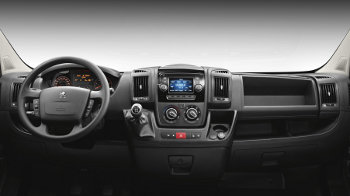
New Peugeot Boxer cab interior

Inside the cab of the new Peugeot Boxer, whose sister van, the Citroen Relay, will be unveiled at the CV Show 2014.

The new vans will be front-wheel drive only, but will be available with Intelligent Traction Control/Grip Control, the PSA electronic limited slip differential system that helps provide additional traction in slippery conditions. Electronic Stability Control will be standard on all models, while a Lane Departure Warning System and Hill Descent Control will be optional extras.

Finally, both vans will boast extended service intervals of up to 30,000 miles/two years, although in my opinion, only high mileage users should even consider this: my view is that extended service intervals are one of the reasons that modern diesels suffer so many expensive problems once they get out of warranty.

I also believe that from a safety perspective, all vehicles should have an annual service: honestly, what kind of business can’t schedule half a day downtime for each of its vans, once a year, in the name of safety, reliability and durability (not to mention resale value)?

Ford reveals details of all-new Transit Courier small van

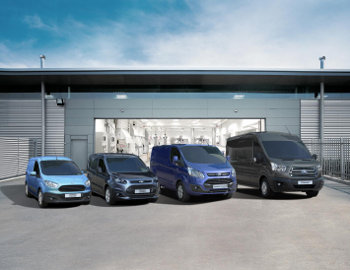
Ford van range 2014

The all-new Transit Courier will go on sale this summer, completing Ford’s new range of Transit vans.

Ford has confirmed the specification of its all-new Transit Courier small van, which the firm hopes will take market share from the Peugeot Bipper/Citroen Nemo/Fiat Fiorino model, which is made by the French PSA group.

The Transit Courier goes on sale this summer, and is the final model to be added to Ford’s all-new four-van range, following the Transit Connect, Transit Custom and Transit.

Engine room

Transit Courier will be available with three engine choices, all of which promise outstanding fuell efficiency and low emissions:

  • 95PS 1.6-litre Duratorq TDCi diesel: 76.3mpg / 97 g/km CO2
  • 1.0-litre EcoBoost petrol: 54.3mpg / 119g/km CO2
  • 75PS 1.5-litre diesel: 72.4mpg / 103g/km CO2

All of these figures are for vans specified with Ford’s optional Auto-Start-Stop system and in some cases a 100 km/h speed limiter, but they promise impressive fuel consumption nonetheless.

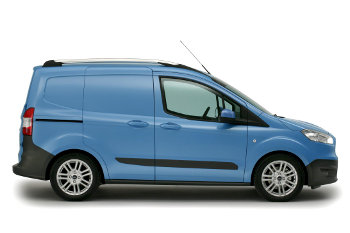
Ford Transit Courier

The new Ford Transit Courier

All powertrains offer extended one-year/20,000 mile service intervals and the vehicle design has been optimised for ease of serviceability and repair.

A multi-piece rear bumper, rugged body-side protection and high-mounted front and rear lights help to reduce the cost of accident damage and lead to lower insurance premiums. Expensive fuelling errors are avoided by the unique, standard-fit, Ford Easy Fuel system.

Load up

In the load department, the Transit Courier promises a lot, too. The van will have a maximum payload of 660kg and can hold a standard Euro pallet, while the load compartment will include a number of features that should make it attractive to fleet buyers and tradesmen:

  • Longer load length at floor level of 1.62m, and easier loading of bulky items via optional sliding rear side doors (width 453mm with bulkhead)
  • Full-height, full-width steel bulkhead (glazed or unglazed), fully compliant with the internationally-recognised standards for load restraints DIN and ISO
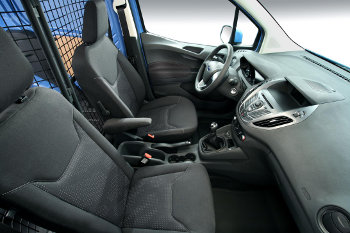
  • Ford Transit Courier interior

    Inside the new Ford Transit Courier

    Optional folding mesh bulkhead (DIN- and ISO-compliant) and fold-dive passenger seat for longer items up to 2.59m, and maximum load volume of 2.6m3 (SAE)

  • Six cargo tie-down points (DIN- and ISO-compliant), including four rear side-mounted points to avoid obstruction of the floor area
  • Multiple pre-installed bodyside fixing points to mount racking or framework
  • Optional ultra-bright LED loadspace lighting for the van bodystyle

Safety first

Finally, Ford continues to raise the bar in terms of safety — traditionally a weak spot for many vans.

Customers can specify Ford SYNC with Emergency Assistance, the latter of which assists the occupants to call the local emergency services operator in the event of an accident, as well as Speed Limiters and a Tyre Pressure Monitoring System. The standard Electronic Stability Control system features Hill Start Assist, Traction Control and Roll-Over Mitigation.

The passenger-carrying Kombi model (effectively a crew cab) also offers side curtain airbags, knee airbags and second-row seat beltminders, in addition to cab area driver, passenger and side airbags.

As with Ford’s other new Transit models, it’s hard to see the new Transit Courier failing — Ford’s cars and vans are amongst the best in the world at the moment, and while it may lack the cachet of the German brands, Ford’s new vehicles don’t want for anything in terms of quality, driveability, practicality or safety.

You won’t find one of these vans at your local van hire firm

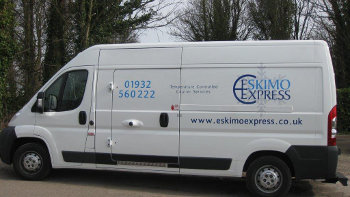
Eskimo Express dual compartment van by Paneltex Somers

One of Eskimo Express’ new Paneltex Somers dual compartment conversions — the temperature difference between the two compartments can be up to 50C!

For most van users, a standard panel van, perhaps with some racking or tie-down points, is all that’s necessary, making it relatively easy to source replacements from hire companies and van dealers.

However, some van operators have much more demanding requirements. One example is specialist courier Eskimo Express, which runs a fleet of 20 temperature controlled vehicles and does a lot of work for the pharmaceutical industry, transporting materials all over Europe.

The firm’s latest vans are Citroën  Relay models with high-specification dual compartment bodies that enable the Citroëns to operate at -25°C in one compartment and +25°C in the other. This means it’s now possible for Eskimo Express to use one vehicle for jobs that previously required two.

Of course, building a conversion like this isn’t simple: consider the level of insulation needed to effectively separate two compartments that might have a temperature differential of 50°C.

Chertsey-based Eskimo Express sourced the new vans from Norwich-based refrigerated body manufacturer Paneltex Somers. Each van uses Paneltex’s Flexi-Temp bulkhead system to provide effective separation between the two compartments, and Tony Colato from Eskimo Express says that the firm hasn’t found any other converters which can offer such high quality refrigerated conversions:

“Much of our courier work is specifically for the pharmaceutical industry and we have found that, apart from Paneltex Somers, no other vehicle body manufacturer can manufacture such a high level of refrigerated conversion that is ideally suited to this industry. Our vehicles work extremely hard, on deliveries and collections all over Europe, so the reliability and consistent performance achieved by our refrigerated vehicles is vital to the success of the business.”

The new Citroën  Relay vans are both L3H2 (long wheelbase medium-high roof) models and the Paneltex Somers conversions have been completed to ATP Certification Class C, which is recognised as the gold standard for refrigerated conversions in Europe. The Flexi-Temp bulkhead has can be secured in two positions, allowing the relative sizes of each compartment to be changed, to suit the loads being carried.

Each van has Europe-wide satellite tracking and twin temperature recorders, ensuring that the load’s integrity is never questioned and that clients have full visibility of ‘their’ van’s location at all times.

Definitely not your average van.