Author Archives: Van Rental

Plantforce Mercedes-Benz Sprinters Demolish Opposition

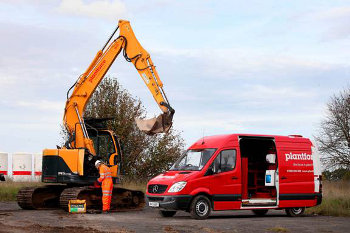
One of Plantforce's new Sprinters

Plantforce has equipped its Sprinters with welding equipment and a sink, in addition to a wide range of spare parts

The construction trade is known for giving its equipment a hard time — on and off the road. That applies to service vans too, which have to cover big miles and work on building sites where conditions are more suited to a JCB than a 3.5t road vehicle.

Given this, it’s no surprise that West Country plant hire specialist Plantforce has been impressed with its first three Sprinters, which recently joined the company’s fleet and are expected to cover up to 60,000 miles per year on a five-year maintenance contract.

Plantforce was founded 14 years ago by Managing Director Claire Trott and its growing fleet now extends to some 380 pieces of equipment, which its hires out to customers on a self-drive or operated basis.

“We rely on our mobile engineers to keep our machines up and running when they’re out working in the most challenging of conditions,” she says. “It’s a tough job and their vans will be worked hard, covering up to 60,000 miles a year, so they must be able to last the pace.

“Our engineers are delighted with their Sprinters, which represent a big step forward for us in terms of specification and cab comfort.

“Given the mileages they’ll be covering the fact that these new vans offer better fuel economy than our previous vehicles was another big attraction, as were the many high-tech safety systems that come fitted as standard.

Plantforce’s Sprinters are 313 CDI medium-wheelbase models, which carry a wide range of tools and spare parts, in addition to welding equipment and a sink. Two fo the vans are based at Plantforce’s headquarters in Bristol, while the third is based at its Exeter depot.

UK Commercial Vehicle Manufacturing Down 27.5% In September

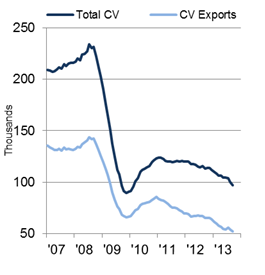
CV output rolling year total

CV output has now fallen nearly as far as it did in the depths of the 2009/10 recession.

The headline says it all, really — the decline in UK commercial vehicle manufacturing (which includes vans) accelerated in September, with total output down by 27.5%, according to the latest figures from the Society of Motor Manufacturers and Traders (SMMT).

The decline breaks down into two main categories; a 16% drop in home market demand, and a 37.7% fall in export market demand, which basically means Europe.

Mike Hawes, who is the SMMT’s chief executive, says — somewhat unconvincingly — that there is some cause for hope:

“CV production remained subdued in September, with continuing uncertainty in the EU and restructuring of UK operations,” said Mike Hawes, SMMT Chief Executive. “While the overall market is striving against tough conditions, there remains cause for optimism in some areas, with the truck sector out-performing the market in September.”

Here’s a summary of the key figures:

CV manufacturing Sep-12 Sep-13 %
Change
YTD-12 YTD-13 %
Change
Total 9,607 6,963 -27.5% 82,315 67,609 -17.9%
Home 4,501 3,783 -16.0% 34,419 31,322 -9.0%
Export 5,106 3,180 -37.7% 47,896 36,287 -24.2%
% export 53.1% 45.7% 58.2% 53.7%  

Data courtesy of SMMT (www.smmt.co.uk)

Car & engine manufacturing powering ahead

Remarkably, the decline seen in the CV sector is not affecting the engine or car manufacturing sector at all. Car output rose by 9.9% in September, while engine manufacturing was up by 8.3%. The decline in the UK’s CV manufacturing industry, where output is down by around 23% since 2011, is a singular thing.

As I’ve mentioned before, part of the problem is the closure of Ford’s Southampton Transit factory, but there must be more to it than that. Sadly, the SMMT doesn’t publish a more detailed breakdown of its figure, so it isn’t easy to say where exactly the decline is coming from — and how much of it is due to weak export demand, rather than cuts to manufacturing capacity.

However, unless this trend reverses, it seems likely that there will be further structural reductions in Britain’s CV manufacturing capacity — because it can’t stay under-utlilised indefinitely.

Iceland Switches To Mercedes For Home Delivery Fleet

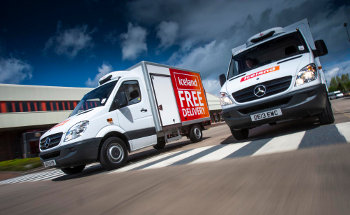
Iceland Mercedes Sprinter delivery van

Coming to a suburb near you — Iceland’s new Mercedes-Benz Sprinter home delivery vans.

Iceland Foods is switching its entire fleet of home delivery vehicles to Mercedes-Benz Sprinters driven by staff trained in a smart new Centre of Excellence sponsored by the manufacturer.

The move follows the high-profile retailer’s recent return to the online shopping arena it pioneered, back in 1999, before abandoning it until recently, when it re-launched its online service at nearly 300 stores.

All but a handful of Iceland’s 800 stores already offer the firm’s well-known home delivery service, which is used by up to 190,000 customers every week, and Iceland is replacing the 1,300 vans currently assigned to this operation with Sprinter 313 CDI chassis cabs fitted with temperature-controlled box bodies.

More than 300 of the new vans will be on the road by the end of this year, and to ensure that driver’s conduct and efficiency matches the quality of their vans, Iceland has invested £250,000 in a ‘Centre of Excellence’ at which drivers will be given vehicle familiarisation training outlining the Sprinter’s key features then providing practical guidance on applying anticipatory and defensive techniques at the wheel – not only do these save fuel, they also improve safety and cut maintenance costs.

Drivers will also be given ‘hearts and minds’ customer service training, and Iceland’s Head of Home Alex McKinlay says that the company is expecting drivers to live up to the standard set by the new vans:

“We’ve said to them: ‘We’re providing these fantastic vehicles but we want something from you in return, in the shape of the very best customer service and a reduction in our accident repair bill’. Their response has been every bit as positive as we’d hoped – the drivers love their new Mercedes and really appreciate the investments we’re making in them.”

Iceland undertook a comprehensive vehicle evaluation exercise before committing to Mercedes-Benz. Key to that decision was the Sprinter’s reputation for reliability and proven fuel-efficiency, as well as its market-leading armoury of safety features, and the round-the-clock repair and maintenance back-up of the Mercedes-Benz dealer network.

Powered by smooth and economical 129 hp engines, Iceland’s Sprinters are air conditioned and equipped with hands-free Bluetooth telephony, as well as telematics systems that monitor driving style, and forward- and driver-facing cameras (a trend I discussed recently).

Crucial, too, was the availability of a fully automatic transmission. Alex McKinlay confirms:

“Not only does the auto ’box make a difficult job that bit easier for our drivers, it will also improve safety and help to reduce wear and tear on the driveline. This, coupled with the 24-hour support of Mercedes-Benz dealers, will keep vehicle downtime to a minimum.”

Nearly 1,300 of Iceland’s 1,600 drivers are scheduled to attend this course during the first year, while longer-term staff development initiatives will also be introduced.

Their purpose-designed, dual-compartment bodies are being built by Gray & Adams and Paneltex, with refrigeration by GAH and Alex. The vehicles carry up to 72 crates in a one-third, two-thirds split – the front, frozen section operates at minus 22ºC, while the bigger compartment is used to carry chilled and ambient products at 4ºC.

Ford Opens 100 ‘Transit Centres’ Across UK

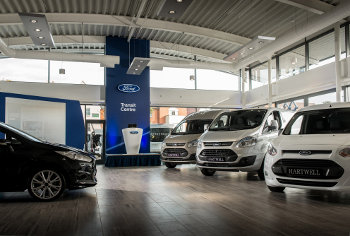
A new Ford Transit Centre specialist van dealer

Hartwell Ford in Abingdon is the first Transit Centre to launch in the UK.

Ford is launching 100 “Transit Centres” across the UK, offering new high-tech showrooms, elevated after sales and service standards and extended opening hours.

The new Transit Centres will provide a cutting-edge environment for Ford to showcase its next generation of commercial vehicles to customers, and will enable the launch of Ford’s Transit24 aftersales programme, announced in February this year, which is aimed at minimising vehicle downtime and reducing whole life costs for commercial vehicle operators.

The 100 Ford sites will be upgraded by the end of 2014 as part of the company’s on-going investment into Britain’s largest dealer network.

Each Transit Centre site employs a dedicated CV sales team as well as Ford-trained technicians and offers specialised workshop equipment, tools and training, and can manage all service, maintenance and warranty work (all Ford CVs come with a 100,000 mile/3 year warranty).

Transit24 will offer while-you-wait servicing to suit the customer, including regular late night appointments, and will respond within 20min to online service booking requests made through the 1Link online booking service. Collection and delivery of vehicles can also be arranged and every vehicle leaves the dealership washed and ready for work.

Jon Wellsman, Ford customer service division director, said:

“The launch of Ford’s new Transit Centre network will provide first class sales, service, maintenance and repair for all of our commercial vehicle operators across the UK. Ford has the largest and widest-spread dealer network in the country, offering a class-leading range of commercial vehicles and technologies and will continue to deliver the best care and assistance to customers.”

The launch of Ford’s Transit Centre network is aligned with the complete transformation of the blue oval’s commercial vehicle range, introducing four new models – Transit Courier, Transit Connect, Transit Custom and Transit – by 2014.

Renault Kangoo Van Z.E. Retains ‘Electric Vehicle of the Year’ Title

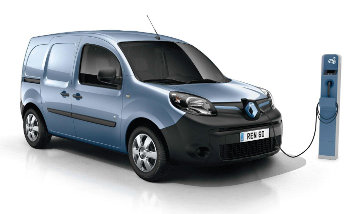
Renault Kangoo Van Z.E. electric van

The Renault Kangoo Van Z.E. electric van has already sold more than 11,000 units, making it the best-selling electric van in Europe.

The all-electric Renault Kangoo Van Z.E. (Zero Emissions) has retained its GreenFleet Awards ‘Electric Vehicle of the Year’ award at the Public Sector Information magazine GreenFleet Awards ceremony, which took place on 17th October at London’s Emirates Stadium, the home of Arsenal Football Club.

Judges, including the editorial and research team and independent representatives from the likes of ICFM (Institute of Car Fleet Management), said Kangoo Van Z.E. “was more than a worthy winner again” and had no hesitation in reinstating it as the Electric Vehicle of the Year.

GreenFleet’s Colin Boyton, one of the judges, said:

“As well as winning last year’s Electric Vehicle of the Year award from GreenFleet, it scooped ‘Ecovan of the Year’ and ‘International Van of the Year’ accolades.  It is more than a worthy winner again.”

Kangoo Van Z.E. is Europe’s best-selling small electric van with sales of over 11,000. Since its launch at the end of 2011, it has been acclaimed repeatedly by the media and secured International Van of The Year award in 2012.

The zero-emission LCV was restyled in June and now features Renault’s new styling identity. In the cabin, the dashboard has been refreshed and enhanced, and owners can now programme the battery to charge remotely to benefit from off-peak electricity rates using their computer or smartphone thanks to the ‘My Z.E. inter@ctive’ pack.

We’ve yet to see electric vans make their way into mainstream van hire fleets, but they are making inroads into large urban van fleets, where their limited mileage and need for overnight recharging is not an issue, and their zero emissions at the point of use are a major benefit.

E.ON Orders 120 New Ford Transit Customs For Meter Fitters

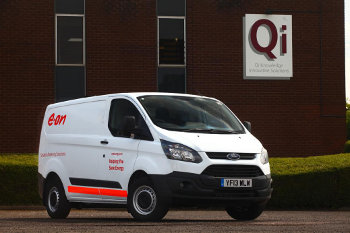
One of E.ON's new Ford Transit Custom vansEnergy company E.ON has taken delivery of nearly 120 new Ford Transit Custom vans for use by its meter fitters nationwide. The E.ON fleet currently comprises around 2,000 vehicles, the majority of which are Ford-badged.

The 118 Transit Custom vehicles – all of them 310 short wheelbase models equipped with the Dagenham-built 100PS 2.2 TDCi power unit – will slot into the fleet once they have undergone conversion by Qi Van Systems, including the fitment of special racking in the load area, Trakm8 telematics and an AVI alarm system.

The vehicles are the first to join the E.ON fleet which have been through the new Whole Vehicle Type Approval ‘enhancement’ scheme, which covers conversions and the addition of after-market equipment.

The Ford Transit Custom offers outstanding fuel economy from 46.3mpg, thanks largely to fuel-saving ECOnetic technologies such as Auto-Start-Stop and Smart Regenerative Charging. It also boasts class-leading load-carrying ability, including innovative features such as the load-through hatch in the bulkhead for extra-long items, and an integrated roof rack which can be folded away when not in use. It retains strong residual values and has a five-star Euro NCAP safety rating.

Stephen Gafson, Ford Direct sales manager, said:

“Ford has enjoyed a long and mutually successful business relationship with E.ON and I’m delighted to see them place a large order for the multi-award-winning Transit Custom. The new van is already well on the way to establishing its own market niche, and will be key to the continued success of the Transit range.”

In September 2012, the Ford Transit Custom became the fourth winner in 12 years from the Transit family to claim the International Van of the Year crown at the Hanover IAA Commercial Vehicle Show.

Ford has sold more than 7,500 Transit Custom vans so far this year – exceeding targets to achieve the expected first year UK volume of 10,000.

Strike A Light! Real Life Matchbox Van Goes Under The Hammer

A ‘real life matchbox van, built in 1937 as an advertising vehicle for England’s Glory matches, will go under the hammer on October 29th at Barons’ sale next Sandown Park auction sale.

The van, was based on a 1932 Austin Seven and is a fully-functioning, road-legal vehicle, although as this gloriously non-politically correct picture shows, it is quite a small vehicle:

1937 Matchbox Van for sale

This 1937 promotional Matchbox van was based on an Austin Seven and will be sold on October 29th, 2013, at an auction at Sandown Park.

It was comprehensively restored in the 1970s/’80s, and is now due for a refresh, so is offered as a fascinating rolling restoration, with an estimated hammer price of £12,000-£15,000.

Update 4 November 2013: The Matchbox van sold at Sandown Park on October 29th for £10,700 to a UK-based collector. Here’s a more recent picture of the van in question:

Real-life Matchbox Van

The real-life Matchbox van sold for £10,700 at auction in October 2013.

Other vehicles that may be of interest include a Group N 1996 Escort Cosworth rally car in road legal trim (estimate £9,000 – £11,000) and a 2007 Jaguar Sovereign 4.2 that was formerly used by the Royal Household and has every option under the sun, including some aimed at chauffeur-driven occupants, such as rear televisions, fold-away business tables and heated rear seats. There’s also a bizarre extra that allows rear seat passengers to electrically adjust the front passenger seat — so if  your ‘man’ is using too much space in the front and you want to stretch our for a snooze in the back, you don’t have to condescend to speak to him — just hit the remote and slide his seat forward!

Finally, there’s also a personal favourite of mine — a 1972 Saab 99, which is thought to be one of just 18 still registered in the UK. The Saab 99 was the forerunner of the classic 900, a car I could once have owned and didn’t — a decision I’ve regretted ever since… This particular model has emerged from eight years in storage and is in excellent, unrestored, original condition. It offers a rare chance to obtain a superb, original collectors’ car, at an estimate of £3,500-£4,500.

For more details on all of the vehicles in the sale, visit www.barons-auctions.com.

Police Return Hire Van Full Of Cannabis To Glasgow Rental Firm

Marijuana plants

John McKinnon’s hire van was full of marijuana plants that had been confiscated in a police raid — but police had forgotten to remove the plants before returning the van.

Scottish police recently hired a van for a drugs raid in the Glasgow area. Following the raid, the van was returned to the hire company — with a substantial amount of cannabis still in the back.

To make matters worse, the hire company concerned didn’t check inside the van before hiring out again, to unsuspecting father-of-two John McKinnon, who then drove it from Coatbridge back to Glasgow, before he opened up the back and realised that he had a problem.

According to the Daily Recordthe van had been hired by Lanarkshire police for used by plain-clothes officers.

The hire van’s unfortunate driver told the paper:

“there was a strong smell of cannabis in the cabin, but it was only when I got back to the office and opened up the back that I realised what was in it.”

I guess the moral of the story is that some van hire companies don’t check their vehicles very carefully when they are off-hired — plus you never know who has hired a vehicle before you, nor what they might have used it for.

A spokeswoman for Police Scotland said that “enquiries are at an early stage to establish the circumstances and it would be inappropriate to comment further”.

Used Van Values Reach All-Time Record In September

Used vans at BCA AuctionUsed van values continued to soar in September, according to vehicle auctioneers BCA, as the supply crunch in the used sector continued to force professional buyers to up their bids to secure sufficient vans to meet demand.

The average September figure of £5,158 for all LCVs represented a 2.8% increase over the August value, with average age rising slightly to 59.3 months and average mileage static at just over 80,000.

Year-on-year values remain well ahead, up by £934 equivalent to a 22.1% uplift over the twelve month period.  Average CAP performance climbed again to 105.19%, rising by nearly three points compared to August and up by 4.5 points compared to a year ago.

Read that again: values are up 22% over the last year and buyers are paying an average of 105% of CAP book price. What’s more, buyers are buying older, higher mileage vans at these new high prices, too, as this table shows:

All vans Avg Age (mnths) Avg Mileage Avg Value Sale vs CAP
Sept 2012 57.93 78,805 £4,224 100.72%
Sept 2013 59.33 80,217 £5,158 105.19%

Duncan Ward BCA’s General Manager – Commercial Vehicles commented:

“BCA saw exceptional levels of demand for light commercial vehicles during September, with a number of 100% conversions for corporate sellers and notably higher average values for fleet/lease vehicles.   The market remains very short of good quality stock and with anecdotal evidence suggesting retail activity picked up in September there was very competitive bidding right across the remarketing sector last month.”

This graph shows how used van values have risen steadily over the last two years, leaving you to wonder when van values really will peak (after their false peak in April this year):

BCA two-year used van values September 2013

Average used values from Aug 2011 – Sept 2013 (courtesy of BCA)

Recent increases in new van registrations will take 2-3 years to filter through to the used market, during which time supply is likely to remain tight. Duncan Ward doesn’t think this trend will end anytime soon, as it is underpinned by the shortage of new vans registered since the recession:

“With professional buyers increasingly looking at buying older, higher mileage vehicles we have seen values rise in the dealer P/X sector, while demand for the very few late year, low mileage LCV’s remains intense. As always, good condition is the key and vans with a nice specification and in an attractive retail colour are very desirable.”

“Looking ahead, there are no signs that stock availability is going to rise substantially this year or even into 2014.  There is an ongoing shortage of younger used LCVs in the marketplace because of the lower new van sales following the onset of the recession.”

Van MPG Marathon Proves Manufacturers’ Figures Can Be Beaten

Ford Transit Custom at MPG Marathon

The Ford Transit Custom at this year’s ALD Automotive / Shell FuelSave MPG Marathon.

This year’s ALD Automotive / Shell FuelSave MPG Marathon was won by a couple of drivers who had never met each other before and had never taken part in an eco-driving event, either.

Leicestershire Council employees Nick Chapman and Rosemary Horner took the overall win by returning an impressive 88.69mpg in their Ford Fiesta ECOnetic 1.6 TDCi over the two-day, 339.3-mile event.

Interestingly, the car was the same model used by last year’s winners, so maybe it’s the car that’s the biggest star?

Whatever the case, the winning Fiesta car was comprehensively outperformed in terms of outright fuel consumption by its Fiesta Sport Van sibling, which returned 108.82mpg in the hands of BBC transport correspondent Paul Clifton and his son, beating the Fiesta Van’s official combined figure of 78.5mpg by 38.6%.

Elsewhere in the van categories, VAN Fleet World editor Dan Gilkes managed to coax 52.08mpg from a chunky Isuzu Eiger double-cab pick-up, proving that such vehicles don’t have to be gas guzzlers, while Status Heating employees Leigh Skillet and Richard Bone managed to deliver a 29.1% increase in the manufacturer’s combined consumption figure for their Citroen Berlingo.

Although critics will say that the driving conditions for the MPG Marathon are unrealistic, especially for vans, which might normally be fully-loaded and forced to make many stop-start journeys, the MPG Marathon is structured to be as realistic as possible and drivers have strict time limits to prevent them driving abnormally slowly and had to face headwinds and heavy traffic conditions at times.

Event organiser Ross Durkin commented:

“The MPG Marathon highlights the fuel – and hence emissions – savings that can be achieved by any driver in any vehicle. And as this year’s winners will testify, you don’t have to be a seasoned, hyper-miling pro to do it.

“The motor manufacturers and technology suppliers have done a tremendous job in improving the fuel efficiency of all news cars and vans, but motorists should see their published fuel consumption figures as a target to beat, not the maximum achievable.”

This year, the MPG Marathon took place on the 9th and 10th October, based at Tankersley Manor hotel, near Sheffield. Competitors pushed for the best economy over two days, choosing their own route between a series of fixed points. Each vehicle was fitted with a TRACKER satellite tracking device to measure the exact distance travelled. The competitors covered an average 360 miles of British countryside, including A and B roads and motorway driving. Day 1 took drivers east to Lincoln and York, while day 2 circumnavigated Stockport and Derby.

Vehicles were split into classes depending on CO2 emissions, with a maximum CO2 limit for passenger cars of 180g/km. Awards were given for the most economical drivers, as well as the most efficient cars and vans.

The winners will be awarded at a presentation held on the 16th October at the Royal Automobile Club in Pall Mall, London.