Author Archives: Van Rental

Ford Joins FTA Van Excellence Scheme

Ford has become the latest van manufacturer to join the Van Excellence scheme, which is run by the Freight Transport Association and aims to encourage high standards of van operation.

The blue oval joins Mercedes, VW, Nissan, Fiat and Isuzu in becoming partners in the scheme, meaning that more than half the vans sold in the UK are now made by Van Excellence partners. As Mark Cartwright, the FTA’s Head of Vans and LCVs explains, the next target for Van Excellence is van dealers:

“We’re delighted to welcome Ford as a Van Excellence PartnerTogether with existing partners Volkswagen, Mercedes-Benz, Nissan, FIAT and Isuzu our manufacturer partners now represent over half of the UK’s annual registrations. Their support is invaluable particularly as we develop a Van Excellence accreditation scheme for dealers.”

The FTA scheme was launched in 2010 to promote high standards of van operation and driving by accrediting operators against an industry code of good practice.

Accredited operators are those who have successfully demonstrated that their fleet management and compliance systems can meet the demanding standards of the Code of Van Excellence, the voluntary code of practice for van fleet operators.

The importance of Van Excellence continues to be well recognised within the industry and continues to grow, as new members which have also recently joined include Carillion Construction, South Devon Healthcare Trust, Daniel Contractors and Corporation of London.

Van Excellence was awarded the Best New Service Award at the 2012 Fleet News Awards.

Earlier this year, Hertz joined Van Excellence and individual van rental operators are welcome to join the scheme. You can find out more at www.vanexcellence.co.uk.

Iveco Announces Bodybuilding Partners For New Daily

Iveco Daily Tipper with double cab and DriveAway conversion

An Iveco New Daily double cab tipper

Iveco has announced its two bodybuilding partners for DriveAway Options programme, which will enable customers to buy chassis cab-based vans with conversions direct from Iveco dealers.

The programme, which was announced in January, will initially be focused on 3.5 tonne variants of the New Daily model. Iveco’s bodybuilding partners will be Ingimex of Telford and Alloy Bodies of Manchester.

The first vehicles are already on forecourts and the programme is designed to enable operators to purchase vehicles and be on the road almost immediately, without the wait traditionally required while the chassis cab is supplied, post sale, to the body builder for conversion.

Iveco is focusing the DriveAway Options programme on tippers and dropsides for the 3.5 tonne market initially, with a variety of New Daily models available offering engine power outputs from 106 hp to 146 hp, and wheelbase lengths from 3,450 to 4,100 mm.  It hopes to grow the range of Iveco vehicles included in the programme over the coming months.

Martin Flach, Iveco’s Product Director, says:

“We are re-introducing the DriveAway Options line-up following increasing demand from customers for a ready-bodied vehicle range, particularly in the light of impending Whole Vehicle Type Approval legislation [click here for the story on this new EU legislation].

“In many cases it will allow an operator to walk into their local Iveco dealership and drive away in a bodied New Daily vehicle that same day.”

A key benefit to customers will be that they will only have to deal with one point of sale — the Iveco dealer — rather than co-ordinating between two or more suppliers.  As a result, there will be significantly shorter delivery times, coupled with lower costs and higher residual values.

All New Daily vehicles purchased through the DriveAway Options programme will receive a comprehensive three year unlimited mileage warranty covering both the chassis and body.

VanRental.co.uk Launches Facebook Van Hire App

Facebook logo linked to vanrental.co.uk Facebook pageAlthough we believe that our unique van hire price comparison engine is the best thing since sliced bread, we know that many of you spend at least as much time on Facebook as you do on the ‘outside’ internet!

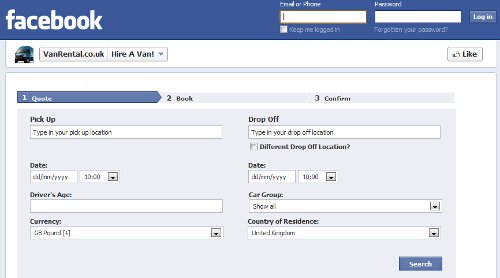
That’s why we’ve now launched the vanrental.co.uk Facebook app, which allows you to arrange van hire direct from our Facebook page! We’re pretty sure it’s the first van hire app on Facebook — although you can book cars and minibuses too!

The new app enables you too book car, van and minibus hire online and gets quotes from most of the UK’s major hire brands, providing you with cheap prices and a great choice of vehicles and locations. Here’s a screenshot showing how the new app looks:

Facebook van hire app from vanrental.co.uk - screenshot

To find out more or give it a try, visit our Facebook page at facebook.com/vanrentaluk.

Naturally, if you’ve got any comments or feedback, leave a comment below or get in touch with us through Facebook and we’ll be happy to hear from you!

Thrifty Adds New London Richmond Van Hire Branch

Thrifty Car & Van Rental logoThrifty has added a new van and minibus hire branch in London Richmond to its UK network.

The branch is located at 110-116 Upper Richmond Road West, London, SW14 8DT and you can find full details of it (including a map) on our branch page.

Prices from this new branch are now included in our van hire price comparison system too, so you can find the cheapest van and minibus hire prices in Richmond.

With the Olympics about to start, now seems like a pretty good time to open a car and van hire branch in the London area — and the new branch offers a full range of cars, vans and minibuses.

The new branch takes Thrifty’s UK total to 87 — you can find full details of all of them on our Thrifty locations page.

Are Petrol and Diesel Prices Rigged?

Fuel gauge nearing emptyHot on the heels of the Libor interest-rate fixing scandal comes the suggestion (in a report commissioned by the G20, no less) that oil prices may have been manipulated too.

To be more precise, a report produced by International Organisation of Securities Commissions (IOSCO) has concluded that the oil market is open to “manipulation or distortion”.

Here’s how the oil market should work:

  1. Oil traders at big banks accurately report how much they are paying for oil to an organisation called Platts or one of a few alternatives.
  2. Platts (& co) compares the prices and creates a benchmark price.
  3. The benchmark price is used as the basis for trillions of dollars worth of contracts to buy and sell the petrol and diesel we buy at the pump.

Here are the problems:

  1. Platts and its main competitor, Argus, don’t have the authority to challenge the numbers they are given by oil traders, so the traders could submit incorrect or misleading numbers, thereby manipulating the pump price of petrol and diesel.
  2. Although Platts and Argus have no financial interest in the oil market, their services are funded by subscriptions, which are paid for by — you guessed it — the oil traders’ banks. This does lead to a possible conflict of interest or imbalanced view of the market.
  3. If the oil price is falsely inflated, we pay more than we should do for fuel.

If it sounds similar to the Libor-rigging scandal, where traders understated the interest rates their banks were paying to borrow money, that’s because it is — like so much in London’s financial world, it’s based on trust.

On the other hand, there are some points to suggest that rigging oil markets would be harder than rigging Libor:

  1. Platts and Argus are in competition with each other to provide the most authoritative benchmark prices. Neither would be keen to lose credibility by producing questionable benchmark prices.
  2. Platts says that its journalists (who compile the benchmark prices) are trained to watch out for anything fishy and are expected to check any figures that appear dodgy.
  3. In total, four organisations set oil prices for the market — Platts, Argus, OPIS and ICIS-LOR. I’d have thought that any consistent discrepancies between their benchmark prices would be investigated by big oil companies. With Libor, on the other hand, only one organisation compiled the interest rates, so there was nothing to compare them to, meaning it was impossible to know if they were accurate (they weren’t)…

So what’s a hard-working van driver to do?

Well, motoring campaigner Quentin Wilson is in a towering rage over at the Fair Fuel UK campaign and is trying to persuade the government to order an official inquiry. If you agree with Quentin, then head over and vote in Quentin’s poll, which he is running to find out how much public support there is for an official inquiry into the oil markets.

M25 Will Use Hard Shoulder Running To Reduce Traffic

A 15-mile section of the M25 is to be widen by using the hard shoulder to provide an extra lane, with work due to start next year.

The affected section is on the southern side of the motorway, between junctions five and seven (Sevenoaks and Redhill/M23 intersection). It is one of the most notorious traffic blackspots on the orbital motorway, which is known for its traffic congestion at peak times.

Using the hard shoulder in this way will make the M25 a ‘managed motorway’, which means that additional lights and signage and speed controls will be installed to allow the hard shoulder to be opened as a running lane during busy times and closed at quiet times to preserve its original function.

Emergency refuge areas are provided every 1.5 miles and CCTV is used to monitor the road, so any breakdowns are quickly cleared. Variable speed limits are often also used to help manage traffic flow, based on the well-proven premise that when traffic is heavy, traffic flows much better if everyone sticks to a lower, more stable speed.

The concept was first trialled in the UK in 2006 on the M42 near Birmingham and is was credited with reducing accidents by more than fifty per cent over a three-year period.  Since then, schemes have also been introduced on the M6, M4  and M5 — all notorious congestion blackspots.

The decision was welcomed by James Hookham of the Freight Transport Association:

“FTA feels that the proposal of what is essentially ‘creating an extra lane on the M25 is good news for this particularly busy stretch of motorway.  Some may see it as the Highways Agency widening on the cheap, but we feel that this will give motorists and most importantly our members extra capacity and will help to keep the motorway moving.”

Drive Away A Great Wall Steed Pick-Up For Just £1

Great Wall Steed

The Great Wall Steed double cab pick-up

The Great Wall Steed is the newest double cab pick-up model to enter the UK market. When it went on sale in April, it was cheaper than most of its competitors — and it’s just got even more affordable, as you can now drive one away with a deposit of just £1!

Paul Hegarty, Great Wall’s UK Managing Director, explains:

“In the current economic climate, paying out thousands for a deposit on a new vehicle sometimes just isn’t possible, particularly for small businesses. Our £1 deposit finance offer allows businesses who don’t want to make a large initial investment to still drive away in a brand new Steed.”

Of course, the company’s real motive for running the £1 offer is to try and help this Chinese manufacturer break into the UK market. Although Great Wall isn’t familiar to most UK motorists, it is a major car manufacturer in China and the Steed is already a popular model in Australia, a market that is far more demanding for pick-ups than the UK.

Although I suspect that UK drivers will initially be sceptical about the quality and reliability of Chinese vehicles, you only need to look at Japanese and Korean brands like Toyota, Nissan and Kia to realise that Asian vehicles are, for the most part, much better quality than European ones. I suspect the Great Wall Steed will soon fall into this category, too.

To tempt buyers, the entry level Great Wall Steed is competitively priced at £13,998 CVOTR and comes specified for demanding use, with a 2,000kg braked towing capacity, 1,050kg payload as well as 16-inch alloy wheels, daytime running lights, remote central locking, a Thatcham-approved Category 1 alarm, electric front and rear windows, an Alpine CD/radio with USB/MP3 and Bluetooth connectivity, steering-wheel-mounted audio controls, air-conditioning, heated fronted seats and a full leather interior. And that’s just on the entry level Steed S model!

To find out more, visit www.greatwallmotor.co.uk.

Note: For the entry-level Steed S model (£13,998 CVOTR), the finance offer consists of a deposit of £1 followed by 59 monthly payments of £285.06, and a final payment of £424.06 (8.8 per cent representative APR).  The plan is available for business users only, through all 45 dealerships in the Great Wall dealer network, and continues until 30 September 2012.

Volkswagen Van Sales Up 3.7%, Big Vans Up 38.7%

Volkswagen light commercial vehicle range

L-R, Volkswagen Caddy, Amarok, Transporter & Crafter

Volkswagen Commercial Vehicles is continuing to deliver rising sales across global markets, even if sales in Western Europe are relatively flat, according to the latest figures released by the German company.

In the first half of this year, VW delivered 270,000 commercial vehicles of all sizes, up by 3.7% from 260,300 during the first half of 2011. One of the biggest growers is the Amarok pick-up — global deliveries of the big 4×4 went up by 24.8 per cent to 36,400 vehicles (January – June 2011: 29,100).

Worldwide deliveries of Volkswagen’s large van, the Crafter, rose by 38.7 per cent to 23,900 vehicles (January – June 2011: 17,200).  Deliveries of the medium-sized T5 Transporter increased by 1.3 per cent to 81,500 units (January – June 2011: 80,500), while worldwide deliveries of the Caddy small van were down by 2.5 per cent to 78,100 vehicles (January – June 2011:  80,100).

In Western Europe, deliveries from January to June 2012 went up by 1.9 per cent to 144,800 vehicles (January – June 2011: 142,100).  Deliveries in Eastern Europe to the end of June rose by 29.2 per cent to 21,000 vehicles (January – June 2011: 16,300) and vehicle deliveries in Europe as a whole increased by 4.7 per cent to 165,800 units (January – June 2011: 158,400).

Unsurprisingly, Germany was the highest-volume European market for Volkswagen Commercial Vehicles, showing an increase of 5.5 per cent to 63,000 customer deliveries (January – June 2011: 59,700).

Are Used Vans About To Get Cheaper?

For some months now, I’ve been reporting on falling new van registration figures each month — they fell by 2.5% in June, for example. What I haven’t mentioned is the effect that low volumes of new van sales are having on the used van market.

Naturally, if fewer new vans are sold, fewer old ones enter the secondary market. What this means in practice is a particular shortage of good quality used vans under three years old — at this age and mileage, postponing replacement for another year is an easy decision for a cash-strapped small business.

Pay more, get less

What has been happening is that used van prices for all sizes of vans have been inching up, but so have age and mileage. In other words, buyers have been being forced to pay top money for older, higher mileage vans in worse condition.

As a result, used van prices were slightly higher in June 2012 (£4,171) than in June 2011 (£4,140), despite  average mileage having increased from 69,129 to 76,661 and average age having risen from 51.59 months to 58.21 months — both figures suggesting vans are being kept for an extra six months before being replaced.

Clearly, this trend can’t continue — and perhaps it is nearing its conclusion, as used prices were lower in June than they have been since last August.

The latest auction results from BCA confirm that this trend might be reaching a common sense limit, as Duncan Ward, BCA General Manager, explains:

“In fact, June brought a much needed reality check to the used commercial sector.  There was almost an expectation from vendors that dealers will continue to pay ever higher prices for older, higher mileage vans because stock is short in supply.   However, buyer confidence in the wholesale market is quite fragile and there is an increasing reluctance to buy poorer condition or excessively travelled vans because of the investment required to get these vehicles ready for retail.”

The graph below shows how used van auction prices have changed since 2010:

BCA used van prices June 2012

BCA used van prices June 2012 (graph courtesy of BCA)

It looks as though sellers looking for top prices are going to have to present their vans in exceptional condition, as Duncan Ward confirms:

“We have been advising our sellers for some time to review their remarketing activity to ensure their vans are presented in the most saleable condition.  Vehicles must be appraised sensibly and methodically and valued in line with market sentiment.  Pre-sale preparation and presentation is important, and all the documentation and service histories should be present when vans are sold.”

Falling used van prices should at least bring some semblance of fairness to the market, with buyers seeking rare, low mileage and nearly new vans continuing to have to pay a premium, while older vans go cheaper.

Leeds-Bradford Traffic Is Worse Than London

Drivers in Leeds and Bradford spend even more time stuck in traffic than drivers in London, according to a new study by sat nav firm TomTom.

TomTom Congestion Index example graphic

TomTom Congestion Index - click to enlarge

Drivers in the Leeds-Bradford area are delayed by an average of 36 minutes in every hour during peak times — meaning that some spend a depressing 86 hours per year stuck in traffic jams. That’s equivalent to two weeks at work!

London is next on the list, with drivers in the capital spending an average of 74 hours per year in traffic jams.

Rush hour traffic in London was found to double  journey times,  with traffic delays adding 27% onto the length of journeys at other times.

Also near the top of the list is  Birmingham (73 hours per year), but Leeds-Bradford holds the overall crown for the UK and has the 7th worst traffic congestion in Europe – here’s the European top 10:

  1. Warsaw
  2. Marseille
  3. Rome
  4. Brussels
  5. Paris
  6. Dublin
  7. Bradford-Leeds
  8. London
  9. Stockholm
  10. Hamburg

TomTom gathers the data through its IQ Routes system, which collects anonymous data from millions of drivers’ sat navs all over Europe and uses it to calculate the fastest route for the time of day when working out a route for any journey.

For van drivers and others who are driving on business, it can be a make a worthwhile difference — especially if you choose a TomTom Live model, which receives live data about traffic congestion and delays and automatically recalculates your route, if necessary, to route you around the problem, rather than straight into it.

If you don’t have a sat nav of your own, many car and van hire firms now offers them as an optional extra — check when booking if you’re interested.

You can find the complete TomTom Congestion Index here.