Category Archives: Van News

News and articles about UK vans – especially information relevant to the van hire market. Coverage of new van model launches from all the major manufacturers – Ford, Mercedes, Volkswagen, Peugeot, Fiat and Citroen.

UK Van Manufacturing Slumps 20% In September

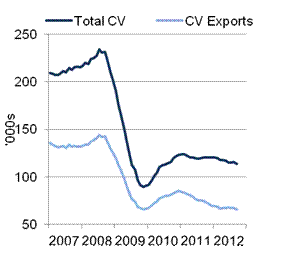
UK commercial vehicle output fell by 20.2% in September, as export demand fell by 26%, accelerating this year’s decline in output.

UK van manufacturing fell by 20.2% in September and is down by 7.5% so far this year, according to the latest figures from the Society of Motor Manufacturers and Traders (SMMT).

A 26% drop in export demand coupled with a 12.5% drop in domestic demand lay behind the drop. Falling export demand has been a continuous trend since the start of 2011, as this graph shows:

SMMT UK CV manufacturing Sept 2012

Commercial vehicle manufacturing 2007-2012

Car Output Falls

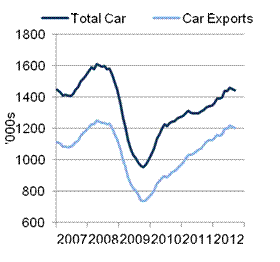
For most of the last three years, car manufacturing output has proved far more resilient than commercial vehicle output, rising steadily from its nadir in 2009 to be above 2007 levels earlier this year.

However, last month saw export demand for British-made cars fall by 8.9%. Since 80% of the UK’s car manufacturing is exported, this made a big dent in the monthly output figures that wasn’t cancelled out by a 9% rise in domestic demand for British-made cars.

SMMT UK car manufacturing output 2007-2012

The good news is that UK car manufacturing output is still up by 10.2% so far this year despite September’s fall. A total of 1,083,276 cars were  exported from the UK in the first nine months of 2012.

European crisis

September’s fall in demand and ongoing weakness in commercial vehicle demand is mostly due to the eurozone crisis, according to Paul Everitt, SMMT Chief Executive:

“Declining demand for cars and vans across the major European markets impacted UK vehicle and engine production in September.

Everitt stressed that long-term structural damage to the motor industry could result if the crisis is not brought under control soon:

European governments must focus on securing financial stability and economic growth or they risk long-term damage to key industries.”

Despite this, leopards don’t change their spots and so far, Europe’s politicians have done everything possible to drag out the crisis. Every step forwards is agreed reluctantly and at the last minute, and measures are often watered-down or compromised. Greece, Portugal, Spain and probably Italy all appear to be locked into a spiral of deepening recession with no ability to reignite growth.

We can only hope that the UK’s motor manufacturing industry can hold out through the crisis — as a major UK employer, any substantial downturn in this area would be bad news indeed.

Nissan Vans Keep Thieves At Bay

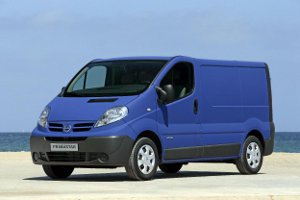
Nissan Primastar van

The Nissan Primastar won the heavy van security category, beating the Renault Trafic and Vauxhall Vivaro.

Nissan has won the Best Van Manufacturer award at the British Insurance Vehicle Security Awards.

Nissan won two awards for its van range at the recent British Insurance Vehicle Security Awards (BIVSA) 2012.

The highlight was the van manufacturer award which saw Nissan’s extensive six vehicle range (NV200, Primastar, NV400, Cabstar, Navara and Pathfinder Van) beat stiff competition from the rest of the light commercial industry.

The award recognises the work Nissan has done across its van range to protect vehicles from being stolen or being broken into which ultimately helps insurers reduce premiums for operators.

In addition the Nissan Primastar, which has an alarm fitted as standard, won the heavy van category for the second year running beating the Renault Trafic, Ford Transit and Vauxhall Vivaro.

This is all the more impressive considering that the Primastar is a rebadged version of the Trafic/Vivaro — obviously Nissan’s contribution to the Primastar adds real value in terms of security.

“Insurance is a major outlay for all van operators and Nissan has spent years improving all aspects of its van security across its extensive vehicle range,” said Andy Connell. Category Manager for LCVs at Nissan Motor (GB) Limited.

Thatcham Chief Executive Peter Shaw said:

“Congratulations to Nissan. For many commercial vehicle owners any potential threat to their vehicle is not only an inconvenience, but can also represent a genuine threat to their livelihood. Strong vehicle security is imperative and in winning the Best Van Manufacturer award, Nissan has demonstrated a real focus in this area across its commercial vehicle range.”

Nissans are not the most widely chosen vans in the van hire industry, but these awards show that the company’s contribution to its NV400 and Primastar vans does make a real difference.

Volkswagen Adds Bluemotion To Transporter Range

Volkswagen Transporter BlueMotion

The Volkswagen Transporter BlueMotion

Volkswagen has introduced BlueMotion versions of its Transporter range.

The Transporter BlueMotion models provide improved fuel efficiency and lower emissions than equivalent standard models. Two of Volkswagen’s main rivals in this category — the Vauxhall Vivaro and the Ford Transit — have long since been available in low-emission spec, so it’s good to see that VW has now joined the party.

The efficiency of the BlueMotion Technology models is achieved by using low rolling resistance tyres, Stop/Start and battery regeneration systems as well as cruise control.

The BlueMotion model also has a tyre pressure warning light to avoid tyres becoming under-inflated and increasing fuel consumption.

The table below shows the difference between standard and BlueMotion models of the Transporter 84PS, 102PS and 114PS models:

Transporter with low (standard) roof 84 PS 84 PS BlueMotion Technology 102 PS 114 PS BlueMotion Technology 114 PS BlueMotion
Urban (mpg)

Extra-urban

Combined

29.1

44.8

37.7

32.8

46.3

40.4

29.1

44.8

37.7

32.8

46.3

40.4

37.7

50.4

44.8

0-62 (mph) 19.7 19.7 15.3 14.8 14.8
Emissions (g/km) 198 184 198 184 166

Transporter BlueMotion and BlueMotion Technology models are available with prices starting from £18,770 (plus VAT) and £17,290 (plus VAT) respectively. For full details of the Volkswagen Commercial Vehicles’ range of vans and people carriers, or to find a local Volkswagen Van Centre, visit www.volkswagen-vans.co.uk

Toyota Reveals ProAce Panel Van – Hiace Replacement

Toyota has released details of a new medium panel van, the ProAce. This will provide a replacement for the discontinued Hiace model.

Toyota ProAce

The Toyota ProAce is based on the Peugeot Expert/Citroen Dispatch and goes on sale in the UK in Spring 2013

As I reported in July, the ProAce will be a rebadged PSA Peugeot Citroën. Toyota will use a rebadged Peugeot Expert / Citroën Dispatch as the basis for the ProAce, which will go on sale in the UK in Spring 2013.

According to Toyota, the ProAce will feature bespoke Toyota design details and branding. It will be available in two lengths and heights, giving load capacities of 5m3. 6m3 or 7m3, according to the configuration chosen. This should make it competitive in the medium van market, which will soon become tougher than ever, with the introduction of the new Transit Custom.

Payloads up to 1,200kg can be carried and ProAce will be able to tow up to two tonnes. ProAce can also be specified as a panel van, glass van or crew cab.

To achieve the best usability and capability, two sliding side doors can be specified, and customers can choose between a top-hinged tailgate and dual side-hinged rear doors that open to 270 degrees.

The ProAce will be available with a range of efficient, Euro 5-compliant diesel engines. The 89bhp 1.6-litre engine produces 180Nm of torque and is matched to a five-speed manual transmission. Two 2.0-litre diesel units are offered, with outputs of 126 and 161bhp and peak torque figures of 320 and 340Nm respectively. Both of these engines come with a six-speed manual transmission.

These sound like the standard engines fitted to the Peugeot and Citroën versions of the van, so I assume Toyota will be using the PSA engines to avoid having to find a Euro 5 engine of its own that fits — common sense, really.

Toyota ProAce cab interior

Inside the new Toyota ProAce

Used Van Prices Rise In September But Fall On Year

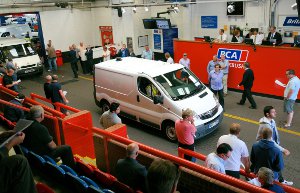
BCA Commercial vehicle auctionDespite the increase, used vans are cheaper than they were in September 2011.
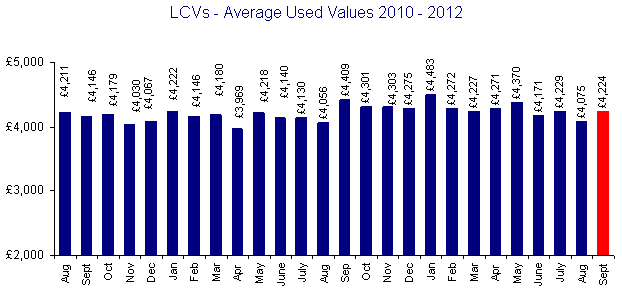
According to BCA’s latest Pulse Report, average used LCV values improved by £149 (3.6%) to £4,224 in September compared to August, although year-on-year figures lagged behind for the first time this year.  Average age fell slightly to just under 58 months while average mileage increased to nearly 79,000.

Values increased in all three sectors, with the dealer part-exchange average values reaching record levels.  Performance against CAP average improved over the month by nearly two points to 100.7% but remains much lower than in September 2011, when average prices were 105.93% of CAP price.

Year-on-year, September 2012 was £185 behind the same month in 2011, with both average age and average mileage increasing this year.

Year-on-year table: All vans

All vans Avg Age Avg Mileage Avg Value Sale vs CAP
Sept 2011 55.10 77,503 £4,409 105.93%
Sept 2012 57.93 78,805 £4,224 100.72%

(Courtesy of BCA)

Used van prices have weakened in recent months as the average mileage and age of second vans has continued to increase. However, despite last month’s increase, the table above shows that used van values are now falling in year-on-year terms.

BCA Used Van Prices 2010-2012 (courtesy of BCA)

BCA Used Van Prices 2010-2012 (courtesy of BCA)

Duncan Ward, BCA’s General Manager – Commercial Vehicles, said:

“The market bounced back in September following the quieter summer period.  Much of this improvement is seasonally driven as trade buying activity rises to meet the needs of small businesses that often look to change their vehicles in the autumn months.”

“However, we are yet to see any significant uplift in vans from corporate fleet sources and demand is still outstripping supply which is keeping values firm.”

“Many buyers are looking at older, higher mileage vehicles if they are in good condition and as a direct consequence we have seen values rise in the dealer P/X sector, while demand for the very few late year, low mileage LCV’s remains intense.  Some astute rental operators are selling stock to take advantage of the demand in the sub-two year old van market and are reaping the rewards as a result.  There is also interest in poorer condition vans if they are valued sensibly.”

“Even so, we expect to see some pressure on values as volumes rise in the wholesale sector and retail demand softens in the run-up to the year end.”

It all adds up to a market that is weak in terms of supply and demand — but with demand slightly exceeding supply and keeping prices firm.

Van Registrations Up 1% In September – Stability?

Van registrations edged up by 1.1% in September, according to the latest figures from the Society of Motor Manufacturers and Traders (SMMT). So does this represent a return of stability to the market?

SMMT chief executive Paul Everitt certainly thought so, commenting:

“The September plate change provided enough of a boost to stabilise van demand in a challenging economic environment. Continuing the trend seen so far this year, light rigids performed strongly in the month growing 23.4%, while light vans and pickups reversed recent declines, recording rises of 8.8% and 17.2% respectively.”

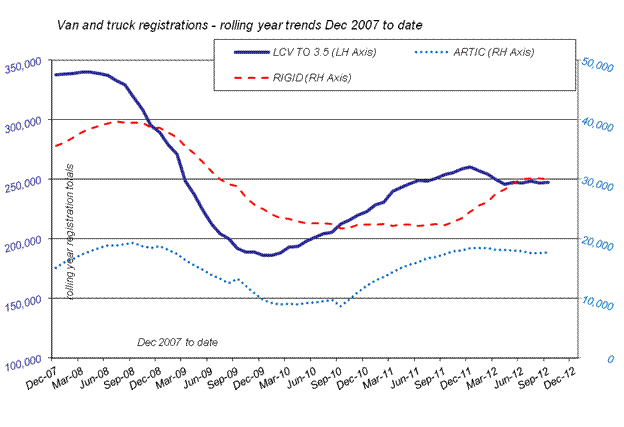
However, I’m not entirely sure I feel as optimistic as Mr. Everitt. A 1.1% increase on last September’s figures is hardly a reversal of the 6.3% decline in van registrations for the year to date (compared to the first 9 months of 2011). Nor does it complete reverse the rolling year decline of 2.6%, although it’s certainly a move in the right direction.

My feeling is that if the plate change only delivered a 1.1% boost, we are likely to be back into flat or negative territory by the end of this month — although I would be very happy to be proved wrong!

SMMT commercial vehicle registration figures

SMMT commercial vehicle registration figures (courtesy of SMMT)

Big Vans vs. Little Vans

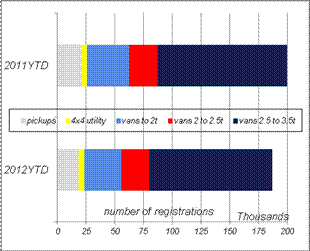
Interestingly, the mix of different types of light commercial vehicles continues to change. This year has seen fewer sub-2t and 2.5t-3.5t van sales, as this SMMT graph shows:

Light commercial vehicle registrations by type

Light commercial vehicle registrations by type (courtesy of SMMT)

Truckin’ Ahead

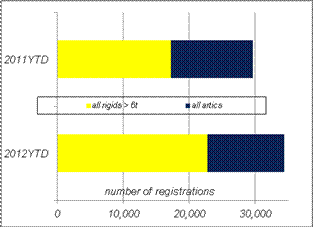
For those that are interested, truck sales have continued to perform more strongly than van sales, especially in the light rigid (3.5t – 6.0t) category, where new registrations were up by 23.4% on the same period last year and are up 48.6% for the year to date.

Registrations of larger rigids have also grown strongly and are up 28% (6.0t – 16t) and 26% (>16t) on the year to date, although >16t recorded an 18% fall in registrations in September compred to September last year.

Truck registrations by type 2012 YTD vs 2011 YTD

Truck registrations for 2011 and 2012 YTD, divided into rigid and artics -- rigids have gained strongly this year (courtesy of SMMT)

Artic sales are flagging and are down 6.2% on the year to date, although sales of 3-axle artics (by far the most popular), rose by 3% last month, perhaps because of the plate change effect.

New Ford Transit Beats Competitors On Residual Values

Ford Transit Custom side shot

The new Transit Custom goes on sale Autumn 2012

The new Ford Transit Custom is set to deliver a 10.5% improvement in residual values over the current model, enabling it to leapfrog its benchmark competitor and offer best-in-class value, according to CAP.

Leading residual value (RV) analysts CAP evaluated the Ford Transit Custom, which is available from dealerships this autumn, and calculated its theoretical resale value in three years’ time.

The award-winning Ford Transit Custom, which was recently crowned International Van Of The Year 2013, has secured a 10.5 per cent improvement in its three-year/60,000-mile residual value compared with its predecessor.

The new Ford Transit Custom has been valued at £725 more than its rival by CAP.  This £1,975 turnaround achieved by the incoming model equates to a 10.5 per cent boost in Transit RVs.

At four years in service and 80,000 miles, Transit Custom RVs are enhanced by £1,500 – moving the new model from being £1,000 behind its benchmark competitor to £500 ahead.

Mark Ovenden, Ford of Britain managing director, said:

“This is a more stylish and more functional Transit, which also manages to reward owners by retaining more of its value.  Thanks to this latest endorsement by CAP, we’re even more convinced that our new Transit Custom will continue the vehicle’s market leading position.”

A new Ford Transit Custom 290S 100PS six-speed 310Nm model will be worth £6,800 at three years and £5,250 at four years – £725 and £500 ahead of its nearest competition, respectively.

The Ford Transit Custom is Ford’s new entry into the one-tonne van segment and is the first of Ford’s all-new commercial vehicle models. The company also plans to launch new versions of the Transit Connect and Transit models by the end of 2013, heralding a complete replacement of its light commercial vehicle range.

77.5mpg – Is This Britain’s Most Fuel Efficient Van?

Citroen Nemo 2012 MPG Marathon Winner - most economical van

The Citroen Nemo won the most economical van category at this year's MPG Marathon for the fourth year running, returning most than 77mpg over the 370-mile test course.

The Citroën Nemo van has again demonstrated its exceptional fuel efficiency by returning 77.5mpg and taking the title of the UK’s most economical van in this year’s independent 2012 ALD Automotive Shell Fuel Save MPG Marathon.

It’s the fourth consecutive year that the Nemo has triumphed in the van category — the model used to beat all the other LCV competitors in this demanding 2-day event was a Nemo HDi 75 manual 660 LX.

Not just a test

The event was organised by Fleet World magazine (it’s the same event as this one) and the Citroën Nemo van was driven by LCV journalist John Kendall, with co-driver Dr. Paul Nieuwenhuis, over a 370 mile route through the Cotswolds, Bristol, South Wales and the South Midlands.

Competitors had to maintain a 30mph average speed to avoid penalties, while ensuring that they successfully achieved optimum fuel economy. The 30mph average speed requirement highlights that the MPG Marathon is not just an impractical test event — it requires decent speed to be maintained at all times in real-world driving conditions.

Scott Michael, Citroën’s Head of Commercial Vehicles & Business Centre Programme, commented; “The 2012 ALD Automotive Shell Fuel Save MPG Marathon, an excellent, independent test of a vehicle’s fuel economy has again enabled the Citroën Nemo  small van to demonstrate its exceptional fuel efficiency in demanding conditions.”

Petrol performance

Although they weren’t driving a van, I must also mention the award-winning performance of Derbyshire Community Health Services NHS Trust driving duo Mark Armstrong-Read and Geoff Murray.

They crewed their Citroën C1 VTR 1.0i 68 manual car to achieve an incredible 84.7mpg. Not only did this make it the most economical petrol engine car in this year’s event, but it also out performed its official combined cycle fuel consumption figure by no less than 28.92%.  This really is an impressive result for a petrol-powered vehicle.

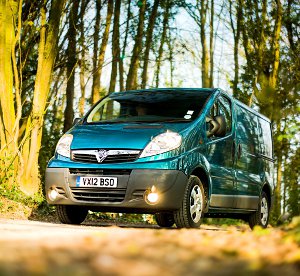
Vauxhall Vivaro Delivers 65mpg In Mileage Marathon

Vauxhall Vivaro ecoFLEX

Vauxhall Vivaro ecoFLEX

Vauxhall’s British-built Vivaro ecoFLEX has triumphed in the Fleet World MPG Marathon with a stunning 59.31 per cent improvement on the combined fuel economy figure.

Although an improvement of this magnitude won’t be possible for all van drivers, it does show what’s possible with a little effort and highlights the benefits of choosing the most eco-friendly model when buying a new van.

In expert hands

Driven by Vauxhall’s archivist and resident eco-driving expert Andrew Duerden, with co-driver Neil McIntee, Editor of VansA2Z.com, the 2.0CDTi-powered Vivaro ecoFLEX registered an impressive 65.16mpg against a combined figure of 40.90mpg.

This sensational result was not only the best percentage improvement for a commercial vehicle but also overall including cars as well as vans.  Soundly beaten rivals included the new-to-market Ford Transit Custom and the Volkswagen Transporter.

The Fleet World MPG Marathon is the UK longest-running economy driving event.  The two-day event took place in the Cotswolds with separate routes covering 350 miles of countryside including a mixture of A and B roads and motorway driving.

“Neil and I are, as they say, over the moon to win the overall best percentage improvement in the Vivaro ecoFLEX,” said Andrew Duerden.  “Fuel economy is a top priority for Vauxhall customers looking to reduce running costs and our MPG Marathon win proves what a frugal van the Luton-built Vivaro is.”

Green technology

Launched earlier this year, the revised Vivaro ecoFLEX features a range of green technology features, including exhaust gas recirculation cooling and optimised gear ratios.  There’s also improved thermal management, low rolling resistance tyres and an aerodynamic kit.

Vauxhall’s MPG Marathon win comes hot on the heels of the Luton-based manufacturer topping the van sales charts to private buyers and small businesses in the crucial plate change month of September, something it also managed in March.

All-Season Tyre Review: Hankook RA10 (Part 1)

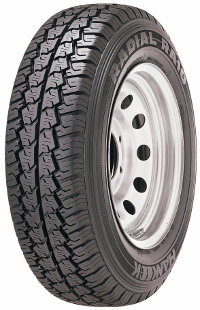
Hankook RA10 All-Season Tyre

Hankook RA10 All-Season Tyre

Disclosure: I paid for these tyres myself and have no relationship with the tyre manufacturer or the tyre supplier.

Recent winters have seen the UK’s transport infrastructure grind to a halt due to levels of snow that would barely rate a mention elsewhere in northern Europe.

One of the reasons for this is undoubtedly our inexperience at dealing with it, because it doesn’t happen that often. However, the other reason is definitely tyre-related: the vast majority of British car and van drivers spend each winter driving around on summer tyres.

Summer tyres are cheap and long-lasting, but they are pretty ineffective in winter, thanks to a tread design that can’t grip snow and a rubber compound that becomes stiff and slippery at low temperatures — anything below 7°C, in fact.

The problem is that winter tyres are overkill for the majority of UK motorists, and nothing short of a new law is likely to bring them into widespread use, even though they provide far superior grip in the kind of greasy, frosty and cold conditions we get for around one-third of each year.

An alternative solution?

Writing elsewhere, I have strongly advocated the use of all-season tyres, a compromise between summer and winter tyres that are standard fitments to new cars in the USA and are popular elsewhere in Europe for drivers who don’t want to swap tyres twice a year.

Recently, I decided that I should put my money where my mouth is and use them myself, to see how they really perform  in UK summer and winter conditions. As it happened, all four tyres on my Ford Transit campervan needed replacing at the start of the summer, so I had the perfect opportunity to switch tyre types and try out a set of all-season tyres.

What are all-season tyres?

All-season tyres use a rubber compound similar to that of a winter tyre that will remain flexible — and grippy — at low temperatures. Unlike winter tyres, however, they have a tread design that is similar to that of a summer tyre, but with the addition of ‘sipes’ — narrow slits in the tyre that fill up with snow and provide extra grip in snowy conditions.

The choice

The choice of all-season tyres in the UK is limited for cars and vans. However, there are a number of good quality choices available that can be bought through some of the big tyre chains and you can find a much bigger choice online at mytyres.co.uk, the UK branch of German tyre Delticom. This is why it has such a great choice of tyres at good prices — it is a huge business in Germany, a country that takes tyres far more seriously than we do.

I bought my tyres from mytyres.co.uk and would recommend it — delivery was fast and the local fitting service was convenient and well priced.

Your choice of all-season tyres will vary depending on the wheel size and load rating required by your van, but some of the main branded choices are:

  • Continental Vanco FourSeasons
  • Goodyear Cargo Vector
  • Vredstein Comtrac All Season
  • Hankook RA10

I chose the Hankook RA10 based on a mixture of good reviews and competitive pricing — the cost was only a few pounds more than the cost of a set of Goodyear Cargo G26 tyres, which I had previously on my van (and liked).

If money was no object, I would probably have had the Contis — but they were nearly £20 per tyre more at the time of my purchase.

Hankook RA10 review – summer

So there I was, at the beginning of summer, with a brand new set of Hankook RA10 all-season tyres fitted to my vans. The previous tyres were Goodyear Cargo’s — a popular tyre choice on 2.5t – 3.0t vans and a good quality tyre.

How do they compare? I’ve compared them to my previous Goodyears below after a summer of use.

Dry grip: Good enough, but not as good as the Goodyear under heavy braking or cornering.

Wet grip: Reassuring and very good, especially in standing water. Possibly a little better than the Goodyear, certainly equal. Good on wet grass and mud, too — they carry a M&S (mud and snow) rating.

Noise: Slightly noisier than the Goodyear Cargos — not a problem, but definitely noticeable in warm dry conditions.

Fuel consumption: No noticeable difference.

Wear: Too early to say. As always, keeping them correctly inflated and cornering sensibly will help prolong tyre life.

Conclusion

The all-season tyres are not quite as good as summer tyres in summer conditions. However, this is what I expected as a trade off for better grip in winter conditions (not just snow — frost, ice, rain and low surface temperatures, too).

Winter is only just approaching and for once, I am looking forward to it and hoping for some cold weather so that I can put the Hankooks to the test.

I will update this article and add a second winter review next year, to provide a complete picture of these tyres’ all-season performance!

Until then, if you have experience with all-season or winter tyres or would just like to make a comment, then I’d love to hear from you in the comments box below.

Note: I’d especially like to hear from anyone who has used winter tyres through the summer, as I have seen British Gas vans doing (in the rural north of England).