Category Archives: Van News

News and articles about UK vans – especially information relevant to the van hire market. Coverage of new van model launches from all the major manufacturers – Ford, Mercedes, Volkswagen, Peugeot, Fiat and Citroen.

New LEZ Rules Have Surprise Effect On Used Van Market

The 3rd January 2012 saw the introduction of new, tighter rules in the London Low Emission Zone (LEZ), which includes most of the area inside the M25.

Although the new LEZ rules only specify Euro 3 emissions compliance for vans under 3.5t, many van operators seem to have decided to go one better and buy a van that is Euro 4 compliant – perhaps with an eye to future LEZ rule changes.

What Has Changed?

The new LEZ rules require vans under 3.5t to meet Euro 3 emissions standards or pay a charge of £100 per day. This meant that most 9+ year old vans instantly became impractical to run – leaving a large number of tradesmen and small businesses in need of a newer van.

Buyers Choosing Scruffy Euro 4 Vans

Van operators such as these tend to do low mileages and have tight budgets – making a new van an unlikely option. What was expected to happen was that they would buy good condition 4-6 year old vans to replace their non-compliant older vans – typically 9-15 years old.

Vans produced since the 1st October 2006 are Euro 4 compliant, and Sussex-based vehicle auctioneer Shoreham Vehicle Auctions says that buyers are choosing damaged, high mileage Euro 4 vans in preference to clean Euro 3 models.

This sounds like a case of once bitten, twice shy – having had their old vans effectively outlawed from the start of this year, they can see the writing on the wall for the next LEZ rule change, which will inevitably require operators to comply with Euro 4 emissions standards, as is already the case for commercial vehicles over 3.5 tonnes.

Alex Wright, Shoreham Vehicle Auction’s managing director, says that many used van dealers have been caught by surprise:

“A 56-plate Transit Connect or Vauxhall Combo that would have been worth £1,000 five months ago is now selling for £1,500.

These buyers coming out of a 9-15 year old van are small businesses who aren’t high mileage users and who can’t or don’t want to get finance. The result is them turning their attention to the cheapest vehicle possible to avoid being penalised which is a complete U-turn in their buying patterns predicted by the industry”

New Rules A Success?

Although the transition for van operators in the LEZ could be expensive and inconvenient, this trend can be said to have vindicated the LEZ rule changes.

Van operators are very unlikely to ever revert to an older van than they are currently using – meaning that Euro 4 and above may become the new de facto standard for van operators in London. This should considerably reduce emissions from their current levels.

Van hire companies have also expected an increase in trade as a result of the new LEZ rules, as van users who only occasionally travel into the LEZ will find it cheaper to hire a van when needed than buy a newer model. It is too early to say whether this trend will materialise, but there is no doubt that the new rules are having an effect on London’s commercial vehicle traffic.
Nissan Electric Van Trial In London

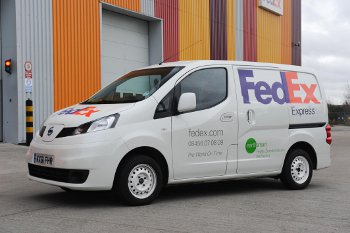
Nissan NV200 EV prototype in FedEx livery as used in London

The NV200 EV will be used by FedEx Express on a two-month trial in London

Nissan is beginning a two-month trial of a prototype electric version of its NV200 van in London. The van will be used for urban deliveries and collections by  FedEx Express, the courier company.

The NV200 EV uses the same powertrain as the Nissan Leaf electric car, which has already sold more than 20,000 units around the globe and was the world’s all-electric mass-market car.

As an all-electric vehicle, it will be exempt from the London Congestion Charge and the more stringent 2012 Low Emission Zone requirements; it is zero emission at the tailpipe.

FedEx Express currently operates 43 all-electric vehicles in London, Paris, New York, Los Angeles, Chicago and Memphis- all of which are ideal dense urban centres.

With zero emissions, no tailpipe, and energy-recycling regenerative braking, the Nissan NV200 EV prototype is particularly well-suited for congested city streets where poor air quality is causing increased concern and the start and stop of city traffic reduces the wasteful loss of energy and thus increases the efficiency of the vehicle’s driveline. Battery charging options include a complete recharge overnight or up to 80 per cent capacity in just 30 minutes using a Quick Charger.

Nissan is aiming to become a world leader in electric vehicles and has already trialled the NV200 EV on postal deliveries for the Japan Post Service.

One Bridge, 60 Ford Transit Vans…

To celebrate the centenary of Ford in Britain, the company is releasing a series of photos from its archives – one each week.

This week it is the turn of the Ford Transit. Back in 2005, Ford was celebrating a twin landmark for this van as it celebrated its 40th birthday and the five millionth Transit van rolled off the production line in Southampton.

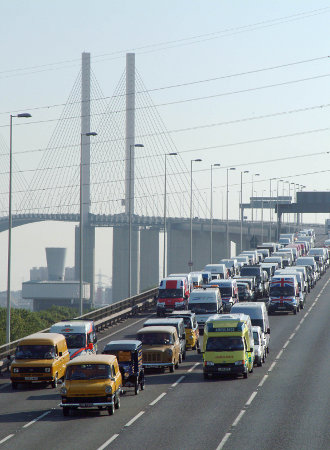
To mark the occasion, the Transit Van Club teamed up with Ford to organise a convoy of 60 vans across the QE2 bridge:

Ford Transit 40th birthday convoy 2005

In 2005, 60 Transit vans drove in convoy over the QE2 bridge to mark the Transit's 40th birthday.

Today, the Ford Transit has been in continuous production in Britain for 46 years. It is undoubtedly one of the most successful vans ever conceived and thoroughly deserves its reputation. I’ve owned two and would not hesitate to buy a third.

Sprinter Conversion Provides Fire-Fighting Control Centre

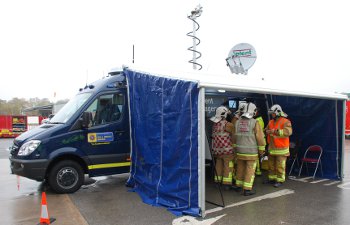
Merseyside Fire & Rescue Service Incident Management UnitMerseyside Fire and Rescue Service has taken delivery of a high-tech Mercedes-Benz Sprinter conversion that has turned into a mobile control centre, capable of simultaneously capturing, co-ordinating and integrating three separate layers of multi-agency communications in real time.
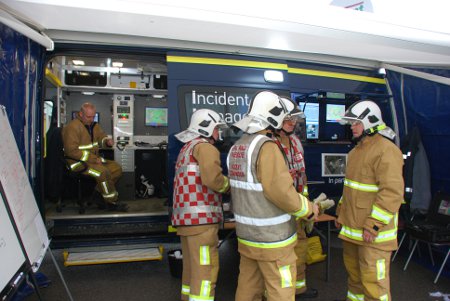
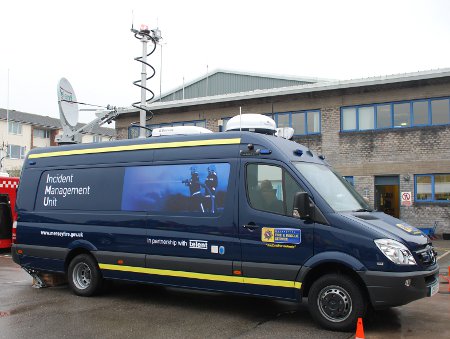
In addition, it can effectively apply its own wireless mesh network around an entire fireground – as well as hosting real time links with Gold and Silver command centres, external media channels, a free-sat television system and even a Heli-Tele option.

This unit is automatically deployed to any incident requiring more than three appliances and carries its own crew of two.

It is based on a 5-tonne Mercedes Sprinter and has been converted to provide the technological and communications support required for almost every eventuality. It has its own satellite dish, onboard generator, IT workstations, communications equipment and a large awning, which can be combined with a 40″ external screen to provide a large, weatherproof briefing area alongside the van.

Additional onboard equipment includes laptop computers, remote cameras and portable power packs and the van itself has a full array of blue lights, sirens and an onboard PA system.

The Incident Management Unit, as the van is known, was converted by emergency services specialist MacNeillie, in partnership with Merseyside’s ICT provider, Telent.

Merseyside IMU interior

The IMU contains two IT workstations and a host of other equipment

Merseyside IMU exterior

The IMU is based on a 5-tonne, XLWB Mercedes Sprinter van

What Van? 2012 Award Winners

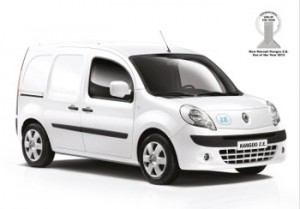
Renault Kangoo Van Z.E. What Van? Van Of The Year

What Van? Van of the Year: Renault Kangoo Van ZE

Anyone considering purchasing a new van in the near future might be interested in the winners of the 2012 What Van? Awards.

Journalists are always keen on new technology and new models, so it was not a big surprise to see that the Renault Kangoo Van Z.E. took that overall Van of the Year title and the new Volkswagen Amarok was chosen as Pick-Up of the Year.

The winners in the other categories are not completely new models, but many of them have had facelifts or updates this year, giving them class-leading fuel consumption, safety and driver comfort.

The latest Ford Transit model was highly praised at its European launch for its improved sound-proofing and engines, as was the latest version of the Volkswagen Crafter. Iveco’s new Daily also picked up an award.

Volkswagen Transporter Sportline

The Volkswagen Transporter Sportline won the Editor's Choice Award

Here’s the full list of winners:

  • Van of the Year: Renault Kangoo ZE
  • Small Van of the Year: Vauxhall Corsavan
  • Light Van of the Year: Fiat Doblo Cargo
  • Medium Van of the Year: Ford Transit
  • Large Van of the Year: Iveco Daily
  • Pick-up of the Year: Volkswagen Amarok
  • Van Conversion Award: Citroen
  • 4×4 Van of the Year: VW Caddy 4Motion
  • Safety Award: Mercedes
  • Green Award: Vauxhall Ecoflex
  • Innovation Award: Citroen Business Class
  • Editor’s Choice Award: VW Transporter Sportline

The Editor’s Choice Award went to the Volkswagen Transporter Sportline – the kind of van that self-employed tradesmen might indulge in when business is good. It’s a model that serves no useful purpose over the standard model but looks great, drives great and is a bit of a status symbol. It’s the kind of van we’d all like but that few of us can justify buying.

Van Hire Boost Expected Thanks To 2012 LEZ Changes

The van hire industry expects the changes to the London Low Emission Zone rules to drive an increase in demand for daily van rental in early 2012, as companies based outside London rent vans for use in the capital instead of replacing any non-compliant vans in their current fleet.

Despite a rise of 17.7% in light commercial vehicle registrations in 2011, there are still a substantial number of vans on the road that fail to meet Euro 3 emissions standards and will thus have to face a £100 per day fee for driving inside the London Low Emission Zone (LEZ)  from 3rd January 2012.

November saw a 18.6% month-on-month increase in new van registrations and Paul Everitt, SMMT Chief Executive, says that he expects the trend to continue:

“Both the van and truck market saw growth, reflecting sustained investment in new vehicles by businesses. London’s new Low Emission Zone comes into effect on 3 January, requiring drivers of older vans and trucks to upgrade their vehicles or pay a daily fee, so we expect to see a boost to registration levels next month and through the early part of 2012.”

If you need to drive into London occasionally but do not want to foot the bill for buying a new van, van hire offers the ideal solution. Most van hire companies run new vans that are no more than 2 or three years old and are often newer. All such vehicles will meet the required Euro 3 emissions standard for driving inside the LEZ.

Click here to compare van hire quotes or click here to learn more about the London LEZ.

Gran With A Van Delivers Flood Aid Nationwide

Most people are prepared to hang up their van keys by the time they reach their mid-70s – but not Suffolk-based grandmother Sue Duncan, who continues to use her 15-year old Citroen Dispatch van to deliver aid to victims of flooding across the UK.

Mrs. Duncan lives in Leiston (about 20 miles north of Ipswich) and runs a small charity called Flood Aid UK, which aims to help the victims of flooding. Having been flooded out of her own home once in 1970, she understands how traumatic it can be, especially for mothers with young children.

Last summer she delivered aid to a young family whose home had been destroyed in the London riots, bringing them beds, a sofa, wardrobe, washing machine and much more: Mrs. Duncan says that she hires a lorry when necessary to deliver aid from the warehouse she uses to store the items she collects from house clearances and receives from donations.

Sue Duncan is holding a fundraising event for Flood Aid UK at Leiston Community Centre this Saturday, 10th December 2011, from 10am-2pm.

You can find out more or contact Sue Duncan here.

Source: EADT24

Self-Driving VW eT! Concept Van Shows Future Direction

Volkswagen eT! concept van

The eT! takes styling cues from the current Transporter - no bad thing

Volkswagen has released images showing eT!, a van concept that provides some clues about how vans of the future might operate, from the second half of the current decade onwards.

The eT! features functionality such as semi-automatic driving – following a postman along a street, for instance – as well as joystick control from the passenger side to allow the driver to move short distances while remaining on the pavement side of the vehicle – speeding up urban multi-drop and postal deliveries. Electric power is also included, providing zero emission urban operation.

The eT! is the result of collaborative research between Volkswagen Group Research, Deutsche Post (a big VW customer) and the University of Art at Braunschweig. It is not likely to see production in the immediate future but according to Dr. Rudolf Krebs, it is part of Volkswagen’s attempt to “make plans today for what the world of lightweight commercial vehicles might look like starting in the second half of this decade, including with regard to electrical drives.”

High on the list is low or zero emissions for urban use, along with improved ergonomics for deliveries (think about how many times a courier driver gets out of his van on the offside – into traffic – and then walks around it to the near-side sliding door each day.

The eT! is an interesting concept, although in the UK at least, legislation regarding leaving vehicles running whilst unattended would probably have to be changed before VW’s mooted semi-automatic ‘follow me’ system could be used. That said, automatic vehicle operation is already possible and has been proven by a number of companies already. I firmly believe it will happen in my lifetime – at least on motorways and other major routes, where it could provide useful safety benefits and contribute to reduced congestion and emissions.

The eT! concept pictured in this article was shown at the Design Centre of Potsdam in Germany and was specifically designed as a mail delivery vehicle. It is easy to see how other configurations would be possible, especially for courier and other delivery use.

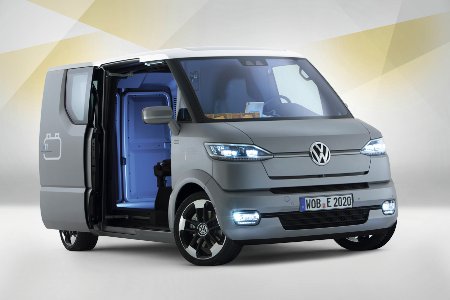
Volkswagen eT! Concept with sliding door open

The eT! has an electric sliding door that provides access to both passenger and cargo bay entrances

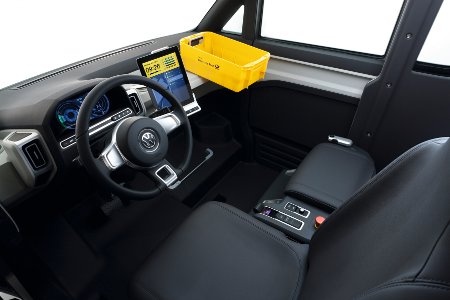
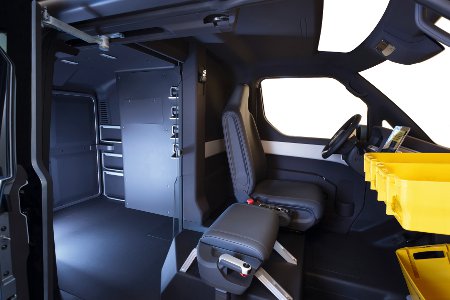
Inside the Volkswagen eT! concept van

No concept vehicle is complete without an iPad docking station!

Load area in VW eT! Concept Van

The 'standing seat' on the passenger side provides excellent access to the load area plus allows the driver to move the van short distances using a joystick control - no more walking all the way around the van to move it 50 yards.

Van News: Award-Winning Hybrids & Compulsory ESP for New Vans

Three Awards for Ashwoods Hybrid Drive System

At the Institution of Engineering and Technology (IET) Innovation Awards this year, Exeter-based Ashwoods distinguished itself amongst 420 entries to win three awards for its Hybrid Drive System, which can be fitted to Ford Transit vans. The awards were in the Power/Energy, Sustainability and Transport categories, perfectly reflecting the benefits offered by the system.

Hybrids are a hot topic in the car world but do not seem to have made the same impression in the van industry, despite the obvious benefits for vehicles employed on urban delivery routes.

In fact, while mainstream motor manufacturers have begun to embrace hybrid cars, it has been left to small independent companies like Ashwoods Automotive to develop retrofit hybrid solutions for popular van models.

Ashwoods has developed a highly-effective Hybrid Drive system for the Ford Transit that is currently being used by a number of public sector organisations. The Hybrid Drive system has been shown to reduce fuel consumption and CO2 emissions by 20% over the European Drive Cycle (NEDC) in formal testing.

Visit www.ashwoods.org for more information.

ESP Compulsory for New Vans from 2014

New EU laws will make ESP (Electronic Stability Programme) compulsory for all new vans sold in the EU from 31st October 2014.

ESP became compulsory for all new car and van models undergoing EU type approval at the beginning of this month and the new law will mean that even older models must be updated if they are to be sold after 31st October 2014.

ESP was invented by Bosch in 1995 and is playing a major role in the European Commission’s road safety strategy. According to Dr. Werner Struth, president of the Bosch Chassis Systems Control division, “ESP can prevent up to 80 percent of all skidding accidents. It is the most important vehicle safety system after the seat belt.”

Most drivers have little or no ability to control a car when it skids, meaning that such incidents often result in major collisions.

The goal of ESP is to prevent skids. It does this by using  intelligent sensors to check 25 times per second whether the driver’s steering input matches the vehicle’s actual direction of travel. If the system detects some discrepancy and identifies that the vehicle is likely to become unstable, ESP intervenes by reducing the engine torque in order to restore stability. If that is not sufficient, then it additionally brakes individual wheels. ESP also incorporates the functions of the anti-lock braking system (ABS) and traction control.

There is no doubt that ESP is a valuable safety feature and I for one would much rather have ESP in my van (or car) than air bags. At present, ESP is fitted to 63% of cars and commercial vehicles under 6 tonnes manufactured in Europe (41% worldwide) and Bosch expects that by 2013, 50% of new cars globally will have ESP.

Van Registrations Up 6.7% In October

New van registrations were 6.7% higher in October than in October 2010, bringing the year-to-date increase in the sub-3.5t sector to 17.3%, according to the latest figures from the Society of Motor Manufacturers and Traders (SMMT). A total of 19,370 commercial vehicles under 3.5t were registered in October.

Growth was particularly strong in the 2.0t-2.5t van sector (vans like the Ford Transit Connect and Volkswagen Caddy), where sales were 38% higher than in October 2010. The 2.5t-3.5t van sector (e.g. Ford Transit, Mercedes Sprinter) actually experienced a 3% fall compared to the same month in 2010, with sales dropping from 11,716 last year to 11,370 in October 2011.

Commenting on the figures, Paul Everitt, SMMT Chief Executive, said:

“The commercial vehicle market remains buoyant with October registrations up by more than 10% and year to date up by nearly 20%. Efficiency is a key driver as operators are investing in the latest models across almost every market sector to reap the rewards of greater load carrying ability and fuel economy.”

Truck sales did even better, rising by 33.3% in October alone, bring the year-to-date increase to 22.7%. In total, commercial vehicle registrations rose by 10.7% in October alone and have risen by 18.0% so far this year.