Category Archives: Van News

News and articles about UK vans – especially information relevant to the van hire market. Coverage of new van model launches from all the major manufacturers – Ford, Mercedes, Volkswagen, Peugeot, Fiat and Citroen.

Van News: FN50 Most Reliable Vans & ACFO Van Awards

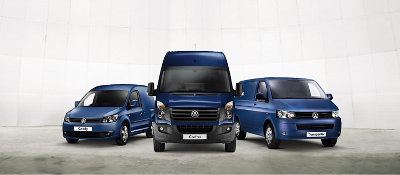
Volkswagen Vans - group shot of Caddy, Crafter and Transporter

Volkswagen was voted overall most reliable van manufacturer - its Caddy and Transporter vans were in the top five, while the Crafter placed sixth.

Mercedes & Volkswagen Win Van Reliability Awards

The Mercedes-Benz Sprinter was voted Britain’s most reliable van in the latest Fleet News FN50 reliability survey, taking top spot from last year’s winner, the Ford Transit.

The FN50 reliability survey polls the UK’s top 50 leasing companies by fleet size to find out their views on manufacturer and model reliability.

However, Volkswagen was voted the most reliable van manufacturer overall – two of its models (Caddy and Transporter) were in the top five, with the Crafter coming close behind in sixth place. Only one Mercedes-Benz model – the Sprinter – was in the top five; the other two places were occupied by the Ford Transit and Transit Connect.

Although some Transit models are built in the UK (in Southampton), no other British-built vans came close to winning an award – Vauxhall, which builds its popular Vivaro van in Luton, did not even feature in the top five most reliable van manufacturers.

Two British-built cars, the Nissan Qashqai ( built in Sunderland) and the Toyota Avensis (built in Burnaston, near Derby) did make it into the top ten most reliable cars, ranking sixth and fifth respectively.

Ford Transit Triumphs at ACFO Awards

Ford won both the Large Van and Small Van awards at this year’s Association of Car Fleet Operators Awards (ACFO). The Transit managed to displace last year’s winner in the Large Van of the Year category, the Mercedes Sprinter, and return to top position for the 15th time in this history of the awards.

The Transit Connect won the Small Van category for the ninth consecutive year – rounding out an impressive night for Ford, in which they won four out of the seven available awards. In addition to the Small and Large Van Awards, the Focus won the Fleet Car of the Year and was also awarded the Fleet Safety Initiative of the Year award for its Ford Focus Driver Assistance Pack option, which is a £750 option on the Focus and includes an impressive range of safety features:

Traffic sign recognition, which uses a forward-facing camera behind the rear view mirror to scan
the roadside for speed limit signs and flashes up helpful reminders on the dash so drivers always
know the speed limit; lane keeping aid; lane departure warning; auto high beam; blind spot alert;
driver alert if sensors detect erratic driving; and Active City Stop, which monitors the road ahead
and brakes the car automatically if a collision is imminent.

Awards also went to BMW (Environmental Initiative of the Year – BMW Efficient Dynamics) and Volkswagen (Green Car of the Year – VW Golf BlueMotion).
Driving A Pre-2002 Van in London? 2012 LEZ Rule Changes Affect You

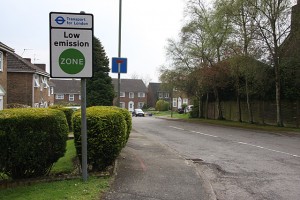
London LEZ sign - courtesy of Martin Addison

London LEZ sign – courtesy of Martin Addison

If you live or work inside the M25 and drive a van (or minibus or motorhome) that was registered before 1st January 2002, then the 2012 changes to the London Low Emission Zone affect you.

Vans Under 3.5t & Minibuses Under 5t

Starting from the 3rd January 2012, vans weighing more than 1,205kg unladen and with a gross vehicle weight of up to 3,500kg (3.5t) must meet Euro 3 emissions standards or pay a £100 per day charge to drive inside the LEZ.

Similarly, minibuses with more than 8 passenger seats and a gross vehicle weight of up to 5 tonnes must also meet the Euro3 standard.

These changes only apply to diesel vehicles – petrol models are unaffected. Euro 3 became mandatory from October 2001, so if your van was registered after then, it will probably be compliant. However, for reasons best known to themselves, Transport for London (TfL) has set the cutoff date for automatic compliance to be 1st January 2002.

To make things even more confusing, a number of companies were producing vans with Euro 3 engines from as early as July 2000 – such as Ford Transit models. These ‘early adopters’ have now registered with TfL, so if your van is one of the early Euro 3 models, it should be recognised as such.

However, there are no guarantees! To check whether TfL believes your van or minibus will be compliant with the 2012 rules, visit the online compliance checker:

Click here to visit the Tfl Compliance Checker (choose the VRM/number plate option)

If you believe your van is Euro 3 compliant but the TfL Compliance Checker does not agree, you will have to prove that it is compliant or pay £100 per day to use it within the LEZ from 3rd January 2012.

Vans Over 3.5t

Vans over 3.5t are classified as lorries and are subject to more stringent new rules.

Starting from 3rd January 2012, all vans with a gross vehicle weight of more than 3,500kg will need to be compliant with Euro 4 emissions standards.

The cutoff date for this is 1st October 2006, but as with lighter vans, some manufacturers were producing Euro 4 engines before they became mandatory in October 2006.

These early adopters of the Euro 4 standard have (mostly) registered their compliant vehicles with TfL, so if you enter your registration number into the TfL Compliance Checker, you should get a thumbs up.

Click here to visit the Tfl Compliance Checker (choose the VRM/number plate option)

If the compliance checker says you vehicle is not Euro 4 compliant but you think it is, then it is up to you to prove it to TfL.

From 3rd January 2012, if you drive within the LEZ in a non-compliant vehicle, you have to pay a fee of £200 per day (or be fined £500 per offence).

What To Do Next?

If you van is compliant with the 2012 LEZ rules, then you have no problem. If it isn’t – but you still need to use it inside the LEZ (which occupies most of the area inside the M25, but not the M25 itself), then you will need to decide what to do.

The LEZ rules are being enforced by Automatic Number Plate Recognition (ANPR) cameras – so there will be no avoiding the penalties if you try to ignore the rules.

Some vans can have diesel particulate filters fitted to their exhaust systems to make them compliant. However, these are expensive (£1500-£3000) and not suitable for all types of van. In addition, they have a record of being troublesome if they are used in town all the time without any longer, high-speed journeys.

If you only need to make occasional visits to the LEZ, the cheapest solution may be to rent a van whenever you need one. For more regular use, you may need to consider long-term rental, leasing or buying a new van – there are no exemptions from these rules except for London taxis.

Visit www.tfl.gov.uk/roadusers/lez/ for more information.

New Vauxhall Combo To Launch In 2012

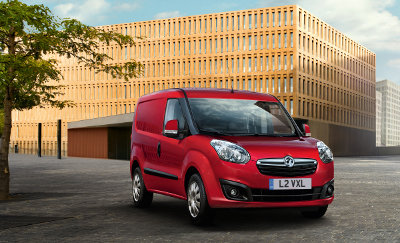
New 2012 Vauxhall Combo small van

Update 23/02/2012: Scroll down to the bottom for a video review of the new Vauxhall Combo.

An all-new version of the popular Vauxhall Combo small van is due in 2012.

As we have come to expect from new models, the new Combo will be bigger than its predecessor and will boast a class-leading payload of up to 1,000kg.

The new Combo will be available in two wheelbases, two heights and two gross vehicle weights (2,000kg and 2,300kg).

It will also have a load volume of up to 4.2 cubic metres and a rear axle capacity of up to 1,450kg – the highest in its sector.

The Combo has always been popular with van rental fleets and Vauxhall has sold nearly 200,000 of the current model. The new model looks set to continue the trend and its increased range of size and engine options should broaden its appeal. For the first time, the Combo will be available in Vauxhall’s Sportive trim, which should help its popularity with self-employed drivers.

Vauxhall’s new Combo will be based on a vehicle platform jointly developed by Fiat and GM – the same platform used by the new Fiat Doblo. The new Combo will, I believe, be built in Turkey, unlike the Vivaro and Astravan models which are built at Vauxhall’s UK plants (Luton and Ellesmere Port, respectively).

Engines

Four engine options will be available on the new Combo, all diesel:

  • 1.3CDTi (90PS)
  • 1.6CDTi (90PS)
  • 1.6CDTi (105PS)
  • 2.0CDTi. (135PS)

The 1.6CDTi engine will be available with Vauxhall’s Tecshift Automated Manual Transmission and all non-Tecshift models will be available with Start/Stop functionality to improve fuel consumption and reduce emissions – very valuable for urban users.

Loadspace & Payload

The new Combo will be available in two lengths – 4.39m and 4.74m. This will provide load lengths of 1.82m and 2.17m respectively. There will also be two height options – 1.85m and 2.1m – both of which are considerably higher than the current model, if I’m not mistaken.

Loading height will be a modest 54.5cm, allowing for easy access and there will be a choice of 750kg and 1,000kg payload options.

Trim & Interior

The new Combo will also be more luxurious and generously specified than its predecessor. Storage pockets inside the cab have been improved and include a lockable glovebox compartment that’s big enough to hold a laptop. The Sportive will even include an overhead storage shelf – ideal for sunglasses and the like.

To help improve comfort for drivers of all shapes and sizes, the new Combo’s steering wheel is adjustable for rake and reach and standard equipment includes a full steel bulkhead, ABS with EBD (Electronic Brake Distribution), a CD/radio and a 12-volt power outlet on the dashboard.

In Sportive trim, the Combo will include air conditioning, a height-adjustable driver’s seat with armrest and lumbar support, metallic paint and body-coloured bumpers and door mirrors. A nearside sliding door will also be standard – presumably implying that will be an option on other models.

A wide range of other options will be available, including cruise control, climate control and rear parking sensors. Three option packs will also be on offer:

  • Load compartment pack includes overhead storage shelf in the cabin, PVC lining for the loading compartment floor, rear auxiliary power outlet and a removable courtesy light.
  • Winter pack consists of headlamp wash, fog lights, external temperature sensor and electric adjustable door mirrors.
  • Driver pack includes CD50 multimedia reader (Bluetooth/USB/MP3), steering column mounted audio controls and leather steering wheel and gear knob.

The new Combo is now available to order for delivery from February 2012. Prices start at £14,703.33+VAT on the road.

Video Review of the New Vauxhall Combo

Here’s a video review of the new Vauxhall Combo, courtesy of the good folks at VansA2Z:

New Fiat Ducato Launched with Euro 5 Engines

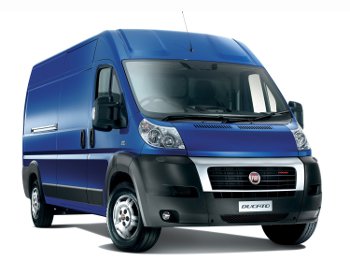
New Fiat Ducato panel vanFiat has launched the latest version of its Ducato large van, complete with an all-new range of Euro 5 engines. As with the recent Volkswagen Crafter and Iveco Daily launches, the engines are the big news and buyers should expect:
  • Euro 5 compliance on all models;
  • Improved fuel consumption;
  • Reduced emissions;
  • Improved power and torque;
  • Improved performance and refinement.

Initial reviews of the Ducato have been very positive, especially with in terms of the performance, handling and comfort of the new van.

Engines & Transmission

The new UK model range is built around two engines – a 2.3l diesel and a 3.0l diesel. The 2.3l engine will come in three power outputs for the UK – 110bhp, 130bhp and 150bhp. Each will have a six-speed manual gearbox and Fiat says that the entry level 110bhp model will offer a 10% improvement in fuel consumption, 11% reduction in emissions and a 20% increase in torque when compared with the 100bhp 2.2l model it replaces.

The range-topping 3l engine offers 177bhp and a stonking 400Nm of torque from just 1,400rpm – an improvement on the old engine’s 1,700rpm figure for the same torque.

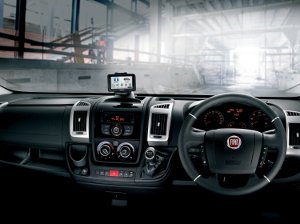
Dashboard of new Fiat Ducato, showing optional TomTom Blue&Me setup

The dashboard of the new Ducato, showing the optional TomTom Blue&Me system

Service intervals on all of the new Ducato engines have been extended from 25,000 to 30,000 miles and all engines have a timing chain designed to last the lifetime of the engine – so no cambelt changes will ever be required.

Fiat’s Comfort-Matic automated manual transmission is available as an option with the 3-litre engine. This is a traditional manual transmission except there is no clutch pedal and the manual linkage to the gearbox is replaced by actuators controlled by a Transmission Control Unit. The shift is either performed automatically or the driver can use the gear lever to prompt changes by pulling backwards or pushing forwards.

The 2.3-litre engines (110, 130 and 150) are available with Fiat’s Start&Stop system. This automatically stops the engine when the van comes to a halt and is put in neutral. Releasing the brake or pushing the clutch re-starts the engine automatically. It’s estimated this can reduce fuel consumption by 15 per cent around town.

Sizes & Conversion Options

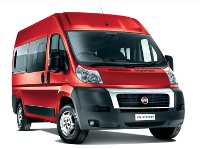
New Fiat Ducato minibusThe new Ducato panel van is available in a range of sizes and shapes:
  • Three wheelbases
  • Four lengths
  • Three heights
  • Gross vehicle weight of 3,000kg – 4,000kg
  • Payloads from 1,000kg to 2,000kg

A range of conversion options will also be available, including a minibus and single and twin cab chassis cab models.

Interior

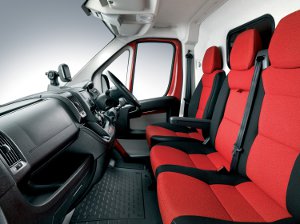
New Fiat Ducato interior showing upgraded cab seats with red fabricThe interior of the Ducato has been upgraded for this new model. The new cab features improved materials, upgraded seats, better sound proofing and more storage, as well as an adjustable steering wheel.

It is also possible to specify a TomTom ‘my port’ when ordering the van. This can then be used with a TomTom Blue&Me system to gather date for Fiat’s eco:Drive fleet management software, which allows drivers and fleet managers to monitor fuel consumption and driving habits in order to reduce running costs.

Final Thoughts

The Ducato has never been massively successful in the UK panel van sector, with neither courier firms nor tradesmen embracing the model very widely. Despite this, there are a lot on the road and it does have a strong presence in the conversion market, where its low, wide, front-wheel drive chassis cab platform has been hugely successful. The Ducato dominates the motorhome market throughout Europe and has sold more than 2.2m units in total in the 30 years it has been in production.

This new Ducato may look similar to its predecessor, but under the skin there are a raft of worthwhile improvements – not least the new engine range, which should provide improved performance with lower fuel consumption and emissions. It remains to be seen whether the Ducato will gain a stronger foothold in the UK van rental market – but initial impressions are good.

Renault Trafic & Ford Transit Manage 59mpg in MPG Marathon

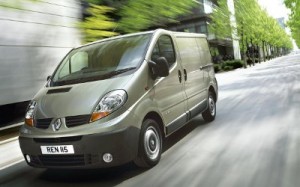
Renault Trafic

Honest boss, I can get 59mpg in one of these...

I don’t know about you, but I am pretty happy if I can get more than 37mpg in my Transit. My all-time (loaded) record is 42mpg, obtained after driving all day at a cruising speed of 50mph on quiet roads (it was in Norway).

However, when placed alongside the winners of the recent ALD Automotive/Shell FuelSave MPG Marathon, I look like a lead-footed boy racer. Contestants had to complete a time-limited 372-mile course over two days. Each driver had two goals – getting the best possible mpg and scoring the biggest improvement over their vehicle’s official combined mpg figure.

The team that achieved the best overall percentage improvement in the LCV category managed to squeeze 59.11mpg out of a standard Renault Trafic – a massive 54.73% better than the van’s official combined mpg figure of 38.2mpg, which is fairly realistic.

Ford also did well in the van categories, with a 2.2l 100PS Transit Econetic achieving 59mpg and Transits emerging as the overall winners in both the 2,800kg and 3,500kg categories.

The small vans entering the competition showed that 70mpg+ fuel consumption figures are not just for cars, scoring some impressive results – although not all managed to beat their manufacturers’ official figures:

  • Fiat Fiorino: 82.96mpg – best overall mpg for a van
  • Citroen Nemo: 81.79mpg
  • Vauxhall Corsavan Ecoflex: 71.3mpg (below the official figure of 78.3mpg!)

It is probably fair to say that the drivers went a bit slower than a van driver normally would – indeed, Corsavan driver Neil McIntee went at 40mph on single carriageways and 50mph on motorways and dual carriageways. I think most van drivers would get a few ‘hurry up hints’ from their bosses for that kind of tardiness, but it does prove the difference that speed can make.

The drivers started from Cirencester on both days and followed circular routes past major towns, including Basingstoke, Southampton, Portsmouth and Salisbury.

Winter Tyres For Vans – They Aren’t Just For Cars!

Winter tyre on snow

Winter tyres aren't big knobbly things, you know! They are just like summer tyres except with a different rubber compound and modified tread that stays soft and grippy at low temperatures.

This year has seen unprecedented levels of winter tyre marketing, most of which has been aimed at car drivers. Despite this, winter tyres are just as relevant for vans and most of the main tyre companies offer winter versions of their van tyres.

Examples include Continental’s VancoWinter 2, the Goodyear Cargo UltraGrip 2 and the Michelin Agilis Alpin.

Mercedes-Benz is now offering a main dealer winter tyre / wheel service for Mercedes vans. It isn’t the cheapest way to get winter tyres on your van but it should be hassle free, especially if your vans are serviced at a Merc dealer.

Remember, winter tyres outperform summer tyres when the ground temperature falls below 7 degrees C – and ground temperature is usually lower in winter than air temperature, which is what the weather forecasts talk about.

I recently attended a winter tyre demonstration by Goodyear and got to drive with winter tyres on an ice simulation surface. The difference between summer and winter tyres was massive. Trying to stop on ice with the summer tyres was scary – the ABS didn’t work and I was just a passenger as the car slid endlessly along. With winter tyres, I stopped in about half the distance and had much more steering control during braking. Although the differences are less pronounced on dry and wet surfaces when the temperature is above freezing, the difference on snow and ice is awesome.

In case you are not convinced, here is some footage from a winter tyre demo Goodyear put on at the Tamworth Snowdome earlier this year. Two cars try to drive up the ski slope, one with summer tyres and one with winter tyres:

Van Sales Up 9.4% In September

New van registrations rose by 9.4% in September, according to new figures from the Society of Motor Manufacterers and Traders (SMMT).

The rise is a contrast to the private car market, where sales fell, but continues a trend seen in commercial vehicle sales throughout 2011 – van sales are up 19.5% over the year to date and 254,045 vans have been sold so far this year.

According to the SMMT figures, van sales in the 2.0t+ market have been particularly strong. One reason for this might be the impending LEZ rule change, which will mean that any vans registered before 2002 will have to pay £100 to enter the London Low Emissions Zone from the start of 2012.

Commenting on the figures, Paul Everitt, SMMT Chief Executive, said:

“Confidence returned to the commercial vehicle market in 2011 and the September market continues the upward trend, growing 8.8% on last year. The future state of the economy is certainly a concern, but it’s clear that owners and operators are currently investing in new, fuel-efficient vehicles to help weather the storm of high fuel prices.”


Van News: VW Used Van 0% Finance Offer & London LEZ 2012 Rule Change

Zero percent finance offers are often restricted to new vehicle purchases, but until the end of October Volkswagen is offering 12 months’ interest-free finance (0% APR) on Assured Used Caddy and Transporter vans.

Volkswagen’s Assured Used vans are available from VW Van Centres across the UK and include a comprehensive warranty:

  • 12 months Volkswagen Roadside Assistance in UK and mainland Europe
  • MOT test cover (covering cost of repairs or parts needed to pass next MOT)
  • Multi-point check
  • 12 months comprehensive warranty (with option to extend for extra 12 months)
  • Reconditioning
  • Van data check
  • Seven days free insurance (subject to terms and conditions)

The warranty also includes the cost of replacement parts and labour up to the value paid for the vehicle and a guaranteed replacement hire van if your van is in the garage for more than 24 hours.

London LEZ Rule Change – 03/01/2012

Remember, if you drive a van that was registered before 2002, then starting from 3rd January 2012, you will have to pay £100 per day to drive inside the London Low Emission Zone (LEZ).

Obviously this is not a sensible option in most cases, which leaves van drivers in London with two alternatives:

  • If you only go into London occasionally, why not hire a van in London?
  • If you need to go into London regularly, you do not have much choice but to buy a newer van – so the VW offer above could be attractive.

You can find full details about the London LEZ on www.tfl.gov.uk/lezlondon and full details of Volkswagen Used vans on www.volkswagen-vans.co.uk.

New Fiat Doblo Work Up Offers Dropside Option

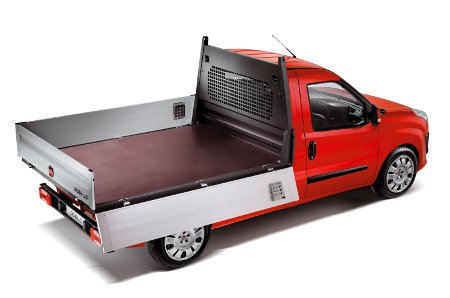
Fiat has launched a new version of its Doblò light van – a dropside version. It’s a model never offered before by a major van manufacturer for this class of van (the Doblò is broadly the equivalent of the Citroen Berlingo or Ford Transit Connect).

Fiat Doblo Work Up - dropside

The Doblò Work Up is a fraction under 5m long and has an impressive payload of up to 1000kg with a load area of 4m² (2.3m long x 1.82m wide). This makes it reasonably compact for urban use but surprisingly capacious – it can take 3 Euro pallets or 33 fruit boxes. It should be ideal for a wide range of jobs – although I don’t imagine it is likely to appear in many van hire fleets.

The Doblò Work Up comes with a choice of two Euro 5 diesel engines – a 1.3 MultiJet 90bhp and a 1.6 MultiJet 105bhp. Both feature a Start-Stop system as standard, along with a diesel particulate filter. The cab comes with a glazed bulkhead window with protective metal grill as standard and there is a tool storage compartment concealed under the rear load bed.

The new Doblò Work Up costs £16,065 (basic) for the 1.3 MultiJet 16v Euro 5 and £17,065 (basic) for the 1.6 MultiJet 16v Euro 5.

Toyota To Discontinue Hiace & Exit UK Van Market

Toyota has announced it is to discontinue its Hiace van and exit the UK van market at the end of 2011, due to the impending requirement for all new vans to meet Euro 5 emissions standards. The Hiace’s current 2.0l diesel unit doesn’t meet the Euro 5 standard – and somewhat surprisingly, Toyota cannot or will not come up with a suitable replacement.

Although it is not a very major player in the UK van market, I’ve always liked the Hiace and it does have a steady following amongst tradesmen and other owner-drivers looking for an alternative to the VW Transporter.

Hilux drivers need not fear that Toyota is going to abandon the commercial market completely – the company has already announced an updated Hilux model for 2012.