Category Archives: Van News

News and articles about UK vans – especially information relevant to the van hire market. Coverage of new van model launches from all the major manufacturers – Ford, Mercedes, Volkswagen, Peugeot, Fiat and Citroen.

2010’s What Van? Award Winners Are Here

If you’re thinking of buying a new van this year but are not sure where to start – or are simply looking for an alternative to the flexible and trustworthy Ford Transit – then the What Van? 2010 awards might be a good place to start.

Journalists are never happy to leave a good thing alone, and the What Van? judges have scoured the van market for all possible contenders, choosing a completely new van model as their Van of the Year 2010. The Nissan NV200 is based on the same platform as a Nissan Micra but manages to squeeze a load length of just over 2m into an overall length of only 4.4m – considerably shorter than most short wheelbase panel vans.

Other interesting category winners include the little-known van versions of the Citroen C-Crosser/Mitsubishi Outlander in the 4×4 van category and the Ford Transit in the Minibus category. The Iveco Daily won the Large Panel Van category, its larger range of engines and weight choices helping it to pip the Mercedes Sprinter to the post.

Both large vans contenders offer some of the cleanest engines ever seen in this sector – all Sprinter models are now compliant with Euro 5 and some Daily engines go one further, complying with the voluntary EEV (Enhanced Environmentally-friendly Vehicle) standard, which is designed as an intermediate step between Euro 5 and Euro 6.

For a full list of the What Van? 2010 Award winners and the judges’ thoughts on them, click here to visit the What Van? website.

4×4 Vans – Can You Rent One?

Four wheel drive vans aren’t common – mostly because hardly anyone needs one (although I know that doesn’t stop people buying 4×4 cars…)

There are a number of 4×4 vans on the market, all of which are sold in limited numbers, mostly to businesses that need their vans to be able to get safely off road from time to time without getting stuck or sacrificing carrying ability. The armed forces are also regular customers, as are emergency services in some rural areas.

Here are a few examples of four-wheel drive vans that are currently on the market:

  • Mercedes Sprinter 4×4
  • Ford Transit AWD
  • Volkswagen Transporter 4Motion (older 4×4 models were called Syncro)
  • Iveco Daily 4×4

There have been a few others over the years, but I think that these are the only mainstream medium/large van models offering a four-wheel drive option at the moment.

The main downside of any four-wheel drive system, of course, is cost. It costs more to buy, there is more to go wrong and it uses more fuel.

Since van operators are conscious of costs in a way that private car owners are not, businesses will never buy 4×4 vans unless they have a genuine requirement for them. That means that the number of 4×4 vans available from daily rental companies in the UK is somewhere close to zero.

I’m sure there might be a few – but you won’t get them from mainstream van rental companies.

Van News – Award For Sprinter & Transit Is Thieves’ Favourite

Ford Transit Tops Stolen List For 2009

The Ford Transit was the most stolen vehicle of 2009, according to the Association of Chief Police Officers Vehicle Crime Intelligence Service (AVCIS). The Transit topped the list with the Mercedes Sprinter the only other van to appear in the top 10:

  1. Ford Transit
  2. Ford Fiesta
  3. Vauxhall Astra
  4. Volkswagen Golf
  5. Vauxhall Corsa
  6. Ford Focus
  7. Mercedes-Benz Sprinter
  8. Ford Mondeo
  9. Ford Escort
  10. Vauxhall Vectra

Interesting to see the Escort at number 9 – even including van variants, none of these have been made for about eight years – perhaps their anonymity is attractive to thieves for some reasons, or else strong demand for spare parts…

According to AVCIS boss Mark Hooper, “the rise in thefts of vans demonstrates their potential value in terms of spare parts, scrap metal and the prospect of stealing extra ‘booty’ within the contents of the van.” I guess the usual advice applies – keep it locked, keep everything inside it hidden and consider an alarm system.

Merc Sprinter Wins Best Large Van Award (Again)

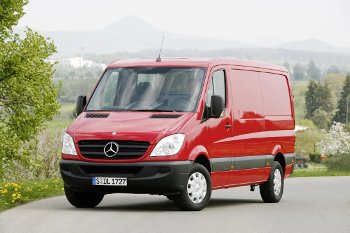
Mercedes-Benz SprinterThe Mercedes-Benz Sprinter has won the Fleet World award for Best Large Van for the third consecutive year. Mercedes was the first van manufacturer to fit Euro 5 engines to its large van range, and as I noted recently, many van manufacturers are still stuck at Euro 4.

In addition to this, the availability of the ECO-Start stop-start system and the Sprinter’s class-leading safety systems mean that it remains the van to beat in the large van sector – as witnessed by the large number of courier and other intensive-use fleets that choose to run Sprinters.

Van News – Master Wins Award and New Movano On Sale

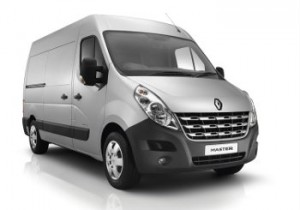
The new Renault MasterBack in January, I wrote about the imminent launch of the new Renault Master. That’s now been and gone and the new Master is not only on sale, but it has already won its first major award – Fleet World 2010 Best New Van.

The new range takes the Master up to 4.5 tonnes for the first time and introduces a RWD option on several wheelbases. It will be available in chassis cab, minibus and other varieties in due course but has initially been launched as a panel van.

Find out more about the new Renault Master here.

Also By Vauxhall…

If buying a Renault isn’t right for you for some reason – no local dealer, perhaps – then the new Master is also available as a Vauxhall. Just like the old Master, the new Master is also being sold by Vauxhall as the Vauxhall Movano.

As far as I can tell, there aren’t many differences in specification between the two brands and both appear to have the same 2.3 CDTi engine and choice of FWD, RWD and a range of GVWs up to 4.5 tonnes.

Find out more about the new Vauxhall Movano here.

Ford Transit – 45 Years & 6 Million Vans

Ford celebrated two impressive milestones in its history today as the Ford Transit reached its 45th birthday and the 6 millionth Ford Transit rolled off the production lines.

Six million Transits have now been sold worldwide – with the UK’s van drivers accounting for 2.1 million of them.  Ford is celebrating these twin milestones with a new limited edition model, the Transit Sapphire. Only 1,150 Sapphires will be made and the generously-specified model will be available in short, medium and long-wheelbase versions. Goodies included as standard on the Sapphire model include air conditioning, cruise control, uprated stereo with bluetooth and auxiliary input for MP3 players and electric windows.

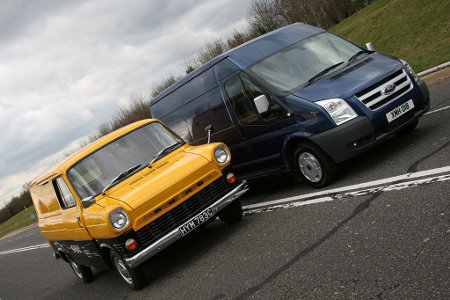
Here’s a picture of the Sapphire alongside a mk1 Transit – how things have changed in 45 years:

2010 Ford Transit Sapphire & a 1965 Mk1 Transit

A Mk1 Transit from 1965 alongside a 45th anniversary 2010 Transit Sapphire

As it happens, the six millionth Transit came of the line at Ford’s Turkish plant – not its Southampton factory – but the first Sapphire did roll off the line in Southampton, with the keys going to the UK’s first ever Ford dealer, Hendy Group, which sells around 3,000 Transits every year and is celebrating its own centenary this year.

Hendy Group MD Paul Hendy collecting the keys of his 45th anniversary Transit Sapphire

Hendy Group MD Paul Hendy collecting the keys of his 45th anniversary Transit Sapphire

Buying A New Van? Consider A Euro 5 Model To Reduce VED

If you are considering buying a new van this year, you might want to look for a Euro 5 model. New 2010/11 rates of road tax for vans mean that new vans that aren’t Euro 5 compliant will cost nearly twice as much to tax as Euro 5 models.

Euro 5-compliant vans will cost £125 to tax for a year in 2010/11, against a standard rate of £200 for other new vans. Although it’s not a huge amount when set against the cost of a new van, the lower rate is guaranted for the lifetime of the van and non-Euro 5 vans may be penalised further in years to come.

Owners of Euro 4 vans registered between 01/03/2003 and 31/12/2006 will also benefit from the £125 rate in 2010/11 – although owners of Euro 4 vans registered since this period have to pay the standard £200 rate of tax.

Owners of most other vans will pay around £200 for a year’s road tax if their van was registered after 01/03/2001 and £205 if it was registered before this date and has an engine larger than 1549cc.

For full details of current rates, click here for the 2010/11 DVLA fact sheet.

What Euro 5 Vans Are Available?

The bad news is that the range of Euro 5 vans available is limited at present. As far as I know, these are the only current models available with Euro 5 engines at present (remember that not all versions of each model may be Euro 5):

  • Mercedes-Benz Sprinter
  • Volkswagen Crafter
  • Volkswagen Caddy & Caddy Maxi
  • Volkswagen Transporter
  • Ford Transit ECOnetic
  • New Fiat Doblo Cargo
  • New Renault Master
  • New Vauxhall Movano
  • Iveco Daily

What this list shows is that several major manufacturers have launched new versions of their largest vans recently, and that these larger models have been the first to get Euro 5 engines – although their heavier HGV cousins have had Euro 5 models available for some time now.

The choice of smaller vans with Euro 5 engines is pretty limited and Ford’s Transit currently seems to be lagging behind in the larger van category, too, with only the ECOnetic available in Euro 5 spec. The ECOnetic only comes in FWD/SWB/low roof spec so is not suitable for all Transit owners. The popular Renault Trafic/Vauxhall Vivaro is only available with Euro 4 engines at present, too – although I suspect this will be remedied fairly soon, given Renault’s excellent reputation for modern diesels.

Renault Launches Kangoo Van Maxi & Updated Trafic

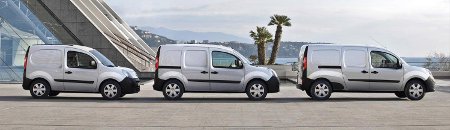
Renault has announced the launch of a new, extended-wheelbase variant of the Kangoo van – the Kangoo Van Maxi. It’s nearly 40cm longer than the current Kangoo van and complements the other variant of the Kangoo, the Kangoo Compact, which is shorter than the regular Kangoo.

Renault Kangoo Compact, Van & Kangoo Van Maxi

Smallest, small and not so small - the Renault Kangoo range

All of this Kangoo goodness comes in a low roof (1.82m), short wheelbase package that ensures that the Kangoo Van Maxi remains well suited for urban use and won’t have its progress impeded by car park height barriers, unlike slightly larger alternatives. It has an overall length of 4.6m with a load length of 2.1m (2.9m with the passenger seat folded down), a payload of 800kg and a load volume of 4.6 cubic metres – a full cubic metre more than the regular Kangoo van.

The Kangoo Van Maxi will go on sale in the UK on 4th June – more details nearer the time.

Trafic Phase III

The Trafic has sold more than 1.1 million units since its introduction in 2001 and remains very popular. It should be no surprise, therefore, that the Trafic Phase III is a definite case of evolution, not revolution. That said, it contains a number of desirable updates to the existing model that should appeal to Renault’s target market for these vans, described by the company as “tradesmen and traders”.

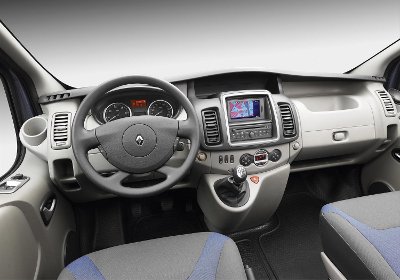
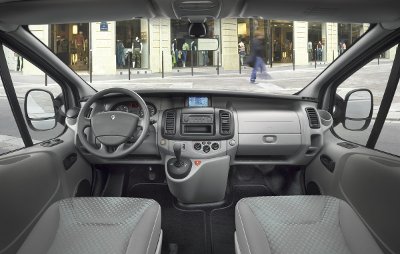
On the outside, it looks pretty much identical. Most of the updates seem to have been inside the cab and under the bonnet. Here’s a comparison of the new Trafic dashboard area with that of the outgoing model:

Renault Trafic Phase III updated cab

The updated cab in the phase III Trafic - replacing the one below

The cab of the phase II Renault Trafic

The dashboard layout of the outgoing phase II Renault Trafic

Changes to the updated Trafic include:

  • In-dash Carminat TomTom satellite navigation, including TomTom’s IQ Routes software, which aims to use real-world traffic data (recorded by other TomTom users) to calculate the best route for your journey at that time of day.
  • Automatic climate control
  • Improved dashboard storage facilities plus a redesigned instrument console to improve “visibility and legibility of the information display”
  • A new range of audio systems including USB and Bluetooth connectivity
  • Cruise control and speed limiter with steering wheel controls
  • Improved fuel consumption and lower CO2 emissions

Renault claim to have improved both fuel consumption and emissions on the Trafic, while leaving the range of engine and power choices unchanged. The same two engines will be available, a 2.0dCi (90hp or 115hp) and a 2.5dCi (150hp). Both 2.0 litre models now boast CO2 emissions of less than 200g/km and Renault claims that it has improved the fuel consumption of the 115hp model by 4.2mpg and reduced its CO2 emissions by 19g/km, to just 195g/km for the manual gearbox.

All have six-speed manual gearboxes as standard but both the 115hp and 150hp models are both available with Renault’s automated manual transmission, Quickshift. In both cases, this promises both lower fuel consumption and lower CO2 emissions than the equivalent manual models – in keeping with the promises made for this type of gearbox.

New Renault Master – Photos & Specifications

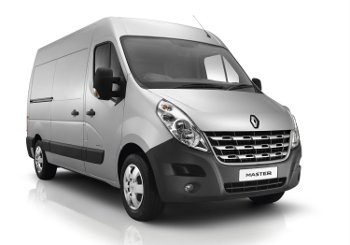
The new Renault Master

The new Renault Master

Renault is launching the latest version of its large van, the Master, on April 9th. It has just released price and specification details along with a raft of photos of the new van. First up will be the panel van models, but chassis cab, crew cab and minibus variants will be along shortly, too.

What’s New?

Most notable is the expanded range of sizes, weights and driveline options. Maximum gross weights now run from 2.8 tonnes to 4.5 tonnes. There are four lengths, with the longest being a clear attempt to compete directly with the extra-long Sprinter – almost 7m long with an internal load length of 4.3m.

All rear-wheel drive models have twin rear wheels, a decision which will please some but not others, and an optional diff lock will be available for anyone who feels they might need it. Given the recent winter weather, this could be a useful option for drivers whose work takes them off the beaten track.

All models use the same (new) 2.3 litre dCi engine, which will be available in 100, 125 and 150hp versions. This should cover all requirements, I reckon, especially given the dollops of torque available from modern diesels and the six-speed gearbox that will be standard throughout the range.

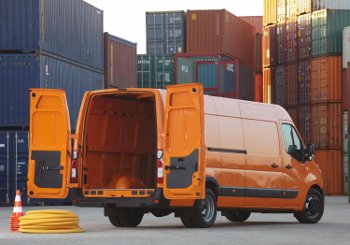
New Renault Master in rear-wheel drive guise

Is it me, or does it look a bit like a Sprinter from this angle? This is a rear-wheel drive model.

The combination of 4 lengths and FWD and RWD drivelines should mean that there is an loadspace to suit almost everyone.

Rear-wheel drive models all have the extended overhang at the back – so MWB in RWD is actually the same length as LWB in FWD. It’s slightly confusing but I suppose it makes sense when weight distribution is considered.

Three roof heights are available plus all the usual window and door options. As you’d expect, the front-wheel drive version has a lower load floor than the rear-wheel drive versions, meaning that the side door opening is taller, too.

In The Cab

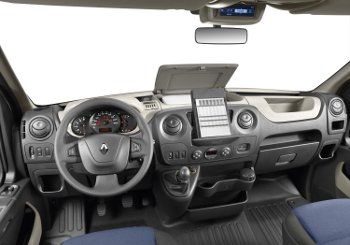
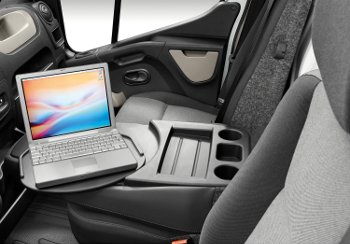
The cab of the new Master looks nice and is typically Renault. There are loads of clever cubby holes, storage facilities and bottle holders, including storage for large items under the twin passenger seat, the base of which lifts up to allow access. The central passenger seat folds down to make a desk for driver or passenger, which could be useful for both paperwork and meal breaks, while the gearstick is the usual dashboard mounted affair.

Inside the cab of the new Renault Master

Inside the cab of the new Renault Master

The middle passenger seat folds down into a desk - very useful for butties and paperwork

The middle passenger seat folds down into a desk - very useful for butties and paperwork

What Does It Look Like?

It looks a bit like all the other large panel vans on the market, to my eye, anyway. I’m not sure why, but they seem to be getting closer to each other in external shape and design. Perhaps it’s something to do with crash test requirements for big bumpers, I’m not sure.

Apart from that, it looks pretty good and comes in a decent range of colours, for anyone who doesn’t fancy white. What more can you ask for?

Driving It & Living With It

The acid test for any commercial vehicle comes when it has been on the road a while. Reliability, running costs and whether drivers like it will all become apparent later this year. The new Master is scheduled to be launched in the UK on the 9th April, although Renault dealers are now taking orders for the vans.

Vivaro Beats Official MPG Figure By 60%

We’ve grown used to treating manufacturers’ official fuel consumption figures with a pinch of salt, thinking of them more as an ideal than a reality. That attitude could need some revision, however, even for van drivers.

The winning team & their Vivaro - © GM Corp.

The winning team & their Vivaro - © GM Corp.

In the recent Fleetworld/ALD MPG Marathon, drivers had to complete a 360-mile course over varied roads using the least fuel possible. Granted, the vans weren’t loaded and didn’t have to contend with the demands of multi-drop, the M25 at rush hour and other such fuel-guzzling activities.

All the same, the results were remarkable – the Vauxhall Vivaro’s class-winning result was an overall 55.25mpg over the entire course – a massive 60% above the Vivaro’s official combined fuel consumption figure of 34.4mpg. Participating vehicles also had to maintain an average speed of 30mph – so their progress was fairly realistic in terms of road speed.

Also competing was the Citroen Nemo, which took the title of “Britain’s Most Economical Van”, beating all other light commercial vehicles with an overall consumption figure of 75.8mpg – more than 20% above the Nemo’s official combined figure.

What this highlights is how big an effect the driver of a van has on its fuel consumption. Sure, real world factors like load, multi-drop, traffic and routing restrictions mean that results like this won’t be achieved by working vans – but worthwhile improvements should still be possible, especially for vehicles on longer-distance work.

I’m going to have to try and squeeze more than 35mpg out of my Transit…

Renault Trafic Review – Van Reviews

Renault Trafic

Renault Trafic

Disclosure: The van driven was a hire van from a well-known rental company which I paid for myself as I needed it to help a relative move house. No freebies were involved.

I recently spent a day driving a 2007 Renault Trafic, so thought this would be a perfect opportunity to write a review on this popular rental van. It also provided me with a good chance to compare it to the (slightly older) Ford Transit that I normally drive.

My route for the day took in a return trip totalling 500 miles and including city roads, motorways and long stretches of rural A and B roads (in Wales). I also experienced torrential downpours and drove part of the journey in the dark, so became very familiar with the wiper and light controls, which were both perfectly adequate (as were the lights and wipers themselves).

First Impressions

If you like swooping curves and bug-eyed headlights, then you will like the Trafic’s looks. For something that needs to be as square as possible, it manages to look quite curvaceous and stylish without sacrificing those essential van like qualities – load space and practicality.

It’s a noticeable contrast to a Transit, which is all straight lines and angles – somehow this makes it look more workman-like than the Trafic.

In terms of size, the SWB Trafic is pretty much identical to a SWB Transit – length, width and height all appeared to be the same, and loadspace dimensions were pretty close, too.

Comfort & Cab Layout
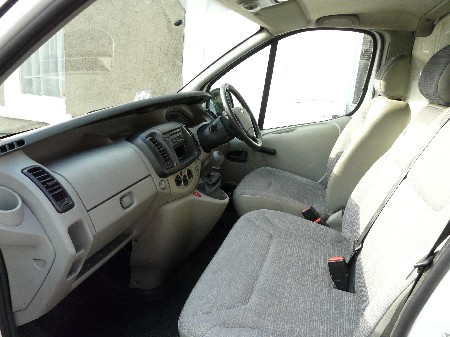
Renault Trafic cab

Renault Trafic cab

Vehicle comfort seems to mean different things in different countries. My experience of French cars and vans, and Renaults in particular, is that the seats are rather soft but nonetheless very comfortable. German vans have firm – but still very comfortable – seats, while Ford cars and vans have carefully middling seats (at least, all of mine have done).

The Renault Trafic stayed true to this pattern – the driver’s seat was quite soft but had adequate adjustment and remained comfortable for the whole of the day I spent in it – at the end of the day, I did not have any aches or pains. It was, possibly, a little bit more comfortable than the driver’s seat in my Transit – although that might be down to my Transit being older and higher mileage – the seat has seen some use.

The rest of the interior was pleasant and usable but unremarkable and a bit plasticy. The dashboard-mounted gearstick comes easily to hand but doesn’t really seem to offer any benefits over its floor-mounted equivalent, other than a slightly shorter throw and more familiarity for car drivers.

Driving & Performance

The Trafic is certainly quite car-like to drive – no doubt one of the contributing factors to its success. The engine pulled well and was reasonably refined and the 6-speed gearbox makes motorway cruising a bit more relaxed and fuel efficient – although 6th gear is only really usable at speeds of over 60mph, which means constant changing down to 5th on a busy motorway. Other than that, performance was very similar to my (5 speed) Transit.

Handling was fine – when empty it was almost like a car and when heavily loaded it remained well balanced and easy to drive. The Trafic’s brakes were decent, although the pedal needed to travel quite a long way down before the brakes really bit.

Load compartment
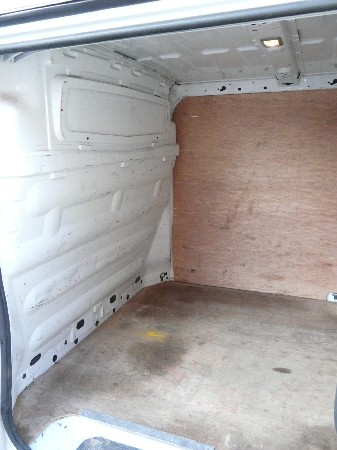
Renault Trafic factory bulkhead - note the curve

Renault Trafic factory bulkhead – note the curve & the step

The Trafic I drove had a full, factory bulkhead – meaning that it curved outwards as it rose to the roof, to fit around the backs of the front seats. This meant that stacking boxes against the bulkhead was awkward – I had to fill out the space at the base until it was level with the top of the bulkhead, then start stacking up to the roof.

Still, this is a worthwhile compromise in a short wheelbase van as it provides extra load length (at floor level) whilst providing the safety and security of a full, fixed bulkhead.

Other than that comment, the load space was exactly what you’d expect and appeared to be virtually identical to that in my Transit, except the Trafic had a shallow step by the side loading door, whereas my equivalent front-wheel drive Transit has a completely flat loadspace floor. This is unlikely to make any practical difference to most people, unless a completely flat floor is essential to you.

Quality & Efficiency

My Trafic was a rental van with 45,000 miles on the clock. It had obviously had a great many drivers and was a bit tatty, but everything still worked and there were no rattles or loose bits of trim. This would suggest that the interior build quality, at least, is fairly good.

Similarly, the van still felt decent to drive. Fuel efficiency was around 35mpg for the day – I didn’t calculate it exactly but it was on a par with my Transit, which religiously returns 35mpg, whatever I do.

Final Thoughts

If I was given a Trafic as a daily drive, I’d be perfectly happy. If I was spending my own money, I’d probably by another Transit – if nothing else, I prefer the interior. However, the differences are small and they are both excellent small panel vans to drive and use.