Author Archives: Van Rental

Vauxhall Offers 4 Years’ Free Servicing & Finance On New Vans

Vauxhall Movano large van

The Vauxhall Movano

Vauxhall is the UK’s most popular van manufacturer with retail buyers — van operators who buy their vans directly from dealers, rather than through fleet orders or leasing companies.

The Luton-based manufacturer has now launched a promotional deal that aims to capitalise on that popularity. The Big Van Event is running from 17th – 27th May 2013 and offers new van buyers £500 of free fuel, up to 20 per cent off selected van accessories along with Vauxhall’s ‘4×4’ offer, which includes four years zero per cent APR finance, a four year warranty, four year breakdown assistance cover and four years’ free servicing.

The Big Van Event is running at Vauxhall van dealers throughout the UK and includes the Corsavan, Combo, Vivaro and Movano, and additional offers apply to each of these models.

The award-winning Combo small van also gets £500 customer saving across the range. The Combo offers a range of modern low-emission diesel engines, with CO2 emissions as low as 126g/km and a combined fuel economy of up to 58.9mpg. Buyers can choose from two wheelbases and two roof heights, making it suitable for a variety of uses and professions.

During the Big Van Event, Vivaro and Movano models will continue to be offered with free Plus Packs. For the Vivaro, this includes air conditioning, vehicle alarm and electric pack, worth more than £1,000. Movano models come with air conditioning, vehicle alarm, trip computer and rear parking sensors, worth more than £1,400.

The deal is available to retail customers only and terms and conditions apply.  Orders must be placed by 27th May — for more details visit your local Vauxhall van dealer or www.vauxhall.co.uk.

Citroën Remembers The Méhari: A True Classic Turns 45

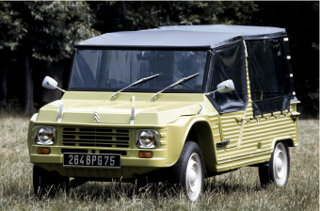
Citroën Méhari

The Citroën Diane 6 Méhari was made from 1968 until 1987. Almost 150,000 were produced and the vehicle took part in several major rallies.

Younger readers may wonder if the vehicle in the pictures was specially produced for a film — given the levels of refinement and safety engineering that are present in almost all modern cars and vans, it is indeed hard to imagine that this was a regular production model up until 26 years ago.

The Citroën Diane 6 Méhari, to give it its full name, was in production from 1968 until 1987, during which almost 150,000 examples were made.

It was intended to be an all-purpose vehicle of the kind that rural dwellers often take to their hearts — as they did in this case.

The roof was fully removable and the windscreen folded flat, meaning that the Méhari could be used for all sorts of pick-up and van-like loads, as well as passengers.

Although it looks flimsy to modern eyes, like the legendary Citroën 2CV, the Méhari was tough, reliable and able to absorb surprising amounts of abuse.

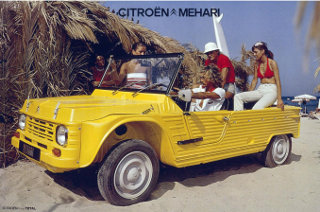
Citroën Méhari

The Méhari’s ABS (plastic) bodywork meant that it could easily be produced in bright colours! The roof was removable and the windscreen could be folded flat, making it a surprisingly versatile load lugger.

It didn’t go rusty, either — at least, the bodywork didn’t — since it was made from ABS plastic.

Citroën Méhari models took part in the Liége-Dakar-Liège rally in 1969, the Paris-Kabul-Paris rally in 1970, the Paris-Persepolis-Paris rally in 1971 and provided medical assistance in the 1980 Paris-Dakar.

The Méhari was even used by the French army as its lightweight design made it easy to parachute drop the car behind enemy lines.

The model’s name – Méhari – comes from a word used in North Africa and the Sahara for dromedary camels whose speed and endurance makes them ideal for the tough conditions in the area, enabling them to transport people and goods.

Citroën is marking the 45th anniversary of the Méhari with a special exhibition at its C_42 showcase on the Champs-Élysées in Paris.

VW Teases Fans With 272PS Amarok Power Pickup Concept

Volkswagen Amarok Power Pickup concept

The Volkswagen Amarok Power Pickup concept, which has 3.0 V6 272 PS engine boasting 600 Nm of torque and was unveiled at the annual GTI enthusiasts’ meeting at Lake Wörthersee in Austria

Volkswagen Commercial Vehicles has wowed the crowds at the annual GTI enthusiasts’ meeting on the shores of Lake Wörthersee in Austria with an Amarok Power-Pickup concept featuring a 3.0-litre V6 TDI engine with a power output of 272 PS and 600 Nm of torque.

The Power-Pickup, based on an Amarok single cab, is designed as a rolling workshop to carry spare parts, tools and race equipment, with performance to take it from standstill to 62 mph in 7.9 seconds in conjunction with an eight-speed automatic transmission and permanent 4MOTION transmission.

The striking exterior design features widened wheelarches to accommodate 22 inch alloy wheels, 80 mm lowered suspension, bi-xenon headlights with chrome surround and a chrome grille plus an enlarged lower air intake.

At the rear there is also a carbon fibre diffuser and dual exhausts, plus tinted taillights and red, white and black side decals.

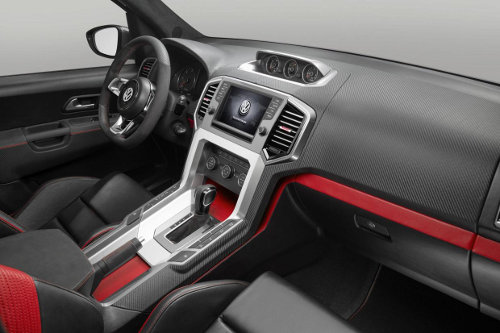
Inside, the dashboard, door trims and exclusive Nubuck leather sports seats have a black, red and white colour theme.  In-car entertainment is supplied via an infotainment system with an eight-inch touchscreen and 500 watt subwoofer.

Volkswagen Amarok Power Pickup concept interior

Inside the VW Amarok Power Pickup concept, which boasts leather, an eight-inch touchscreen and a 500W subwoofer.

VW hasn’t said whether the Amarok Power Pickup will make it into production, but full details of the current UK Amarok range are available at www.volkswagen-vans.co.uk.

Isuzu 7.5t Choice Delivers For P&H Direct

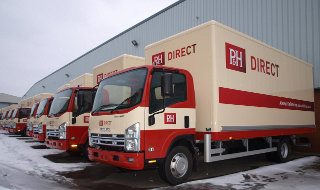
P&H Direct Isuzu 7.5t truck

One of Palmer and Harvey’s new Isuzu 7.5t trucks, which will be used for its P&H Direct operation, servicing food service outlets.

When Palmer and Harvey rolled out its new nationwide van sales food service operation last month under the ‘P&H Direct’ banner, the vehicle fleet used for this service is based on 50 Isuzu Forward N75.150 7.5t rigid vehicles. The trucks were specifically purchased for this brand new initiative and all specified with purpose-designed Paneltex bodywork.

The addition of these 50 new vehicles now means that Palmer and Harvey’s national vehicle fleet currently incorporates over 110 Isuzus covering a range of distribution applications, all at 7.5 tonnes GVW.

P&H Direct is a brand new van sales operation set up by Palmer and Harvey to service retail food outlets such as cafes, snack bars, garden centres, sandwich shops and pubs – this move into food service is a first for the wholesaler.

Each Isuzu vehicle stocks market-leading FMCG lines including crisps, countlines chocolate, chilled drinks, chewing gum and key catering essentials such as tea and coffee. A FMCG category specialist, who can provide expert advice to any of the outlets on ranging, merchandising and promotions, staffs each vehicle.

According to Huw Davies, Managing Director at P&H Direct:

“We pride ourselves on providing the most reliable distribution service to our customers and for this we require a dependable vehicle fleet. As a company, Palmer and Harvey has operated Isuzu trucks for well over 10 years within its national fleet and the proven performance and reliability of the products, supported by unrivalled customer service, is second to none. Furthermore, the payload capacity we achieve from the Isuzus is by far the best in the industry.”

These latest 7.5t Isuzus all feature Isuzu’s popular Easyshift transmission and Hull-based manufacturer Paneltex was chosen as the exclusive supplier of bodywork for the vehicles. Each truck has an extra-long Paneltex Ecofont S dry-freight body, which has an interior length of 6100 mm. Whilst the dry-freight body is principally designed for ambient products; there is a provision for chilled products through the supply of a mobile refrigeration unit within each truck. Mounted on castors, the container has an approximate capacity of 500 litres and is fitted with a top-mounted fridge that can be plugged into either 12 V DC or 240V A/C supply.

To facilitate ease of access into the truck body for the driver/salesman, there is a single, centre rear door with double-folding step. The body also has a compact Penny Hydraulics Load Lift 250 platform at the rear that can handle the loading and unloading of roll cages and trolleys up to 300kgs. Within the body itself, there is a specific office facility with additional electronics for iPads and overall vehicle security is provided through Maple, Twin-Active, Lock-Secure systems to the rear door.

According to P&H Direct, these new Isuzu trucks will each have a working life of seven years covering approximately 20,000 miles per annum operating as sales vans working on a localised geographical area.

Used Van Prices Rise 17% In The Last Year

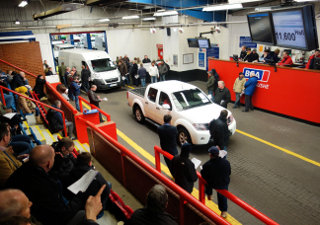
Vans being sold at a BCA auctionLight commercial vehicle values rose for the third consecutive month to reach a new highpoint in April according to BCA’s latest Pulse report.
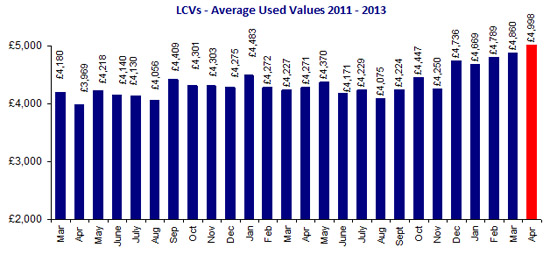
The average April figure of £4,998 for all LCVs was the highest on record for any month since Pulse began reporting in 2005.  Values rose by £138 (2.8%) compared to March.

There was some good news, in terms of value for money — unlike previous months, where both average age and mileage have increased along with price, in April, average age was unchanged at just under 59 months, while average mileage fell back by nearly 4,000 miles.

However, although mileage fell back from March, both age and mileage were broadly the same as in April 2012, despite a 17% increase in the average value over the last year:

All vans Avg Age Avg Mileage Avg Value Sale vs CAP
Apr 2012 57.37 77,736 £4,271 98.96%
Apr 2013 58.78 76,999 £4,998 101.38%

Data courtesy of BCA (www.british-car-auctions.co.uk)

Year-on-year, April 2013 was ahead by £727 or 17.0%, with age rising and mileage falling over the period.

BCA average used LCV values April 2013

Average used LCV values at auction, March 2011 – April 2013 (courtesy of BCA).

Commenting on the figures, BCA’s Duncan Ward said:

“April has continued the pattern seen over recent months with demand virtually across the board from smaller car-sized vans up to large long-wheel base panel vans.  Condition and presentation remain important, and high mileage may discourage some bidders, but overall average values and conversion rates remain very strong.

In the current market, the limited supply and levels of demand in the remarketing sector have seen prices rise for corporate stock and older dealer part-exchange vans.  Anecdotal evidence from a number of sources suggests retail used van activity remains slow, yet the wholesale remarketing sector is relatively strong.  LCV values have been universally strong throughout the first third of this year and are significantly higher than the same period last year.”

Values in the fleet & lease LCV sector improved again in April, rising by £264 (4.4%) to £6,171 – the first time average monthly values for corporate LCVs have been above £6,000.  Values have risen every month bar one since last August.   Performance against CAP fell back by nearly two points to 100.9%, while retained value against Manufacturer Recommended Price improved to 37.17% from 35.43% in March.

Year-on-year, the value evolution for corporate stock remains significant – April 2013 was £1,063 (20.8%) ahead of the same month in 2012 – with average age and mileage down over the year.

Year-on-year table: Fleet & lease vans

Fleet/Lease Avg Age Avg Mileage Avg Value Sale vs CAP
Apr 2012 44.49 70,379 £5,108 99.14%
Apr 2013 43.39 66,805 £6,171 100.92%

Data courtesy of BCA

April part-exchange van values were also the highest since Pulse began reporting in 2005, increasing by £114 (3.4%) compared to March.   CAP comparisons at 102.7% continue to outperform the fleet & lease sector, while year-on-year values remain well ahead by £634 or 22.9%, with average age and mileage relatively static compared to a year ago.

Year-on-year table: Part-Ex vans

Part-Ex Avg Age Avg Mileage Avg Value Sale vs CAP
Apr 2012 79.24 91,140 £2,759 98.23%
Apr 2013 79.01 91,144 £3,393 102.70%

Data courtesy of BCA

Where next for prices?

As these figures show, used van prices have been going through the roof, rising by around 20% over the last year for vehicles with near-identical ages and mileages.

The law of supply and demand is in evidence here, and it could be several years before increased new registrations start to have a positive effect on the used market.

Citroën Relay Now With Stop & Start

Citroen Relay Stop & Start

The new Citroen Relay Stop & Start

The new Citroën Relay  Stop & Start vans are now on sale after their CV Show debut last month.

With this launch, Citroën – one of Europe’s pioneers of this fuel-saving and CO2 reducing technology – now has three Stop & Start equipped LCV models on sale in the UK (Nemo, Berlingo and Relay).

The Relay models available with Stop & Start are the Relay 30 L1H1e-HDi 130 Stop & Start 6-speed manual and the Relay 35 L3H2 e-HDi 130 Stop & Start 6-speed manual van.

Thanks to its lighter weight, the Relay 30 model is the more fuel efficient of the two, and offers urban cycle fuel economy of 32.5mpg, according to official figures — a 9.2% improvement on the standard Relay 30 L1H1 HDi 110 6 speed manual van. Combined cycle fuel economy for the Relay 30 Stop & Start is a healthy 39.2mpg.

Scott Michael, Citroën’s Head of Commercial Vehicles & Business Centre Programme, commented:

“With the new Relay Stop & Start equipped vans, Citroën has further improved the fuel economy and reduced the CO2 emissions of one of the sector’s most fuel-efficient and cleanest LCV ranges. The new Relay Stop & Start equipped vans will appeal to all operators, but particularly those working in urban environments, where they will deliver worthwhile financial, operational and environmental benefits.”

For more information visit www.citroen.co.uk.

VOSA Plans Crackdown On Rogue Van Operators

Emergency service blue lightsVOSA is planning to step up enforcement action on van operators who are not complying with the regulations.

At a recent speech to van operators at the Freight Transport Association’s Van Excellence conference in Sheffield, Gordon Macdonald, VOSA’s Head of Enforcement Policy, made it clear that the organisation planned to crackdown on rogue van operators, saying that:

VOSA [is] determined to improve van operational standards and makes no secret of its intention to significantly ramp up the number of roadside inspections and other enforcement activity”

Van operators’ relative lack of regulation when compared to HGV and bus operators — vans up to 3.5t don’t require an operator’s licence, six-week maintenance checks or driver tachographs — has enabled many van operators to enjoy considerable freedom from enforcement in recent years.

50% MOT Failure Rate

A recent FTA survey found that 50% of vans failed their first MOT at three years old. This suggests sloppy maintenance and perhaps hints that operators take a relaxed approach to other compliance issues — most notably loading.

Van hire offers a partial solution to this problem, taking maintenance and servicing out of the equation for the operator — but ultimately, complete compliance requires the willing participation of van operators and their drivers.

Van Registrations Up 43%: Has The Market Turned A Corner?

Van registrations rose by 43% in April, compared to the same period last year, according to the latest figures from the Society of Motor Manufacturers and Traders (SMMT). This now means that van registrations have grown by 17.6% during the year-to-date:

UK van and truck registrations: 2013 and % change on 2012

April %
change
Year-to-
date
%
change
Rolling
year
%
change
Vans 20,751 43.0% 89,633 17.6% 253,078 2.9%
Trucks 3,619 -12.1% 13,679 -15.5% 43,186 -7.0%
Total 24,370 30.9% 103,312 11.8% 296,264 1.3%

Data courtesy of SMMT (www.smmt.co.uk)

The data are encouraging, but as Nigel Base, SMMT Commercial Vehicle Manager, explains, there are still question marks over the health of the wider economy:

“The CV market saw further growth in April, up almost 40%, but it’s a mixed picture across the different vehicle types. A lift in van demand is contributing to growth across the overall market, but truck registrations continue to decline. This could be symptomatic of operators holding-off on buying vehicles in anticipation of new Euro 6 legislation coming into play later this year as well as wider economic challenges impacting the road transport sector.”

Breakdown by size

As the table below shows, the growth in registrations has not been evenly distributed across the range of vans and other commercial vehicles. In percentage terms, pick-ups (up 73.6%) and vans between 2.0t and 2.5t (up 97.3%) have seen the biggest growth, but numerically, the biggest increase was provided by a 37.8% rise in registrations in the 2.5t – 3.5t sector, where sales rose to 12,056 from 8,746 in April 2012.

Month Apr-13 Apr-12 % change
Pickups 2,099 1,209 73.6%
4x4s 441 329 34.0%
Vans <= 2.0t 2,564 2,404 6.7%
Vans > 2.0 – 2.5t 3,591 1,820 97.3%
Vans > 2.5 – 3.5t 12,056 8,746 37.8%
All Vans to 3.5T 20,751 14,508 43.0%

Data courtesy of SMMT.

Trucks in decline

Truck registrations have continued to decline and rigid registrations were down by 9.7% in April, during which artic registrations fell by 16.4%. The decline in rigids over 16t was particularly large, at 19.8% — given that such vehicles tend to be used for distribution and construction work, this could reflect a weakness lack of growth in the retail and construction sectors.

What’s next?

April’s rise in van registrations marks the third consecutive month of gains for this most essential class of vehicle. After the disappointment of 2012, which saw van registrations end the year down by 7.9%, it’s good to see some signs of growth — although I’m not holding my breath for a wider economic recovery just yet.

Use Van Hire to Cut Costs and Get Dangerous Bangers Off the Road

A recent data from the Freight Transport Association (FTA) showed that half of all vans on the roads over 3 years old are unroadworthy*. Europcar, the leading car and van hire company in Europe, is urging businesses to consider van hire as a cost-effective, flexible, and most importantly, safe alternative to running a fleet of older vans.

The FTA study found that there was an almost 50% failure rate on first time MOTs for vans, a sobering statistic, and one which Europcar believes demonstrates it is not always best for a business to run its own fleet of vans. As the industry changes, van rental can offer a solution which not only provides newer vans for use, but is also more flexible for a changing market.

Ken McCall, Managing Director of Europcar UK Group, explains:

“These figures from the FTA go to illustrate something that has been known within the industry for a long time – businesses are holding onto vans for longer, without having them properly maintained. This is a false economy for businesses at a time when costs are all important – as eventually the vans will either breakdown or fail their MOT.

“Rental provides the answer. Vans that are on average under 9 months old and maintained to the highest standard are available at short notice, providing a flexible fleet of vehicles for usage which can actually save businesses money.”

Listening to the changing needs of its customers, Europcar has recently undertaken a rapid expansion in its van network and portfolio of products. These innovations include increasing the number of locations where vans are available to 172 across the UK, extending operational hours and offering a discount of 25% for overnight rentals.  The core make-up of vans on the Europcar fleet has also been enhanced to ensure it remains the leading provider of vans in the UK.

“While it may seem counter-intuitive to some businesses to hire all or part of their van fleet rather than own, the market is changing, and owning and maintaining a costly fleet of vans is no longer the default option” concluded Ken McCall.  “Europcar has recognised this change in the behavior of businesses and evolved its van fleet accordingly, taking innovative steps to ensure our vans not only offer a supplementary service to fleets, but are actually a viable alternative.”

Click here to get an instant quote for Europcar van hire.

*Source: FTA, March 2013

Car and Van Hire Delivers £14bn of UK GDP

The UK’s car and van rental industry contributes £14bn to the UK’s economy each year, according to a new report commissioned by the BVRLA, the industry’s trade body. That’s equivalent to £1 in every £90 of UK GDP when the operations of the industry itself, the UK-made vehicles and engines it purchases, the activity of UK dealerships and its impact on the used car market are taken into account.

Not all car and van hire businesses have thrived during the recession, but it has remained pretty healthy and some operators have thrived. The success of the industry has been helped by innovative and forward-thinking companies such as this one, that have realised that daily hire can be a meaningful substitute for ownership and leasing, removing the balance sheet risk and financing difficulties from businesses, leaving them free to concentrate on their core activities.

In terms of jobs, the industry employs 38,000 people directly and a further 145,000 people through wider supply chain and consumer spending effects. The total employment supported by the industry is equivalent to 1 in every 175 workers in the UK, and the sector generates around £2.8 billion of tax revenue per year.

The automotive sector is one of the UK’s few manufacturing success stories and vehicle rental and leasing companies are among its largest customers, purchasing an estimated 220,000 vehicles in 2011. This is 15% of total output but a massive 82% of UK vehicles sold to domestic customers. This expenditure is estimated to have supported a £2.4 billion contribution to GDP, 52,000 jobs and £810 million in tax receipts.

In the same year, the vehicle rental and leasing industry’s expenditure on foreign-made vehicles containing UK-made engines is estimated to have generated a £349 million contribution to GDP, 7,600 jobs and £120 million in tax receipts.

The vast majority of this business is conducted through motor dealers. In 2011, the sector purchased £11.1 billion of foreign-made vehicles from UK dealerships. This activity supported a £98 million contribution to GDP, 2,000 jobs and £31 million in tax receipts.

There is also a positive environmental angle to this activity. The industry can rightfully claim to play a leading role in driving down emissions. At 123g/km, the CO2 emissions of the average lease car registered in 2012 was 25% cleaner than the average car on UK roads.

Sounds like a good reason to consider hiring a van instead of owning one, especially if you don’t need it every day.