Author Archives: Van Rental

Van Models Guide Part 5: 7.5 Tonne Lorries

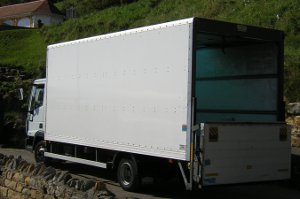
7.5t box lorry with tail lift

7.5t lorries are considerably bigger than vans. If you are driving one for the first time, you will need to take care.

So far in this series, I’ve looked at small, medium, large and luton vans. But what if you need something bigger still?

In terms of van hire, the main option available if you need something bigger than a luton or extra-long wheelbase panel van is 7.5t truck hire.

7.5 tonne lorries are far larger than even the largest of vans but also have a much greater payload. The difference between weight and space is important – sometimes, vans cannot carry enough weight, even when they have enough space.

As a general rule, a 7.5 tonne lorry will have a payload of around 3,000kg – approximately 2-3 times that of most 3.5 tonne vans. This will vary depending on the lorry’s body, make and model and whether it has a tail lift.

Can I Drive A 7.5t Lorry On My Car Licence?

Many drivers can drive 7.5t lorries on their car licences – it depends on when you passed your car driving test.

Drivers who passed their car test before 01/01/1997 should have category C1 on their driving licence. C1 is required to drive a goods vehicle with a maximum laden weight of between 3,500kg and 7,500kg.

Drivers who passed their car test after 01/01/1997 will not have C1 entitlement unless they have taken an additional C1 driving test.

You should also be aware that if you are driving a 7.5t lorry for hire or reward (i.e. not purely for personal use, such as moving house) you will be subject to tachograph rules.

As the driver, it is your responsibility to be aware of this and to comply. The Business Link website has a good introductory guide to tachograph law and the Direct Gov website is the best place to start if you are looking for information about driving licence requirements for goods vehicles.

About 7.5t Lorries

As their name suggests, 7.5t lorries have a MAM of 7,500kg. This class of vehicle really includes all goods vehicles (vans and lorries) with a MAM (maximum laden weight) of between 3,500kg and 7,500kg.

Speed limits for lorries up to 7.5t are the same as for vans up to 3.5t:

  • Single carriageways: 50mph
  • Dual carriageways: 60mph
  • Motorways: 70mph

However, almost all vans and lorries over 3.5t are now fitted with speed limiters set to 56mph, so the dual carriageway and motorway speed limits are now irrelevant.

Driving 7.5t Lorries

If you have not driven a lorry before, you will find driving a 7.5t truck quite different to driving a van or car.

The seating position places you directly above the front wheels, meaning that you are further forward in the vehicle than you are used to and may feel that you have to turn into corners later than usual in order to get the correct line (and avoid the pavement).

Similarly, braking and handling will be quite different to a van or car and the handbrake is likely to be an air brake, controlled by a lever on the dashboard.

On top of all of this, a 7.5t box lorry will be much wider, higher and longer than anything you have driven before. Make sure you know the overall height and width of the vehicle and keep an eye out for low bridges and other restrictions. Do not turn into roads with a signposted 6’6″ width restriction – you will get stuck.

Make sure your mirrors are correctly adjusted and that you understand how to use them to check the space around you. Be careful and don’t try to rush.

Disclaimer

All the information in this article is provided for information only and is especially not intended to be a definitive statement on tachograph law. If you need to know the exact dimensions or payload of the vehicle you are hiring, you will need to speak to the company concerned when making your booking.

It is standard practice in the car and van hire industry to specify a ‘typical’ model when customers make bookings – this won’t necessarily be the exact make or model you get. Usually, this doesn’t matter, but it can do if space or weight is tight.

Van Models Guide Part 4: Large Panel Vans

So far in this series, we’ve looked at small vans, medium vans and luton vans.

In this article, I’m going to take a look at another type of van – long wheelbase and extra-long wheelbase panel vans.

Extra-long wheelbase panel vans

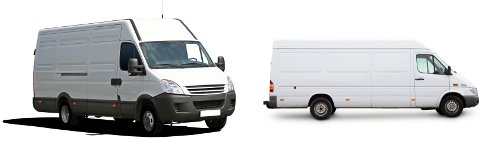
Two popular XLWB vans - the Iveco Daily and the Mercedes Sprinter. Note the long tail overhang - this is a characteristic of extra-long vans. Each of these vehicles is about 7m long

These are the vans you are mostly likely to see driven by couriers (usually Mercedes-Benz Sprinters) but they are also favoured by van rental companies and tradesmen who need large vans that can be driven on a car licence.

Large Panel Vans: LWB vs. XLWB

First of all, it is important to understand that LWB (long wheelbase) is not the same as XLWB (extra-long wheelbase).

These are the most popular long and extra-long wheelbase vans used by UK van hire companies:

  1. Ford Transit (Ford calls the extra-long Transit the ‘Jumbo’)
  2. Renault Master
  3. Mercedes-Benz Sprinter / Volkswagen Crafter (these are the same van with different badges and engines)
  4. Iveco Daily

Each of these has slightly different dimensions, but this is approximately what you will get:

Model Vehicle length Load length Typical payload
Long wheelbase Approx. 6m 3.4m-3.5m 1000kg – 1400kg
Extra-long wheelbase Approx. 7m 4.1m-4.5m 900kg – 1,300kg

(By way of comparison, a typical medium panel van (short wheelbase) is 5m long with a load length of approximately 2.4m.)

It is also worth noting that that LWB and XLWB vans usually come in both high and extra-high roof models – obviously a higher roof provides a greater cubic capacity inside but does not increase the van’s maximum load weight. Just because you can fit more in does not mean it is legal to do so.

Take care when loading your van to keep the heaviest objects low down to help stability and prevent things shifting or getting damaged while you are driving.

Large vans that have been overloaded are an increasingly common problem and the police are very wise to this. Overloading is an offence and the driver is always responsible – ignorance is no excuse.

Disclaimer:

Please remember that van payloads and dimensions all vary slightly between different makes and models of van. If you need to know the exact dimensions or payload of the van you are hiring, you will need to speak to the company concerned when making your booking or when collecting the van. Do not use the figures on this page as a guideline – they are intended as an approximate illustration only.

It is standard practice in the car and van hire industry to specify a ‘typical’ model when customers make bookings – this won’t necessarily be the exact make or model you get. Usually, this doesn’t matter, but it can do if space or weight is tight.

Van Models Guide Part 3: Small Vans

So far in this series we’ve looked at medium panel vans and luton vans – two of the most popular types of rental van. In this post, I’m going to take a look at a different type of van that has become increasingly popular in recent years – the small van.

Examples of small vans

Small vans, from l-r: Renault Kangoo, Ford Transit Connect & Volkswagen Caddy

Small vans like these are available from almost all van rental companies and are surprisingly flexible and useful. Despite being no bigger than a medium-sized car on the outside, on the inside, their lack of rear seats and square load compartments means that they are bigger than you might think.

Here’s a typical example:

  • Overall length: 4.4m
  • Overall height: 1.8m (ok for car parks with height barriers)
  • Loadspace length: 1.7m
  • Load height: 1.1m
  • Load width: 1.1m (between wheel arches) and 1.5m (outside wheel arches)
  • Payload (carrying capacity): 600kg-800kg, depending on model

Speed Limits for Small Vans

Given that these vans are no bigger than a family car, you might expect them to be subject to the same speed limits as cars.

They aren’t.

Standard van speed limits apply to small vans like the Volkswagen Caddy, Ford Transit Connect, Citroen Berlingo and almost all other small vans, even if they have a maximum weight of less than 2,000kg (2 tonnes)

I’ve discussed the law behind van speed limits before (see here), but all you need to know is that these are the speed limits and they are enforced:

  • Single carriageways: 50mph
  • Dual carriageways: 60mph
  • Motorways: 70mph

Introducing Car-Derived Vans

The only exceptions to these limits are for vans that are genuinely car-derived (i.e. they are based on a car and are the same as the car from the B pillars/seat belt pillars forwards) and have a maximum gross weight of under 2 tonnes.

In practice, this means that only the very smallest vans are exempt from van speed limts. Pretty much all of these are named after the cars they are based on, so they are easy to recognise. For example:

  • Ford Fiesta Van
  • Vauxhall Corsavan
  • Vauxhall Astravan (this is unusually big for a car-derived van and is unique in the UK market)

Car-derived vans are available from some van rental companies but not all – they are so small that most people just use their cars to transport this kind of load, and don’t bother renting a van.

One Million Drivers Breathalysed in European Police Crackdown

Almost one million drivers were stopped and tested for drink and drugs offences in the latest Europe-wide crackdown on drink and drug driving by TISPOL, the European Traffic Police Network.

The crackdown ran for one week from June 6th – 12th and twenty-eight countries took part, including countries from outside the EU such as Switzerland and Norway.

In the UK, just 19,064 drivers were stopped but 1,053 (5.5%) of these were found to be over the alcohol limit and 278 (1.5%) were found to be committing drugs offences.

Here are the figures for the UK and some of our immediate European neighbours. It is hard to read too much into these figures, as we don’t know whether each police force used the same criteria to decide how to stop and test drivers. On the other hand, they all prove clearly that drink and drug driving remains a serious issue in Europe:

  • UK: 19,064 stopped, 1,053 (5.5%) alcohol offences & 278 drug offences
  • Germany: 77,311 stopped, 1,056 (1.4%) alcohol offences & 497 drug offences
  • France: 143,146 stopped, 3,386 (2.4%) alcohol offences & 377 drug offences
  • Spain: 114,846 stopped, 2,370 (2.1%) alcohol offences & 1 drug offence
  • Netherlands: 19,864 stopped, 264 (1.3%) alcohol offences & 0 drug offences
  • Ireland: 1,538 stopped, 205 (13.3%) alcohol offences & 9 drug offences

It’s interesting to note how many more people were stopped in Germany, France and Spain than in the UK, despite these countries having similar-sized populations to the UK. The larger sample sizes may suggest more random stops than the UK – which might explain why their alcohol offence levels were so much lower. On the other hand, perhaps more Brits drink-drive…

Equally, in the Netherlands, almost exactly the same number of drivers were stopped, but British police found four times as many drivers over the alcohol limit as the Dutch police. Are British drivers really four times more likely to drink drive, or were the British police stops more targeted and less random than those of the Dutch police?

It’s impossible to read too much into these figures except that to note that drink driving especially remains a significant problem throughout Europe. The Irish contribution does deserve some comment, however – Irish police only managed to stop 1,538 people, of whom 205 (13%) were over the drink-drive limit. Wow – either the Irish police are amazingly good at targeted stops or Irish drivers have a drinking problem…

Driving Abroad? Alcohol Limits Are Often Lower Than UK

One thing that these figures don’t show is that many countries have lower blood alcohol limits for driving than the UK. Norway, for example, has a limit of 0.02% blood alcohol content – just a quarter of the UK’s generous 0.08% limit. (The UK’s limit is one of the highest in the world – only a handful of other countries have limits as high as 0.08%.)

Similarly, most other EU countries have a limit of 0.05% – Germany, France and Spain, for example.

If you are driving a van (or car) abroad, make sure you are prepared and know the local rules before you go and always err on the side of caution. Missing out on a few drinks is a lot easier than dealing with the consequences of being over the limit. Remember, if you are in an collision anywhere in Europe and the police are called, you will usually be breathalysed as part of standard procedure, even if the collision was not your fault.

The AA’s website has an excellent country-specific guide to driving in Europe – click here.

Van Model Guide Part 2: Luton Box Vans & Tail Lifts

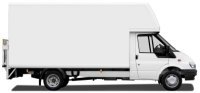
Ford Transit Luton VanIn part 2 of my guide to popular hire van models, I’m going to look at the king of DIY removals – the Luton box van. Famed for its high capacity yet legal to drive on a car driving licence, it’s favoured by ‘man and van’ removal services all over the UK.

At the same time, it’s taller, wider and less stable than anything you are likely to have driven before (unless you have a motorhome), so it’s worth taking a little time to understand what it is and how it differs from a regular panel van.

Here are some of the characteristics that define a luton van:

  • The word ‘Luton’ refers to the large storage area that sticks out over the cab of the van. Strictly speaking, this is what defines a luton van. Allegedly called luton becuase the first ones came from the Bedford factory that used to be located in Luton. Modern lutons increasingly have streamlined lutons to help reduce fuel consumption.
  • Luton vans normally have a maximum gross (laden) weight of 3.5t (3,500kg). This means that they can be driven on a standard car licence.
  • Unlike panel vans, lutons have a completely flat load floor. This is because the body of the van is built on top of a framework that places it above the rear wheels. This means that the floor in a luton is much higher off the ground than in a panel van.
  • Many luton vans have tail lifts and they are extremely useful, if not essential, for moving house. The reason that some lutons don’t have tail lifts is because the tail lifts themselves are very heavy, thus taking away some of the payload (carrying capacity) of the van. Some commercial users choose to do without a tail lift so that they can carry more weight.
  • The make of the van is pretty irrelevant with a luton – all that the van manufacturer produces is the cab and vehicle chassis. A separate bodybuilding company then builds the luton or box body on top.
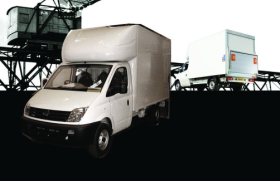
Streamlined luton box van

Luton bodies are increasingly streamlined to help reduce fuel consumption - although this reduces the storage space available in the overcab luton

Here are my top tips for hiring a luton or box van:

  1. A luton will usually be big enough to move the contents of a 1-2 bedroom flat, unless you have a lot of bulky furniture. Remember, if it’s not far, you can always make two trips.
  2. When booking a luton van rental, most companies allow you to specify whether you want a tail lift or not. If you do not book a van with a tail lift, you may not get one. This could mean a lot of heavy lifting when you are loading the van.
  3. Tail lifts are electrically operated from the van’s battery and are simple to use – you should be shown how the tail lift works when you collect the van from the hire company.
  4. Most luton vans have a payload of around 1,200kg – 1,500kg, but if you think you will be cutting it fine, make sure you ask the hire company what the payload of your rented luton van is. Driving a van that is overweight is both dangerous and illegal.
  5. The length of luton box vans can vary considerably, but the following approximate load space dimensions are fairly common: 3-4m long, 2m wide & 2.1m high
  6. Luton vans are much higher than most panel vans – the overall vehicle height is likely to be between 2.5m and 3m, so watch out for height restrictions and overhead obstructions like trees – you will have to pay for damage caused by overhead objects.
  7. Remember, in the UK, van speed limits are lower than car speed limits – don’t get caught out.

Please remember that all of these can vary slightly. If you need to know the exact dimensions or payload of the van you are hiring, you will need to speak to the company concerned when making your booking.

It is standard practice in the car and van hire industry to specify a ‘typical’ model when customers make bookings – this won’t necessarily be the exact make or model you get. Usually, this doesn’t matter, but it can do if space or weight is tight.

Van Models Guide Part 1: Medium Panel Vans

One of the original reasons I created vanrental.co.uk (formerly known as MyLocalVanHire.co.uk) was that I knew from personal experience how confusing and intimidating van hire could be if you had never done it before and didn’t know much about vans.

That was four years ago and since then we’ve had more than 1.5m visitors – but things still haven’t changed; the most popular page on vanrental.co.uk is still the Van Size Guide, which provides a simple guide to the load space and carrying capacity of all the most popular types of hire van.

With that in mind, I’ve decided to create a more detailed guide to the main types and models of van that are on the market today and used by Britain’s van rental companies. This guide won’t cover every possible model of van, but it will cover most of the vans you are likely to come across when hiring a van.

Introducing Medium Panel Vans

vanrental.co.uk has had more than 1.5 million visitors in the four years since it was launched and a great many of those have gone on to rent vans from one of the companies listed in our database (more than 720 branches in 400+ locations at the last count).

One thing we have learned is that the most popular type of hire van is the medium panel van – in other words, a bog standard Ford Transit type van:

Medium panel vans

Medium vans - from l-r: Volkswagen Transporter, Renault Trafic/Vauxhall Vivaro & Ford Transit SWB

When you rent a medium van, this is what you are most likely to get (sometimes with a higher roof). These vans are usually short wheelbase models – Ford Transits in particular come in lots of different lengths, but this is the smallest, and the most common size you will get when you request a medium van.

Here are the four most common van models in this category. They are all very similar in size (see below) but they do vary slightly – I’ve listed them in size order, from largest to smallest:

  1. Ford Transit SWB (short wheelbase)
  2. Vauxhall Vivaro/Renault Trafic (the same vehicle, badged differently)
  3. Volkswagen Transporter

For anyone concerned about the economy, there is some good news here too – many Transits are built at Ford’s Southampton plant, while Vauxhall Vivaros are all built at Vauxhall’s Luton factory.

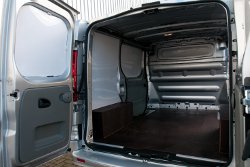
Renault Trafic load compartment

Inside the rear of a Renault Trafic

Here’s what to expect, in terms of size:

  • Overall van length: 5m
  • Height: 2m or more, with a high roof
  • Load space: 2.4m long, 1.7m wide & 1.4m high
  • Payload (maximum load weight): Approx. 1,000kg (1 tonne)
  • Maximum vehicle weight (fully laden): Usually 2.6t – 2.8t

These vans are all pretty easy to drive and are not much bigger than a large 4×4 – click here for my review of a Renault Trafic.

Please remember that all of these can vary slightly. If you need to know the exact dimensions or payload of the van you are hiring, you will need to speak to the company concerned when making your booking.

It is standard practice in the car and van hire industry to specify a ‘typical’ model when customers make bookings – this won’t necessarily be the exact make or model you get. Usually, this doesn’t matter, but it can do if space or weight is tight.

We’ve Moved To VanRental.co.uk!

Welcome to vanrental.co.ukthe new home of MyLocalVanHire.co.uk.

As you may have noticed, we’ve moved! Our new home is vanrental.co.uk – a shorter, easier and more memorable website address for you to use.

Nothing else has changed – we’ve still got more than 720 van hire branches listed in over 400 locations – enabling you to be sure of finding a van rental company in your local area.

We have also got some big improvements planned for the next year – so stay tuned!

How To Get Started on vanrental.co.uk

Are you looking for a van hire company in your area? Click here

Do you run a van hire company? Click here to sign up to vanrental.co.uk

As always, if you have any questions for us, please leave a comment below or drop us an email – we will be glad to help.

Olympic 2012 Minibus Hire – Book Now, It’s Not Too Early!

If you applied for tickets for the 2012 London Olympics, then you should know by now whether you have been successful or not and what events you will be going to see (according to the official website, “A notification will be sent to confirm which tickets you have been allocated by 24 June 2011“).

Assuming you do not live in or close to London, the next big decision (and expense) is in working out your transport and accommodation arrangements.

Train travel has the advantage of not requiring you to park or pay the congestion charge, but it is horrendously expensive for more than a couple of people. Carrying any amount of luggage on the train is also hard work and often inconvenient.

Far cheaper, if you are in a group, is to hire a people carrier or minibus that can carry your whole party together. This will almost certainly work out much cheaper than train travel if you are travelling any distance and will make it easier to carry a mixture of luggage, adults and children than when travelling on the train.

vanrental.co.uk’s minibus hire search engine makes it incredibly easy to find a minibus rental company near you, wherever you are in the UK – so why not click here to get started and get a quote today?

It is not too early to book for 2012 and availability will almost certainly be poor nearer to the event, as groups of visitors from all over the UK and abroad compete for hire cars and minibuses.

High Wycombe Van Hire: Rent A Van 365

The latest van hire company to join vanrental.co.uk is Rent A Van 365 of High Wycombe.

Rent A Van 365 offers a wide range of vans and minibus for daily hire from its base in High Wycombe. Rent A Van 365 serves the High Wycombe area and the wider south-east of England, including London.

Vans and minibuses available for hire include:

  • Small vans (e.g. Ford Transit Connect)
  • Short, long and extra-long wheelbase panel vans (e.g. Ford Transit, Mercedes-Benz Sprinter XLWB)
  • Luton box vans with tail lifts
  • 3.5t dropside tippers
  • 17 seat minibuses

Rent A Van 365 guarantees to match any written quote and its fleet has an average age of less than three years.

For more details or to make a booking, contact Rent A Van 365 direct:

Walsall Van & Minibus Hire: Senior Vehicle Rental

Senior Vehicle RentalI’m very pleased to welcome Senior Vehicle Rental of Walsall to vanrental.co.uk. Senior Vehicle Rental offers car, van and minibus rental from its Walsall base at Three Crowns Garage on Sutton Road, Walsall.

Senior offers a very wide range of hire vans, starting with car-derived small vans such as the Ford Fiesta Van and ranging up to 7.5 tonne box and curtainsider lorries. In between these two extremes are a comprehensive range of 3.5 tonne panel vans, tippers, dropside, crew cab vans and luton box vans, with or without tail lifts. 3.5t curtainside vans are also available.

Senior Vehicle Rental also has a comprehensive range of minibuses – 7, 8, 9, 12, 15 and 17 seater MPVs and minibuses are all available.

For more information or to make a booking, contact Senior Vehicle Rental directly: