
Author Archives: Van Rental

Last Night Of The Proms & Festival Minibus Hire

It’s summer – and that means that people all over the UK have a sudden urge to do things outdoors that they would normally do indoors, like cooking, drinking and listening to live music.

If live music outdoors is your thing, you may be planning a trip to one of the year’s major outdoor music events – we’ve already had Glastonbury, but the BBC’s Proms in the Park is still to come, as are a load of other outdoor music events:

  • Leeds Festival & Reading Festival (26th – 28th August)
  • V Festival (20th-21st Augus, near Birmingham & Chelmsford)
  • Creamfields (26th August)
  • Bestival (8th September)
  • …plus the unmissable Wakefield Rock n Wrestle Festival!

Check out the UK Festival Calendar website for loads more info and ideas!

While I’m talking about BBC Proms in the Park, it’s worth noting that it is not just taking place in London‘s Hyde Park this year – concerts are also being put on in Dundee, Caerphilly and Bangor (just east of Belfast, not the Welsh one!).

There’s also a new ‘Last Night of the Proms’ taking place this year – at Scarborough‘s Open Air Theatre, which only opened in 2010 but has already played host to Elton John, Jose Carreras and N-DUBZ, amongst others. This year’s Last Night of the Proms will be a classical event starring opera singer Dame Kiri Te Kanawa. Why not treat yourself to a weekend by the seaside?

Getting There

If you are planning to travel in a group to any of these events, then what you will probably need is to hire a minibus. (Unless you are playing at any of them, in which case you may need to hire a splitter van).

Hiring a minibus makes a lot more sense than taking two or three cars. Not only are you doing your bit to reduce traffic congestion going to the event (and thus reduce your queueing time), you will also spend less on fuel and only need to make sure that you have one driver who is sober and correct when the time comes to drive home – leaving everyone else free to carry on partying a  little longer…

If you are driving the minibus, don’t forget that it will not go under car park height barriers and it will be wider, slower through corners and need longer to brake than you may be used to. Apart from that, you shouldn’t find any major differences – modern vans and minibuses are very easy and pleasant to drive.

Are You Planning A Booze Cruise To France?

The idea of crossing the channel to buy a load of cheap wine and beer does not seem as popular as it used too, but it is still done and can still make good sense, especially if you live close enough to Dover for an easy day trip and would like to buy a reasonable amount of wine.

You may be able to manage with a large car, but if you want to buy a reasonable amount – for a large wedding, party or family occasion – you may find that a car is not up to the job of carrying that much weight and you need to hire a van.

We have produced a ‘Booze Cruise Van Rental Guide‘ that covers all the things you need to know if you are planning a big wine or tobacco shopping trip. Here are our top tips:

  • Try to limit the maximum number of people to three – most vans seat three. Restricting your party to three people will leave plenty of payload free for wine and beer supplies – bottled drinks are surprisingly heavy.
  • A bottle of wine weighs around 1.2kg – so a box of 6 weighs about 7.5kg. Champagne and sparkling wine bottles weigh much more because the glass is thicker. If three of you are buying a lot, you may end up exceeding the maximum weight for your van.
  • Dover-Calais by ferry (90 minutes) is usually the cheapest way to cross the channel and there are lots of big supermarkets and wine warehouses near Calais (e.g. Pidou, although the (in)famous Eastenders has now closed)
  • Eurotunnel (Folkestone-Calais) is quicker, taking just 35 minutes – and Folkestone is slightly quicker to get to for most people
  • Remember that although there are theoretically no limits to how much alcohol or tobacco you can import from another EU country, customs will take an interest if you have a really huge amount. The current guidelines are:
  • 3,200 cigarettes
  • 200 cigars
  • 400 cigarillos
  • 3kg of tobacco
  • 110 litres of beer
  • 90 litres of wine
  • 10 litres of spirits
  • 20 litres of fortified wine (for example port or sherry)

Boozes cruises can still pay, although in reality the savings are not as big as they used to be five or ten years ago. The key is efficient planning and clubbing together – three people, three sets of purchases and one hire van can make the whole day seem very cheap!

Remember that not all van hire companies let you take vans abroad  – and it needs to be arranged in advance. Click here for our European van hire guide.

Surf’s Up! Time To Hit The Road In A VW Transporter

Volkswagen Transporter SportlineIf you and some friends are heading down to Cornwall (or any of the other good surfing areas in the UK) to do some surfing, you may find that your normal wheels are not quite up to the job.

Either you won’t have enough space for you, your mates and your surf boards, or you just don’t want to turn up in your old Vectra – you want to live the dream with a VW Transporter.

The good news is that there are quite a few van rental companies that do offers VW vans – one vanrental.co.uk advertiser (near Dartford) only has VWs.

If you are planning to hire a van for a surfing trip and haven’t driven one before, check out our van driving tips – in short, remember that vans are wider, heavier and don’t handle as well as cars and have lower speed limits. That said, a VW Transporter is about the best-handling and most luxurious medium van you’ll find, so it you should still enjoy the drive.

Using A Van To Transport Scaffolding

ScaffoldingAre you planning to hire a van for a small scaffolding job? Perhaps you are working on a self-build home or a holiday home renovation.
Scaffolding comes in a wide range of shapes and sizes and can be quite heavy. You definitely need to have a rough idea of what you will be transporting before you choose a hire van (or 7.5 tonne truck) to carry it; paying for delivery sometimes makes more sense.

Types of Scaffolding

There are two main types of scaffolding – conventional scaffolding and system scaffolding.

Put simply, conventional scaffolding is what scaffolding companies use – it is suitable for all jobs, can be built to almost any shape and size and is very strong and long-lasting. It is also requires skilled scaffolders to erect it – it is not DIY friendly if you don’t have any experience of scaffolding.

System scaffolding is designed for DIY use – it is a bit like the scaffolding equivalent of flat-pack furniture. You can buy it in kits and it comes with instructions! Most people working on self-build and DIY renovation projects will choose system scaffolding if they want to put up their own scaffolding – it is safer and easier.

This website sells both types of scaffolding and has lots of good information – it is well worth a read if you want to learn a bit about scaffolding from the experts.

What Size Van For Scaffolding?

Scaffolding tube comes in a variety of lengths.

Conventional scaffolding tube comes in various different lengths, up to 21ft (6.4m). The longest size that can be accommodated in an extra-long wheelbase panel van is 13ft (4m). If you do transport scaffolding this way, only do so in a van with a steel bulkhead and make sure you push the scaffolding tubes hard up against the bulk head. You don’t want the scaffolding tubes to come shooting forwards underneath you if you have to brake suddenly…

The size and weight of scaffolding tubes is why scaffolding for large jobs is always transported on a lorry, usually a 7.5 tonne dropside.

System scaffolding such as Kwikstage and Cuplok seems to come in shorter lengths. I think this is due to the modular way it is constructed. The longest lengths I have found are 12′ (3.6m) – so you should be able to load this into an extra-long wheelbase van without problems. Again, make sure you load the tubes so they are lying flat and are pushed up against the bulkhead.

Remember: If you are planning to transport scaffolding, make sure you understand its weight and dimensions accurately before arranging a hire van with suitable payload and loadspace dimensions. This article is provided for information purposes only and is not a definitive guide.

Click here for our guide to van sizes.

Volkswagen Launches New Crafter Van

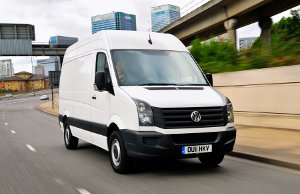
Volkswagen Crafter vanVolkswagen has just launched the new version of its Crafter van. The Crafter is VW’s largest van and has never been as popular in the UK as the Mercedes-Benz Sprinter, despite the two vans being built in the same factory and being very nearly identical, except for having different engines.
The engine appears to be the biggest difference again – VW has replaced the 2.5TDi engine that was previously used in the Crafter with the same 2.0l, 4-cylinder engine that is used in the VW Transporter.

VW says that the engine has been retuned for use in the Crafter so that it provides more torque at lower engine speeds, reducing wear and tear and improving the driving experience. The new engine will be available with approximately the same power levels as the 2.5l unit it replaces – 109PS, 136PS, 143PS and 163PS.

Despite this, the engine will meet not just Euro V emissions standards but the EEV (Enhanced Environmentall Friendly Vehicles) standard, which is something of a halfway house between Euro V and Euro VI. VW says that in Bluemotion trim, the Crafter’s CO2 emissions will start from just 199g/km, very impressive for a large van.

Fleet News was impressed with the new Crafter when they drove it recently and it will be interesting to see if it makes any further headway against the Sprinter, especially in the van rental market.

VW’s official fuel consumption figures look impressive; the 109PS engine is expected to be the most popular and should provide an 11% improvement in fuel consumption on the outgoing model, according to VW’s figures for the combined cycle. Whether it will gain market share against the Sprinter and Iveco Daily is another question.

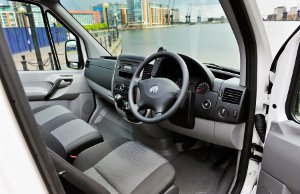
Volkswagen Crafter cab interior

The new Crafter's cab - a very nice place to spend time

Mercedes has a powerful brand advantage – the Sprinter’s reputation is legendary, as is the mileage some Sprinter engines reach. One concrete advantage the Sprinter has always had has been its low maintenance chain cam engine.

VW has always favoured a cambelt-driven engines meaning that the belt requires periodic replacement, as with most car engines. However, maintenance intervals keep getting longer on all vehicles and VW says that owners can opt to run the new Crafter on LongLife oil – meaning service intervals of up to 25,000 miles or 24 months, depending on how the van is used.

Update: In what is perhaps a deliberate move to try and break into the 3.5t fleet market currently dominated by the Sprinter, VW has announced that it will be making 80 Crafters available to large fleet customers for an extended six-month ‘try before you buy’ demo period. These vehicles will be in addition to VW dealer’s regular demo vans. Full details on Fleet News.

Taking A Van Abroad? Keep The Rear Doors Locked

Illegal immigrants trying to smuggle themselves onto Channel ferries by climbing into lorries is old news – but the illegal immigrant problem goes further and can apply to vans, too.

Leaving aside the problem of drivers deliberately trying to smuggle people into the UK (like this recent case at Hull), anyone driving a big van or a luton should still take care to keep the rear doors locked at all times, even when they are in the vehicle.

I often see luton vans driving around with unlocked roller doors – this may be an acceptable risk in the UK, but I would not recommend it if you are anywhere near a ferry port. This does not just apply to Dover-Calais crossings, either – as the case above shows, immigrants are quite willing to endure a longer crossing such as Hull-Rotterdam and perhaps even the Portsmouth/Plymouth-Bilbao service. Someone with a half-full hire van driving back from Spain would make an ideal target.

If you are in a hired luton van with a roller door that has no lock (quite common), make sure you take your own padlock to keep it secure while you are using the van, especially if you are driving abroad. Remember that you will be responsible for whatever ends up in the van – whether it’s illegal people or illegal drugs. You may also want to protect your own possessions from being stolen!

Both Customs and the UK Border Agency seem to be increasingly active at ferry ports. I recently travelled to the continent on the Hull-Rotterdam crossing and my van was stopped by customs for an inspection on the way out. On the way back, we were sniffed by a sniffer dog before boarding at Rotterdam and when we arrived in Hull, we found that the UK Border Agency were having a field day and checking everyone’s vehicle details on the computer as they came off the ferry.

The UK Border Agency makes no secret of the range of facilities at their disposal – sniffer dogs, heartbeat monitors and CO2 detectors all form part of its armoury, especially at Dover, which is the main point of entry to the UK for illegal immigrants. I have also had my van checked over by sniffer dogs at Rotterdam and Bilbao before now, so the chance of detection is quite hig, whichever route you are travelling on.

The law generally holds the driver responsible for the contents of their vehicle, even if people or drugs have been smuggled into the vehicle without the driver knowing. The best protection is good security and an open pair of eyes – you don’t want to be the one that gets caught out.

EU Introduces Biofuel Sustainability Certification – But Will It Really Help?

Nearly four years after I first wrote about the problems caused by the EU’s fetish for biofuels (also see here and here), said EU has finally introduced a certification scheme for biofuels, aimed at trying to make sure that biofuel use does actually reduce carbon emissions and deliver some environmental benefits.

The underlying problem is that the environmental cost of producing biofuels can be quite high, especially where there has been an ‘indirect land use change’. Examples of this include deforestation in South America to make room for growing more sugar cane. Green groups believe that the new certification schemes do not go far enough but they should, at least, be a step forwards. Biofuels that have been grown on land that was formerly forest or wetland will not qualify for certification; hopefully this will remove some of the more blatant abuses from the biofuel production system.

There are seven new certification schemes, covering different types of biofuel and different production locations. To qualify for certification under any of the schemes, biofuels will have to produce at least 35% less greenhouse gas than fossil fuel equivalents.

Of course, all of this still does not address the madness of using food crops as vehicle fuel, thus putting pressure on food prices and availability of edible oils globally. Many farmers around the world have switched from growing food crops to biofuel crops over the last year, thanks to generous subsidies and guaranteed market prices in areas, such as the EU, where biofuel use in regular fuels has been mandated by law.

To me, the use of biofuels makes no sense – it is not sufficiently scalable to drive a serious reduction in fossil fuel use and it is fraught with abuses, complications and inefficiencies that make it likely to cause at least as many problems as it solves. Developing the potential of electric and perhaps hydrogen power for vehicles makes much more sense – and the electricity needed to generate both these fuels should come from a combination of modern power stations (including nuclear) and renewable power generation facilities.

Read more on this issue here, here and here.

The Nottingham Band That Was Born In A Van

Nottingham band The Barnum Meserve had its origins in the van that singer Leon Wiley used to live in between stints working offshore on an oil rig. Readers from the East Midlands may remember going to see them at Nottingham‘s Rock City and Junktion 7 venues before the band split in 2005.

The band is back together now and finalising plans for its debut album – although they are still searching for a record deal. In the meantime, I suspect The Barnum Meserve will be doing as much gigging as possible – perhaps with the help of a hired splitter van.

The band’s music was recently used in the BBC documentary ‘An Abuse Of Trust’ and you can hear some of its latest songs and see the video for the band’s single ‘Broken Window’ on its Myspace page.

For more information on band van hire, click here.

Heading Abroad For A Holiday Home Renovation?

Derelict home in Izeda, PortgualHoliday homes seem to offer the opportunity for endless idyllic holidays, but as anyone who has owned one knows, that is only half the story.

Many people buy old wrecks with the intention of doing them up and even those that don’t often discover that at least some of their holidays will have to be spent on DIY and maintenance work.

If you are working on a big project abroad, one of the problems you might face is arranging for all the supplies you need to be delivered to your holiday home. Not only will you probably have a language barrier to deal with, but you are also likely to have very tight time frames.

After all, if you are planning to spend a fortnight fitting a new kitchen to your Spanish villa, a delivery estimate of ‘the next fortnight’ is not much use. It can’t be delivered before you get there but it needs to be delivered as soon as you get there. My experience of UK building merchants and kitchen suppliers is that kind of precision delivery is a rare thing.

One solution that could save a lot of frustration and risk is to simply take everything you need with you. That way, you can choose, order and inspect your materials at your leisure before you go and know that you will have everything you need to hand as soon as you arrive at your holiday home.

There’s still one problem – I hear you say – how on earth can I get it all there?

Van hire, of course! Plenty of UK companies allow their vans to be taken abroad and modern vans are more than capable of munching up a few thousand foreign motorway miles at respectable speeds.

What’s more, if your holiday home is in Spain, you can hire a van one way from the UK to Spain. Your family can follow along behind or go ahead, you can bring the stuff in the van and then you can return the van and return home with your family.

What could be simpler?

Click here for more information on one-way van hire between Spain, UK and Portugal.

Rise In Drink Driving Following Spending Cuts

The number of positive or refused* breath tests administered to drivers by UK police has risen by 8% this year, according to the latest figures released by the Association of Chief Police Officers (ACPO). This coincides with a massive cut in government funding for anti-drink drive campaigns – funding has been reduced from £3.4m in 2009/10 to just £550,000 in the current financial year.

The latest figures relate to June’s summer drink driving campaign, during which a total of 88,629 drivers were breathalysed by police. Of the drivers tested, 6.06% (5,373) tested positive – a similar figure to the UK figures in the recent Europe-wide TISPOL crackdown, which also took place during June.

These figures are bad enough, but what is worse is that the anti drink-drive message seems to be failing to reach younger drivers. The number of drivers aged under 25 who tested positive in June was 15% higher than in June 2010 – more than double the overall increase in positive tests.

Breath testing is standard procedure for drivers who have been involved in collisions that are attended by police, and the number of positive tests following collisions was 11.27% higher than in June 2010. The total number of accidents recorded was 16% higher than in June 2010, highlighting the link between drink driving and collisions and showing that a cut in anti-drink drive campaign spending could well result in a far higher costs.

It is worth emphasising that the UK blood alcohol limit of 0.08% is one of the highest drink-drive limits in the western world. As far as I know, all other European countries have lower limits – Ireland, one of the few other countries with a limit of 0.08%, is lowering its limit to 0.05% later this year, to bring it into line with most other European countries.

Just to recap, the UK drink drive limit can be expressed in three ways, all of which are equivalent:

  • 0.08% blood alcohol level
  • 80 milligrammes per 100 millilitres of blood
  • 35 microgrammes per 100 millilitres of breath (this is the measure used by police breathalysers)

Cutting spending on anti-drink drive campaigning is likely to prove a terrible false economy. The human and monetary cost to families, businesses and the emergency services is almost certain to far exceed a few million pounds saved by the government.

If you are hiring a van to drive to Europe, remember that most European countries have a lower limit than the UK and in Scandinavian countries the limit is virtually zero.

*Drivers only refuse a breath test when they are expect it will be highly positive and would rather take the penalty for refusing a test than reveal how drunk they are. Refusing a breath test is an offence, the penalties are similar to those for drink driving.