Category Archives: Van News

News and articles about UK vans – especially information relevant to the van hire market. Coverage of new van model launches from all the major manufacturers – Ford, Mercedes, Volkswagen, Peugeot, Fiat and Citroen.

GVT OX

Flat-packed OX van is ready to roll

Back in 2013 we reported on the OX, a flat-pack truck designed for Africa. Fast-forward three years and the OX is ready to go into production.
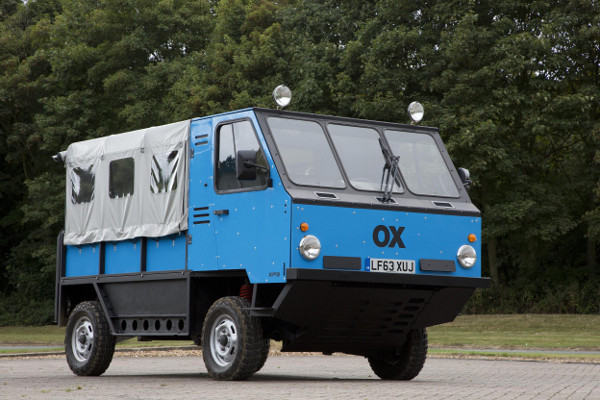
GVT OX

The Global Vehicle Trust OX, designed by Professor Gordon Murray

THe OX is the result of several years of hard work by Sir Torquil Norman’s Global Vehicle Trust and designer Gordon Murray. The flat-pack design means that six flat-packed OX’s can be shipped in one 40ft high-cube shipping container. Three trained technicians can put together an OX in approximately 12 hours, so assembly time is fairly minimal.

The OX is only 4.3m long — significantly less than a short wheelbase van or a pickup. Despite this, the load area is big enough to hold eight 44-gallon drums, three Euro pallets or 13 people. Maximum payload is 1,900kg — roughly double most medium vans and pickups.
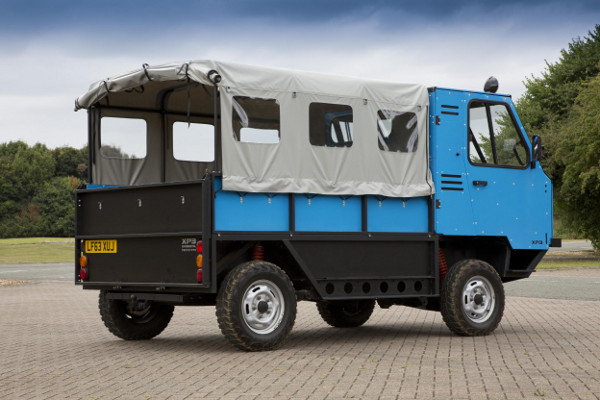
The GVT OX

The Global Vehicles Trust OX, designed by Gordon Murray.

As it’s primarily designed for Africa, the OX has to be able to perform well off road. Although it’s two-wheel drive, the OX has been engineered to ensure that a the front (drive) wheels are always well loaded with weight, providing good traction in all conditions. GVT believe that the OX’s all-terrain ability is “as good, or better, than a four-wheel drive across a range of surfaces”.

The OX is powered by a 2.2-litre diesel engine that’s taken from a Ford Transit. The engine and running gear should be reliable and relatively straightforward to service, albeit not as simple and indestructible as older non-turbo diesel engines might be.

GVT founder Sir Torquil Norman says that feedback from aid agencies and contacts in Africa has been positive. Sir Torquil is now focused on finding funding to put the OX into production. There’s no word on the likely price, but low cost was one a key element of the design brief, so I’d expect the price to be significantly lower than a European van or pickup.
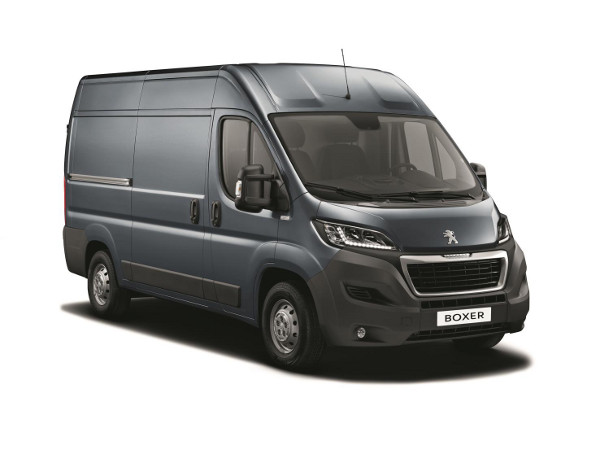
Peugeot Boxer BlueHDi Euro 6

Peugeot Boxer goes Euro 6 with updated BlueHDi engines

The Peugeot Boxer van will now be sold with an updated range of 2.0-litre BlueHDi Euro 6 diesel engines.

This new engine means that all of Peugeot’s van models have now been updates with Euro 6 power plants in order to meet the 1 September deadline after which all new LCVs sold in the UK (and throughout the EU) must meet Euro 6 emissions standards.

Peugeot Boxer BlueHDi Euro 6

The Peugeot Boxer is now Euro 6 compliant, thanks to a new range of 2.0-litre BlueHDi engines.

Improved Performance

The new engine is available in three power levels, all of which are paired with a 6-speed manual gearbox:

  • 110hp and 300Nm, an increase of 50Nm compared to the previous engine
  • 130hp and 340Nm, an increase of 20Nm compared to the previous engine
  • 160hp and 350Nm, an increase of 10hp compared to the previous engine

Stop & Start is standard or optional across the range. Peugeot says thatthe new engine means that the Boxer can now claim record official fuel consumption figures in the large van segment, with the 130hp version offering 47.0mpg with 154g/km of CO2, a reduction of 30g/km CO2 compared to the Euro 5 version.

Euro 6 is not universally popular with van buyers, in part because the addition of an AdBlue tank and Selective Catalytic Reduction (SCR) hardware can cause payload to fall. Peugeot is keen to emphasise that this isn’t the case here.

The Euro 6 Boxer has the same payload as the Euro 5 models. Slightly oddly, Peugeot is also reassuring customers that maximum speed is the same. I’m not sure that’s a big concern for most van operators, but what will be pleasing for drivers is that the performance of the 110hp engine is significantly improved.

According to Peugeot, the 110hp will accelerate from 0-62mph up to 4 seconds quicker than the outgoing model. Overtaking should also be easier, thanks to a reduction of up to 8 seconds in the 50-80mph in-gear acceleration test.

Extra testing for van use

This 2.0-litre engine is a new addition to Peugeot’s van range, but has been in use in the firm’s cars — such as the 508 and 308 — since 2013. To try and make sure that it offers the kind of durability required for commercial vehicle use, Peugeot has subjected the engine to a tougher testing regime than for cars:

  • Specific tests to boost the endurance and durability of the turbo and the exhaust manifold;
  • Tests with a 50% greater load than for private vehicles;
  • Tests in climatic chambers at -30°C and 6,000 extra cycles of thermal shocks compared to private vehicles, equivalent to 15 years of heavy use;
  • Specific ground clearance and endurance tests of the exhaust pipe, with post-treatment spraying with water and mud.

Prices for the updated Boxer start from £20,970, with Professional models from £21,970 and Window vans from £23,070.

UK Van registrations Aug10-16

New van registrations hit 11-year high in August

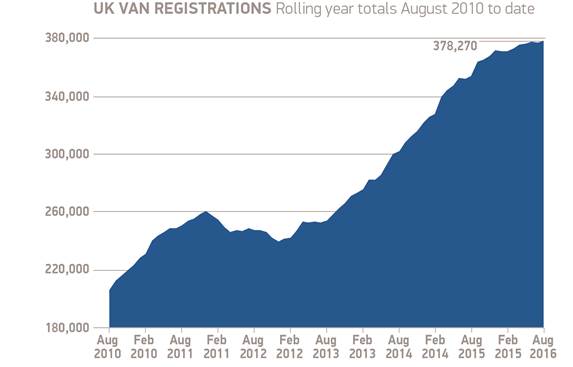
New van registrations clocked their best performance since 2006 in August. A total of 15,385 new LCVs were registered, 6.3% more than during the same month last year. The biggest increase was in the large van (2.5-3.5t category), where registrations rose by 14% to more than 9,600, accounting for 63% of the UK LCV market.

Overall performance for the first eight months of the year remained steady, with a 2.9% increase in demand totalling 231,857 new van registrations.

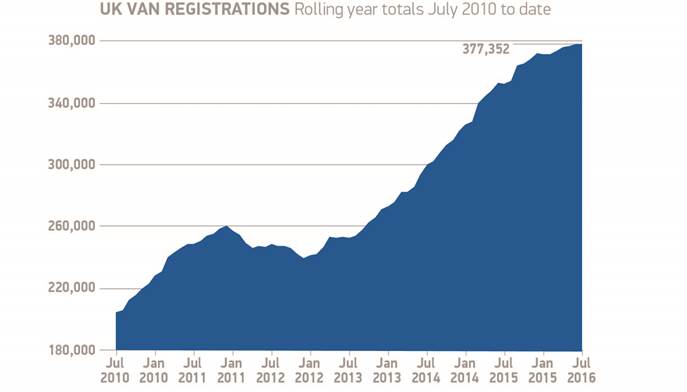
Here’s how UK van registrations have changed since August 2010:

UK Van registrations Aug10-16

UK Van registrations from August 2010-2016. Courtesy of SMMT.

Commenting on the figures, Mike Hawes, Chief Executive, SMMT, said:

“After a slower July, it is good to see growth in the new van market pick up again in August, with a record made in this traditionally quiet month. To ensure this performance continues, it is vital that government takes the necessary steps to secure economic stability and maintain confidence for operators to continue to invest in their fleets.”

Top-selling vans

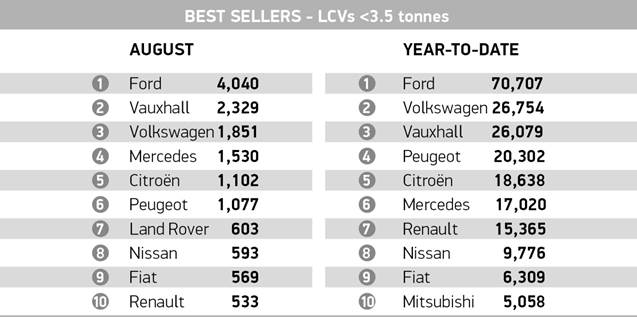
There were few surprises in the best-seller tables for August. Ford retained its position as the best-selling van manufacturer, with 4,040 new registrations in August and 70,707 so far in 2016. In both cases that’s significantly more than the second and third-placed Vauxhall and Volkswagen:

Best selling LCVs August 2016

Ford has dominated the LCV sales charts this year (data courtesy of SMMT)

Although sales during August were unusually high for the time of year, August is traditionally a quiet month and sales are much lower than most other months. For example, Ford’s 4,040 total is 45% lower than the 7,428 vehicles registered for the manufacturer in July.

This lack of volume can lead to quirky results — Renault isn’t really the tenth best-selling van manufacturer in the UK. What’s more likely is that the French firm didn’t register any large fleet orders in August.

Will the van market’s strength continue into the new registration month of September? It will be fascinating to see, as van registrations are often considered to be a useful barometer of the state of the real economy.

Ford Transit key

New Ford key fob promises lifetime reliability for van drivers

Little things can make a big difference when you’re working hard.

Like being able to lock and unlock your van reliably, without having to worry about whether your key fob will still work after having been dropped in a puddle.

Vehicle key fobs fail or need new batteries with tedious regularity. But Ford is determined to rescue hard-working van drivers from this minor form of purgatory.

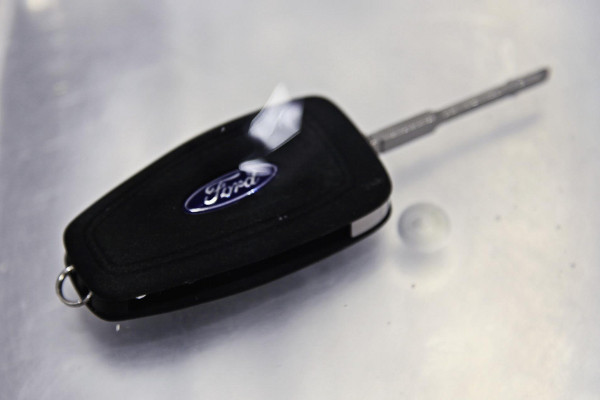
The company has introduced a new ignition key for Transit and Transit Custom vans that promises to be almost indestructible and should never need a new battery.

Ford Transit key

Ford tested the key – for Transit and Transit Custom vans – to ensure it could survive being submerged underwater for 30 minutes, dropped 50 times onto a concrete floor and exposed to temperatures from 60deg C to – 20deg C.

Engineers also tested the key using using climatic chambers in temperatures simulating everything from desert heat to arctic cold, and in humidity levels of up to 100 per cent. Further tests included ensuring:

  • Dust resistance – five hours surrounded by a fine, penetrating dust
  • Chemical resistance – up to 96 hours continuous exposure to diesel, petrol, ethanol, detergents and sweat
  • Pocket simulation – four hours non-stop vibration with coins and other keys
  • Button durability – 10 button presses with 12 times the usual force
  • Endurance – 100,000 activations in temperatures ranging from 50deg C to -10deg C

The new Transit key fob looks like any other ignition key, with a keypad to lock the vehicle and a flip-style key blade. However, to ensure it is completely waterproof, it is permanently sealed shut, with the two halves of the plastic housing joined by friction welding. The inside of the key is carefully designed to resist typical workplace impacts, and a rechargeable battery cell is charged whenever the key is placed in the ignition, to ensure it never runs out of charge.

Personal experience backs up Ford’s claims of ignition key quality. I recently sold a 2001 Transit which I’d owned for eight years. The key fob still worked perfectly.

In contrast, the key fob for my much newer Peugeot car has needed fixing twice in the last three years.

Just another reason to own a Transit, I guess.

Euro NCAP logo (copyright)

5-star safety rating is optional extra on new Toyota Hilux

Euro NCAP logo (copyright)Much of the latest safety technology available on new cars is optional. Buyers must fork out extra cash to benefit from these impressive systems. The problem is that some of these systems make a real difference to how safe the car or van is, as measured by the Euro NCAP safety tests.

It’s probably fair to say that new vehicle option lists have never had such a large focus on safety. Buyers who are willing to pay extra can get a safer vehicle.

To get around this problem, Euro NCAP has recently introduced a new ‘Dual Rating’ testing system. The base version of a vehicle is tested, along with a second model that has a full quota of optional safety equipment. Judging from early results under this new duel testing regime, the differences in safety can be significant.

For example, the new Toyota Hilux scores just three stars in standard specification. However, when fitted with the optional safety pack, the Hilux’s Euro NCAP rating rises to the maximum five stars. I was intrigued by this and wondered what the differences were between the two vehicles.

Where are the safety weaknesses in the standard specification Hilux?

To find out more, I’ve compared the test details for each car. First of all, here’s how each version of the Hilux scores in the four sections of the Euro NCAP test:

Safety test Standard Hilux Hilux with safety pack
Adult occupant 85% 93%
Child occupant 82% 82%
Pedestrian 73% 83%
Safety Assist 25% 63%

It’s clear that the biggest impact of the safety pack is in the Pedestrian and Safety Assist categories. But adult occupant safety also benefits. You can find out much more about what these safety tests mean and how they’re conducted on the Euro NCAP website, here.

Here’s a summary of the differences between the two Hilux models tested.

What’s the same?

All versions of the new Hilux have the same airbags and seatbelt-related features, such as Isofix. Drivers get four airbags, while front passengers get three. There’s an airbag cut-off switch for the front passenger seat, too.

What’s different?

Where things get different is in the driver assistance department. Toyota offers a wide range of safety systems that fall into the category of semi-autonomous driving — they guide the driver’s actions or take partial control of the vehicle in certain circumstances.

These systems aren’t included in the Hilux standard specification, but are available as an optional safety pack. This includes systems which meet the following Euro NCAP test requirements:

  • AEB Pedestrian (AEB = Autonomous Emergency Braking)
  • AEB City
  • AEB Inter-urban
  • Speed Assistance
  • Lane Assist System

These systems have been shown to offer a number of benefits, in terms of both avoiding potential collisions and reducing the impact when a collision does happen. They remain optional on most vehicles at the moment, but I expect them to gradually become standard over the next few years.

In the meantime, drivers — and corporate buyers — will have to choose how much safety they want to pay for when buying new cars, vans and pickups.

Volkswagen Transporter Sportline

VW Transporter Sportline could be top choice for rapid deliveries

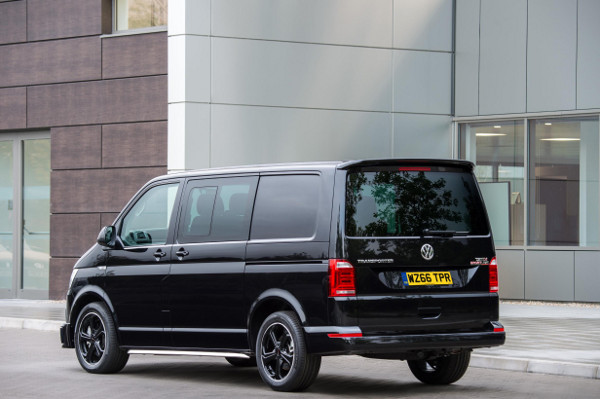
The Sportline badge is set to return to the Volkswagen Transporter range. Initially available on the T32 kombi model, the Sportline grade will be offered in Transporter panel van from early 2017.

Volkswagen Transporter Sportline

The new Volkswagen Transporter Sportline is initially available in Kombi spec and will be available as a panel van in 2017.

The Transporter Sportline will be based on the generous specification of the Highline model, combining sporty features plus a raft of additional equipment designed to give driver and passengers an even more satisfying experience.

The Kombi version of the Sportline will ride on 18-inch bi-colour alloy wheels. It comes with lowered suspension and deeper front and rear spoilers to give a more dynamic look. The Sportline exterior design package also includes trapezoid styling bars with puddle lights and carbon fibre mirror caps.

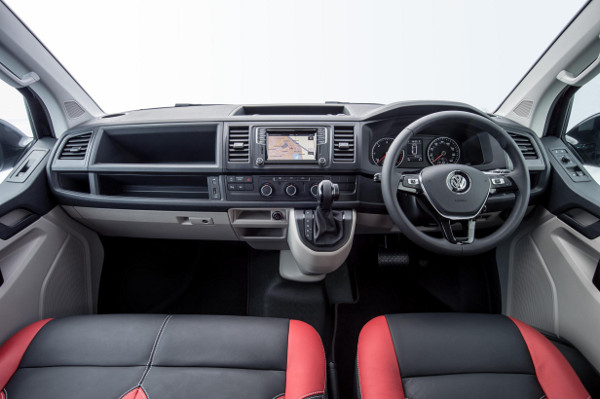
Inside, the Sportline adds in all the features that are often missing from vans. Embossed leather interior trim, Climatic air conditioning, heated windscreen and Discover Media touchscreen navigation system.

Volkswagen Transporter Sportline interior

Leather seats and high spec Climatic air con and infotainment system make the Sportline a comfortable place to spend time.

In addition, the first raft of kombi Sportline models also feature front parking sensors, LED headlights and tail lights, USB input and App Connect – a system that allows owners to seamlessly connect their smartphones to the infotainment system.

Sportline badging and unique Sportline floormats complete the interior look.

The first Transporter available in Sportline trim will be the T32 2.0 BiTDI 180PS kombi model equipped with the brand’s acclaimed seven-speed DSG gearbox. Available to order now from Volkswagen Van Centres, it is priced from £36,295 (OTR exc VAT). First deliveries are expected in September.

Following its introduction on the T32 kombi, Volkswagen will expand the Sportline range further with panel van and additional wheelbase and transmission options available to order later this year for delivery in early 2017. These models will be available with a 2.0 BiTDI 204PS engine, along with a choice of two gearboxes – six-speed manual or seven-speed DSG – and a long-wheelbase variant.

The ultimate owner-driver van for 2017?

BCA van auction

Used van prices creep higher in July

Used vehicle auctioneer BCA says that the average price achieved by vans in its salerooms rose by £23 to £5,931 in July, compared to June’s results.

BCA van auction

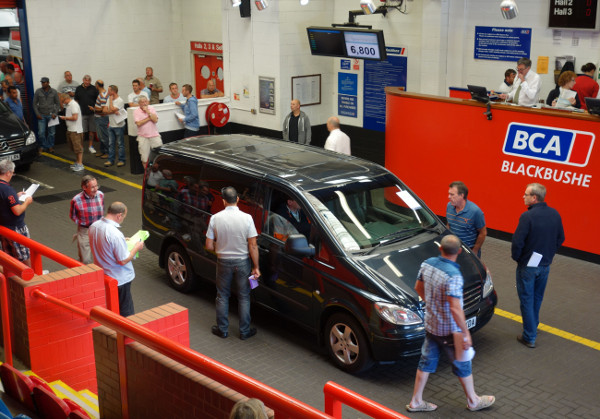
Used van auction. Copyright BCA

This kind of small, monthly change is insignificant, in my view. What’s more interesting is that the average sale price was £387 (6.9%) higher than one year ago. This suggests either that buyers are paying more for the same vans or that they are buying bigger, better or newer vans.

The answer appears to be that the vans are newer. The average age of vans sold by BCA has fallen by 3.1 months since last July, while the average mileage has fallen from 76,182 to 69,632. Duncan Ward, BCA’s head of commercial vehicles, confirms that this is mainly as a result of younger stock flowing into the firm’s salerooms:

“Volumes have risen in the wholesale markets with continuing questions over poor condition stock and while average selling price appears to be holding up, this is largely due to the influence of a younger, lower mileage profile of vehicles currently reaching the market.

Buyers have more choice now than they have experienced at any time this year and are understandably focusing on the best presented vehicles.”

Sounding every so slightly like a stuck record, Mr Ward went on to emphasise that “it is vital for sellers to prepare their vehicles and appraise them in line with market sentiment”. It’s a reiteration of a warning Mr Ward has been sounding for some months now. Strong new sales over the last couple of years means have led to an improved supply of good quality used vans. In turn, this means that battered old vehicles will only sell if they’re cheap.

For August, Duncan Ward expects to see “some pressure on average values” ahead of the new registration plate in September. Volumes remain strong but with condition critical, the average could be pushed down by poorly-presented vans.

Nissan Navara Euro 6

Nissan Navara pickup gets Euro 6 engine

The new Nissan NP300 Navara pickup range now comes with Euro 6 engines only. The move is no surprise, as it comes ahead of the UK’s September deadline for all new LCVs sold in the UK to comply with the tougher emissions standard.

Nissan Navara Euro 6

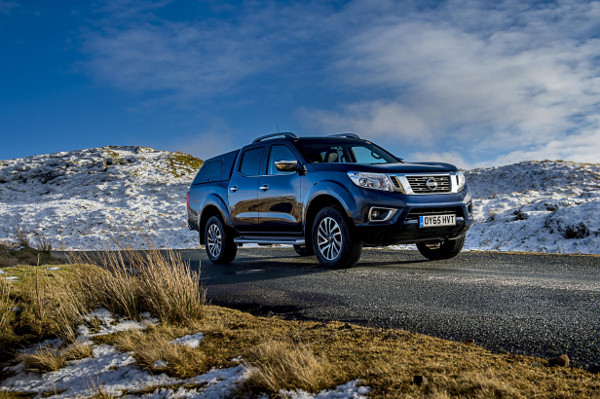
The Nissan Navara is now available with Euro 6 engines only.

The new standard is not not before time, either. Euro 5 has proved to be flawed and less effective than hoped for in actually reducing emissions of poisonous NOx (nitrous oxides) from diesel engines.

Nissan’s upgraded engine will be a 2.3-litre dCi model available in 190PS twin turbo and 160PS single turbo versions. According to the firm, it will make a significant different to the pickup’s environmental perofmrance by cutting CO2 emissions by 8g.km to 159g/km.

The addition of a Selective Catalytic Reduction (SCR) system — a.k.a. AdBlue — promises to reduce harmful NOx emissions too. Nissan doesn’t specify by how much NOX emissions will fall. I suspect the reality is that as road tax rates are only linked to CO2, most buyers don’t really care that much.

What probably will be of interest to potential buyers is that the Navara’s AdBlue tank will hold 17 litres. A tankful will last “up to 7,150 miles”, according to Nissan, after which drivers will need to refill it.

The firm has thrown in a few sweeteners for buyers, who may not be keen on adopting Euro 6. Nissan’s Idle-Stop System (normally known as start-stop) will also be standard across the Navara range, helping to reduce fuel consumption. Navara models now come with a colour combimeter, cruise control with speed limiter, Bluetooth hands-free audio and multi-function controls on the steering wheel.

The one-tonne payload and 3.5-tonne towing capacity remain unchanged, as does the Navara’s 5-year/100,000 mile warranty.

Renault Kangoo Ready4Work

Renault Kangoo now available with pre-fitted racking and storage

Renault has extended its Ready4Work range of dealer-supplied conversions to include offering racking and storage systems for the Renault Kangoo.

Renault Kangoo Ready4Work

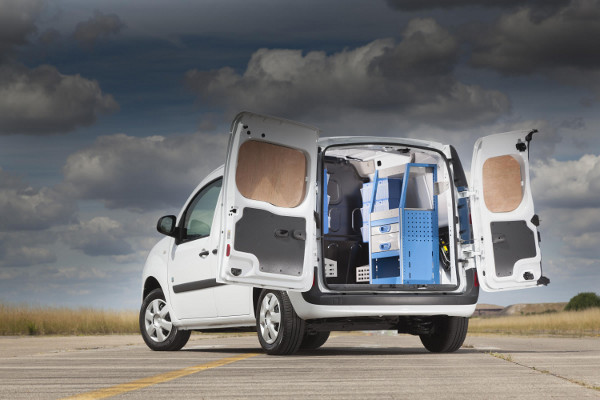
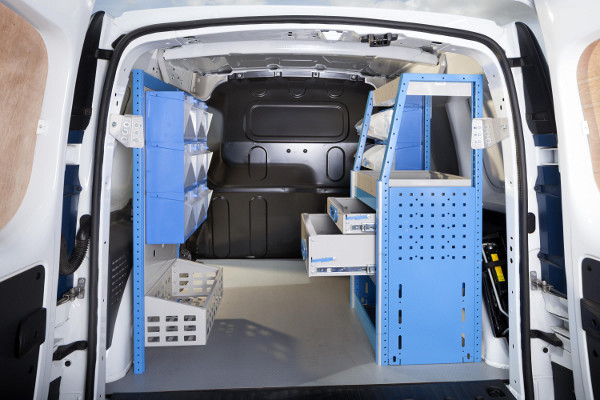
Renault Kangoo fitted with Ready4Work racking and storage kit

Customers can choose from two Ready4Work kits to optimise storage and load space in the back of their vans. The kits will be fitted before the van is delivered to the dealership. Prices start from £1,150 including VAT and can be included in the van’s finance package.

Similar offerings are already available for the larger Renault Trafic and Master vans, so extending this service to the smaller Kangoo makes sense. Unveiled at the 2015 Commercial Vehicle Show and developed in partnership with vehicle storage specialist Bri-Stor, the Renault Kangoo Ready4Work mobile workshop racking systems are designed to cater for the in-van storage requirements of the vast majority of small businesses and trades.

There are two versions of Ready4Work racking available.

Kit 1 is designed to provide engineering tradesmen with an economical racking solution that offers storage for tools, parts and accessories together with the option to add additional features, while Kit 2 is designed to suit the more specialised tradesmen who require an enhanced racking solution for the storage of tools and service equipment.

Renault Kangoo with racking kit

The Bri-stor racking offers a safe and efficient storage solution designed to optimise use of space in the Kangoo.

Both kits are constructed from lightweight, high strength Dual Phase steel with a yield strength of 800N/mm2 and feature the same tool panel assemblies, which each include six Euro bins and 500mm Storage Basket.

Kit 1 also includes a two-part phenolic coated floor (9mm plywood base with anti-slip phenolic coating to the top face) and a unit that has three sizeable tool baskets.

In addition to the tool panel assemblies, Kit 2 adds a unit with shelves and anti-slip matting together with a drawer unit module, which are supported by two heavy duty end frames with punched infill panels.

Utilising pre-assembled sections that are fixed to the van’s existing load lashing points, the kits allow easy and quick installation with no requirement to drill into the Renault Kangoo’s structure, which works to prevent corrosion and maintain residual values.

Both Ready4Work racking kits are covered by the four-year/100,000 mile warranty that comes as standard with the Renault Kangoo and the rest of Renault’s LCV range.

SMMT LCV registrations July 2010-16

New van registrations unchanged in July

Registrations of new light commercial vehicles fell by 0.2% in July to 24,506 units, according to the latest figures from the Society of Motor Manufacturers and Trader. Effectively that means no change from this time last year.

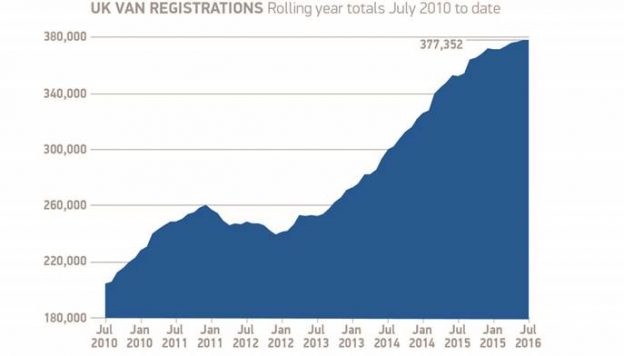
Looking at the year to date, registrations have risen by 2.6% to 216,472 so far in 2016. Registrations have slowed since their record performance during the first half of the year but remain at a post-recession high, as this graph shows:

SMMT LCV registrations July 2010-16

LCV registrations July 2010 to date (courtesy of SMMT)

Discussing the figures, Mike Hawes, Chief Executive, SMMT, said:

“After a record performance in the first half of the year, it was inevitable that growth would start to level off over the summer. Maintaining business confidence for LCV operators will be critical to this sector’s future performance.”

July’s slight decline was fairly evenly spread across the market, with only the sub-2.0t van segment and pickups seeing any gains. Heavy vans (2.5-3.5t) remain the biggest volume sellers, accounting for 3 out of every five vans sold last month.

Best sellers

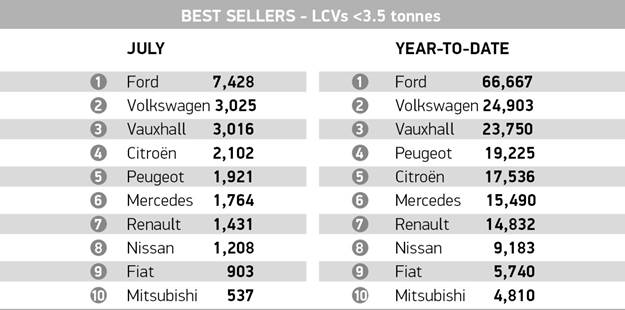
July’s best sellers table looked remarkably familiar. Ford topped the list with 7,428 units registered. That’s more than double second-placed Volkswagen, which clearly isn’t suffering too heavily from the diesel emissions scandal.

Here’s the full list of best-selling brands for July and for the year-to-date. Perhaps the only surprise to me is that Fiat is lagging so far behind its PSA stablemates Citroen and Peugeot. Almost all of these firms’ vans are the same, simply rebadged and sometimes with different engines.

July best selling vans  - SMMT

The best selling van manufacturers in July and 2016 to date (courtesy of SMMT)