
LICENCECHECK RealTime

Beginner’s guide to van hire: driving licence and age limits

LICENCECHECK RealTime

Welcome to the first in a series of posts covering everything you need to know about van hire.

Two of the most common questions we get asked by first-time van hire customers are about driving licences and age restrictions.

Here’s what you need to know.

Driving licence requirements

The short version: If you have a full UK car licence, you can drive virtually all rental vans.

When renting a van, you will also need to provide a driving licence check code – available from www.gov.uk/view-driving-licence (you’ll need your National Insurance number and driving licence).

You may need to know: Your UK car driving licence covers you to drive goods vehicles (like vans) with a maximum loaded weight of up to 3.5 tonnes. Virtually all rental vans in the UK fall into this category.

The only possible problem is if your car licence is for automatics only. Almost all hire vans are manual, so you won’t be able to drive one.

Point on your licence? Most companies allow you to have some points for speeding, but there are usually some limits. Endorsements for more serious offences (e.g. CD, DD, DR or DG) are likely to bar you from hiring. The rules vary between companies, so if you are unsure, ask before you hire.

Age restrictions

The short version: If you are aged between 25 and 75, you shouldn’t have any problems. If you’re aged between 21 and 25, some companies will let you hire a van, but you’ll usually have to pay extra.

You may need to know: Age limits are not set in law, they are chosen by hire companies. Most of the big companies have slightly different rules to each other.

In general, drivers aged 21-25 will need to pay a young driver surcharge. In some cases, companies won’t accept drivers below a certain age at all. Younger drivers may also only be allowed to hire smaller sizes of van.

The rules are even more arbitrary for older drivers. Some companies do not specify any restriction. Others have an upper age limit. This is often 75.

If in doubt, check directly with the hire company you want to use before booking.

Still got questions?

We have more information about age limits for specific companies here.

We also have a lot more information on our van hire FAQ page.

If you’re still stuck, drop us an email or get in touch on Twitter @vanrentaluk

Deutsche Post StreetScooter Ford Transit electric van

Deutsche Post plans Ford Transit-based electric van

Deutsche Post StreetScooter Ford Transit electric van

Deutsche Post will produce a new electric van using a Ford Transit chassis and bespoke electric drivetrain and body.

Electric vans may still be a rarity, but German logistics giant Deutsche Post is making a big commitment to e-power. The group has announced plans to build a new e-van based on a Ford Transit chassis. Production is due to start next month (July 2017) and expectations are for “at least 2,500” of these vans to be in use by Deutsche Post DHL Group by the end of 2018.

Deutsche Post isn’t without experience in this area. The vans will be made by the group’s subsidiary, StreetScooter. As I reported in January, this former startup has already designed and produced a smaller electric van model. The postal group is already using 2,500 of these smaller vans throughout Germany. Plans are now in place to scale up production to 20,000 units per year.

StreetScooter’s new Ford Transit-based electric van will be equipped with a battery-electric drive train and fitted with a special body construction based on Deutsche Post and DHL Paket specifications.

The company expects that this new model will help the project become the largest manufacturer of all-electric medium-duty delivery vehicles in Europe.

It may seem unlikely for a logistics group to be designing and manufacturing its own vehicles. But in my view it’s a sign of the times. Large vehicle manufacturers have been slow to take advantage of this new technology and are perhaps constricted by their need to make models with commercial appeal for a wide range of customers.

Corporate giants such as Deutsche Post have the scale and financial firepower to leapfrog the automotive industry’s development processes. They can — and are — simply producing the vehicles they want using readily available technology. It’s a similar situation to the increasing number of large US companies who are switching away from conventional electricity companies and generating their own green electricity from solar farms.

The automative world is changing, folks. And this is only the start.

BCA van auction May 2017

Used van prices rise as ex-rental stock drives down average age

BCA van auction May 2017

I read somewhere the other day that 50% of used cars resold at 6-18 months old are ex-rental models. I’m not sure if the same statistics apply to the used van market, but what is clear is that the van rental sector has a big influence on the average age, mileage — and price — of used vans going through auction.

Auction group BCA released its used van sales report last week. BCA says that the average used van price in May was £6,452, up marginally from £6,431 in April. The average price was 9.5% higher than in May 2016, but as this table shows, both average and and mileage have fallen significantly over the last year:

All vans Avg Age (mnths) Avg Mileage Avg Value
May 2016 54.42 71,121 £5,892
May 2017 50.28 66,291 £6,452

Source: BCA

The firm says that the decline in average age and mileage is “largely as a result of the influx of younger rental stock over recent months”.

However, Duncan Ward, BCA’s LCV Operations Director, says that rental volumes are easing and described May as a “fragmented” and “patchy” month:

“Buyer demand was patchy during May as professional buyers had a choice from a wide selection of stock and inevitably cherry-picked the best presented and most desirable vehicles.  The Bank Holidays and half-term were additional distractions that fragmented demand during the month.”

This doesn’t sound especially positive to me. It will be interesting to see whether a more settled June follows. If buyer demand remains patchy, average prices could soon start to weaken if volumes remain high.

Questor Insurance logo

[EXPIRED] Discount code for June: Questor Insurance

Questor Insurance logo

The insurance excess when you rent a van (or a car) is often £500 or more. If you want to reduce this to £0, then the hire company will usually charge you an extra daily fee.

One of the best ways to save cash when hiring a car or van is to buy your excess protection insurance from a specialist company, not from your hire company.

Questor Insurance offers excess protection insurance for van hire from just £6.19 per day. That’s much cheaper than some rental companies.

To cut the cost even further, we have a 5% discount code from Questor for you to use in June. Here are the details:

  • ** THIS DISCOUNT CODE HAS NOW EXPIRED **


Terms and conditions apply. See Questor Insurance website for details.

The new Volkswagen Crafter

Volkswagen sets safety standard with AEB on all new vans

The new Volkswagen Crafter

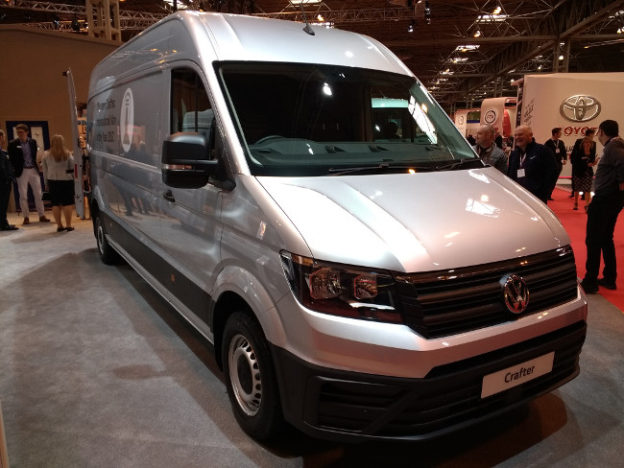
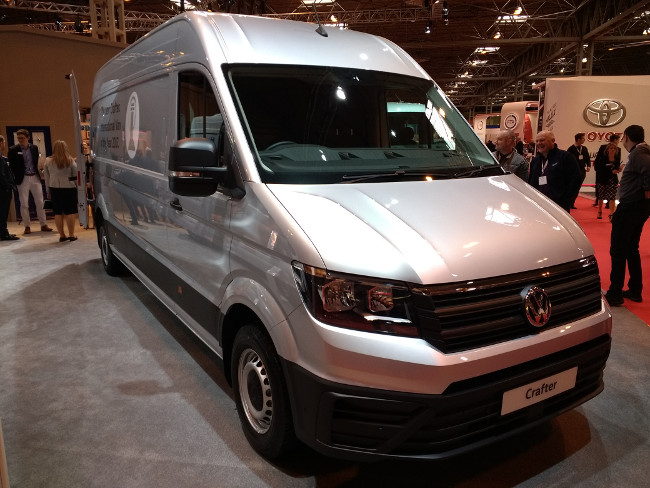
The new Volkswagen Crafter will be fitted with AEB as standard from 1 June 2017, as will VW’s other van models.

Volkswagen has announced that it will become the first manufacturer to fit all of its new vans sold in the UK with an autonomous emergency braking system. The decision applies to the firm’s Caddy, Transporter and Crafter vans from 1 June 2017.

Autonomous Emergency Braking, or AEB, is fast becoming one of the most important safety systems on modern vehicles. It uses front-facing radar to apply the brakes automatically and stop or slow the vehicle if a collision seems likely.

AEB is already fitted as standard to many cars, but fitment to vans has lagged behind. Where AEB is available, it’s often an option.

According to Thatcham Research, who conduct Euro NCAP safety testing in the UK, AEB has the potential save more than 100 lives and avoid 120,000 casualties over the next ten years. It can reduce the number and severity of collisions and has also been proven to cut third party injury insurance claims by 45 per cent.

Peter Shaw, Chief Executive at Thatcham Research, said:

“Volkswagen is a trailblazer and should be applauded for being the first manufacturer to fit AEB as standard on all its vans in the UK.  The truth is that we are seeing a year on year rise in deaths and serious injuries involving vans which this technology can help to avoid.”

Volkswagen says that vehicles fitted with AEB benefit from an average insurance premium reduction of 10%.

The firm’s AEB system has two elements, The first is Front Assist — which alerts the driver and applies the brakes if necessary if an obstacle is approaching too quickly. The second element is City Emergency Braking, which will automatically brake the vehicle at speeds of under 18mph if the driver fails to see or react to an obstacle.

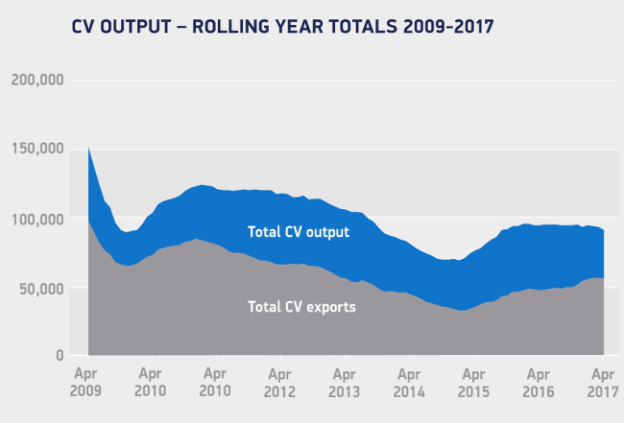
CV output rolling year April 2009-2017

UK commercial vehicle manufacturing volumes fall 28.3% in April

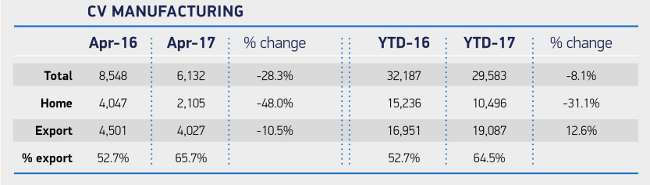
Commercial vehicle manufacturing output from UK factories fell by 28.3% to 6,132 units in April, down from 8,548 during the same month last year.

The latest figures from the SMMT show a sharp decline in output for April. One argument put forward by the motor industry trade body is that the timing of Easter (late April) reduced the number of working days in April, depressing output.

Easter fell in March last year, so there’s obviously some truth in this argument. However, I don’t see how an extra two days off can account for a fall in production of nearly one third. Strangely enough, manufacturing output also fell in March 2017, even though the same period last year contained two bank holidays that moved into April this year.

It seems clear to me that underlying demand is also falling. That’s not necessarily a problem after a long period of strong demand, as Mike Hawes, SMMT chief executive, explains:

“With fewer working days in April and following two years of exceptionally strong demand, it’s not surprising to see a decline in CV output, especially when you consider the effect of fleet buying cycles on manufacturing timing. However, as the proportion built for export reaches levels not seen since the start of this decade, it highlights the importance of maintaining good links with our biggest trading partner, Europe. Securing a strong trading relationship will be vital to the continued success of UK CV manufacturing.”

Looking at the figures in more detail, it’s clear that it’s weak demand in the UK which is really eating into the output of our factories:

UK CV manufacturing April 2017

Source: SMMT

UK demand almost halved in April and has fallen by nearly a third so far this year. That’s a hefty decline. Although some of this may be due to shifting fleet replacement cycles (some of which can account for hundreds of vans in a single order), I suspect underlying demand may have weakened somewhat.

It will be interesting to see which way orders go for the remainder of the year. If bank holidays and fleet purchasing cycles are to blame for the slump in demand, I’d expect some normalisation during the remaining seven months of the year.

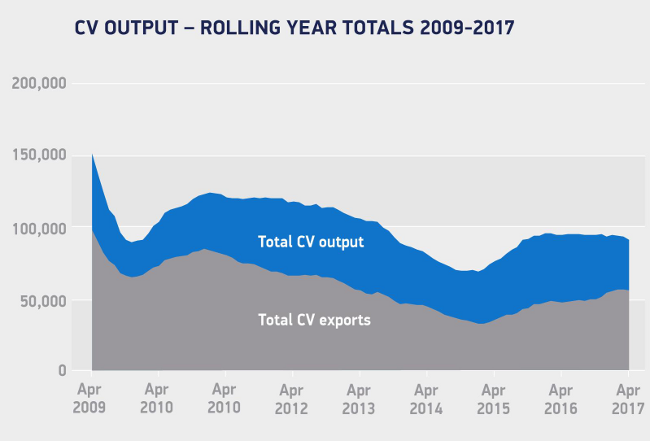
After all, it’s worth putting these figures in perspective. Export demand is up by 12.6% so far this year and overall production has only fallen by 8%. Looked at on a bigger scale — from April 2009 up to April 2017 — the picture still looks fairly benign:

CV output rolling year April 2009-2017

Source: SMMT

Falling age and mileage drive used van prices higher – Manheim

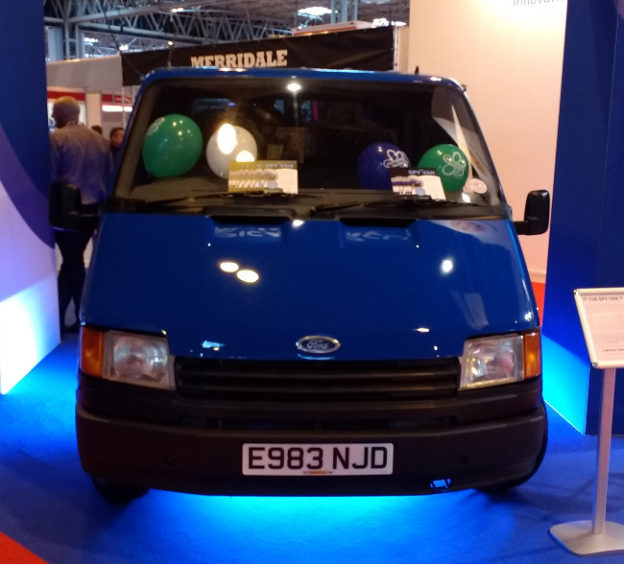
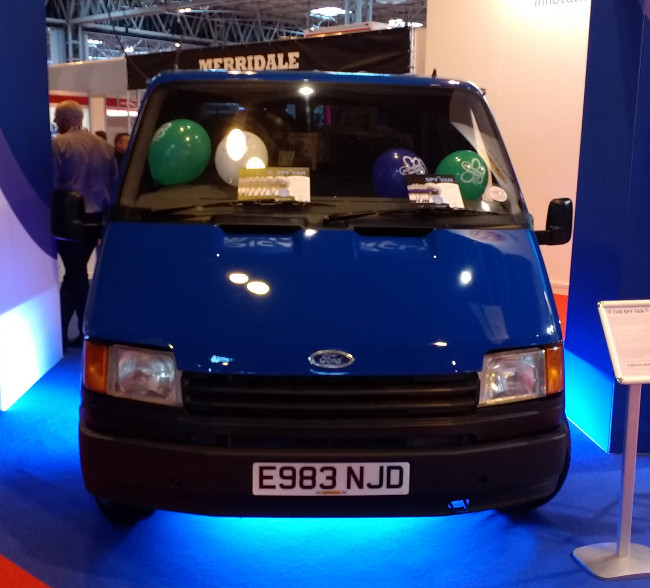
The Spy Van is a former HMRC undercover vehicle. Fitted with a range of high-tech kit (see below) it’s been restored by Manheim LCV expert James Davis and went under the hammer to raise funds for Alzheimers Society on 22 May 2017.

Used vans sold by Manheim auctions in April fetched an average of £5,154 — a whopping 13.8% more than during the same month last year, according to the latest figures from the auction group.

Fortunately for buyers, the increase was largely due to a significant fall in age and mileage, rather than a boom in demand. The average age among vans sold in April was 63 months, versus 70 in April 2016. Similarly, average mileage fell by more than 10,000 miles to 74,731.

The company says that among the most popular models were Ford Transt 280 SWB models and high spec Ford Transit Custom vans. Long and extra-long wheelbase Sprinters were in demand, as were top spec VW Transporter models.

Less popular were base spec Transporters, older Transits, big Citroen and Peugeot vans and — perhaps unsurprisingly as we head into summer — several of the leading pickup models.

The company says it remains confident about buyer demand heading into the summer, despite April bringing “a slightly tougher atmosphere in the commercial vehicle market than we have seen so far this year”.

Finally, if you’re wondering what the picture at the top is all about, I’d like to offer congratulations on behalf of vanrental.co.uk to Manheim’s James Davis. James’ painstakingly restored ex-HMRC Spy Van Ford Transit fetched a record £10,300 auction earlier this week. All proceeds are going to The Alzheimer’s Society.

You can see photos of the Spy Van in my CV Show 2017 write up, or check out James’ Facebook page at www.facebook.com/Therestorationvanman/

Renault Kangoo Z.E. wireless charging

Renault showcases wireless battery charging at 60mph

Renault Kangoo Z.E. wireless charging

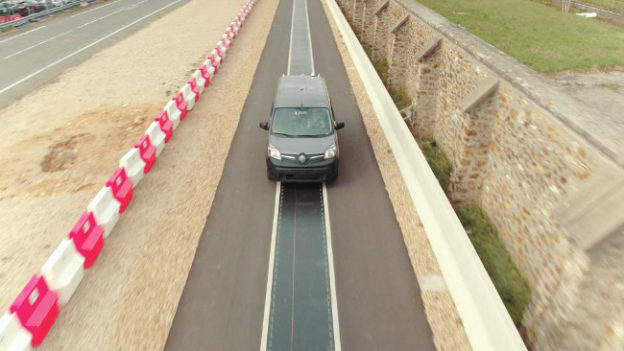
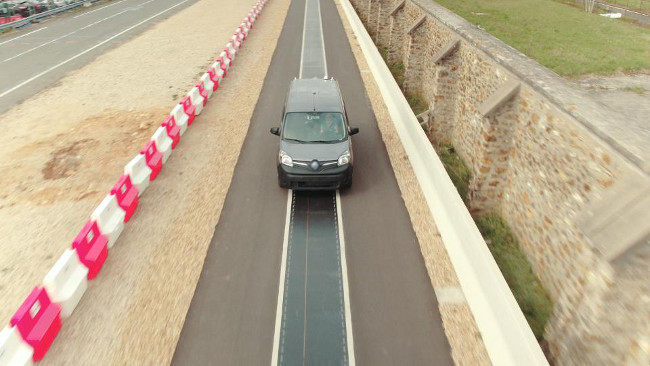
The solution to range anxiety? Renault has demonstrated a wireless charging system allowing vehicles to be charged while driving at speeds of up to 62mph over a special charging track. (source: Renault)

Charging battery-powered devices — from smartphones to cars — is without doubt the most inconvenient aspect of owning an using them. Being tethered to a power point by a cable often means the device can’t be used.

In the case of electric vans and cars, a flat battery at the wrong time could leave you stranded roadside or unable to set off on an important journey while charging is underway.

Range anxiety is certainly the only reason I won’t buy an electric car — we only have one car in our household and it needs to be able to do long journeys as well as short ones.

All this may soon change. On Thursday 18 May 2017, Renault demonstrated dynamic wireless electric vehicle charging (DEVC). This allows an electric vehicle to be charged while driving at speeds of “up to, and excess of” 62mph (100kmh).

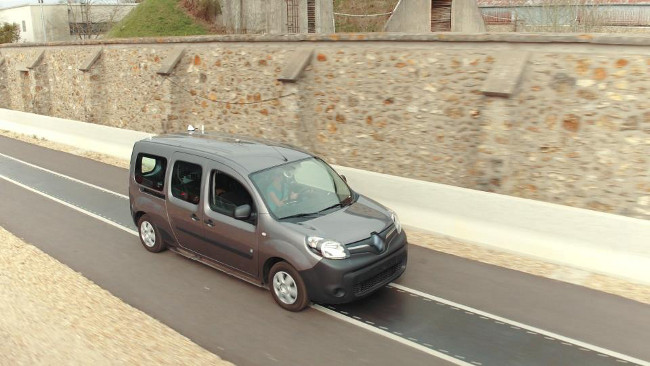
Renault Kangoo Z.E. using DEVC wireless charging

Renault Kangoo Z.E. driving along DEVC wireless charging track (source: Renault)

The DEVC system has been designed with partners Qualcomm Technologies and Vedecom. It allows a suitably fitted electric vehicle to pickup charge in both directions when driving over a charging track.

So far, the only charging track available is a 100m strip on the FABRIC project sit at Satory, Versailles, near Paris. Further testing is now planned. But the potential of this system seems obvious.

Motorways and other trunk roads could potentially be fitted with charging tracks, allowing electric cars to be charged during long journeys, extending their range without the need for long pit stops at roadside services. Car parks and driveways could be fitted with charging strips, negating the need for plugin connection points.

These wireless DEVC solutions are being investigated as part of the FeAsiBility analysis and development of on-Road chargIng solutions for future electriC vehicles (FABRIC) project, which is being run by a consortium of 25 partners from nine European countries. The main aim of FABRIC is to conduct feasibility analysis of wireless DEVC as a means of EV range extension.

It’s still early days, but technologies like this leave me more convinced than ever that the future of automotive power will be mainly electric — for both cars and vans.

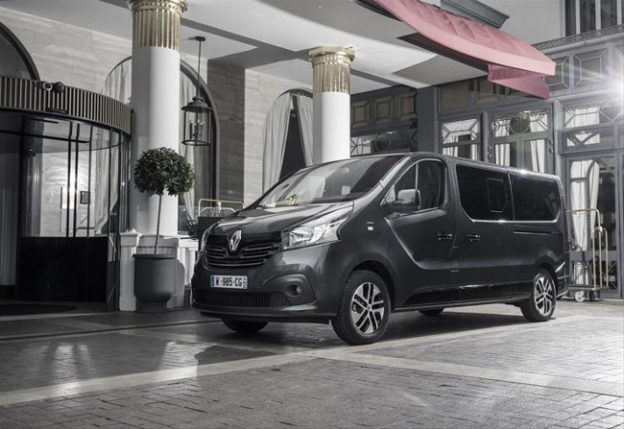
Renault Trafic SpaceClass

Renault targets VIP market with new Trafic SpaceClass

Renault Trafic SpaceClass

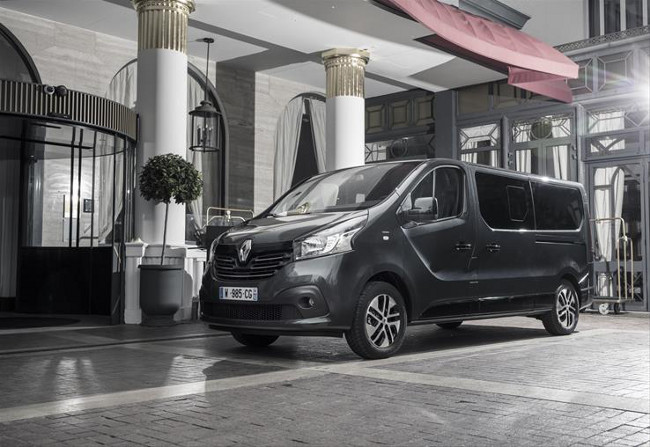
The new Renault Trafic SpaceClass executive minibus goes on sale in September 2017.

Renault’s new Trafic SpaceClass minibus was launched at Cannes Films Festival, where it served as a shuttle to deliver VIP guests to the red carpet.

It was a fittingly upmarket and French introduction for a model that’s clearly aimed at the VIP airport and taxi market, a model currently dominated by Volkswagen Caravelle and Mercedes-Benz Viano.

The Trafic SpaceClass is designed to seat up to nine people in comfort, but I suspect it will more commonly be used for a maximum of six passengers — the number of people who can fit on the modular seas in the rear compartment of the van. These can be configured in forward-facing rows, or so that the two rows face each other, providing a lounge-type setting.

Renault Trafic SpaceClass interior

As you’d expect, the Trafic SpaceClass has been loaded up with creature comforts. Depending on the version chosen, these include dark-tinted rear windows, individual LED reading lamps, leather seats and regulated air conditioning. A mobile office setup is also available, including a pivoting seats and a removable central table. All versions include 220V and USB sockets for charging devices in the front and rear of the vehicle.

Improved driver

Upfront, the driver isn’t neglected, either. He or she will enjoy the tactile pleasure of a leather-covered steering wheel, plus a dash design that’s been enhanced with chrome and gloss-black inserts. A 7-inch central touchscreen provides access to the MediaNav navigation system, reversing camera or R-Link with Android Auto, depending on the version.

Renault Trafic SpaceClass dashboard

On the outside, the Trafic’s already stylish looks have been upgraded with extras such as 17-inch diamond-effect alloys, Comet Grey launch paint, body-coloured bumpers and a chrome grille — all of which may vary slightly depending on what version is chosen.

The Trafic SpaceClass will go on sale in September 2017 in most European markets.

BCA van auction April 2017

Used van prices fall as fewer ex-hire vans reach market

BCA van auction April 2017

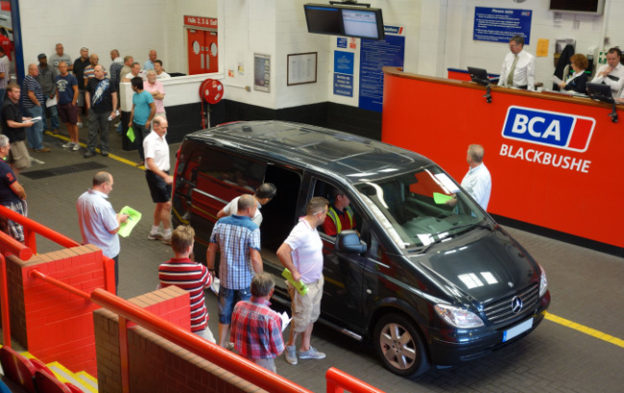
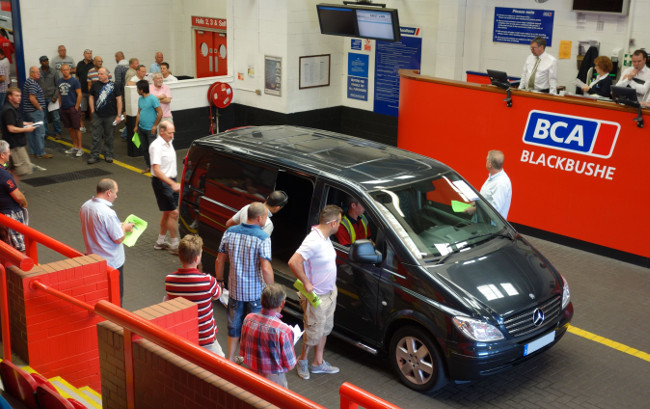
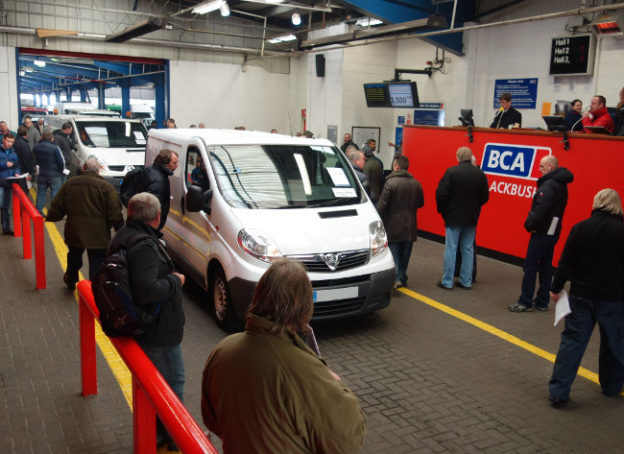
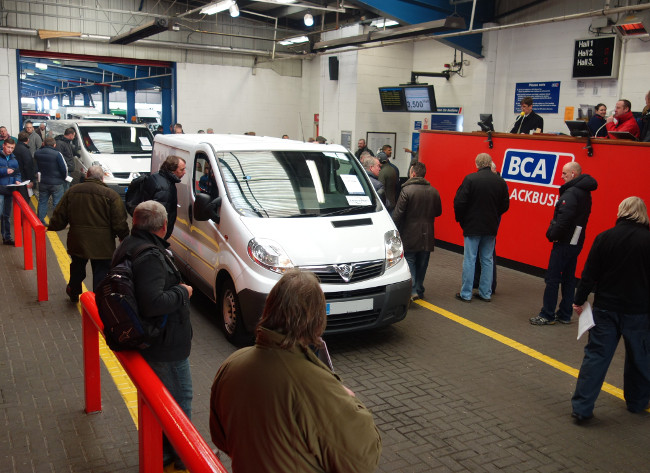
Vans being auctioned at BCA Blackbushe

The average price of a used van fell by 1.4% to £6,431 in April, according to the latest figures from auction group BCA.

It’s the second consecutive month of declines, a trend BCA says is caused by a reduction in the number of late-plate ex-hire vans reaching the market. Despite this, prices are still ahead by £465, or 7.9%, on a year-on-year basis.

One factor supporting prices is probably the continuing reduction in average age and mileage — used vans are getting newer as fleet replacement cycles contract and return to normal:

All vans Avg Age (mnths) Avg Mileage Avg Value
Apr 2016 54.05 73,758 £5,966
Apr 2017 50.89 67,196 £6,431

Source: BCA

According to BCA, ex-fleet and lease prices remained flat in April, while dealer part-exchange prices (older vans) fell.

Duncan Ward, BCA’s LCV Operations Director, says that overall demand remains healthy:

“The market dipped slightly in the post-Easter period but overall demand has held up well, particularly when considering external factors such as the snap election, which might have introduced some uncertainty.

“The model mix is starting to change as we are seeing rental volumes easing for the first time this year, while 4×4 double cab volumes continue to rise.  The latter sector has seen some price pressure in recent weeks as a result of these increased volumes and the price guides have not always reflected this.”

My view is that the used van market has largely been flat-lining this year. That’s not surprising, given the keen financing offers available on new vans, and the beginnings of a slowdown in new van registration rates.