
Škoda Monster Truck Is World’s Biggest Ice Cream Van

Skoda vRS Ice Cream van

Free ice cream! The world’s largest ice cream van will be coming to an event (or a television screen) near you very soon!

Fancy an ice cream? It’s free, but you’ll need a ladder to get to the counter!

The Škoda vRS giant ice cream van was launched at Great Yarmouth today and is the latest stage in the firm’s marketing campaign to celebrate the launch of the Octavia vRS, which is the fastest Škoda ever. A crack team of Škoda engineers were given the task of bringing the same qualities that go into the car to other everyday objects.

The result is every child’s dream – a giant ice cream van complete with 5 foot monster truck wheels and four mega speakers. Other objects that have already received the vRS treatment include a giant toy ‘trike’, lawnmower with multiple exhaust pipes and flaming go-faster stripes, and the vRS Man-Pram.

The giant ice cream van, which measures over 21 feet, weighs in at a chunky 5.5 tonnes.  It took the team of engineers over 3 weeks to create and stars in the new advert for the Octavia vRS, which hits TV screens on Sunday 25 August.

What is it really?

As this is a van blog, I thought I should try and identify the vehicle behind the giant ice cream van. Naturally, Škoda wasn’t saying, but I reckon I’ve worked it out. Although my first thought was that it was an old Mercedes Unimog, it didn’t look right, and a closer look at the press photo reveals Škoda’s giant ice cream van has a ‘Step Van 30’ badge.

A quick Google later, and I’m fairly sure it’s an American import — a Chevrolet Step Van 30. To show you how they normally look, here’s an example of a road-going Step Van 30 ice cream van.

Where can I see it?

The giant ice cream van will be visiting and serving free ice cream at:

The new advert will feature in commercial breaks during the Premier league matches between Manchester United and Chelsea and between Cardiff City and Manchester City on Sky Sports. The advert will also appear on Channel 4 during the return of BAFTA nominated drama Top Boy as well as on Five during the final Ashes test between England and Australia.
Volkswagen 2013 Brazil T2 Kombi vs 2013 Euro Transporter: Some Things Haven’t Changed

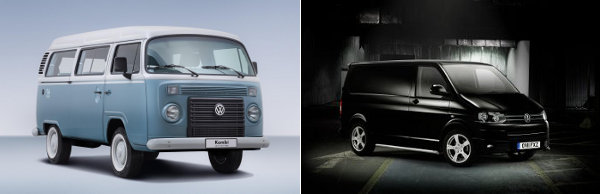
You may not be able to imagine walking up to your local Volkswagen dealer and ordering a new rear-engined Kombi van like the one pictured below, but if you lived in Brazil, you could.

Volkswagen started producing the Kombi vans in Brazil on 2 September 1957, and is still making them today — making it the longest-produced model in automotive history, according to the firm. However, after 56 years, VW is calling time on the Brazilian T2 Kombi and ceasing production of the model, which is getting a little long in the tooth.

The Kombi Last Edition is a 600-unit special edition model that’s been designed to commemorate the end of Kombi production in Brazil, so to mark the occasion, I thought it would be interesting to compare the current-day Kombi with the model that has since replaced it in Europe, the Transporter T5.

Volkswagen Brazil Kombi vs T5 Transporter

Volkswagen’s Brazil-built T2 Kombi Last Edition alongside a current T5 Transporter Sportline. Hard to believe both vans are in current production!

The Kombi’s 80hp 1.4-litre petrol engine may have a comparable power output to the current base model T5’s 84hp 2.0TDi diesel engine, but the similarity stops there. The present day van offers a whopping 220Nm of peak torque from 1,250-2,500 rpm, whereas the Kombi only offers its 124Nm of peak torque at a fuel-guzzling 3,500rpm.  What’s more, the top of the range T5 offers a jaw-dropping 180hp and 400Nm of torque — figures that couldn’t even be imagined when the Kombi was designed.

The drivetrain changes don’t stop there. While the T5 transmits all of that lovely torque to the front wheels via a slick, modern six or seven-speed gearbox, Kombi drivers have to make do with a somewhat rustic 4-speed gear box and rear-wheel drive.

Fuel economy is not officially specified for the T2 Kombi, but it’s probably fair to assume that this brick-shaped oldster won’t come anywhere near the 37.7 combined mpg figure that Volkswagen specifies for its modern-day sibling.

Long-distance drivers would be well advised to stick with a T5, too — while the modern Transporter can cruise at 70mph all day long, cossetting its occupants in air-conditioned, audio-enhanced luxury, the T2 Kombi has none of these features and will struggle to maintain a solid 70 on the motorway. As a special concession, Volkswagen has pushed the boat out with the specificiation of the Kombi Last Edition, which will include an MP3 sound system “with red LEDs” and auxiliary and USB ports!

Although the Kombi has been hugely popular in Brazil, and its robust simplicity presumably makes it much cheaper and easier to repair than a T5, the T2 isn’t as cheap as you might expect. According to this Autocar review, the T2 Kombis cost £14,800 in Brazil, while T5 Transporters start from £18,085. I’m not sure that’s a big enough discount for such basic technology.

However, there is one area where nothing has changed over the years: practicality. The Kombi’s ability to be both load lugger and people carrier was always one of its defining features and selling points, and this hasn’t changed. Both vans offer a large, flat load area and a sliding door that allows a surprisingly wide range of loads to be carried in the van. Both can be converted into comfortable 9-seaters that are no bigger than a large car, and both can be turned into the compact, flexible campervans that have been the vehicle for so many dream holidays.

The Kombi is a true design classic that has stood the test of time remarkably well. Sadly, the world around it has grown up and got all sophisticated and safe — and much faster moving. I’m not sure it’s more fun, though.

Van Hire Isn’t The Only Cheap Way To Move Stuff

Although vanrental.co.uk is dedicated to van hire, we’re always trying to help visitors find the cheapest, most effective way to move their stuff — and sometimes, van hire isn’t the best answer.

Today, I’d like to tell you about an alternative service that offers a real alternative to van hire.

Basically, the idea is that you hire empty space in a courier van, and the courier will take your item and deliver it to its destination. The service is called Anyvan.com and it’s something I mentioned in a recent vanrental.co.uk newsletter, but in case you missed it, here’s a quick summary.

  • List your item online with details of its size, location and destination
  • Couriers who will be in your area with empty space in their vans will provide you with quotes through the Anyvan system.
  • You choose the best quote, then sit back and wait for your item to be collected…
  • …and delivered to its destination — all without you having to drive anywhere.

To me, it sounds like an ideal way of collecting or delivering a large eBay purchase — maybe a sofa or wardrobe that won’t fit in a car.

In my view, there are two particular situations where you could save a lot of money by using Anyvan.com instead of hiring a van:

  1. Your delivery destination is a long way away, so if you hired a van, you would have a lot of fuel to pay for, or would have to pay extra for a one-way hire and then catch a train or bus back home -> it’s all very expensive.
  2. You only have one or two items to move, but they won’t quite fit in your car, or you don’t have a car. If you hired a van, it would be 3/4 empty but you’d still have to pay the full cost of the hire and fuel -> it’s all very expensive.

Regular users on Anyvan get eBay-style user ratings, so you can see how reliable other people have found their services. In some ways, the whole setup is a bit like eBay — and indeed, it’s ideal to use for large eBay purchases, as I mentioned above.

Anyvan.com is an interesting new service that I think could be worth a look if you have one or two large items that need to go in a van, but won’t fill it up.

Niki Lauda’s Rush Ferrari Team Van Is For Sale

Niki Lauda Team Ferrari van from Rush

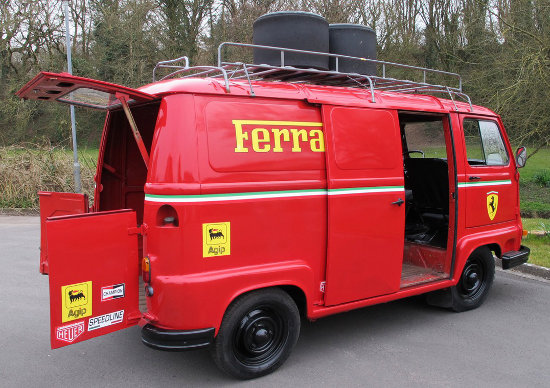
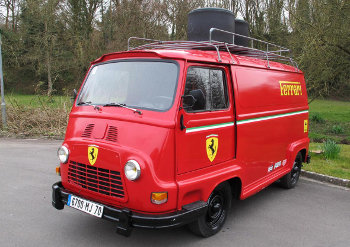
1979 Renault Estafette Niki Lauda Ferrari Team van

I’m always a sucker for a smart classic van. Although I wouldn’t necessarily want to own one as an everyday vehicle, they’ve got real character, especially when they have a smart paint job and an exciting provenance.

This 1979 Renault Estafette van must be pick of the bunch — Niki Lauda’s Team Ferrari van as used in the upcoming film Rush. Although this isn’t an original Team Ferrari van, it is an original vehicle that has been faithfully adapted.

With just a few weeks left before Ron Howard’s epic film ‘Rush’ — which documents the epic rivalry between James Hunt and Niki Lauda — appears in cinemas nationwide, this van is being auctioned at CarFest South by Silverstone Auctions on Sunday 25th August, at Laverstoke Park Farm.

This particular van Renault van started life as a fire truck on the French/Swiss border, but has been faithfully modelled for its new role, with authentic factory paint and decals from one of Formula One’s most exciting eras, the late 1970s.

Will Smith, classic car specialist, Silverstone Auctions, said:

“With ‘Rush’ set to thrill cinema goers, our CarFest South auction couldn’t be better timed for one of its star characters, albeit one with four-wheels.

“It’s a great little van, which even comes complete with fat Avon racing tyres on the period roof rack, and I’m sure it would be the ultimate addition to any Ferrari collection or race team.”

Niki Lauda's Team Ferrari van in Rush

1979 Renault Estafette Niki Lauda Ferrari Team van

Estimated at between £15,000 to £20,000, the van is one of more than seventy lots being offered in the ‘Pride & Joy’ auction. Also being offered are a variety of charity lots where all the money raised will go to BBC Children in Need.

For more information this Renault Estafette, or any of the lots on offer, then visit www.silverstoneauctions.com.

Is This The Hottest Vito On The Road?

Mr Raja's customised Mercedes-Benz Vito Sport X

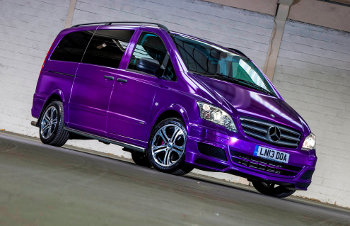
Mr Raja’s customised Mercedes-Benz Vito Sport X, including a purple vinyl wrap!

Distribution company boss Zamir Raja chooses Mercedes-Benz trucks and vans for their unwavering reliability and low operating costs. When it comes to his personal transport, though, he prefers a vehicle with a touch more individuality and flair.

That vehicle is the dynamic Mercedes-Benz Vito Sport-X, a machine that proves you can mix business with pleasure.

Powered by a fire-breathing V6 engine that pumps out an eye-watering 224 hp, and with muscular Brabus-styled looks to match, the Sport-X is the van industry’s “wolf in wolf’s clothing”.

Mr Raja, the Managing Director of Hemel Hempstead-based Multi Distribution Ltd (MDL) has just taken delivery from Hatfield dealer S & B Commercials of his third successive Vito Sport-X.

Mr Raja has personalised his new van by wrapping it in vibrant purple vinyl, with co-ordinated interior details to match. The result is a vehicle which, with its 18-inch alloy wheels, customised spoiler and chrome sidebars, is guaranteed to turn heads wherever it goes.

“I just love the Vito Sport-X,” he declares. “It’s a vehicle that appeals to the heart as well as the head by being roomy and practical, yet at the same time beautiful. Plus, of course, it’s fast and great fun to drive.”

Not that the manufacturer makes any concessions when it comes to safety. In addition to the market-leading armoury of active and passive features fitted as standard to other models in the Mercedes-Benz van range, the Vito Sport-X also gets powerful bi-xenon headlamps with LED daytime driving lights.

Multi Distribution was founded by Mr Raja in 1999, and operates a 73 vehicle, all Mercedes-Benz fleet from its headquarters in Hemel Hempstead, and from other depots in Croydon and east London. The company specialises in the delivery of office supplies and furniture throughout southern England for an impressive portfolio of customers, the biggest of them being VOW Europe.

Latest additions to the Multi Distribution fleet are a pair of 7.5-tonne Atego trucks with GM Billings curtainside bodies and 1.0-tonne Dhollandia column tail-lifts, and two 3.5-tonne Sprinter 313 CDI Lutons by Allied Bodies, their extra volume capacity allowing them to carry more bubble-wrapped furniture than a panel van (see here for the vanrental.co.uk guide to van sizes)

Used Van Values Flatline In July: Still Up 12.8% On Last Year

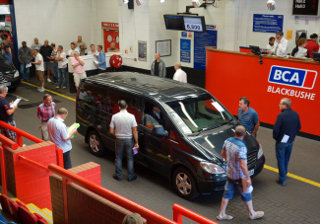
Van at BCA auctionUsed van values remained largely flat in July, compared to June, according to the latest figures from auction specialists BCA.
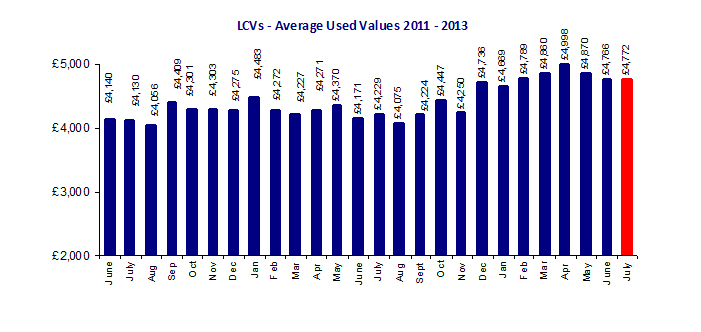
BCA’s July sales figures show that the average light commercial vehicle sold for £4,772 in July, just £6 more than in June. Average age remained largely unchanged at 58 months but, average mileage rose for the third consecutive month.

Despite monthly falls over the last three months, used van values remain 12.8% (£543) higher than they were in July 2012, and vans are selling at an average of 101.3% of their CAP values — up from 99.6% during July last year.

Looking beneath the headline figure, BCA says that fleet and lease values fell, but dealer part-exchange values rose strongly, to the third-highest monthly average value on record.

Commenting on the figures, Duncan Ward BCA’s General Manager – Commercial Vehicles, said:

“The summer holiday period is typically a weaker time for demand but values have been maintained at a similar level to last month largely as a result of the low levels of supply.  Trade buyers are continuing to focus on the very best retail vehicles which are routinely making exceptional money, while vans in poor condition may struggle for attention. ”

BCA used LCV values 2011-13

Average LCV values from June 2011 – July 2013 (courtesy of BCA)

As the graph above shows, the trend in used van values has been relentlessly upwards over the last two years, but Duncan Ward believes this could moderate come September, thanks to an influx of realistically-priced dealer part-exchange vehicles:

“Sellers should consider adjusting valuations now on poorer condition vans with a view to remarketing them before volumes begin to rise and buyers have more choice from mid-September onwards.”

“Vans entered from dealer part-exchange sources have outperformed the market in recent weeks, and values rose sharply during July.   Dealers are valuing their part-exchange vans realistically to tempt buyers in and have reaped the rewards of rising average values, a CAP percentage that is ahead of the wider market performance and good sale conversions as a result.”

The dramatic and long-lasting fall in new van registrations since 2007 has helped support used van values, as the supply of decent quality, one-owner vans has fallen steadily as operators have held onto their vans for much longer than previously, or reduced their overall requirements.

New van registrations have recently started to turn up, and this seems to be being reflected in both UK CV manufacturing output, which has risen recently, and in used van values, which have started to weaken after reaching record highs.

Ford Transit Custom

What Size Van Can I Drive On A Car Licence?

Ford Transit Custom

This article was last updated on 31 January 2018.

The driving licence requirements for driving a van are fairly simple, but we do get a lot of questions asking about driving licences for vans, so I thought I would take a closer look to help clarify the situation.

Driving a Van – licence requirements

If you have a car driving licence (category B) than you can drive all vans with a maximum gross weight of up to 3,500kg (3.5t).

This includes vans like the Ford Transit and Volkswagen Transporter. It also includes minibuses with up to eight passenger seats.

Almost all of the vans operated by van hire companies in the UK are 3.5t models or smaller, so you shouldn’t have any problem renting and driving a van with a standard car licence.

Most hire companies have a minimum age limit and require you to have held a full driving licence for a minimum period of time. Please visit our driving licence/age restriction page for more information.

Ready to hire a van?
Book now


Note: It’s important not to confuse the maximum permitted weight of the van with its payload, or load capacity. A 3.5t van might typically have a maximum load weight of 900kg – 1,300kg, depending on the model and size of the van.

Driving Vehicles over 3,500kg (C1)

To drive a vehicle with a MAM of between 3,500kg and 7,500kg (3.5t – 7.5t) you need category C1 entitlement on your driving licence.  This enables you to drive 7.5t lorries, of the kind that are offered by many van and truck hire companies.

If you passed your car driving test before 01/01/1997, you will have C1 entitlement. If you passed you car driving test after 01/01/1997, you will not have C1 unless you have taken a seperate C1 driving test.

However, not all van and truck rental companies will allow you to hire their 7.5t vehicles, even if you have C1 entitlement. There are two reasons for this.

The first reason is that 7.5t trucks are much larger and more difficult to drive than cars. Most car drivers do not have sufficient experience in larger vehicles, so many hire companies think it is too risky to rent these vehicles out to inexperienced drivers.

The second reason is that some hire companies will insist that you must have a goods vehicle operator’s licence to hire a 7.5 tonne lorry. This is legally required if the vehicle will be used for business purposes, although it is not required for personal use such as a DIY house removal.

However, by restricting 7.5t hire to customers with an operator’s licence, hire companies can avoid many of the problems which might result from inexperienced drivers renting these large vehicles.

Hire a 7.5 tonne lorry:
Hire a 7.5t lorry


Driving a Minibus

Driving licence rules state that you can drive a minibus with up to 16 passenger seats using a car driving licence, as long as it is not for ‘hire or reward’ – in other words, as long as no one is paying for the minibus service to be provided (cash in hand for fuel, for a social trip is ok).

To drive a minibus for hire or reward, you need category D1 on your driving licence.

Hiring a minibus: Some rental companies will only allow drivers with D1 entitlement to hire a minibus, regardless of whether the minibus is going to be used for ‘hire or reward’. As with some companies’ restrictions on hiring C1 vehicles, this is likely to be due to insurance and risk restrictions.

Ready to hire a minibus?
Book now


Disclaimer: All information was believed to be correct when this page was last updated (31 Jan 2018) but vanrental.co.uk will accept no responsibility for any errors or omissions, or for any consequences arising from the use of this information. Future changes to the rules may not be notified on this page. If in doubt, check directly for yourself before driving or hiring a vehicle – the gov.uk website has an excellent guide to driving licence categories.

Child Seat Hire With Van Rental: How Much Does It Cost?

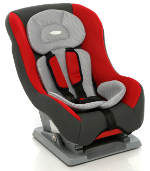
A group 1 child seatIn today’s article, I’m going to continue my ‘How Much Does It Cost?’ series with a look at child seat hire, a widely available optional extra on car and van hire.

Although you may be more likely to need a child seat when you’re hiring a car, most of the big van hire companies also offer this service with van hire, since these vehicles do have three seats and are often used for family removals and other occasions where a child may be travelling in the van.

As anyone who has bought a child seat will know, a child seat isn’t simply a child seat. Broadly speaking, child seats come in four types, catering for children from birth up until 12 years old (or 135cm in height). Here’s a brief explanation (all ages are approximate, weight and/or height are more important to ensure a good fit):

  • Group 0 / 0+: Rear facing, suitable from birth until 9/12 months or 0-13kg
  • Group 1:  Age 1-3 years or 9-18kg
  • Group 2: Age 4-6 years or 15-25kg
  • Group 3: Full seats or booster seats for children aged 6-12 years or under 135cm

Group 2 and 3 are sometimes combined, and you may see this in some rental companies offerings, too.

If you’re a parent and in need of a child seat, you’ll probably know this stuff already, but if you would like more information you can find details of the legal requirements for child seats in a guide I wrote for SimpleMotoring.co.uk a while ago, as well as some more details on the different types of child seats.

Hiring a child seat?

A group 2 or 3 child seat boosterSo what do you need to know if hiring a child seat from a van hire company?
Well, vans are unlikely to have ISOFIX mounting points than cars, so child seats will have to be fastened using the seat belt option or by using an ISOFIX base onto which an ISOFIX seat can be mounted.

You can expect reputable hire companies to offer you a suitable package to fit in the van you’ve hired. If you ask for assistance fitting the seat, you may be refused – most hire companies seem to have a policy that the customer must fit the seat themselves, presumably to avoid insurance/liability claims in the event of an accident where the seat was incorrectly fitted.

As with cars, passenger air bags should be deactivated when you use a rear-facing child seat, although I don’t know how feasible this is with common models of van.

How much does it cost to hire a child seat?

I’ve gathered together the daily rates for child seats from all of the main hire companies listed on vanrental.co.uk, together with details about the terms and conditions where I’ve been able to find them. This isn’t an exhaustive guide, but it should give you an idea – remember that advanced booking is normally required:

  • Europcar & National: Child seats of all sizes cost £10.99 per day, up to a maximum of £109.99 per rental. Lost, damaged or stolen seats will incur a £200 charge. Booster cushions cost £3.99 per day, up to a maximum of £39.99 per rental. Lost damaged or stolen booster cushions will incur a £50 charge.
  • Hertz: Hertz only offers child seats and booster seats for larger model vans; at the time of writing*, these were listed on Hertz’s website as Ford Transit Dropside and Tipper models only. Child seats are available to cater for children aged 9 months – 6 years (9-36kg), not for younger children. Hertz’s daily rate for child seats is £11.88 per day, up to a maximum fee per rental of £83.16. Booster seats are available to suit children from 6-11 years of age, for a daily rate of £4.62, up to a maximum fee per rental of £32.64.
  • Sixt: Baby seats (Group 0+ / 0-13kg), child seats (9-18kg) and booster seats (15-36kg) are available for a daily rate of £10.00 or £59.99 per month.
  • Thrifty: Child seats are available to suit children from birth to 12 years/135cm. All seats are £5 per day, with a maximum of 10 days charged. Subject to local availability, contact the hire branch directly to confirm availability.
  • Argus Car Hire: As a broker, availability and cost of child seats varies depending on the rental supplier for your booking.
  • Van Hire 3000: As a broker, availability and cost of child seats varies depending on the rental supplier for your booking.

Who is the cheapest?

Thrifty’s child seat hire is by far the cheapest of all the companies listed – at £5 per day up to a maximum of 10 days charged, it leaves you wondering how much profit companies charging more than £10 per day are making on each child seat.

In my last article on the cost of sat nav hire, Thrifty was also cheapest (along with Hertz), so it’s definitely worth getting a quote from Thrifty if you want to hire a van with extras.

To learn more about the true cost of van hire, check out the following articles:

*This article was written on 9 August 2013.

Top Gear Hovervan Heads For Beaulieu

Top Gear mk2 Hovervan

See? It floats. Jeremy, Richard and James with the mk2 Hovervan on the River Avon

You can always rely on the Top Gear team to come up with crazy-but-just-doable ideas that will make entertaining television, even if they do annoy the half of the population that doesn’t like Top Gear.

On that basis, the mk2 Hovervan is a cracking idea. The mk1 model was less good (it sank), so the mk2 Hovervan was fitted with bigger engines, larger skirts and additional floatation devices.

These modifications enabled it to “skip gracefully across the surface of the River Avon causing barely a ripple”.

Allegedly.

Based on a highly modified Ford Transit, the Hovervan has also been described as “noisy – and dangerous – and thirsty – and disruptive – and destructive – and uncontrollable – and expensive”.

You can now make up your own mind about the Hovervan, because it has joined the ranks of wacky and crazy Top Gear vehicles in Beaulieu’s World of Top Gear. Other Top Gear triumphs at Beaulieu include the Hindustan Ambassadar taxi, which was recently crowned by Jeremy and the lads as the world’s best taxi.

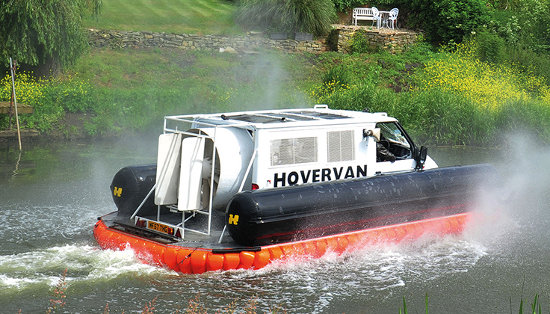
The Top Gear mk2 Hovervan in action

The Hovervan in action on the River Avon. Fancy a closer look? The Hovervan is now on display at the Beaulieu World of Top Gear, along with other classic Top Gear ‘designs’.

Away from Top Gear, Beualieu is also home to the Bond in Motion exhibition and of course the National Motor Museum. For a petrolhead — or anyone with a passing interest in how cars and popular culture have developed hand-in-hand over the last century — it’s a great day out.

The Competition Is Drained As EEG Chooses More Sprinters

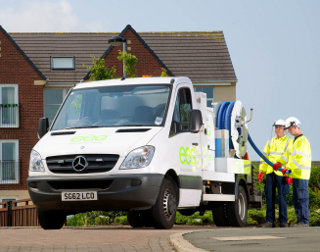
EEG Mercedes Sprinter drain maintenance van

One of EEG’s 5-tonne Mercedes Sprinter drain maintenance vans

Drain maintenance specialist EEG is used to dealing with unpleasant waste below the ground — but when the company’s crews are on the road, they demand the best. EEG Fleet Manager Douglas Stewart explains why the company has just purchased a new fleet of 17 customised 5-tonne Sprinter 513 CDI vans:

“These vehicles represent a new venture for us. But we already run around 50 Sprinter vans with CCTV equipment, which we use to inspect drains.

“We’ve been relying on Sprinters since 2002 and although they rack up some very high mileages, only very rarely does one suffer a problem. You can’t buy that sort of reliability anywhere other than Mercedes-Benz.”

Each of EEG’s new Sprinters is fitted with bespoke body with water tank, jetting and suction equipment by Dutch specialist Rioned. Each van is a miniature version of the company’s fleet of 300 26- and 32-tonne trucks, which provide drain maintenance services for larger properties, but are too small to serve the company’s domestic customers.

Glasgow-based EEG is one of the UK’s largest providers of drainage and sewer cleaning, inspection and repair services, providing nationwide reactive and emergency maintenance and repair coverage. Operating from 23 main and satellite sites, it offers multi-utility solutions to clients ranging from local authorities and utility companies to industrial and corporate businesses.

The 5.0-tonne Mercedes-Benz Sprinter is available as a chassis cab, on which a wide variety of bodes can be fitted, or as a panel van. EEG’s latest vans are powered by fuel-efficient 129hp engines which are cleaner, more powerful and more economical than the equivalent model from the previous Sprinter range.