
Author Archives: Van Rental

Ford Transit Custom Sport Van: A New Van For The Boss

Ford Transit Custom Sport Van
The Ford Transit Custom Sport Van goes on sale early in 2013 — definitely one for the boss.

Ford’s previous Transit Sport Van and Transit Connect Sport Van proved very popular with self-employed traders and small businesses looking for a flagship van — and Ford is aiming to build on that success with the new Transit Custom Sport Van.

The new model will be powered b y a Dagenham-built 155PS 2.2-litre Duratorq diesel engine that delivers 385 Nm of torque.

Brentwood’s latest high-spec van will only be available in short wheelbase with a 2.9 tonne gross vehicle weight and Ford says it will combine “strong performance with muscular styling and a bold colour-coded exterior”…

The spec will include body-colour bumpers, side mirrors, door handles and body-side mouldings. The van will sit on 18-inch alloy wheels on low profile 235/50 tyres, and the signature twin bonnet stripes in a contrasting colour.

Inside, there will be partial leather trim combining Pewter seat fabric with charcoal black leather bolsters, and the latest interior technologies such as the Ford SYNC voice-activated, in-car connectivity package and a DAB audio system.

The Transit Custom Sport Van will be available to order in early 2013. For more details visit Ford’s website.

Van Registrations Plunge 16% In November

Even the most talented spin doctor would fail to put this year’s new van registration figures in a positive light.

Van registrations fell by 16.4% in November, leaving them down by 7.4% for the year-to-date. Truck registrations followed suit, falling by 13.7%, although they are still up by 9.9% on the year-to-date.

UK van and truck registrations: 2012 and % change on 2011

November %
change
Year-to-
date
%
change
Rolling
year
%
change
Vans 18,975 -16.4% 223,836 -7.4% 242,251 -6.4%
Trucks 3,885 -13.7% 42,123 9.9% 46,734 12.6%
Total 22,860 -15.9% 265,959 -5.0% 288,985 -3.8%

Source: SMMT

However, dire figures didn’t stop SMMT Chief Executive Paul Everitt from attempting to put a positive spin on the van market:

“This year has seen the van market re-adjust after bouncing back from recession, while truck volumes have been steady. We look forward to next year where greater stability should see the van market return to slow, but steady growth.”

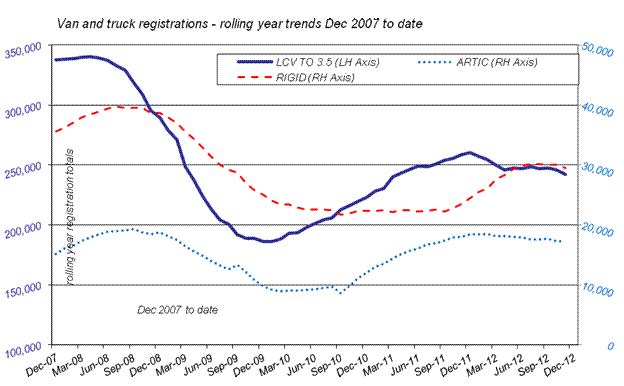
I think that “bouncing back from recession” is a pretty optimistic way to describe the van market over the last three years. Looking at the graph below, I think that the van market’s recovery could best be described as stalled, with little evidence that next year will be any better:

SMMT van and truck registrations Dec 2007 - Nov 2012

SMMT van and truck registrations Dec 2007 - Nov 2012

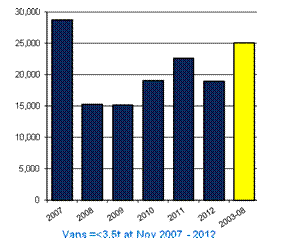
What the graph above doesn’t really show is how much van sales have fallen since last year. What’s more, they remain below the average level seen between 2003 and 2008:

SMMT annual van registrations Nov 2008 - 2012

SMMT annual van registrations Nov 2008 - 2012

While a shortage of decent quality used vans could eventually be a catalyst for growth in new van registrations, I’m not convinced that this will happen as soon as next year.

Used Van Values Remain Strong Despite Seasonal Effect

BCA Commercial vehicle auctionUsed van values remain near record levels, according to leading vehicle auctioneers BCA, despite the expected seasonal decline and the fact that average age and mileage continue to climb.

According to BCA’s latest Pulse Report, average used LCV values fell back in November by £197 (4.4%) to £4,250.  Both average age and mileage rose over the month to 59.7 months while average mileage increased to 81,400.

Despite the fall, price performance remained on a par with much of 2012, with average values at near record levels in the fleet/lease sector, while the low volume nearly-new sector recorded the highest monthly value since Pulse began reporting in 2005.  Performance against CAP average fell over the month by a point to just under 100%.

Year-on-year, November 2012 was behind by £54 or 1.2%, with both average age and average mileage increasing over the period, as the figures in this table show:

All vans Avg Age Avg Mileage Avg Value Sale vs CAP
Nov 2011 56.71 76,670 £4,304 100.39%
Nov 2012 59.74 81,408 £4,250 99.98%

Source: Data courtesy of BCA

The fall in van registrations since 2008 means that supply continues to be tight, meaning that even poor quality vans continue to sell, as BCA’s General Manager Duncan Ward explains:

“Typically when the market eases, buyers leave the poorest condition vehicles behind but with the shortage of stock in the marketplace, sale volumes held up well in November and were on a par with October’s figures.”

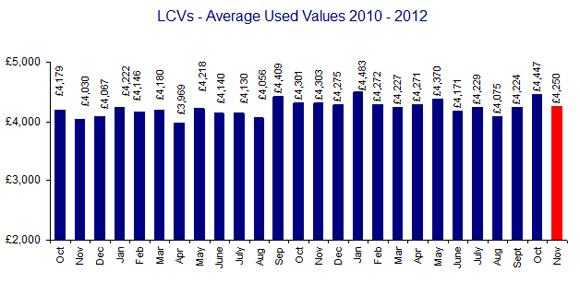
The graph below shows just how strong used LCV values have remained since 2010, despite a weak economy and a rising mileage and age profile as fleets keep vehicles on the road longer before replacing them:

BCA Average LCV Used Values 2010-2012 (Nov 2012)

BCA Average LCV Used Values 2010-2012 (Nov 2012)

Duncan Ward again:

“Overall, prices remain strong when taking the longer view and average values during 2012 have probably exceeded the expectations of most market watchers when placed in the context of the relatively weak economy and low business confidence.”

In other words, it’s remarkable what a really tight supply can do to the market — especially when finance for new vans becomes harder to get and less attractive.

Northgate Posts Solid Results Despite Downturn

Van hire specialist Northgate has published its half-yearly results, which suggest that its recovery plan is on track and it is continuing to deliver solid performance in both the UK and Spain.

Darlington-based Northgate, which operates a fleet of 51,000 vans in the UK and 37,700 in Spain, reported profit before tax of £24.6m for the last six months — down slightly from £26.9m for the same period in 2011, but still broadly in-line with expectations for full year. It also managed to reduce net gearing from 105% to 94%, thanks to a £28.1m reduction in net debt to £343.2m.

As has been the case in previous periods, Northgate managed to maintain its fleet utilisation levels by trimming its fleet. Over the last six months, the company’s UK fleet was reduced from 52,900 to 51,000, while utilisation fell from 90% to 89%. This is a smaller drop than during the same period last year.

Northgate said that average hire revenue per rented vehicle “has remained stable since the beginning of the financial year”.

In Spain, the company’s fleet dropped from 38,400 to 37,700, while utilisation remained solid, falling 1% from 91% to 90%.

New locations

Northgate also reported that it expected to open four new UK van hire sites by the end of the financial year (30 April 2012). The firm did not disclose the new locations but said:

Our analysis shows that a branch needs to be approximately 20 minutes from local businesses to meet their requirements.  Analysing the UK population and GDP has identified gaps in our network where we do not currently address many potential customers’ needs, which are met by small local or regional rental operators.

UK vans get younger, Spanish vans get older

Northgate said that the average age of its UK rental fleet had fallen from 21.4 months at the end of April 2012 to 20.4 months at the end of October 2012, and said that it had purchase 9,600 new vans over the last six months.

During the last six months, Northgate said that it had sold 12,000 vehicles — down from 14,500 for the same period last year. Of these, 19% were sold through its Van Monster retail sales operation, which Northgate describes as “more profitable” than other fleet disposal channels.

Conversely, Northgate said that it was “ageing” its Spanish fleet to reduce capital costs and improve cash generation — although it emphasised that it was “still running a young fleet in comparison to the rest of the market”.

Retail boost

Northgate said that the bulk of the reduction in its UK fleet was due to the loss of several large customers. The company’s regional business, which deals with smaller businesses and retail customers, saw vehicles on hire increase by 200 over the last six months.

Ford & Vauxhall Triumph At What Van? Awards 2013

Ford Transit Custom

The Ford Transit Custom is What Van? Van of the Year 2013

British van brands Ford and Vauxhall came away from the What Van? 2013 Awards looking like the biggest winners, collecting three gongs each to take six out of a possible 11 awards, including Van Of The Year 2013 for the new Transit Custom.

Brentwood-based Ford won three awards, including the overall Van of the Year 2013 award, and was highly commended in three further categories.

Unsurprisingly, the all-new Ford Transit Custom (one of which has just appeared on my local Ford dealer’s forecourt) won the Van of the Year 2013. This all-new model was praised by the judges for its interior and exterior quality, as well as a host of innovations new to the light commercial vehicle sector.

What Van? editor Paul Barker said:

“The new Transit Custom does the name and heritage of the UK’s dominant van proud by improving vastly over its award-winning predecessor, particularly in terms of innovation and interior quality, which is superior to anything van drivers are used to,” said What Van? Editor Paul Barker. “Replacing the vehicle that dominates the UK market was never going to be easy, but Ford has certainly produced the goods and deserves continued success.”

The Transit Custom also won the Medium Van of the Year award, while the new Ford Ranger romped home with the Pick-Up of the Year gong.

Vauxhall also took a hat-trick of prizes – its Ecoflex efficiency technology claimed the Green Award, the Corsavan won the Small Van of the Year prize and the Combo shared the Light Van of the Year Award with the Fiat Doblo Cargo on which it is based.

The best of the rest

MINI Clubvan

The MINI Clubvan won the What Van? Editor's Choice award

The new MINI Clubvan picked up the Editor’s Choice award, while Chinese newcomer to the UK market Great Wall was highly commended in the same category for its Steed pick-up, which should be a useful marketing feather in the cap for this large Chinese manufacturer.

The Iveco Daily retained its Large Van of the Year award, but it will be interesting to see if it manages this trick after the new two-tonne Ford Transit goes on sale next year. Unlike the current Transit, the new van will be a genuine large van that should compete head-to-head with the Iveco Daily and other popular large van models, like the Sprinter and Renault Master.

Driver favourite Volkswagen was notably absent from the award winners, although it did manage two highly commended mentions for its VW Transporter (which was displaced from the winner’s slot by the Ford Transit Custom) and the VW Caddy 4Motion, which was beaten to the 4×4 Van of the Year award by the mighty Mercedes Sprinter 4×4.

What Van? Awards 2013 Full Results

Here’s the complete list of winners and runners up:

Category 2013 winner 2013 Highly Commended
Van of the Year Ford Transit Custom
Small van of the Year Vauxhall Corsavan Ford Fiesta van
Light van of the Year Fiat Doblo Cargo
Vauxhall Combo
VW Caddy
Medium van of the Year Ford Transit Custom VW Transporter
Large van of the Year Iveco Daily Nissan NV400
Renault Master
Vauxhall Movano
Pick-up of the Year Ford Ranger Isuzu D-max
4×4 van of the Year Mercedes Sprinter 4×4 VW Caddy 4Motion
Safety Award Mercedes Ford Ranger NCAP
Green Award Vauxhall Ecoflex DfT Electric Vehicle Subsidy
Innovation Award Emerald Automotive Ford Transit Custom
Editor’s Choice Award Mini Clubvan Great Wall Steed

For more details on the winners see www.whatvan.co.uk.

Vauxhall & VFS Launch Movano Caged Tipper Conversion

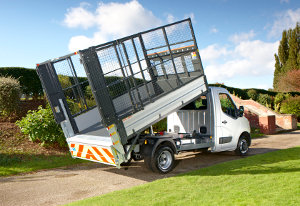
Vauxhall and VFS Movano caged tipper conversionVauxhall has partnered with commercial vehicle conversion specialist VFS to produce a new Movano Caged Tipper.

The latest conversions are available as a purpose-designed cage for the existing Movano Tipper core conversion, or a custom-built VFS caged tipper based on a Movano chassis cab.  A utility cab conversion based on the Movano double cab is also available to provide even greater versatility.

The cage is two metres high with a galvanised mesh and rear doors that open to 270 degrees. The vehicle includes a full height sliding door and a rear header bar with marker lamps for optimum visibility. The assembly is painted in dark grey to match the original tipper body structure, while all handles, latches and door retainers are highlighted in ‘traffic’ yellow.

The tail-lift features a folding aluminium platform and the external controls are mounted within a dustproof and waterproof enclosure, while an instrument panel and operation instruction signage are all included.

The cage is available on Vauxhall core conversion tippers or alternatively a custom-built caged tipper from Southampton-based VFS is available on Movano chassis or crew cabs.

“The Movano Caged Tipper is the ideal vehicle for a wide range of trades and public services, including waste and scrap collection and construction,” said Steve Bryant, Brand Manager, Luton-based Vauxhall Commercial Vehicles. “It offers customers the flexibility to easily load and carry different payloads, while the cage provides excellent space and security.”

The cage is available from £1,560 + VAT and the tail-lift is available from £2,480 + VAT. Prices for specific custom builds are available from VFS on request.

For further information on customised Vauxhall fleets, Vauxhall fleet services and this conversion please visit www.vauxhall.co.uk/movano or www.vfs.co.uk

Van Speed Limit Rules Get Crazy

Peugeot Bipper van -- at the moment, this van is subject to lower speed limits than the (larger) Citroen Berlingo...

Will these crazy examples finally lead to a common-sense ruling on van speed limits?

In my 2008 post, “Van Speed Limits: Clarity (almost) for sub 2-tonne vans I reported on how the DfT had said that for a van to be subject to car speed limits, rather than the lower limit that applies to goods vehicles under 7.5t, it must:

According to the DfT, for vans to be excluded from van speed limits, they must be based on a standard car chassis and must have a body the same as that fitted to a car equivalent as far back as the B pillar (behind the front doors). A box body behind this is acceptable, but only if it is built onto a standard car chassis.

In addition, the vehicle must have a maximum laden weight under 2 tonnes.

Homologation Question

However, that was four years ago and the world has moved on — not least with the introduction of the Peugeot Bipper/Citroen Nemo/Fiat Fiorino small van, all of which have matching car models and maximum laden weights of under 2 tonnes, but are subject to van speed limits, according to this article in What Van?, which says:

[they] aren’t classified as car-derived vans because they were homologated for sale first as commercial vehicles.

The article goes on to say that the Citroen Berlingo, a larger heavier model, is considered car-derived because it was homologated as a car model before it was homologated as a van, so is only subject to car speed limits (as is the obviously car-derived Vauxhall Astravan).

So the gist seems to be that if a van model is also made as a car and has a maximum laden weight below 2 tonnes, the speed limits that apply to the vehicle will depend on whether it was first homologated as a van, or as a car — even though the vehicle itself does qualify as car-derived. There’s not really any way of knowing unless you happen to know which model was homologated first — highly unlikely.

For van hire customers, it makes it all but impossible to know the correct speed limit for small vans unless the rental company tells you — or has a sign in the cab with the correct speed limits on. In my experience, both of these are surprisingly rare.

This is clearly a crazy situation and the What Van? Article concludes by suggesting that discussions are ongoing between Peugeot and the Society of Motor Manufacturers and Traders (SMMT) to resolve the issue.

Watch this space.

Note: If you are not sure what the speed limits for vans are, click here for details.

Brandon’s Custom Fiat Ducato Is Mini Low Loader

Brandon Hire KFS Special Vehicles Plant & Go transporter, based on a Fiat Ducato Back-to-Back model

Brandon Hire's KFS Special Vehicles Plant & Go transporter, based on a Fiat Ducato Back-to-Back model

The Fiat Ducato may not be the most common panel van in the UK market, but it does dominate the motorhome market throughout Europe, helped by Fiat’s provision of motorhome-specific chassis-cab models with modified chassis.

Fiat also produces a model that has no chassis at all! Known as the Back-to-Back, it consists of a Ducato cab with no rear chassis. Converters can then build a bespoke chassis and body on the rear themselves.

The Back-to-Back is popular with motorhome converters but also has other uses, as Bristol-based Brandon Hire recently demonstrated with its choice of 6 KFS ‘Plant & Go’ delivery vehicles based on the Fiat Professional’s Euro 5 Ducato.

(KFS offers a number of conversions based on Ducatos.)

The KFS Special Vehicles-built plant transporter has a light, low load bed with multiple strapping points, an in-built tailgate/loading ramp and a payload of almost 1,600kg, enabling it to carry a wide variety of small plant and machinery within the 3.5t limit.

Steve Pensom, Brandon Hire’s Fleet and Logistics Manager, explains:

“What really impressed us, when the vehicle was on test, was the fact that anyone with a car licence could drive the truck. This benefit, along with improved MPG performance and the potential to safely carry greater payloads, provided us with the ideal vehicle to help minimise our costs and maximise our staff levels.”

I think that the current Ducato has improved with age and is good value for money. It’s probably a little under-rated in the UK market, where the Transit has traditionally had a strong lead. Whether that will remain the case now that Ford’s Southampton factory is closing is another question — perhaps other European marques will become more popular.

Driving A Van In Wind And Rain? Beware Of These Risks

Driving in heavy wind and rainHigh winds and heavy rain shouldn’t be a surprise at this time of year — but they always seem to catch motorists out. if you’re hiring a van you need to take extra care, as the risks are greater, especially in high winds.

Driving in heavy rain and high winds isn’t much fun at the best of time, but it’s even harder if you are driving an unfamiliar rental van. You will find that the van is more susceptible to being blown around by the wind (especially if it’s empty) than your car, and you may not be completely familiar with the controls for windscreen wipers and ventilation — a recipe for disaster if you are on a motorway or main road.

These tips from the Institute of Advanced Motorists apply to all drivers but are especially relevant to drivers of rented vans — so take a quick look:

  • Before you set off, set your heater controls – rain makes the windows mist up in seconds. You don’t want to be fiddling with controls when you should be concentrating on the road.
  • Slow down. In the rain your stopping distance should be at least doubled. Giving yourself more space helps you to avoid spray, especially when following a large vehicle.
  • Keep your eyes on the road ahead and plan your driving so that you can brake, accelerate and steer smoothly – harsh manoeuvres will unbalance the van.
  • Strong winds can also unsettle your car and even change your direction of travel. Grip your steering wheel firmly and be aware of the effects of the elements on other road users, particularly motorcyclists and flat-sided vehicles.
  • If you have cruise control, avoid using it on wet roads – it may create problems if you start to aquaplane.
  • See and be seen. Put your lights on – as a rule of thumb, whenever you need to use your wipers you should also turn your headlights on, and before overtaking put your wipers on their fastest setting.

In cases of severe flooding, you should reconsider making the journey at all. If it is unavoidable, and you have to drive through deep water, the IAM recommends drivers take the following precautions:

  • Drive on the highest section of the road and don’t set off if a vehicle is approaching you
  • Leave time and space to avoid swamping other cars and pedestrians
  • If you can’t see where you are going to come out of the water, such as when approaching flooding on a bend, think twice about starting to drive into it
  • In deep water never take your foot off the accelerator, as this could allow water to travel up the exhaust pipe
  • Once you’re out of the water, dry the brakes before you need them. The best way is to lightly apply the brake as you drive along for a few seconds, after checking nothing is following you too closely.

Remember, it’s better to arrive late than not at all…

Will New Type Approval Rules Cause Fleet Headaches?

Ford Transit mk7

The BVRLA is warning fleet managers that the new EC type approval rules leave a lot of questions unanswered.

New European Community Whole Vehicle Type Approval (ECWVTA) rules requiring all modified vans to have whole vehicle type approval are due to come into force in Spring 2013.

The main purpose these regulations is to create a common standard for vehicles throughout the European Community, eliminating the need for each country to carry out type approval testing to its own requirements.

The British Vehicle Rental and Leasing Association (BVRLA) has raised concerns that fleets could face major bureaucratic headaches in trying to comply with the rules which require all modifications made to a vehicle before it is registered to undergo type approval.

According to the BVRLA, this even extends to include minor items such as roof beacons.

What approval means

According to the Department for Transport (DfT), vehicle type approval is a requirement for vehicles before they are registered with the DVLA — i.e. when they are in an ex-factory condition.

Once a vehicle — such as a new van — is registered, then the type approval is ‘spent’, according to the DfT. Modifications after its initial registration have to comply with construction and use and other regulations as they do at present, but no further type approval is required.

As far as I can see, this means that racking, roof racks, ply-lining and so on can all be fitted with impunity after a new van has been registered.

Light Touch Proposal

As I understand it, the problem is that there is a growing tendency for vans to be fully kitted out before they go to the dealer to be registered and delivered.

The obvious solution to this would be to register the vans before they are fitted with accessories, but on the basis this won’t always be possible, the BVRLA is working with VOSA and the Vehicle Certification Agency (VCA) to develop a list of modifications that can have ‘blanket’ or ‘light touch’ approval.

This is promising, but as BVRLA Chief Executive John Lewis says:

“While the VCA’s ‘light touch’ proposal is a step in the right direction, there are still too many unanswered questions and we are very concerned that the system will not be able to cope with this potential new surge in type approval testing.”

Not being a fleet manager or a dealer, what I’m not sure about is how much of a problem this really is. If all that is required is for a vehicle to be registered before it’s modified, then surely it’s just a paperwork exercise?

Introducing ‘blanket approval’ schemes for roof beacons seems madness…

Do you know better?

If you are involved in the fleet or van trade and know better than me, then please leave a comment below and let us know how you see the situation.

Disclaimer: This article is my opinion only and is definitely not a guide to the new rules. Contact VOSA or the VCA if you want to know the facts, don’t trust me!