Category Archives: Van News

News and articles about UK vans – especially information relevant to the van hire market. Coverage of new van model launches from all the major manufacturers – Ford, Mercedes, Volkswagen, Peugeot, Fiat and Citroen.

Used van values hit all-time high in August — but is vehicle mix changing?

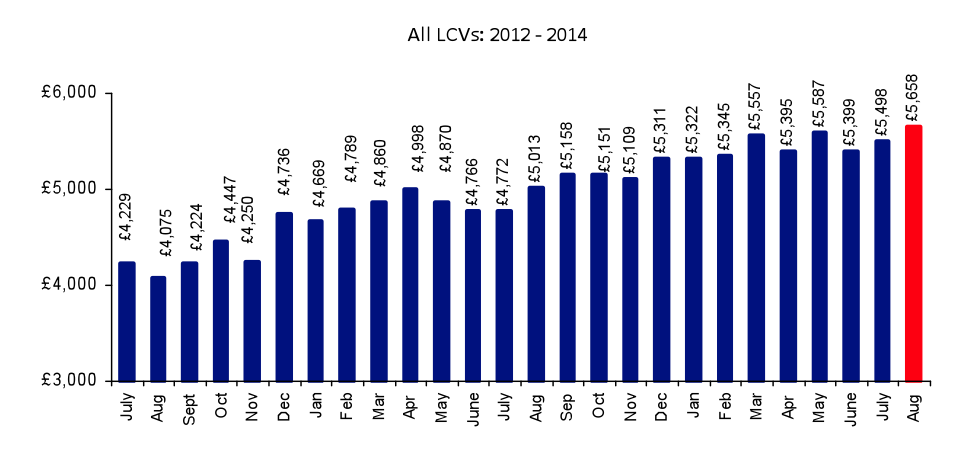
Average used van values hit an all-time high of £5,658 in August, according to the latest sales data from British Car Auctions (BCA). According to the firm, demand from professional buyers remained strong last month and shortages of good retail quality vans continued.

The average van at BCA sold for £5,658 in August, an increase of £160 (2.9%) compared to July and the highest monthly average figure on record.  Fleet & lease and nearly-new values rose, month-on-month, while part-exchange values fell back.  Year-on-year values remain well ahead by £645 (12.8%), with both age and mileage falling and performance against CAP improving slightly.
BCA used van values Aug 2014

Used van values July 2012 – August 2014 (courtesy of BCA)

I obviously have some egg on my face, having been calling for the peak of the used van market for a little while now, but I would like to point out one quirk in the figures, which suggests to me that the outright increase suggested by the graph above may not be the only interpretation of the facts.

[Update 08/09/14: Figures from the Finance & Leasing Association have just crossed my desk, showing that used car purchases by businesses fell by 50% in July, compared to the same period last year, while new car purchases (on finance) rose by 29%. If similar trends are being seen in the new and used van sectors, then we could soon see further downwards pressure on used van prices.]

Mix change?

Although the overall average price was the highest on record in August, the average value of fleet and lease sector vans was lower than in the peak months of February and March. Similarly, the average value of part-exchange vans has fallen continuously since May, while the average value of nearly-new vans was also lower than the peak values of February, March and several other months over the last two years.

In other words, the overall average used value is at an all-time high, but none of the average sector values are.

To me, this suggests the mix of vehicles being auctioned may have changed — BCA don’t specify the relative volumes sold in the fleet and lease, part-ex and nearly-new sectors, but my understanding is that nearly-new volumes are pretty low, while the largest volume comes from the fleet and lease sector.

If this is true, then an increase in the number of ex-fleet and ex-lease vans coming through the salerooms could have boosted the overall average price to a new record high, even if the average price of each van sold did not rise. This is also supported by the continuing rise in new van registrations, which rose by 22% in August, compared to August 2013.

This is only my opinion, of course. If you know better, please leave a comment below or let me know on Twitter (@vanrentaluk) or Facebook facebook.com/vanrentaluk).
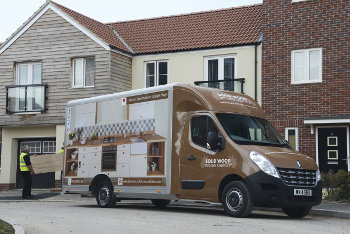
Vans you can’t usually hire: Renault Master Loloader furniture van

Direct Online Services Renault Master Loloader

One of Direct Online Services’ new Renault Master Loloader vans

The range of vans offered by van hire companies is usually enough to meet most requirements, but in some cases, standard hire vans just don’t cut it when compared to specialist models.

The specialist dual compartment refrigerated van I wrote about here is one such example, while another is the Renault Master Loloader vans now being operated by Direct Online Services, a solid wood kitchen furniture specialist.

If you think about it, a solid wood kitchen has several distinguishing features: it’s heavy; it may have long lengths of worktop and it’s basically square. Clearly what’s required is a long, low, square van body with a high payload.

Although a luton with a tail lift would meet some of these requirements, the weight of the tail lift (around 150kg for a modern lightweight model) eats into the payload of the van and makes offloading heavy, long pieces of furniture and worktop quite awkward.

It’s far easier if the driver and his mate can step straight from the load area of the vehicle onto the ground, when unloading — something that’s possible with a the Renault’s Loloader body.

This isn’t a design that’s unique to Renault, and it’s similar to the dropwell luton design favoured by removal companies (and by vanrental.co.uk advertiser Admiral Van Hire), except without the high luton roof, providing a more aerodynamic and fuel-efficient profile.

The advantages of the new, tailored design are clear, according to Direct Online’s Logisitics and Operations Director, Phil Allright, who said:

“We’ve been really impressed by our first Renault Master and in particular the size of the load area and weight carrying capacity. With our other vehicles [Iveco and Ford] we typically get 800-900 kilos but with the Renault Master we’re getting over 1,240 kilos which is obviously great news for our business. We are also currently saving money on running costs of around 7% so we are clearly keen to bring more of these vehicles on to our fleet.”

The combination of a significant increase in payload and a reduction in fuel consumption should equate to increased profits for the firm, as each van may be able to fit more deliveries on board within the legal weight limit, cutting the number of journeys required.

Van sales rise 22% in August

New van registration rose by 22.3% to 12,652 in August, compared to the same period last year, according to the latest figures from the Society of Motor Manufacturers and Traders (SMMT).

The figures are well down on July (24,764), but given the similar like-for-like percentage increase, this appears to be mostly due to regular seasonal effects — perhaps buyers holding back ahead of the September registration change?

UK van and truck registrations: August 2014 and % change on 2013

August % change Year-to-date % change Rolling year % change
Vans 12,652 22.3% 192,948 19.1% 302,083 19.1%
Trucks 2,401 -22.7% 22,011 -22.0% 50,008 12.9%
Total 15,053 11.9% 214,959 13.0% 352,091 18.2%

Source: SMMT (www.smmt.co.uk)

The truck market continues to be lacklustre as last year’s pre-Euro 6 sales surge gradually falls out of the figures, but SMMT chief executive Mike Hawes suggests that van demand could continue to support the commercial vehicle market for the remainder of this year:

“The commercial vehicle market has delivered another strong month overall, driven by an impressive number of van registrations. This reflects growing business confidence in the economy and the variety of highly capable and efficient vans on the market. The truck sector is continuing a downward trend brought about by an influx of orders at the end of 2013 due to incoming Euro-6 standards. There is increasing positivity in the market, however, which should see registrations return to normal levels over the coming months.”

Hot vans

The big volume growth was at the heavier end of the van market, with sales of 2.5t – 3.5t vans rising by 21.8% to 7,403, while sales of vans in the 2.0t – 2.5t range (e.g. Citroen Berlingo) rose by a 32.8% to 2,404, up from 1,810 during August 2013.

Pick-up sales were also strong, rising by 31% to 1,175 units.

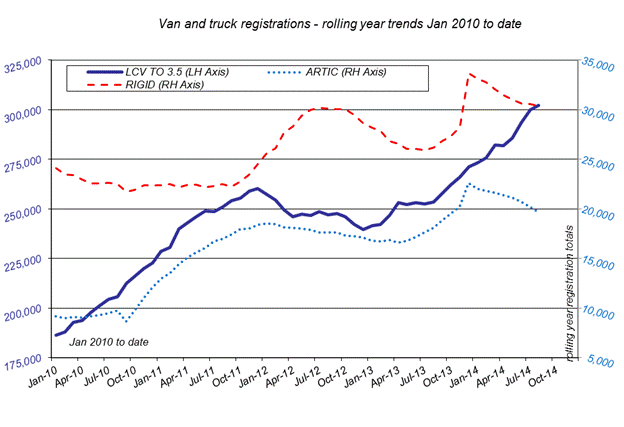
As usual, a picture says a thousand words, so here’s the usual excellent graph from the SMMT, showing how van and truck registrations have changed since January 2010:


SMMT CV registrations August 2014

Rolling year van and truck registrations 2010 – to date (courtesy of SMMT)

As the kids head back to school, it will soon be Christmas, and I suspect many of the UK’s car and van salesmen will be looking forward to bumper bonuses this year.

Euro NCAP test results: Nissan e-NV200, Citroen Berlingo & Peugeot Partner

I’ve remarked before on the tendency for new van models to score relatively poorly in the Euro NCAP safety tests, compared to contemporary cars.

Ford has somewhat bucked the trend with its all-new range of vans, but most manufacturers are continuing to specify their vans and van-derived MPV models with fewer, more basic safety systems than purpose-built cars.

Euro NCAP has just published its latest round of test results, which tend to confirm my theory, with even the smallest supermini car models outscoring several new van-derived MPVs:

  • Mercedes-Benz GLA-Class: Five Stars
  • Toyota Aygo (also Citroën C1 and Peugeot 108) cars: Four stars
  • Renault Twingo: Four stars
  • Nissan e-NV200 Evalia: Three stars
  • Citroën Berlingo / Peugeot Partner MPV: Three stars

Let’s take a closer look at the reasons for these poor scores.

Nissan e-NV200 electric van

The MPV version of the e-NV200 only managed a three-star score in the latest Euro NCAP tests — compared to five stars for the new Qashqai.

Nissan e-NV200 Evalia

The e-NV200 Evalia is an electric people carrier version of the recently-launched e-NV200 van. Although the van model has won widespread praise from fleet trial users, its three-star safety test result highlights several weaknesses.

While Nissan’s new Qashqai model — similar in size — scored five stars in the same test earlier this year, the e-NV200 Evalia was let down by a poor 38% score in the Safety Assist category of the test, compared to 79% for the new Qashqai.

Although both models have an electronic stability system, the Evalia had a non-compliant speed limiter system, no seat-belt reminder for rear seats, and no optional lane departure or autonomous braking systems — all of which were available as standard or as options on the Qashqai.

Peugeot Partner / Citroën Berlingo

Citroën’s new Berlingo MPV model (which is identical in safety terms to the Peugeot Partner) also scored three stars in the 2014 Euro NCAP tests.

The 2014 Citroën Berlingo

The MPV version of the new Berlingo scored three stars in the latest Euro NCAP tests.

Despite its larger size, the Berlingo scored just 56% and 74% for adult and child occupancy safety — compared to 80% in both categories for the new supermini C1 model.

The Berlingo also faired worse in the Safety Assist tests, scoring only 48%, against the C1’s 56%. In fairness, Citroën’s C-Elysée saloon model, which was also tested earlier this year, also scored worse than the new C1, suggesting that one cause for this might be the older origins of the current Berlingo design, compared to the C1.

However, I think that most consumers would expect a larger vehicle to be safer for occupants than a smaller car of the same age.

Should van drivers worry?

It’s important to remember that these scores are all relative — in reality, today’s new cars and vans are considerably safer than most older models. It’s just surprising that van-derived models seem to continue to lag car designs.

Things are generally improving, however — the Ford Transit Custom scored five stars last year in its Tourneo guise, while the VW Transporter Kombi and Mercedes-Benz Citan Kombi also managed four-star scores in last year’s test.

The main sticking point this year appears to be a relative lack of safety systems, such as lane departure and autonomous braking, in new vans — areas which are receiving greater emphasis in this year’s test.

Renault Trafic gets social with Knight Rider spoof

Renault TraficFollowing on the back of the launch of all-new Trafic, Renault’s best-selling Light Commercial Vehicle with 1.6 million units sold, the brand has launched a video for the Web, produced in with the social media agency We Are Social.

The film is a remake of the famous opening sequence of Knight Rider, the cult TV show featuring Michael Knight, a modern-day hero working for a philanthropic foundation, and his high-tech car equipped with a built-in, artificially intelligent computer.

In Renault’s ‘Trafic Rider’ film, available on the brand’s YouTube channel, the new van plays the role of K.I.T.T. and Michael Knight has been replaced by everyday hero Michael Craftsman.

The aim is to creatively communicate the special bond that artisan business owners have with the Renault vehicles they use for their businesses and to showcase the performance of our LCVs.

Caroline Mechaï, Global Advertising & Media Director at Renault, says:

“This is an unprecedented initiative for a Renault LCV. The intention is to give Trafic a more dynamic image and reach out to a broader audience than simply business users.”

The All-New Renault Trafic went on sale in the UK in the summer with a choice of bodystyles – Short Wheel Base and Long Wheel Base – a choice of roof types, a range of four efficient diesel engines and a choice of three trim levels.  All-New Trafic is priced from £18,245 (ex VAT) and is available for customer deliveries now.

Watch the video here:

Citroën injects £2m to boost availability of van conversions

Citroen Relay conversionsI’ve written about Citroën and other manufacturers‘ van conversion ranges a number of times over recent years.

Being able to order a van — such as a luton or tipper — and take delivery of it from your local dealer means that small businesses can avoid the hassle of arranging third-party conversions and don’t have to worry about new EU type approval requirements.

However, there’s still that pesky lead time — the van has to be built, and then converted (usually by a third party contracted to the manufacturer) before the customer can take delivery.

It’s not exactly like buying from stock.

Citroën is well aware of SMEs’ need for timely availability and is taking steps to increase the stock of ready-built conversions across its UK dealer network by investing £2.4m in a further 100 ready-bodied Relay vans.

These models will join the new LCV stock already held across the unique Citroën Business Centre network from September onwards, and will include:

  • 40 x New Relay 35 L2 HDi 130 6-speed manual Tipmaster-bodied Tippers @ £23,735 + VAT & delivery
  • 30 x New Relay 35 L3 HDi 130 6-speed manual Ingimex-bodied Dropside trucks@£22,440 + VAT & delivery
  • 30 x New Relay 35 L3 HDi 130 6-speed manual Buckstone-bodied Luton vans @ £24,970 + VAT & delivery

All of these ready-bodied Relay models are covered by Citroën’s 2 year/unlimited mileage or 3 year/100,000 mile factory warranty for both the chassis and the conversion bodywork — another bonus of manufacturer-backed conversions.

Badge prestige isn’t just for car owners: it’s important in the LCV sector, too

According to a recent Fleet News article, CAP residual price data show that buyers will pay up to 7.5% more for a Citroen Nemo than a Peugeot Bipper — even though the two are simply rebadged versions of the same van.

According to CAP, it’s a similar story with the Mercedes-Benz Citan, which can command used prices of up to 20% more than its sibling, the Renault Kangoo.

Celtic Manor Mercedes fleet

The prestige of the Mercedes-Benz brand complements Celtic Manor’s five-star ethos in a way that few others could, according to the company.

Given fleets’ must of necessity focus on minimising the total cost of ownership, this would seem to mean — broadly speaking — that manufacturers with weaker residual values must sell their vans for less, if they are to be competitive on cost terms.

Even this isn’t enough, however, as many buyers would prefer the status offered by prestige brands such as Mercedes and Volkswagen, and aren’t bothered about the additional upfront cost, as they are confident they will recoup it through potential reliability savings (even if these are illusory) and, more tangibly, through stronger residual values.

This phenomenon was nicely illustrated by a press release which dropped into my inbox today.

The Celtic Manor Resort, near Newport, in Wales, is a 2,000 acre golf, spa and hotel complex that prides itself on delivering a true five star service. Celtic Manor was the first Welsh venue to host golf’s prestigious Ryder Cup, and this year it will play host to the 2014 NATO Summit.

The size of the estate means that a minibus service is required to transport guests between locations — and the estate’s minibus fleet is expected to reflect its five-star ethos, as Transport Manager Tim Fosdick explains:

“Celtic Manor is a five-star venue, so naturally we want to operate five-star vehicles that reflect and complement our own brand image – when it comes to light commercial vehicles that can only mean Mercedes-Benz.”

Celtic Manor has recently taken delivery of three 17-seat Sprinter 513 CDIs and a pair of nine-seat Vito 116 CDIs, all in factory-built Traveliner specification, and replace a previous Mercedes-Benz fleet. Although they will primarily operate on ‘local’ work, within the bounds of the estate, mileage and wear can be considerable, according to Mr Fosdick:

“Make no mistake, though, these are working vehicles and they will lead hard lives. Each is contracted to cover 40,000 miles per year and we have some very steep hills at Celtic Manor, which means a lot of gear changing and wear and tear on the driveline and brakes as we ferry golfers and diners around the various facilities.

“Previous experience has proved that the Mercedes-Benz Traveliner offers the build quality, engineering integrity and reliability to withstand this demanding regime, as well as being very economical to operate.”

And there you have it: brand matters in the LCV sector.

The Mercedes brand has been built up over more than 100 years, and it’s very hard to see how any of the firm’s peers will topple it in my lifetime.

CV manufacturing down 25% in July as decline continues

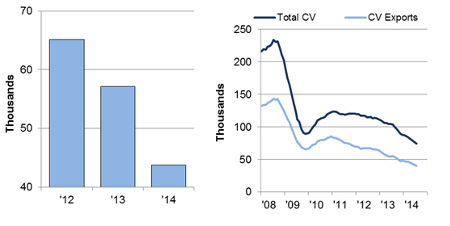
UK commercial manufacturing output continued its long-running decline in July, with output down by 25% to 6,338 units, compared to 8,454 units in July 2013, according to the latest figures from the Society of Motor Manufacturers and Traders.

CV manufacturing July-13 July-14 % Change YTD-13 YTD-14 % Change
Total 8,454 6,338 -25.0% 57,118 43,798 -23.3%
Home 2,346 2,125 -9.4% 26,367 20,723 -21.4%
Export 6,108 4,213 -31.0% 30,751 23,075 -25.0%
% export 72.2% 66.5% 53.8% 52.7%

The falls reflect structural changes — a.k.a. downsizing and closures — in the UK CV manufacturing sector last year, which have not yet worked their way out of the comparative figures:

SMMT CV manufacturing July 2014

Graphs courtesy of SMMT (www.smmt.co.uk)

A comparison with June 2013 suggests that production has been fairly stable in recent months: 6,348 vehicles were produced in June, compared to 6,338 in July.

Sounding ever-so-slightly like a stuck record, SMMT chief executive Mike Hawes said:

“UK commercial vehicle production fell by a quarter over last July, continuing the trend seen over the last year.

With the effects of the 2013 restructuring still evident, as well as the spike in truck registrations towards the end of last year, this was to be expected. The coming months should provide more optimism, however, with European demand showing sustained improvement.”

The decline seems to have bottomed out, based on month-by-month figures, but the long-term decline in CV manufacturing output is pretty scary — down from around 225,000 per year before the financial crisis to less than 100,000, today.

Used van values hesitate in July

Have used van values started to fall? The data are slightly ambiguous, but they are certainly not soaring ahead.

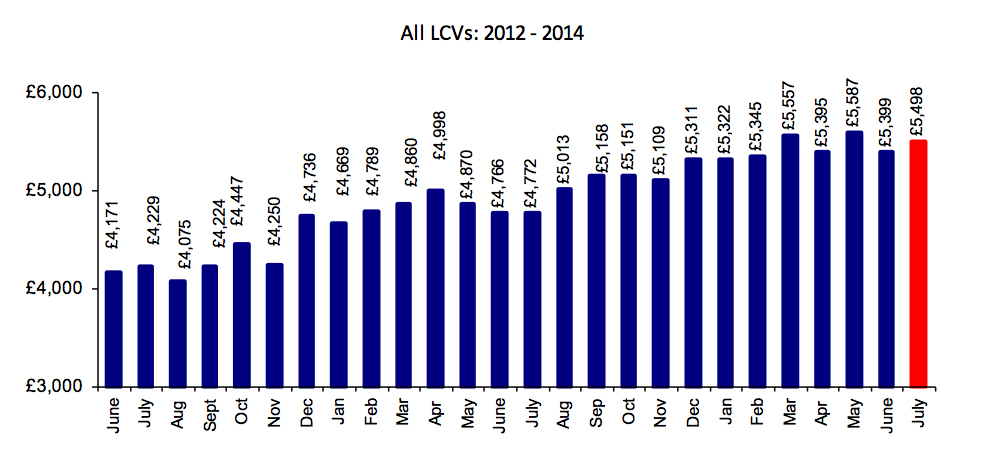
According to auctioneers BCA, the average used van sold for £5,498 in July. Although this was an increase of 1.8% on June, the rise was due to a change in the model mix, says BCA, not to an increase in like-for-like prices.

Indeed, BCA says that average fleet, lease and dealer part-exchange van values all fell during July, albeit by a small percentage, with only high-quality corporate stock supporting the overall average price.

BCA used van prices July 2014

BCA used van prices June 2012 – July 2014 (courtesy of BCA)

BCA’s General Manager – Commercial Vehicles, Duncan Ward, commented:

“As we said last month, we expect to see some pressure on average values over the summer months and July bore that out. The change in the model mix in favour of more expensive corporate stock actually resulted in the headline value rising, but that should not mask the fact that the used van market is notably quieter at this time of year.”

We’ll need to see August and September price data before deciding whether the market really has reached a turning point, but further big gains are beginning to seem less likely, in my view.

Ford expands AA role with 343 new Transit Customs

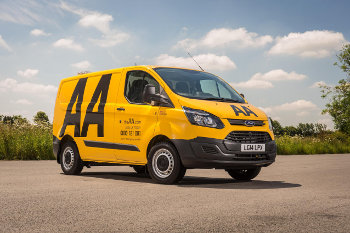
AA Ford Transit CustomFord is supplying 343 Ford Transit Custom vans to the AA to join its fleet of patrol vehicles. They will raise Ford’s share of the 2,100-vehicle AA patrol fleet to more than 50 per cent.

Ford secured the order from the AA following an exhaustive analysis of whole-life costs. Sarah Dopson, AA head of fleet, said:

“We looked at all the usual factors – acquisition price, depreciation, servicing and maintenance costs, running costs including fuel economy – and the Transit Custom came out top.

Deliveries of the new vehicles will be complete by November, in time for our busiest period for call-outs.”

Prior to delivery, the Transit Custom vans – a mix of 310 and 330 L1 models – undergo conversion at a vehicle preparation specialist, which includes fitment of the AA’s new contract recovery trailer to allow the partial lift and recovery of broken-down vehicles, a dual battery system, specialist racking systems and of course the organisation’s distinctive yellow livery.

Ian Watson, Ford’s direct sales manager, said:

“Ford is already supplying around 3,000 cars a year to the AA Driving School, and we are very pleased that the organisation has recognised the Ford Transit Custom’s many attributes, including the important financial ones. They look eye-catching in AA livery and will prove a reassuring roadside sight for AA members.”

The purchase is another high-profile endorsement of Ford’s incredibly successful Transit Custom van, which is part of its all-new van range.

Of course, Volkswagen Transporter drivers benefiting from Volkswagen Commercial Vehicles’ roadside assistance service — standard with new VW vans — will still be rescued by an AA Volkswagen Transporter: avoiding the bad publicity VW would incur by allowing its new vans to be rescued by Ford Transits is worth whatever premium VW might be paying for its dedicated, liveried roadside assistance service…