Used Van Prices 2nd Highest On Record In January

The latest BCA auction figures show that van prices remained firm in January, with the LCV average of £4,669 the second-highest on record since 2005.

BCA’s latest Pulse data shows average LCV values remained on a high in January, with fleet & lease values increasing and dealer part-exchange falling slightly from the exceptional prices seen in December, when lack of stock, a shorter trading period and changing mix contributed to the values achieved.

The average January figure of £4,669 for LCVs was the second highest on record for any month since Pulse began reporting in 2005.  Both average age and mileage rose over the month to 56.6 months and 80,700 miles respectively.  There was strong demand from professional buyers across the widest range of commercial vehicles and sold volumes rose significantly compared to December.
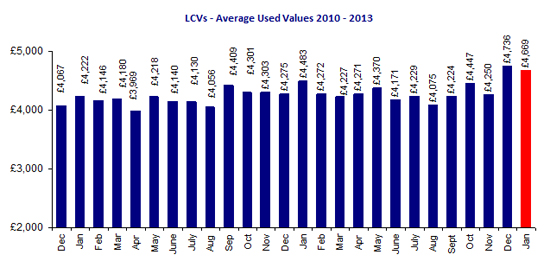
BCA used van prices January 2012

As the numbers below show, buyers are now paying more for an older van with higher mileage than they were this time last year, providing a graphic demonstration of supply and demand (and inflation):

All vans Avg Age Avg Mileage Avg Value Sale vs CAP
Jan 2012 55.37 75,814 £4,483 100.02%
Jan 2013 56.64 80,736 £4,669 102.24%

*Data courtesy of BCA

Duncan Ward BCA’s General Manager – Commercial Vehicles commented commented:

“Although the headline value declined compared to December, January essentially delivered more of the same – a shortage of stock allied to decent levels of demand that generated exceptionally strong prices in the used van market.”

“With stock remaining thin on the ground, buyer demand is focused on the best quality commercial vehicles and this is driving values up, particularly for corporate sellers where average values reached a new highpoint in January.  Sale conversion rates also rose in January as buyers competed for stock and BCA saw lots of activity in the online arena with nearly a quarter of all vehicles being purchased by internet bidders.”

He added “The rise in average prices at the ‘value-for-money’ end of the market continues unabated and dealer part-exchange values have stepped up significantly over the past two months.  This is likely to be a side-effect of the tough economic climate.  With continuing redundancies across a range of business sectors from retail to manufacturing, many people will be tempted strike out on their own and one of the first things they will buy with their redundancy money is a van.”

I’m not sure when the pressure on used van supply will end — used van purchases are rarely discretionary and are usually driven by business need, so van operators are going to have to continue paying more in order to acquire second-hand vans.
DfT Introduces Common-Sense Exclusions For Van Type Approvals

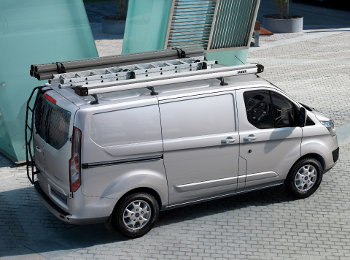
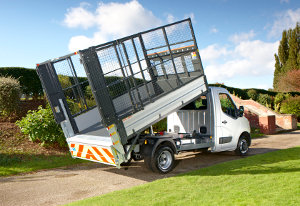
Vauxhall and VFS Movano caged tipper conversionWith new EU Type Approval rules due to be introduced in April, UK van converters were beginning to worry that even such mundane modifications as ply-lining would need individual type approval.

(Even though, as I pointed out here, the DfT has always emphasised that type approval only applies to vehicles before they are registered — there are no restrictions on modifications after this point*.)

Whatever the case, there was still a grey area of uncertainty and doubt that suggested that the van industry was going to have to face a monumental paperwork headache come April this year. Luckily, common sense has prevailed (along with a bit of lobbying by the SMMT) and a solution has been found.

SMMT has announced today that it has successfully negotiated a valuable Van Enhancement Scheme that removes the requirement for UK-based van manufacturers and bodybuilders to seek Type Approval on basic vehicle modifications.

Under legislation set to hit N1 category vehicles from April this year (and N2 vehicles from October 2014), any modification would have required separate Whole Vehicle Type Approval (WVTA). The Enhancement Scheme, secured by SMMT with VCA and VOSA, removes the requirement for basic modifications (ply-lining, basic racking, etc) to be approved.

“SMMT has worked hard to achieve this crucial Type Approval change that will avoid unnecessary paperwork and save UK businesses thousands of pounds every year,” said SMMT Commercial Vehicle Manager Nigel Base. “We have found a solution that works for all parties while maintaining safety standards for those converters making basic modifications to panel vans. This sort of administrative burden could have forced some firms out of business, but thanks to close collaboration with industry partners and government this will now be avoided.”

Over the past 10 months SMMT has worked with a group of van manufacturer and converter members, the VCA, VOSA and the Department for Transport to try and reduce the regulatory burden of Type Approval. The process has achieved a result that will see around 80% of vans sold in the UK avoid the burdensome Type Approval requirements, with another 15% of the market benefiting from an enhanced process of application and approval of multiple vehicle types.

Those  converters that need to go through the Enhancement route will benefit from an upgraded version of SMMT’s online Type Approval guide – SENTA (www.smmt.co.uk/SENTA). The tool guides companies through all combinations of Whole Vehicle Type Approval, streamlining the process and saving companies time and costs.

*Disclaimer: This article is my opinion only and is definitely not a guide to the new rules. Contact VOSA or the VCA if you want to know the facts, don’t trust me!

All-New Mitsubishi Outlander Will Keep Van Version

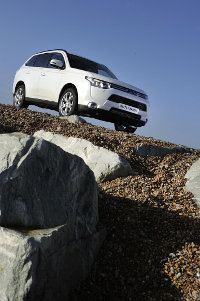
Mitsubishi Outlander

The new Mitsubishi Outlander

Mitsubishi has launched an all-new version of its mid-size Outlander 4×4. The company will continue to produce a commercial version of the 4×4, which will be badged the Outlander GX1 4Work.

As with the outgoing model, the GX1 won’t be a full-blown van, but instead will have blacked-out rear windows and no rear seats, providing a 1,000-litre loadspace,  along with go-anywhere capability. The new Outlander has a 2,000kg towing capability, making it superior to the majority of cars and vans and cheaper than most of the heavyweight towing 4x4s.

The new model has already achieved a five-star Euro NCAP safety rating and will be powered by a redeveloped version of the established and technologically advanced Mitsubishi 4N14 2.2-litre 16v DOHC diesel engine, which now produces improved low-end torque, superior fuel economy, class leading CO2 emissions of just 138 g/km of CO2  and easily meets the latest Euro 6 emission standards.

What’s more, the new Outlander will shortly be available in hybrid spec: although the Outlander Plug-In Hybrid PHEV official homologation figures will be finalised in a few weeks time, the latest data already confirms the excellent credentials with targeted CO2 emissions (weighted) of 44g/km, fuel consumption of a staggering 147.9 mpg and an electric driving range of 32.5 miles.

Past times

The previous Outlander was also sold badged as the Citroën C-Crosser, and both models were available in a commercial version, designated the Outlander GX1 and C-Crosser Enterprise  respectively.

January Pickup Sales Fuel 11.9% Rise In Van Registrations

The year got off to a good start for the UK’s van dealers, with an 11.9% rise in new van registrations compared to January 2012. However, a strong rise in pickup sales obscured more modest gains for vans.

The latest commercial vehicle registration figures from the Society of Motor Manufacturers and Traders (SMMT) show that while van registrations climbed strongly in the first month of the year, truck sales went into reverse, dropping by 19.6% compared to January 2012.

The changes left truck sales up by 2.1% on a rolling-year basis, while rolling-year van sales remained underwater, down by 6.2% on the preceding twelve month period:

UK van and truck registrations: 2013 and % change on 2012:

January % change Year-to-date % change Rolling year % change
Vans 16,049 11.9% 16,049 11.9% 241,352 -6.2%
Trucks 2,882 -19.6% 2,882 -19.6% 44,998 2.1%
Total 18,931 5.6% 18,931 5.6% 286,350 -5.0%

(All figures courtesy of SMMT)

However, if you look more deeply into these figures, it becomes clear that the rise in ‘van’ registrations was heavily aided by a big increase in pickup and 4×4 registrations — perhaps unsurprisingly, given the weather we’ve had.

In percentage and volume terms, pickups saw the biggest rise in registrations in January, with pickups recording a 34.5% increase in registrations, corresponding to 564 new vehicles registered. The next biggest volume increase was in the 2.0-2.5t van sector, where registrations rose by 20.4% (404 vehicles).

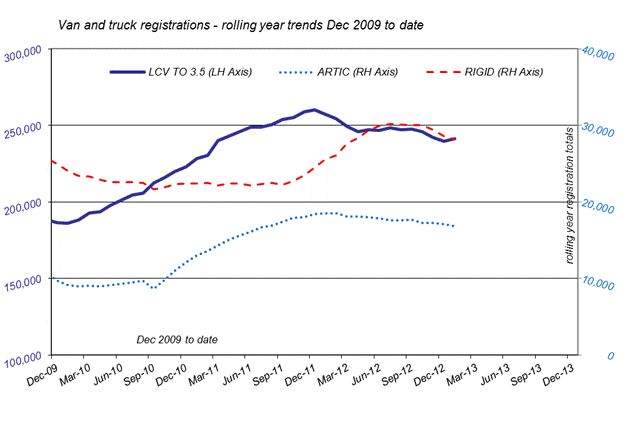
Unfortunately, I reckon the boost in pickup sales could be seasonal, and that February or March will see a return to last year’s lacklustre performance:

SMMT van and truck registrations January 2013

CV registrations rolling years from Dec 2009 to date (courtesy of SMMT)

Despite my reservations, the figures were cautiously good news for the CV industry, which saw registrations fall steadily last year. Commenting on the figures, Nigel Base, SMMT Commercial Vehicle Manager, said:

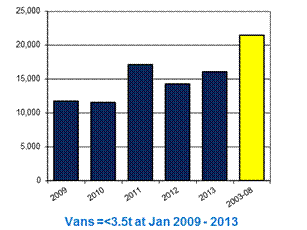
SMMT van registrations January 2009-2013

SMMT van registrations January 2009-13 (SMMT)

“2013 is set to be a telling year for the commercial vehicle sector with van registrations off to a good start and the truck sector’s performance under close scrutiny ahead of the introduction of Euro 6 from January 2014,” said Nigel Base, SMMT Commercial Vehicle Manager. “Van registrations were up 12% in the month and SMMT forecasts that the light commercial vehicle sector will grow almost 5% over the year, with new models and greater business confidence driving the market.”

One telling statistic is how much lower average registrations are, compared to the 2003-08 period.

You can see the difference in the graph on the right, which leads me to think that it will be many more years before boom-time levels of sales will return.

Smaller truckin’

In the truck sector, the only category to show an improvement in registrations in January was the 3.5t – 6.0t rigid sector, where registrations rose by a whopping 22.8%. This continues a trend I mentioned last year, and must surely be the result of ongoing cost optimisation and improved compliance — both of which are good news, in my opinion.

Ford Transit Custom Bags Five-Star Euro NCAP Best-In-Class Rating

Ford Transit Custom

The new Ford Transit Custom won the Euro NCAP best-in-class award for the Business and Family Van sector, scoring a five-star Euro NCAP rating and earning an Advanced reward for its Lane Keeping Alert system.

The Ford Transit Custom has been awarded a five-star Euro NCAP rating and an Advanced award in the Business and Family Vans category of Euro NCAP’s 2012 best-in-class safety awards.

Ford Motor Company won three out of a possible seven 2012 Euro NCAP best-in-class safety awards – more than any other manufacturer – with wins for new Kuga, new Transit Custom and new B-MAX.

New Transit Custom achieved 77 per cent for overall protection after becoming the first vehicle in its class to earn a five-star Euro NCAP rating that also applies to the new Tourneo Custom people mover.

Last year, Brentwood-based Ford became the first car manufacturer to achieve a total of seven different Euro NCAP Advanced rewards in recognition of a wide range of technologies that Ford has introduced across a number of vehicles.

The Transit Custom earned the Advanced reward thanks to its Lane Keeping Alert system. Although this type of system is quite widely implemented in new cars already, vans have historically lagged behind cars in terms of safety features, despite their large size.

Michiel van Ratingen, Euro NCAP secretary general, said:

“Euro NCAP is recognising the efforts of some manufacturers already offering a higher level of occupant protection in their cars, but today safety means more than protecting occupants in a crash. Through the expansion of our tests and the assessment of important active safety systems, our aim is to inform and allow all road users to benefit from safe cars with advanced systems in the most affordable way, and to contribute in reducing the number of road accidents.”

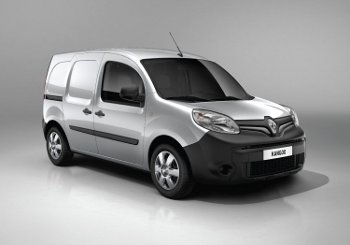
Renault Aims High With Kangoo Facelift – A Merc Beater?

Renault Kangoo 2013 facelift model

The updated Renault Kangoo has a new front end and improved build quality.

Renault has launched a facelifted version of its popular Kangoo small van.

The changes to the Kangoo, which has sold more than 400,000 units since the current model’s 2008 launch, include a new front end, improved fit and finish and a few minor specification upgrades:

  • New bumper, door mirrors and headlights
  • Stop&Start now available with the dCi 75 and dCi 90 diesel engines
  • Electronic Stability Control, Hill Start Assist and Grip Xtend are all available
  • In-dash Renault R-Link multimedia system
  • Improvements to build quality — better spot weld finishes, cleaner, more consistent finish to crimping on door panels, improved precision in the application of body sealants, and enhanced improved soundproofing and noise reduction.

Renault vs. Mercedes?

It’s interesting to note that the timing of this model update, with its emphasis on quality, coincides with the launch of Mercedes’ new small van model, the Citan. The Citan is a rebadged Kangoo that’s made in Renault’s MCA de Maubeuge factory in France, and it seems to me that Renault’s stated focus of “robustness and modernity” ties in quite nearly with the attributes that Mercedes buyers will be looking for.

Renault may well have killed two birds with one stone here, keeping Mercedes happy and boosting the quality of its own van.

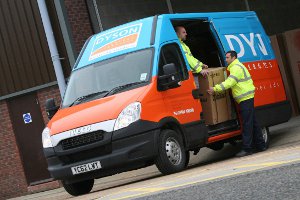
Dyson Energy Takes 20 New Iveco Dailys To Meet Heating Needs

Dyson Energy Iveco Daily

Dyson Energy Iveco Daily

Business is booming for West Yorkshire-based Dyson Energy Services, which is expanding its domestic heating division with the addition of 20 new Iveco Daily 35S11 vans.

The new 3.5 tonne Dailys, built on a 3,300mm wheelbase, join an existing fleet of more than 200 commercial vehicles – with a further 15 Dailys expected to follow in early 2013.

Supplied by Northern Commercials, the delivery marks the first of the latest generation of Daily van to enter operation with the customer, which has been a major operator of Iveco vehicles for over a decade.

The 12m³ vans will be spread across Dyson’s network of nine depots and will remain in operation for five years, clocking up around 30,000 km a year with a two-man crew.

Ian Morrall, Director of Dyson Energy Services, explains: “We’ve been running Dailys for years as they are reliable, competitive on fuel and the perfect size for our business. They are also popular with drivers; especially these latest models, which have added driver comforts and an improved driving position.”

Iveco’s current Daily sees interior noise reduced by 5 dB(A) during the most common operating conditions (between 1,600 and 2,000 rev/min), to ensure a more relaxing journey for the crew.  Interior upgrades over the previous model include a new adjustable steering column, in combination with a seat which offers a greater range of adjustment.

Each of the vans is powered by a 2.3 litre FPT Industrial engine capable of delivering up to 106 hp between 2,700 and 3,900 rev/min, and up to 270 Nm of torque between 1,800 and 2,600 rev/min, driven through a five-speed synchromesh gearbox.

Dyson Energy Services splits its fleet funding between outright purchase and full service leasing from Iveco Capital. Vans and trucks located at its depots in Brighouse, Gateshead, Manchester and Sheffield are purchased by the company and serviced within its own workshop, whilst vehicles further afield (in Birmingham, Crawley, Glasgow, Northampton and Southampton) are leased and maintained via the Iveco dealer network.

Each of the new Dailys features a striking orange and blue livery and will be on the road five days a week.  They have been signwritten as ‘Dyson Energy Services’, following a recent change in company name from ‘Dyson Insulation’. The change reflects the wider scope of the company, having been founded more than 30 years as a small firm installing loft insulation with one depot in West Yorkshire – but which has grown into a much broader energy service provider employing in excess of 400 people.

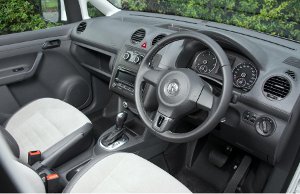
Volkswagen Launches 30th Anniversary Limited Edition Caddy Van

Volkswagen Caddy Edition 30

Volkswagen Caddy 30th Anniversary Edition — only 117 will be available in the UK.

To celebrate 30 years and three generations of its compact Caddy van, Volkswagen Commercial Vehicles has launched a stylish and desirable special edition – the Caddy Edition 30.

With only 117 of this limited edition model available in the UK, the Caddy Edition 30 is also exclusive.

The striking exterior follows the design cues of other sporty Volkswagen vans, such as the Transporter Sportline, and it is distinguished by a black roof and roof rails contrasting against Candy White paintwork, with body-coloured bumpers, door handles and door mirrors, plus chrome grille detailing, 17-inch ‘Budapest’ alloy wheels and Edition 30 logo on the door sills and exterior.

Other standard features include Bluetooth connectivity, Climatic air conditioning, leather steering wheel, an upgraded RCD 310 radio/CD unit, electric windows, electrically adjustable and heated door mirrors, tailgate with heated rear window and wash/wipe, height adjustable driver’s and passenger’s seats, plus front fog lights.

The superior Timo upholstery is standard, while for even more luxury, models with DSG transmission feature alcantara leather upholstery.

Volkswagen Caddy Edition 30 interiorWith Volkswagen’s refined 2.0-litre TDI 140 PS engine, the Edition 30 has the performance to go from zero to 62 mph in just 10 seconds (10.1 for DSG models), yet it is also economical with combined fuel consumption of 47.1 mpg (44.8 DSG), and low emissions of 158 g/km (166 DSG).

Low insurance groups of 6E and 7E for manual and DSG models, respectively, also help reduce running costs.

The compact size and economical running costs of the Caddy have proved a great success, and it is now Volkswagen’s second best-selling van in the UK behind the Transporter.

The first Caddy, introduced for the 1983 model year, was based on the Golf Mk I pick-up body, but was also available with a hardtop.  The Mk II model was introduced in 1995, initially as a van, followed later by a pick-up version, and the current, third generation superseded it in 2003, with the addition of the long wheelbase Caddy Maxi in 2007.

Volkswagen Caddy Edition 30 badgingThe Caddy Edition 30 is now available in Volkswagen Van Centre showrooms, with retail prices of £17,660 (excluding VAT) for manual models, or £19,060 (excluding VAT) with the DSG transmission.
For full details of the Volkswagen Commercial Vehicles range of vans, people carriers, conversions and pick-ups, or to find a local Volkswagen Van Centre, visit www.volkswagen-vans.co.uk.

Citroën To Launch Electric Berlingo At Birmingham CV Show

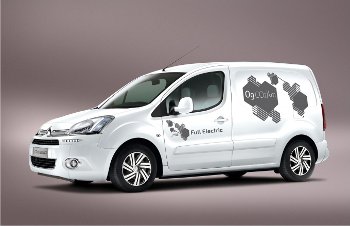
Citroen Berlingo Electrique

Citroen Berlingo Electrique

Citroën will be showing its all-new Berlingo Electrique van at this year’s Commercial Vehicle Show (NEC, 9-11 April).

Citroën’s CV Show stand will also be the launch platform for a number of other new LCV products, including the new Dispatch L1H1 HDi 125 6-seat Crew Van and Stop & Start equipped Relay vans.

In addition, Citroën will be continuing its ‘Citroën Vans – Business Class’ theme, with Citroën Contract Motoring personnel providing instant contract hire and other business-friendly finance quotations to the show’s visitors.

Berlingo Electrique

The new, well equipped Berlingo Electrique will be the sister vehicle to the Peugeot Partner Electric, which was shown at the Hanover Motor Show last September. The electric motor is positioned under the bonnet and the lithium-ion battery pack is located underneath the vehicle’s load deck. This means the load compartment of up to 3.7m3and payload of 636kg is equivalent to that of a similar diesel-powered Berlingo van.

With a total battery capacity of 22.5kWh, the Berlingo Electrique has a range of up to 106 miles. Using a domestic socket, the vehicle can be fully charged in around 8½ hours or, alternatively, it can be charged to 80% of capacity in only 35 minutes using a specific 380V three-phase terminal in quick-charge mode.

The Berlingo Electrique’s permanent magnet synchronous electric motor produces 49kW (67hp) and has a peak torque rating of 200Nm. The motor drives the front wheels through a speed reducer and a single-ratio gearbox.  This should translate to pretty perky performance, especially as the electric motor’s torque is available from a standing start.

Full UK specification and pricing will be announced closer to the CV Show, but among the Berlingo Electrique’s features are:

  • Eco-driving information, including an energy consumption/regeneration indicator, an instantaneous energy consumption gauge and an auxiliaries consumption gauge, which displays data on heating, air conditioning and other secondary power usage
  • A deceleration and braking energy recovery system
  • An electric heating system with an eco-mode to limit energy consumption
  • Hill start assist coupled to the ESP system

As I commented recently, I believe that electric vans offer a far more appealing commercial proposition than electric cars, at present — and once the initial purchase cost comes down a little, I expect them to become popular quite quickly.

The 2013 Commercial Vehicle Show will be held at the Birmingham NEC from the 9th – 11th April 2013. Visit www.cvshow.com for more details.

Nissan e-NV200 Gets Rave Reviews At Test Event

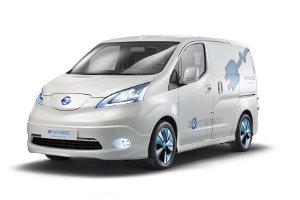
Nissan e-NV200 electric van

Nissan e-NV200 electric van

Fleet van operators are jostling to place orders for the Nissan e-NV200 electric van, according to Nissan, who recently ran a two-day demonstration event to promote the van, which is due to go on sale in 2014.

Nissan has received extremely positive feedback from the fleet industry on its new e-NV200 electric van when it was showcased in late 2012.

Five leasing companies, six major fleet operators and three used value guides visited Nissan’s Barcelona production facility and drove the new e-NV200, a diesel NV200 and the LEAF.

The group met the e-NV200 development team and were able to give their thoughts on all aspects of the vehicle, including how they envisage it fitting into a fleet strategy.  Nissan also shared its overall EV vision including product creation, development and future EV plans.

All delegates reacted positively to the 100% electric van’s driving and performance characteristics with many keen to put the vehicle into immediate use.

Personally, I’ve long thought that electric vans make far more sense than electric cars — with vans, you know exactly how far and over what route they will travel each day and you can plan to have them recharged in an off-road base each night.

Nissan’s findings certainly seem to suggest that this might be true:

“We were blown away with the response and we already have leasing companies and fleet operators who want to trial the vehicle, and some who want to order a fleet of vehicles for urban delivery use,” explained Matthew Dale, Nissan’s national LCV sales manager.

“After driving the vehicle on the two day trip they could immediately see the business benefit of running electric vans across specific parts of a fleet. Commercial vehicles are working tools and our guests recognised both the savings in fuel costs and reduced emissions offered by the e-NV200,” he added.

From a residual value perspective the used guides could see a definite role to play for the e-NV200 and that used prices should be strong based on the vehicle’s practicality and whole life costs, which will give it a second and third life in the used market.

“Residual values are key to the success of any commercial vehicle so we were pleased to hear some very positive initial comments from the used vehicle experts,” said Dale.

The Barcelona trip follows successful trials with major fleets such as British Gas, FedEx and the Japan Post Service in 2011 and 2012 as Nissan prepares the e-NV200 for mainstream production. The e-NV200 is expected to go on sale in 2014.