Catering supplier bakes Van Excellence into fleet operations

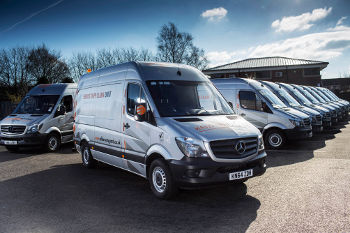
Millers Vanguard Mercedes-Benz SprintersThe Freight Transport Association’s Van Excellence scheme is akin to a scaled back version of rules and regulations under which heavy goods vehicle operators have to monitor and maintain their fleets.

Van Excellence was conceived as a way of addressing concerns that widespread poor compliance — on weight, for example — and minimal regulation was tarnishing the reputation of van operators, who had no way of demonstrating their professionalism to customers or compliance agencies.

The scheme has gained some heavyweight members over the last few years, including BT Fleet, Ford, and Hertz Van Rental.

One of the latest firms to join the scheme is Lancashire-based catering equipment supplier and maintenance firm, Millers Vanguard, whose 240-strong Mercedes-Benz van fleet has now been accredited by the FTA Van Excellence scheme.

Interestingly, the move to join Van Excellence was driven by the firm’s newish fleet manager, Nick Webb, who joined the company a year ago from a background in truck operations — where compliance and monitoring burdens are much heavier.

Mr Webb was keen to introduce a set of consistent, measurable standards across the company’s light commercial vehicle fleet, and said that Van Excellence appeared to be tailor-made for the purpose:

“We run 100 vans from our headquarters but the rest are out with engineers across the UK, which makes ensuring compliance and best practice even trickier than usual. Van Excellence proved to be an invaluable tool to ensure a uniform approach across the fleet; it allowed us to draw a line in the sand below which standards must never fall.

“We implemented various solutions to achieve our end goals, such as instigating daily walk-round checks and ensuring the cleanliness of vehicles. Since then we’ve been continually refining and improving our processes to make them quick and simple to implement from a driver’s point of view, and easily monitored for the fleet management team.”

Having worked through the Van Excellence list of qualifying criteria, and ensured all its standards were being met or exceeded across its fleet, Millers Vanguard submitted its application last October – then waited for the FTA to complete its comprehensive audit of a sample of 10 drivers and 10 vehicles.

There are three possible outcomes: operators are either told that they do or do not make the grade, or that they almost pass, in which case they are given a list of issues to address. Millers Vanguard passed with flying colours.
New Citroën Berlingo & Peugeot Partner to make UK debut at CV Show 2015

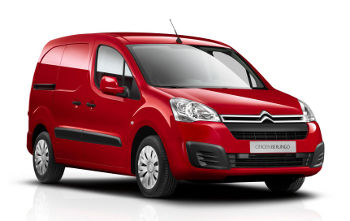
Citroen Berlingo 2015

New 2015 Citroen Berlingo will make UK debut at CV Show 2015

The new Citroën Berlingo and Peugeot Partner small vans will make their UK debuts at the CV Show 2015, which takes place at the Birmingham NEC from 14-16 April.

While the styling and specification of both vans have been tweaked, the big change is that both models will now be available with Euro 6 engines.

Euro 6 is the latest European standard for emissions control and is particularly relevant for diesel engines at it includes much tougher legislation on nitrogen oxide (NOx) emissions.

These are responsible for respiratory and other health problems in urban areas, and while NOx levels should have fallen under Euro 5, it was found that the technology used for Euro 5 didn’t work very effectively in urban environments*. As a result, NOx levels didn’t fall by as much as expected following the widespread adoption of Euro 5.

Naturally, emissions control technology is getting more complex, as Citroën explains:

BlueHDi (Euro 6) powered New Berlingo models have an efficient, three-stage SCR process to treat emissions caused by combustion:

– Stage 1: an oxidisation catalyst converts the unburned hydrocarbons (HC) and carbon monoxide (CO) in the exhaust into water and carbon dioxide (CO2)

– Stage 2: the SCR module then adds AdBlue to convert nitrogen oxide (NOx) into nitrogen (N) and water

– Stage 3: a particulate filter then eliminates 99.9% of particles in the vehicle’s exhaust emissions

BlueHDi powered New Berlingo vans have a 17-litre AdBlue tank, which will last for up to 14,000 miles, depending on the type of vehicle operation.

The Peugeot Partner is of course essentially the same van, and will have a near-identical range of engines. Both firms will wisely also offer a 1.6-litre petrol engine, which should win favour with low mileage urban operators and perhaps off-road users, such as airports, where speeds and distances are very low and do not allow a modern diesel to warm up and operate efficiently.

Peugeot will also continue to offer the Partner Van Electric, an all-electric model, while there will be a new Berlingo Electric Van (presumably using the same electric drivetrain).

What else is new?

I’ve written about both new vans previously (Berlingo & Partner), so I won’t repeat everything here, but to summarise, the main enhancements to each model are technological and safety related: Active City Brake, Hill Start Assist, tyre pressure sensors, cruise control and front and rear parking sensors and camera are all available as options, while the 2/3-seat cab seating format will continue to be available.

Payloads for the updated vans range from 625kg to 850kg, while inside a 7-inch touchscreen media system will also be available for the first time.

*https://consultations.tfl.gov.uk/environment/ultra-low-emission-zone/user_uploads/ulez-supplementary-information—final-291014.pdf

Major rental firm adds hybrid cars to London fleet: will vans be next?

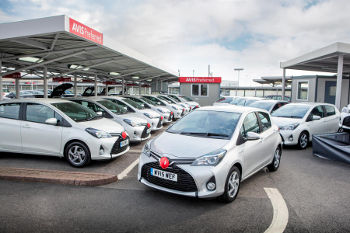
Avis Toyota Yaris Hybrid cars

Avis has just added 100 Toyota Yaris Hybrid cars to its London car rental fleet

Car rental giant Avis has added 100 Toyota Yaris Hybrid cars to its London fleet, flagging up the growing acceptance of hybrid and electric vehicles among major fleet operators.

The Yaris Hybrid cars will initially be available at Heathrow and Stansted airports, plus major central London locations. Availability will gradually be extended to Gatwick, Luton and other key south-east locations.

As full hybrids, the Yaris Hybrids are currently exempt from the London congestion charge and boast CO2 emissions of just 75g/km. At low speeds, the cars automatically switch to full electric mode, with the engine firing up as needed at higher speeds.

Will the Avis example encourage any van hire operators to make the switch?

One problem is that with the exception of the 4×4-derived Mitsubishi Outlander PHEV hybrd (plug-in electric vehicle hybrid) — which isn’t really a normal van — there aren’t currently any production hybrid vans. All the available models are either all-electric or petrol/diesel, not hybrids.

However, given that PSA Peugeot Citroen has a diesel hybrid system which is available on cars such as the 3008 and 508, it’s not an impossible stretch to imagine that this system could be adapted to fit the Peugeot Expert van, improving its urban emissions credentials.

There’s also the Ashwoods Hybrid Transit, an aftermarket hybrid conversion for the Ford Transit that’s won widespread acceptance and makes a credible claim to reduce emissions and fuel consumption by around 15%.

Hybrid technology seems to be gaining widespread acceptance in the car world, and overcomes the core objections which face electric cars — they aren’t suitable for long distances or as an only car. I don’t see any reason why hybrid technology can’t start making in-roads into the van market, especially as cost-wise, hybrid vehicles are increasingly on a par with non-hybrid alternatives, especially when fuel and emissions costs are factored in.

Rare barn find 1968 Austin Mini Van in mint condition — for sale

Fancy a ‘new’ van that’s 47 years old?

An almost unused 1968 Austin Mini Van is to be auctioned by Silverstone Auctions at the Birmingham NEC on March 28.

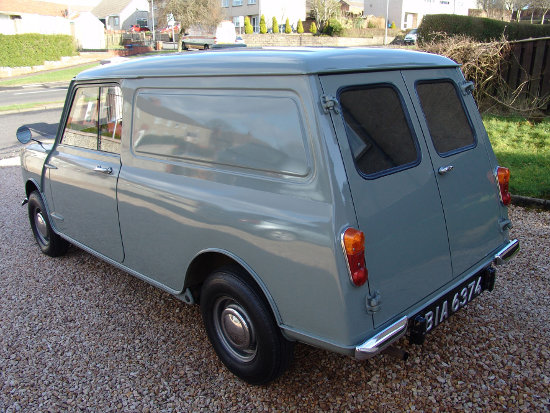
Built on the longer Traveller chassis but without side windows, the Mini Van proved popular in 1960s Britain as a cheaper alternative to the car. It was classed as a commercial vehicle and as such carried no sales tax.

1968 Austin Mini Van

This rare find is is in perfect order and will go on sale on March 28, at the Birmingham NEC

This car, estimated at between £23,000 and £25,000, was first registered on the 14th March 1968. It was bought new for a mere £400 by a Miss G. Crumcott from Northern Ireland so she could learn to drive. Miss Crumcott never managed to pass her driving test however, so the car was kept unused in her garage for nearly 30 years.

1968 Austin Mini van rear view

The car was then bought in July 1997 by a local BMC Mini dealer, Mr T. Turkington, who placed it in the Mini centre’s showroom until 2006 before selling it onto another collector in Northamptonshire. It has now been brought back onto the market, and, with so few owners, it is no surprise the car has covered a miniscule and very desirable 302 miles.

The charming classic will be sold at the Practical Classics Restoration Show sale, but the new owner is not expected to need to spend much on his or her new  steed.

Inside mint condition 1968 Austin Mini van

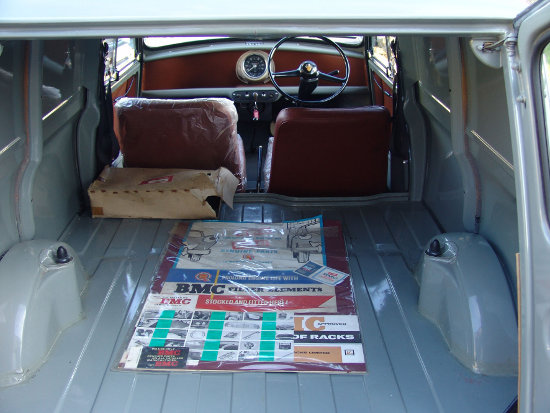
The van is complete, right down to the original, unopened, toolbox

This Austin Mini van is in remarkable unrestored original condition, right down to the seat protectors and rubber floor mats. Still retaining its original crossply Dunlop tyres and spare wheel, all of which are unused, the motorcar has been so carefully stored it has also preserved its initial exhaust and sealed Lucas battery. The car is also supplied with its original toolbox, which remains unopened; a delightful added extra.

According to Silverstone Auctions, the van is in perfect running order. For more information, visit www.silverstoneauctions.com.

Used van values approaching tipping point — BCA

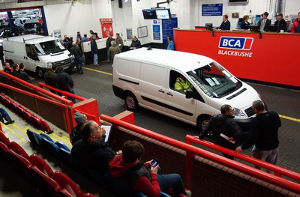
BCA Auction February 2015After months of waiting, it looks like I’m no longer the only person calling the top of the used van market: Duncan Ward, BCA’s Head of Commercial Vehicles — a man with much better visibility of the used market than me — believes we may have reached a turning point:
“We have been predicting a tipping point in used values for some time and possibly we are starting to see a levelling off following many, many months of average value growth.”

Mr Ward’s comments were made alongside February’s used van price report, which showed that the average used van price at BCA rose by £72 in February, compared to January. Prices were also higher against February 2014, but age, mileage and sales vs CAP price all fell, suggesting that in real terms — relative to age and condition — valuations are weakening:

All vans

Avg Age (mnths)

Avg Mileage

Avg Value

Sale vs CAP

Feb 2014

60.73

81,346

£5,345

102.57%

Feb 2015

59.35

77,754

£5,532

100.79%

Data courtesy of BCA

As seen in January, higher volumes and and a significant number of vans with issues over quality and presentation were key factors in February’s auction market. Mr Ward again:

“Corporate volumes took a slightly larger share of the market in February, although issues over quality and presentation remain as vehicles from corporate sources are returning at generally higher ages and mileages than we were seeing a year ago.”

“Notably, the average price performance for both fleet/lease and dealer part-exchange vans was lower than a year ago, a result of the generally poorer condition and higher age and mileage profiles reaching the marketplace.”

Things are set to get worse, too: Mr Ward’s believes that the approach of the Easter holidays and May’s general election could trigger “uncertainty” in the wholesale markets and make now a very good time for van dealers to “appraise any over age stock and get it sold, rather than chasing the market in a few weeks’ time if values soften.”

Strong words: in my view, suggesting that a full-scale retreat is now likely in the face of a continuous rising tide of new van registrations — as I’ve been predicting for some time.

How will the end of the driving licence paper counterpart affect van hire companies?

After an initial half-baked attempt to abolish the paper counterpart of the UK driving licence in January, the government has confirmed that the paper counterpart issued with UK photocard driving licences will no longer be valid from 8 June 2015.

This has a number of important implications for van hire companies, and addressing this change will require forward planning if companies are to avoid costly and risky workarounds.

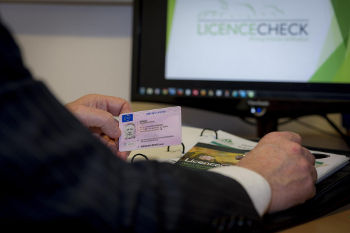
LICENCECHECK RealTime

LICENCECHECK RealTime is the first product to provide real-time UK driver licence checks for companies ahead of the abolition of the paper counterpart.

The British Vehicle Rental and Leasing Association (BVRLA) has issued some guidelines explaining the issues — and how they can be addressed.

Perhaps by coincidence (perhaps not), the first real-time driver licence checking system, LICENCECHECK RealTime, has also just been launched: such systems are likely to be the only viable way for firms to check licences once the paper counterpart has gone.

Here’s what the BVRLA has to say on the subject (my comments in italics):

  • The driver record held centrally by the DVLA will be the only legal source of the driver’s licensing history, penalty points, endorsement and disqualification details.
  • From 8 June 2015, fleets will have three options for checking a driver’s details:
    • They can call the DVLA’s premium rate telephone service. This costs 51p per minute and the driver must be present.
      However, I suspect this will be too slow and expensive for all but the smallest companies. Plus the BVRLA says it will not be sufficient for audit/compliance purposes as it will not provide an authenticated, timed record of the check. 
    • They can ask drivers to provide a printed copy of their licence details using the DVLA’s new Share My Driving Licence (SMDL) service, which is accessible via the www.gov.uk digital government services portal. The SMDL service is free and the details can be separately verified online by using a one-time-only DVLA access code supplied by the driver.
      The DVLA warns that handling and storing driver information brings reponsibilities under data protection legislation. In my view, it’s also clear that this approach will be cumbersome and unreliable — especially as many drivers will fail to turn up with a suitable printout from the SMDL service. To access the information, drivers need their driving licence number and National Insurance number, plus access to a computer and printer — so last minute checks could be difficult.
    • They can use an accredited driving licence verification service provider.
      Inevitably this will be the only satisfactory option for most van hire companies. Data protection, audit and compliance responsibilities will all be taken care of by DVLA-accredited licence check service providers.

The way forward is pretty clear — a subscription service offering reliable, real-time access to the DVLA’s driving licence database, with no data protection issues, and a reliable audit trail.

Introducing LICENCECHECK RealTime

As if by magic, the BVRLA’s press release hit the newswires at exactly the same time the makers of LICENCECHECK announced the launch of their new real-time licence checking software, named RealTime.

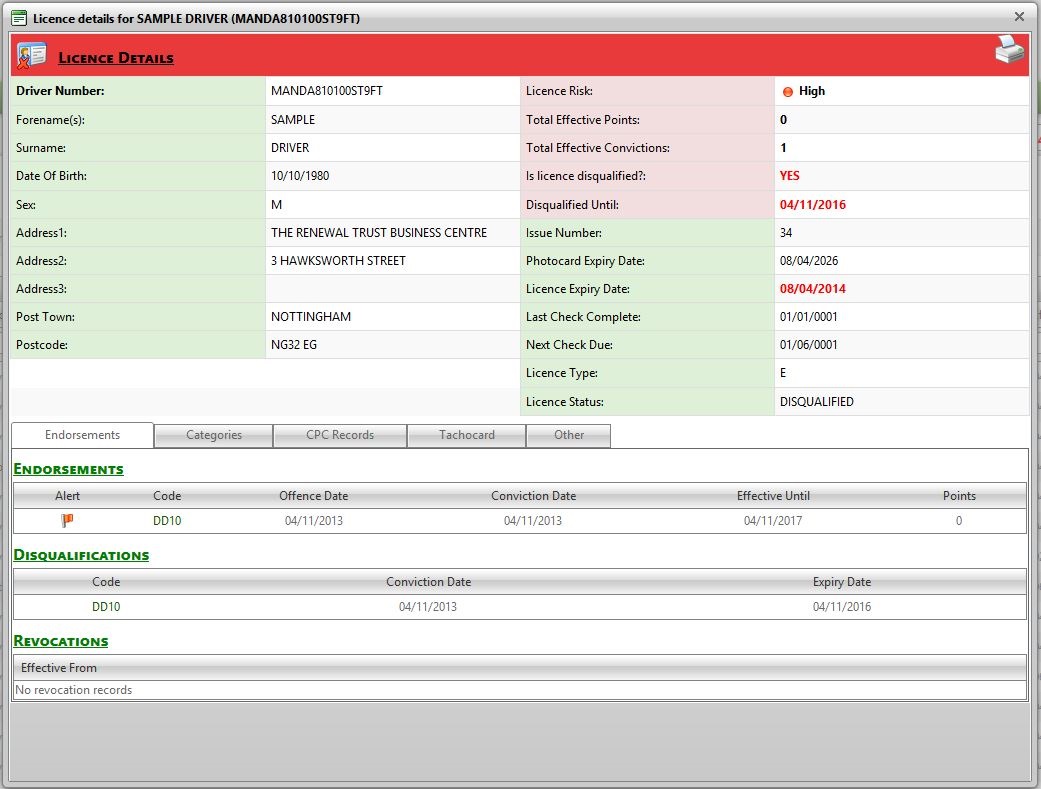
According to the firm, this is the first product of its kind that’s commercially available in the UK. It uses the DVLA’s technology to provide immediate results — previous versions of the firm’s system delivered results overnight, rather than instantly.

Example real-time driver licence check

An example of a real-time driving licence check result from LICENCECHECK RealTime (click to enlarge)

LICENCECHECK managing director Richard Brown said:

“Not only does our RealTime software make life easier for companies with fleets, but it reduces potential corporate liability considerably, and with the drive towards corporate responsibility and an awareness of their organisation’s duty of care  moving upwards in our clients’ agendas, it’s an area which can’t be overlooked.”

It takes little imagination to see the legal and compensation issues that could result from hiring a vehicle to someone without a valid driving licence — or with prohibited endorsements which they failed to declare, invalidating the hired vehicle’s insurance.

In my view, there’s no doubt that the scale of these risks means that van hire companies will flock to sign up to systems such as LICENCECHECK — although I would stress that there will be competitors in the market and the DVLA is providing an open platform to allow companies to develop their own solutions.

The only question is how many of these other solutions will be ready by June?

New van registrations up 20.2% so far in 2015

New van and truck sales continued to rise during February: new van registrations rose by 17.9% during the month, compared to the same period last year, while truck sales fared better with a 31.7% increase, according to the latest figures from the Society of Motor Manufacturers and Traders (SMMT).

UK van and truck registrations: 2015 and % change on 2014

February % change Year-to-date % change Rolling year % change
Vans 13,832 17.9% 35,881 20.2% 327,714 18.9%
Trucks 2,092 31.7% 4,610 35.3% 42,673 -21.8%
Total 15,924 19.5% 40,491 21.7% 370,387 12.1%

Source: SMMT (www.smmt.co.uk)

Commenting on the figures, Mike Hawes, SMMT Chief Executive, said:

“The van market continues to expand, posting a tenth consecutive month of increases as improving confidence among SMEs and consumers takes effect. The growing demand for both vans and trucks has delivered a month of impressive performance for the total commercial vehicle sector once again.”

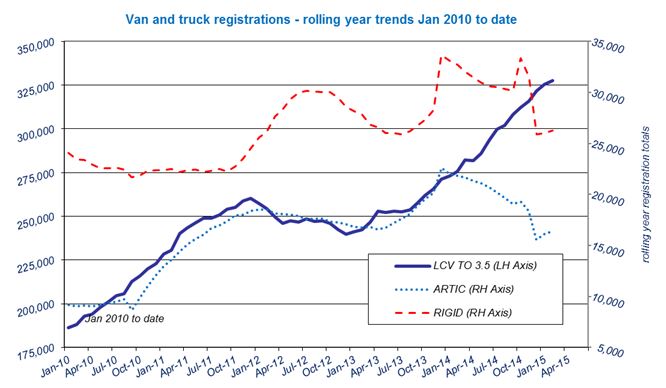
To save me a thousand words, here’s a picture showing how truck and van sales have changed since January 2010:

SMMT van and truck registrations 01-10 to 02-15

Graph courtesy of SMMT

As usual, it was the 2.5t to 3.5t category (e.g. Ford Transit, Mercedes-Benz Sprinter) that was driving the majority of sales growth. This is by far the largest section of the van market and has accounted for 20,051 of the 35,881 vans registered so far this year. Interestingly, new registrations in this category rose by 29.3% in February, while sales of smaller vans were broadly flat.

However, sales of smaller 2.0-2.5t vans (e.g. Citroën Berlingo) have risen by 40.5% over the last twelve months, so perhaps it was simply a case of no major fleet orders going through in February?

Finally, a word about the used market: I’ve written at length about my view of how the rise in new sales are beginning to impact the used van market, and that’s a subject I’ll revisit later this month, when we get the latest auction sales figures from BCA and Manheim.

New Volkswagen Caddy Maxi offers extended option for buyers

Volkswagen recently unveiled the fourth generation of its popular Caddy. The firm has used this week’s Geneva Motor Show to launch a long wheelbase version of the van, the Caddy Maxi, along with its people-carrying version, the Caddy Maxi Life.

Volkswagen Caddy Maxi

The new Volkswagen Caddy Maxi will launch later in 2015.

The payload for the Caddy Maxi panel van, including the driver, is up to 1,005 kg, while two roads of folding seats in the Caddy Maxi Life mean that this windowed model also delivers van-like carrying capacity — especially if you remove the second and third rows of seats, which is easily possible, and provides a stupendous 3,700 litres of space, 848 litres more than in the standard wheelbase Caddy Life, with seats removed.

As with the standard Caddy, the Caddy Maxi will be powered by Volkswagen’s Euro 6 diesel engines, offering a choice of three power outputs: 75PS, 102PS and 150PS. There was no word in today’s release on whether the old stinkers Euro 5 engines will be available as an alternative, as they are in the standard Caddy, but I guess they probably will be.

The Caddy Maxi will gain the same new safety and driver assist options as the standard model, among which will be the option of Adaptive Cruise Control, which hasn’t been available on previous Caddy models.

The new Caddy and Caddy Maxi will be launched in Germany at the end of June. UK vehicles will arrive later in the year, as will UK pricing and specification details.

Nissan unveils e-NV200 electric 7-seater

Nissan e-NV200 7-seater

The Nissan e-NV200 7-seater still leaves ample luggage room behind the third row of seats. Both rows can be folded out of the way.

Growing demand has prompted Nissan to bring forward the launch of the latest variant of its popular e-NV200 electric van, a 7-seater people carrier or minibus model.

Nissan Europe’s director of electric vehicles, Jean-Pierre Diernaz explains the introduction, commenting:

“We have always planned to offer a higher-seating capacity version of the Nissan e-NV200. Marketplace demand has meant we have moved this introduction forward by several months to satisfy this need.

Nissan has had requests from taxi companies, VIP transfer services, hotels and private motorists who are interested in buying this uniquely flexible and capable vehicle.”

The seven seat version of the e-NV200 is configured with two seats in the front, three in the middle and two in the rear. Both the second and third rows can be folded to allow for larger quantities of luggage to be carried, making the new variant a hugely flexible vehicle for commercial or private use.

The second row rolls forward and the third row folds to the sides to open up an enormous 2.94 cubic metres of cargo capacity, which is enough to transport three bicycles with the wheels in place, unique in this class. With all three rows in place, the luggage capacity is 443 litres under the tonneau cover, and up to an impressive 870 litres when measured to the roof line, allowing the possibility to carry seven people and a large volume of luggage.

To increase passenger comfort the seven seat passenger version comes equipped with additional rear air conditioning to ensure a more even temperature through the cabin, even for those in the third row of seating.

The new model is available with the CHAdeMO quick charging system, which gives the access to the most widely installed rapid charging system in Europe today with over 1,500 accessible points. The quick charging option allows businesses or drivers to extend journeys or do multiple short journeys in a day with a quick top up. Already, users of the e-NV200 like Taxi Electric in the Netherlands and C&C Taxis in the UK have installed their own quick chargers to increase utilisation and flexibility.

The van and five seat versions of the e-NV200 were launched last summer and have already met with a very positive reception with orders from taxi companies across Europe in addition to large fleets like DHL Express in Italy, and APM, part of the Maersk group.