Citroën polishes off competition with Morelli order

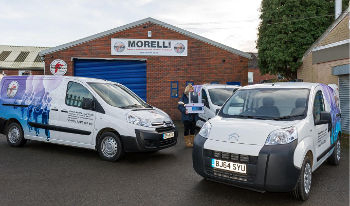
Morelli Group Citroën vansHot on the heels of Citroën’s dominating performance in the Business Van awards last week comes news of a new fleet renewal and expansion deal for the firm.

Automotive refinishing products specialist, the Morelli Group, has taken delivery of 15 new Citroën Dispatch L2H1 HDi 125 6-speed manual Enterprise vans.

The new vehicles have been ordered to meet growing demand and to replace older vans being de-fleeted, and the Enfield-based firm will base the new vans at depots throughout the UK.

The majority of the Morelli Group fleet are DS and Citroën models, totalling 48 Citroën vans and 27 cars, and Robert Cohen, the group’s financial director, says that this isn’t a coincidence:

“We like the way Citroën offers its vans with defined trim levels, rather than a large number of options, which makes ordering vehicles easier. Citroën’s LCVs are ideal for our intensive, high-mileage operation, providing excellent driver comfort and safety, along with reliability and low cost of operation.”

The 1200kg payload Dispatch L2H1 Enterprise models are powered by an HDi 125 engine, which has excellent combined cycle fuel economy of 44.1mpg and low CO2 emissions of just 168g/km. Standard specification includes air conditioning, rear parking sensors, a Connecting Box (including Bluetooth® hands free and a USB socket), electrically folding heated door mirrors and a full steel bulkhead. In addition, the Dispatch also comes with Teletrac intelligent satellite navigation and Trackstar stolen vehicle tracking.
How long can a van last?

Dreams Mercedes-Benz SprinterMost car owners I know, especially younger drivers, seem to get nervous if their cars are old enough to be out of warranty or have more than about 60,000 miles on the clock.
Many commercial vehicle operators also like to run a new fleet — and there’s no doubt it gives a smart impression and saves on a certain amount of hassle.

However, it wasn’t always like this — the constant drive to replace perfectly serviceable vehicles seems to be part of the ‘newness’ culture that prevails today: no one wants anything if it isn’t new.

Yet many vehicles can deliver far more service than we’ve been conditioned to expect.

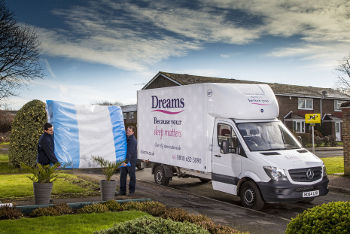
Take the Mercedes-Benz Sprinter. Bed retailer Dreams is currently in the process of replacing its 10-year old fleet of Luton-bodies Sprinters. These vans have seen some use — according to Shaun Bullock, Dreams’ Distribution Controller:

“Some of our older Mercedes-Benz vehicles have clocked-up well in excess of 400,000 miles, yet they’re still going strong. Indeed, they have proved over the last 10 years to be brilliant workhorses and we’ve every confidence that our new fleet will be just as reliable and cost-effective to operate.”

Yes, that’s 400,000 miles. Admittedly the kind of usage Dreams vans get is probably relative easy — weights are low, the vans don’t do courier-style multidrop work, and they don’t get the kind of hammering they’d get in the construction business, for example.

Even so, Dreams’ experience suggests that many vehicles are disposed off well before the end of their useful, reliable life.


Ford Transit Custom expands blue oval role in NHS blood fleet

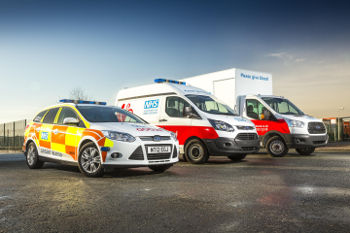
NHS Blood Transfusion vehicles from FordVehicles operated by the NHS Blood and Transplant service (NHSBT) may not have the same high profile as other emergency services vehicles, but they deserve to.
Collectively, the NHSBT’s 500-strong fleet is responsible for collecting and transporting blood donations from all around the UK, and distributing them to hospitals as required — sometimes under emergency, blue light conditions.

Ford vehicles already played a major role in the NHSBT fleet, with around 65 per cent of the current fleet featuring the blue oval badge on their bonnet. This presence will now be extended by the addition of the Ford Transit Custom to the NHSBT fleet.

Current NHSBT Ford models include blue-light Ford Focus Estate models and specially-adapted Ford Transits, each of model has a key task in keeping blood supplies circulating.

NHSBT’s national fleet service manager, Larry Bannon, said:

“We are pleased to welcome the Ford Transit Custom on to our fleet and we are sure it will more than meet our expectations. The Transit is recognised throughout this industry as the perennial best in class, and it is certainly the best vehicle that fits our purpose, with excellent network support and a spare parts supply second to none.”

In addition to emergency-service livery and the fitment of special storage equipment, each van is lined in a special waterproof resin to enable power-washing of the interior to ensure cleanliness to prescribed and regularly audited levels.

Larry Bannon added:

“The Ford vans are used in every stage of the blood donation process, from collecting the blood from the village halls and schools where blood donation sessions are set up, then transporting the donated blood to our regional processing sites where it is tested, processed and sorted, through to delivering units of blood to hospitals, whether as part of a routine order or under emergency blue-light cover to meet a hospital’s urgent needs.”

Citroen takes top spot in Business Van Of The Year Awards 2015

Updated 2014 Citroën Berlingo

The Citroen Berlingo

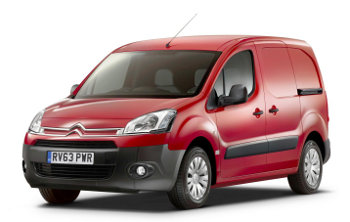
The Citroen Berlingo bagged the top prize at the recent Business Van Of The Year awards, thanks to its ubiquitous popularity, durability, generous specification and deceptive load-lugging ability.

The model specified by the Business Van judges was the Berlingo HDi 75 manual L1 625 Enterprise — broadly speaking an entry level standard wheelbase model that’s probably the most popular choice among Berlingo buyers.

Here’s a run-down of all the winners from this year’s awards:

  • Van of the Year: Citroen Berlingo HDi 75 manual L1 625 Enterprise
  • Best Small Trades Van: Citroen Berlingo HDi 75 manual L1 625 Enterprise
  • Best Large Trades Van: Vauxhall Vivaro 1.6CDTi 16v bi-turbo 120bhp L1H1 Sportive
  • Best Heavy Panel Van: Citroen Relay 35 L3 H2 130bhp Enterprise
  • Best Crew Van: Volksagen Transporter Kombi T30 Highline 180
  • Best City Van: Fiat Fiorino Cargo 1.3 MultiJet 75 Tecnico Start Stop
  • Best Local Delivery Van: Volkswagen Caddy 1.6TDI Highline 102PS C20
  • Best Green Van: Nissan e-NV200 Electric
  • Best Double Cab: Volkswagen Amarok 2.0 Trendline 180PS 4Motion
  • Best Utility Pick-Up: Volkswagen Amarok 2.0 Trendline 180PS 4Motion
  • Best Servicing Package: Volkswagen
  • Best Financing Package: Volkswagen

In terms of numbers, Volkswagen pipped Citroen to the post, with the German marque taking six awards compared to the French firm’s three. However, perhaps the most remarkable exclusion was Ford — this must be the first time for a couple of years that Ford has managed to avoid winning anything at an industry awards ceremony!

UK CV production down 19.7% in 2014, but December figures hint at return to growth

Sometimes, statistics just play out the way you want them to. Last month, I suggested that the UK’s flat commercial vehicle output in November could herald the end of a long decline and the start of something better.

Today, the Society of Motor Manufacturers and Traders (SMMT) confirmed that this was exactly what happened.

CV production rose by 12.6% in the UK last month, according to the latest figures from the SMMT. This was driven by a collossal 177% increase in home demand, that I suspect is due to production ramping up of the new Vauxhall Vivaro — gains that may not be sustainable in the medium term. However, the picture is clearly brighter than it has been for a long time:

CV manufacturing Dec-13 Dec-14 % Change YTD-13 YTD-14 % Change
Total 5,163 5,815 12.6% 88,110 70,731 -19.7%
Home 1,041 2,891 177.7% 40,200 35,909 -10.7%
Export 4,122 2,924 -29.1% 47,910 34,822 -27.3%
% export 79.8% 50.3% 54.4% 49.2%

Data courtesy of SMMT (www.smmt.co.uk)

This is what Mike Hawes, the SMMT’s chief executive, had to say about the figures:

“The growth of commercial vehicle manufacturing output in December represents a turning point in the sector’s fortunes,” said Mike Hawes, SMMT Chief Executive. “A ramping up of new model production, as well as a thriving home market, is expected to yield a stronger 2015, while the effects of restructuring in 2013 will no longer be felt.”

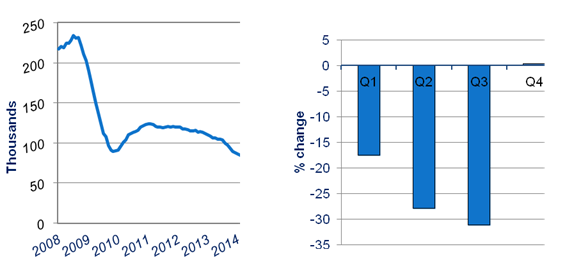
To finish off, I’ve included two graphs which show how CV production has changed since 2008, and highlight the nascent recovery the industry appears to be starting to enjoy:

SMMT CV output graphs Dec 2014

(L-R) CV output from 2008-2014 and the % change in quarterly output during 2014, compared to the equivalent quarter of 2013

All we need now is for the €1.1tn of quantitative easing planned for the eurozone to take effect and boost export demand — UK manufacturers might then be off to the races…

Big payload and small footprint make FUSO Canter obvious choice for tile firm

Walls and Floors FUSO Canter

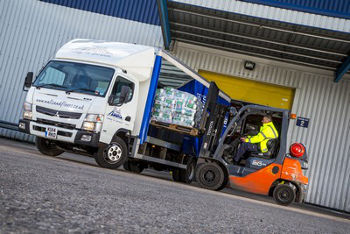
As you can see from the size of the fork lift truck in the picture, Walls and Floors FUSO Canters have been fitted with fairly compact curtainside bodies — any more height or length would impact fuel efficiency and be unusuable, due to the high weight of tiles.

When considering what size of van or truck will best suit your requirements, you need to consider both the weight and the size of your typical load.

At one extreme you’ll find ultra lightweight products such as polystyrene packaging, which weigh very little but take up a lot of space.

At the other end of the spectrum are compact, heavy products, such as tiles. As anyone who has ever shifted a few dozen boxes of tiles knows, despite their deceptively small size, they are very heavy.

As a result, vans and trucks delivering tiles need above-average payloads for their size if they are to be fully loaded, while staying safe and legal. The obvious answer to this dilemma is a compact 7.5t truck, rather than a large 3.5t van, and tile retailer Walls and Floors is a faithful adherent of this practice.

The Kettering-based firm recently replaced its previous fleet of Canters with eight new Euro VI models, and John Steel, the firm’s operations director, confirms that payload and footprint are key to the Canter’s appeal:

“The Canter’s industry-leading payload is, of course, key to its appeal. Its size is also important, though – the Canter has a relatively compact footprint for a 7.5-tonner, which allows the vehicle to access tight locations and makes it very manoeuvrable.

The Canter 7C18 is powered by a 129 kW (175 hp) engine that offers a useful combination of economy and performance. Walls and Floors’ vehicles are also equipped with fully automated DUONIC dual clutch transmissions, which deliver smooth, fuel-efficient gear changes and incorporate an Eco Mode feature as standard.

Like their predecessors, the trucks offer impressive payload capacities. Most can carry in excess of 3,750kg, the only exceptions being the two which are additionally equipped with 1,000kg Anteo tuckaway tail-lifts weighing in at around 250kg, which are used for building site deliveries.

Toyota Proace demolishes competition for deconstruction specialist

The Toyota Proace isn’t the most commonly-sighted van on UK roads, not least because the world, the European version is essentially a rebadged Fiat Scudo. Sadly UK drivers can’t get their hands on the highly regarded HiAce model that’s sold in Africa and Australasia.

Still, Toyota’s reputation for build quality and durability means that the Proace is an ideal choice for demanding users, such as Falkirk-based deconstruction contractors GCM Services.

GCM provides its specialist services to heavy industry and the petrochemical sector, and recently purchased several Proace vans to supplement its fleet.

The new vehicles are long-wheelbase models and have been finished in GCM Service’s corporate livery. They will be used for the company’s contract services across the UK, and are expected to stay in service for three years before being replaced.

Commenting on the acquisition, Gordon Marshall, managing director, said:

“We needed vehicles that reflected the quality of our business and which delivered the right capability and reliability. The Toyota Proace fits this profile perfectly.”

Powered by a flexible, efficient 2.0-litre turbodiesel engine, the Proace medium duty van is designed for ease of use. The long-wheelbase model chosen by GCM allows a payloads of up to 1.2 tonnes to be carried, while the firm’s drivers will enjoy a comfortable and safe environment, with Bluetooth, driver and passenger airbags and electric windows and door mirrors included in the standard specification.

Were there any vans in the 2015 Dakar Rally?

The Dakar rally includes four classes of vehicles — motorbike, quad bikes, cars and trucks. For Dakar purposes, the car class includes all vehicles weighing less than 3,500kg, while the truck class is for vehicles weighing more than 3,500kg.

As it happens, there were not any actual vans models in the Dakar this year, but a number of interesting vehicles derived from pick-ups, trucks and even vans make it into the rally each year. In this article I’ve highlighted a few examples of each category — access to official Dakar photography is limited so these are pictures provided by the manufacturers concerned.

Unsurprisingly, Toyota put on a strong show, with both Hilux and Land Cruiser entries. The Toyota Imperial Hilux finished second in the car class:

Dakar 2015 Toyota Imperial Hilux

Dakar 2015 Toyota Imperial Hilux

Meanwhile — perhaps even more impressively — the Toyota Land Cruiser dominated the production 4×4 diesel class, occupying the top 5 slots in the rankings!

Dakar 2015 Toyota Land Cruiser

The Toyota Land Cruiser finished occupied the top five positions in the diesel production 4×4 class!

The MINI isn’t exactly a commercial vehicle, but there was a Clubvan model for a short while (now sadly discontinued). Plus, a MINI won has won the Dakar for the last two years. Here’s the latest Dakar MINI in action (not the winner, I don’t think):

Dakar 2015 MINI

The 2015 Dakar MINI

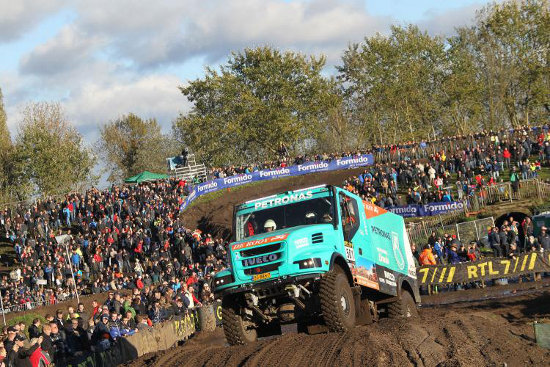
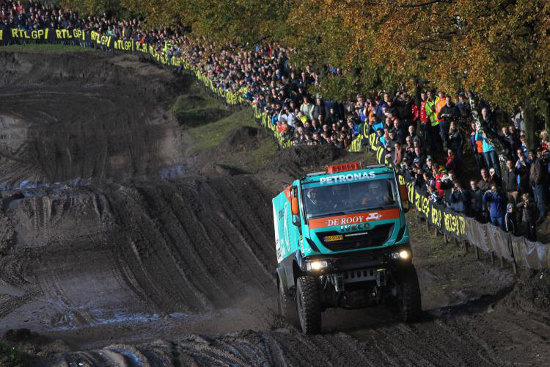
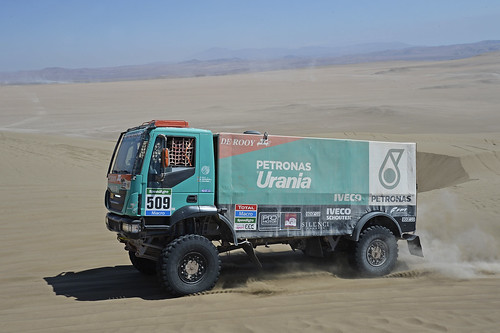
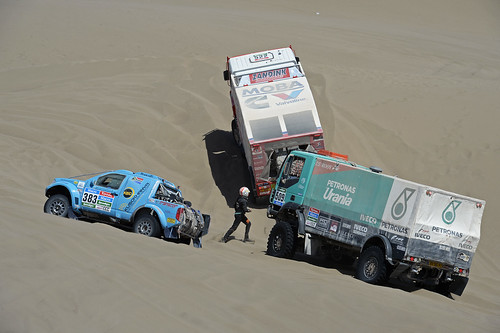
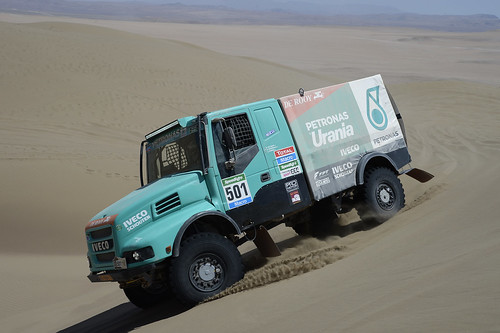
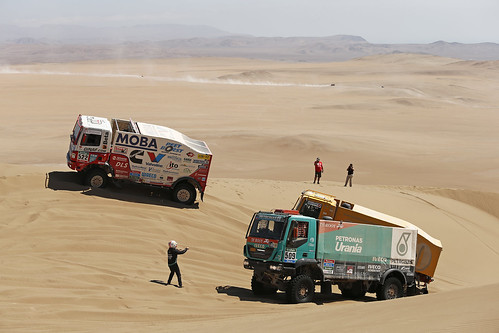
Iveco is one of the stalwarts of the Dakar truck class, and this year was no exception, with the Italian manufacturer entering three vehicles in partnership with the Dutch Iveco DeRooy Petronas team.

The models chosen were the Powerstar — a bonneted truck model that’s not sold in the UK — and the Trakker, which is a quarry/off-road model that is available in the UK, albeit not that commonly seen:

Dakar 2015 Iveco Powerstar

The 2015 Dakar Iveco Powerstar, driven by 2012 Dakar winner Gerard de Rooy

Dakar 2015 Iveco Trakker

The 2015 Dakar Iveco Trakker — you may see one of these down your local quarry…

Here are a few more Dakar 2015 truck pics, courtesy of the Iveco Flickr feed:

Desert Work Trakker

Spirit Driver Dakar

Ranking Truck Dakar

Driver Dunes Trucks


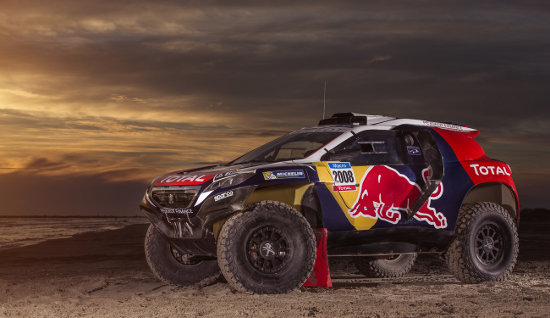
Finally, it’s also not a van — but the previous model was available as a van. Peugeot discontinued the 207 Van model when the 207 was replaced, but the firm’s return to the Dakar is worthy of note, especially as the Dakar-spec 2008 is a truly awesome machine, powered by a 3-litre V6 diesel engine mounted at the rear of the car, which delivers 340hp and 800Nm of torque — truly in the same spirit as the all-conquering 205 T16 of yesteryear (showing my age, here):

Dakar 2015 Peugeot 208

The Peugeot 208 as entered into the 2015 Dakar

Save up to 20% on Europcar Van Hire in January sale

Europcar van hire

Save up to 20% in the Europcar January sale

Europcar is currently offering discounts of up to 20% on van hire as part of its January Sale.

This is valid for bookings made by February 1st and completed by 30th June, with certain exclusions.

**THIS OFFER HAS NOW EXPIRED**

If you need a van for a trip to the tip, to move furniture or for a big DIY project, this could be a good opportunity. Europcar has also provided some helpful tips for driving and load a van (we have more tips on driving and loading vans):

All you have to do to benefit from the Europcar January sale discount is book online as normal*: click here to visit the Europcar website.


Tips for driving a van

  • Vans are bigger than cars – Be aware of the width, length and height of the vehicle when hiring a van, especially if you’re not used to driving one
  • Take corners slowly – it is possible for a heavy loads to move around if you take the corner too fast
  • Space for corners – Remember that larger vans need more room to turn so give yourself plenty of time and space when taking corners.
  • Stopping distance – Remember that the larger or heavier the vehicle, the longer it takes to stop, especially in icy or wet conditions.
  • Blind side – Watch out for cyclists and bikers who might be tempted to overtake on the blind side.

Tips for loading a van

  • Start loading your items at the front of the van and work your way to the back.
  • Spread the load evenly across the base, uneven loads can have a massive effect on a van’s stability.
  • Keep all items stacked as tightly as possible to keep everything from shifting during the drive.
  • When loading a van, place heavy items on the floor of the vehicle, and plastic and lighter things on top of the heavier ones.
  • You may have to take apart things like tables and desks in order to load everything tightly and to ensure safe transport.
  • Be careful not to scoot or drag furniture in the van as damage may occur to sofas, table legs and dresser bottoms.
  • When lifting a heavy load bend your legs not your back.

*Terms and conditions apply. See Europcar website for details.

Ambulance fleet introduces new concept vehicles to emergency fleet

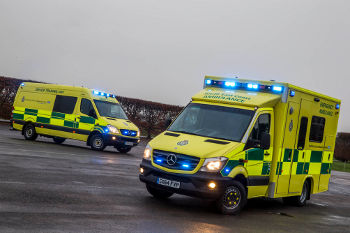
SECAmb Mercedes-Benz Ambulance and training vehicle

One of SECAmb’s new driver training vans, alongside a new emergency ambulance.

South East Coast Ambulance Service NHS Foundation Trust (SECAmb) has introduced a range of new vehicle concepts to its fleet. 

Although chassis cab 5.0t Sprinter ambulances remain at the heart of the fleet — SECAmb operates 300 of these A&E ambulances — the trust has started to introduce a wider range of other models and specifications for different duties.

One area of emergency care where patients may notice a difference is in SECAmb’s new fast response vehicles. Over recent years, ambulance trusts across the UK seem to have standardised on well-specified medium-sized estate cars for paramedics, but the downside of these is that they provide no room for even basic treatment, which often results in an ambulance being called to transport the patient to hospital.

To help alleviate this problem, SECAmb has replaced a number of its fast response cars with 2.8t Vito 116CDI Dualiners — panel vans with a second row of seats and purpose-built interiors which allow patients to be treated for minor wounds and injuries at the scene, inside the vehicle, eliminating the need for a trip to A&E.

SECAmb has also introduced a new class of vehicle for driver training: five 4.0t Sprinter 419CDI panel vans are now operating as dedicated Driver Training Units. Fitted with a variety of cameras and motion sensors, the vans have been specified with a second row of seats and onboard monitor and video equipment, which allows multiple students to receive tuition at once and to watch back their driving immediately after manoevures have been completed.

Elsewhere in SECAmb’s fleet, five critical care ambulances have been introduced: these are based on the standard box body ambulance specification, but carry additional equipment for treating the most seriously ill patients. The trust has also added a number of Sprinter and Citan panel vans to its fleet for logistics and support use.

As you may have noticed, all of these vehicles are Mercedes-Benz — commenting on the choices, Justin Wand, SECAmb’s Head of Fleet Operations, said:

“However, while acknowledging the need for vehicles of different sizes and specification, we also wanted to standardise on a consistent, reliable platform. Mercedes-Benz was the obvious partner, not least because in the Sprinter, Vito and Citan its range includes a model which is right for every application.

“Plus, of course, we already know from long experience that on a whole-life cost basis, taking account of factors such as fuel economy, reliability and maintenance, Mercedes-Benz products represent better value than those of its competitors.”

As we’ve seen before, Mercedes customer always appear ready to sing the praises of the three-pointed star, and their loyalty is often notable.