Author Archives: Van Rental

72% Of People Choose Van Hire To Move House – New Survey

A new survey carried out on the vanrental.co.uk website has found that 72% of drivers chose to take the DIY removals option and hire a van last time they moved house.

Driving a van held no fear for most drivers, with 66% saying that they felt ‘comfortable’ driving a van or that it was ‘not too bad’.

Interestingly, hiring a van is such good value that even the 21.3% of drivers questioned who refused to drive a hire van would still hire one, relying on friends or family to do the driving.

Unsurprisingly, most people identified either loading and unloading (35.8%) or paying the bill (37.6%) as their least favourite elements of van hire – although none disputed the cost savings when compared to using a removals company.

The survey also found that hiring a van is a pretty rare activity for most people – of the 2,600 people questioned, only 52.2% had hired a van at all in the last five years – and just 3.5% had hired a van more than once a year in that period.

To find out more, click here to see the full story.

Self-Driving VW eT! Concept Van Shows Future Direction

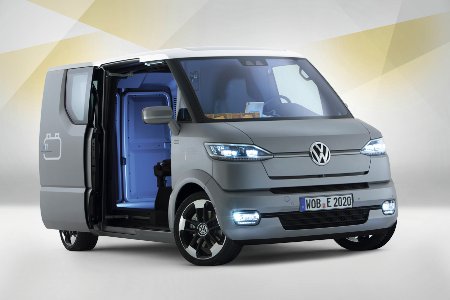
Volkswagen eT! concept van

The eT! takes styling cues from the current Transporter - no bad thing

Volkswagen has released images showing eT!, a van concept that provides some clues about how vans of the future might operate, from the second half of the current decade onwards.

The eT! features functionality such as semi-automatic driving – following a postman along a street, for instance – as well as joystick control from the passenger side to allow the driver to move short distances while remaining on the pavement side of the vehicle – speeding up urban multi-drop and postal deliveries. Electric power is also included, providing zero emission urban operation.

The eT! is the result of collaborative research between Volkswagen Group Research, Deutsche Post (a big VW customer) and the University of Art at Braunschweig. It is not likely to see production in the immediate future but according to Dr. Rudolf Krebs, it is part of Volkswagen’s attempt to “make plans today for what the world of lightweight commercial vehicles might look like starting in the second half of this decade, including with regard to electrical drives.”

High on the list is low or zero emissions for urban use, along with improved ergonomics for deliveries (think about how many times a courier driver gets out of his van on the offside – into traffic – and then walks around it to the near-side sliding door each day.

The eT! is an interesting concept, although in the UK at least, legislation regarding leaving vehicles running whilst unattended would probably have to be changed before VW’s mooted semi-automatic ‘follow me’ system could be used. That said, automatic vehicle operation is already possible and has been proven by a number of companies already. I firmly believe it will happen in my lifetime – at least on motorways and other major routes, where it could provide useful safety benefits and contribute to reduced congestion and emissions.

The eT! concept pictured in this article was shown at the Design Centre of Potsdam in Germany and was specifically designed as a mail delivery vehicle. It is easy to see how other configurations would be possible, especially for courier and other delivery use.

Volkswagen eT! Concept with sliding door open

The eT! has an electric sliding door that provides access to both passenger and cargo bay entrances

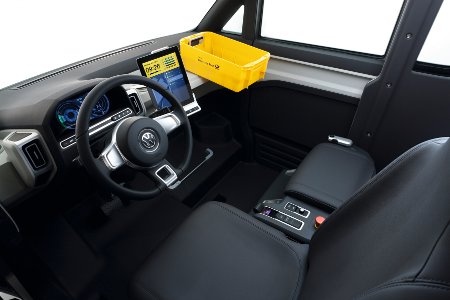
Inside the Volkswagen eT! concept van

No concept vehicle is complete without an iPad docking station!

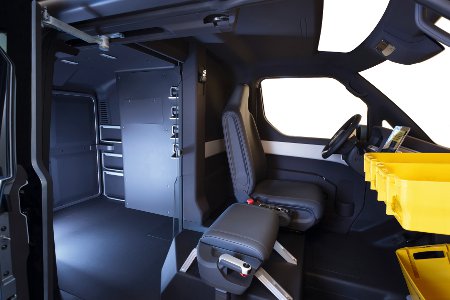
Load area in VW eT! Concept Van

The 'standing seat' on the passenger side provides excellent access to the load area plus allows the driver to move the van short distances using a joystick control - no more walking all the way around the van to move it 50 yards.

Van News: Award-Winning Hybrids & Compulsory ESP for New Vans

Three Awards for Ashwoods Hybrid Drive System

At the Institution of Engineering and Technology (IET) Innovation Awards this year, Exeter-based Ashwoods distinguished itself amongst 420 entries to win three awards for its Hybrid Drive System, which can be fitted to Ford Transit vans. The awards were in the Power/Energy, Sustainability and Transport categories, perfectly reflecting the benefits offered by the system.

Hybrids are a hot topic in the car world but do not seem to have made the same impression in the van industry, despite the obvious benefits for vehicles employed on urban delivery routes.

In fact, while mainstream motor manufacturers have begun to embrace hybrid cars, it has been left to small independent companies like Ashwoods Automotive to develop retrofit hybrid solutions for popular van models.

Ashwoods has developed a highly-effective Hybrid Drive system for the Ford Transit that is currently being used by a number of public sector organisations. The Hybrid Drive system has been shown to reduce fuel consumption and CO2 emissions by 20% over the European Drive Cycle (NEDC) in formal testing.

Visit www.ashwoods.org for more information.

ESP Compulsory for New Vans from 2014

New EU laws will make ESP (Electronic Stability Programme) compulsory for all new vans sold in the EU from 31st October 2014.

ESP became compulsory for all new car and van models undergoing EU type approval at the beginning of this month and the new law will mean that even older models must be updated if they are to be sold after 31st October 2014.

ESP was invented by Bosch in 1995 and is playing a major role in the European Commission’s road safety strategy. According to Dr. Werner Struth, president of the Bosch Chassis Systems Control division, “ESP can prevent up to 80 percent of all skidding accidents. It is the most important vehicle safety system after the seat belt.”

Most drivers have little or no ability to control a car when it skids, meaning that such incidents often result in major collisions.

The goal of ESP is to prevent skids. It does this by using  intelligent sensors to check 25 times per second whether the driver’s steering input matches the vehicle’s actual direction of travel. If the system detects some discrepancy and identifies that the vehicle is likely to become unstable, ESP intervenes by reducing the engine torque in order to restore stability. If that is not sufficient, then it additionally brakes individual wheels. ESP also incorporates the functions of the anti-lock braking system (ABS) and traction control.

There is no doubt that ESP is a valuable safety feature and I for one would much rather have ESP in my van (or car) than air bags. At present, ESP is fitted to 63% of cars and commercial vehicles under 6 tonnes manufactured in Europe (41% worldwide) and Bosch expects that by 2013, 50% of new cars globally will have ESP.

Easirent 7% OFF Voucher Code – Van Hire & Car Hire [EXPIRED]

Car and van hire company Easirent has just released a fantastic new 7% OFF voucher code.

This new Easirent discount code is valid for all hires (car rental and van rental):

  • Start Date: All hires starting from 15/11/2011 – 31/03/2012
  • End Date for booking: 30th December 2011
  • Voucher Code: CARHIRE5

**THIS OFFER HAS NOW EXPIRED**

Easirent has van hire branches in the following locations:

Collection and dropoff are also possible at many major airports and railway stations – visit www.easirent.com for more information.

Van Registrations Up 6.7% In October

New van registrations were 6.7% higher in October than in October 2010, bringing the year-to-date increase in the sub-3.5t sector to 17.3%, according to the latest figures from the Society of Motor Manufacturers and Traders (SMMT). A total of 19,370 commercial vehicles under 3.5t were registered in October.

Growth was particularly strong in the 2.0t-2.5t van sector (vans like the Ford Transit Connect and Volkswagen Caddy), where sales were 38% higher than in October 2010. The 2.5t-3.5t van sector (e.g. Ford Transit, Mercedes Sprinter) actually experienced a 3% fall compared to the same month in 2010, with sales dropping from 11,716 last year to 11,370 in October 2011.

Commenting on the figures, Paul Everitt, SMMT Chief Executive, said:

“The commercial vehicle market remains buoyant with October registrations up by more than 10% and year to date up by nearly 20%. Efficiency is a key driver as operators are investing in the latest models across almost every market sector to reap the rewards of greater load carrying ability and fuel economy.”

Truck sales did even better, rising by 33.3% in October alone, bring the year-to-date increase to 22.7%. In total, commercial vehicle registrations rose by 10.7% in October alone and have risen by 18.0% so far this year.

Van News: FN50 Most Reliable Vans & ACFO Van Awards

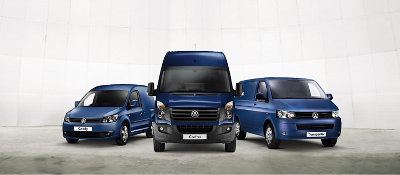
Volkswagen Vans - group shot of Caddy, Crafter and Transporter

Volkswagen was voted overall most reliable van manufacturer - its Caddy and Transporter vans were in the top five, while the Crafter placed sixth.

Mercedes & Volkswagen Win Van Reliability Awards

The Mercedes-Benz Sprinter was voted Britain’s most reliable van in the latest Fleet News FN50 reliability survey, taking top spot from last year’s winner, the Ford Transit.

The FN50 reliability survey polls the UK’s top 50 leasing companies by fleet size to find out their views on manufacturer and model reliability.

However, Volkswagen was voted the most reliable van manufacturer overall – two of its models (Caddy and Transporter) were in the top five, with the Crafter coming close behind in sixth place. Only one Mercedes-Benz model – the Sprinter – was in the top five; the other two places were occupied by the Ford Transit and Transit Connect.

Although some Transit models are built in the UK (in Southampton), no other British-built vans came close to winning an award – Vauxhall, which builds its popular Vivaro van in Luton, did not even feature in the top five most reliable van manufacturers.

Two British-built cars, the Nissan Qashqai ( built in Sunderland) and the Toyota Avensis (built in Burnaston, near Derby) did make it into the top ten most reliable cars, ranking sixth and fifth respectively.

Ford Transit Triumphs at ACFO Awards

Ford won both the Large Van and Small Van awards at this year’s Association of Car Fleet Operators Awards (ACFO). The Transit managed to displace last year’s winner in the Large Van of the Year category, the Mercedes Sprinter, and return to top position for the 15th time in this history of the awards.

The Transit Connect won the Small Van category for the ninth consecutive year – rounding out an impressive night for Ford, in which they won four out of the seven available awards. In addition to the Small and Large Van Awards, the Focus won the Fleet Car of the Year and was also awarded the Fleet Safety Initiative of the Year award for its Ford Focus Driver Assistance Pack option, which is a £750 option on the Focus and includes an impressive range of safety features:

Traffic sign recognition, which uses a forward-facing camera behind the rear view mirror to scan
the roadside for speed limit signs and flashes up helpful reminders on the dash so drivers always
know the speed limit; lane keeping aid; lane departure warning; auto high beam; blind spot alert;
driver alert if sensors detect erratic driving; and Active City Stop, which monitors the road ahead
and brakes the car automatically if a collision is imminent.

Awards also went to BMW (Environmental Initiative of the Year – BMW Efficient Dynamics) and Volkswagen (Green Car of the Year – VW Golf BlueMotion).

Competition: Win Ring Automotive Digital Tyre Compressor & Tyre Gauge

WIN a Ring RAC630 tyre compressor and RTG6 tyre gauge

Win this RAC630 12V digital tyre compressor PLUS a Ring Automotive RTG6 digital tyre gauge and tread depth gauge

Keeping your tyres correctly inflated is one of the easiest and most effective ways to reduce your car or van’s fuel consumption, optimise its handling and minimise tyre wear.

There is really no excuse not to do it – and to make it easier still, we have an award-winning Ring Automotive RAC630 12V digital tyre compressor and a Ring RTG6 digital tyre gauge and tread depth gauge to give away to one lucky winner in our new competition.

The RAC630 is an Auto Express award winner and has a load of great features. To use it, simply:

  1. Plug it into your car or van’s cigarette lighter;
  2. Preset the pressure you require on the digital display;
  3. Connect up the hose to the tyre and let the RAC630 do all the work – no more pumping!

I use one of these on my van and it has no problem at all reaching at least 55psi.  The RAC630 also has a built-in lamp for night-time use – this is especially useful at this time of year.

Click Here to enter the competition

The Ring Automotive RTG6 tyre gauge and tread depth gauge is also a nice piece of kit – one of the best of its kind, it is easy to use, accurate and the inclusion of a tread depth gauge makes it easier to keep an eye on the state of your tyres, too.

Finally, don’t forget we currently have an exclusive Europcar van hire discount code – save up to 20% on Europcar van hire throughout the UK. Click here for full details.

Biofuel Palm Oil Plantations Release More CO2 Than Fossil Fuel

New research by scientists at the University of Leicester has found that CO2 emissions from tropical palm oil plantations could be 50% higher than previously thought.

The research was conducted for the International Council on Clean Transportation, an international think tank that wanted to assess the greenhouse gas emissions associated with biodiesel production.

Biodiesel Law Drives Up Palm Oil Demand

Biodiesel mandates like the RTFO and the corresponding EU policies, which require a percentage of biodiesel to be used in standard road fuels, have both a direct and indirect impact on palm oil demand.

The direct demand is due to the requirement for a suitable biofuel to mix with mineral diesel, while the indirect demand is the result of additional demand for food oil where crops formerly used for this purpose (e.g. rapeseed oil) have been diverted to biofuel use.

Peatland Biodiesel Is High In CO2

The problem lies in the fact that much of the additional palm oil being used to create European biodiesel comes from newly-created palm oil plantations on tropical peatland (e.g. in Indonesia).

Using tropical peatland to create new palm oil plantations releases vast stores of CO2 that were previously harmlessly locked away in the peat. This is akin to burning a forest or a large amount of coal – all the CO2 locked in the peat is released rapidly, having taken many millenia to accumulate.

Apparently, tropical peatland is one of the Earth’s largest and most effective carbon sinks when left uncultivated – but when used for plantations, the resulting degradation of the peat triggers huge carbon emissions that have not previously been accounted for when assessing the carbon emissions of biofuels.

Biofuel Policies Likely To Fail At Reducing Global CO2 Emissions

The outcome of all of this is that the carbon emissions caused by using biodiesel from tropical peatland palm oil plantations are so great that they cancel out any reduction in emissions relative to using standard fossil fuel diesel.

The end result is that as I have discussed a number of times before, the EU’s love affair with biofuels at almost any cost is gradually being revealed as the short-sighted, ill-conceived notion that many scientists and environmentalists have always believed it to be.

For more detailed information, the full report is available on the ICCT’s website.

Europcar Van Hire 20% Discount – only on VanRental.co.uk

Don’t forget that you can currently save up to 20% on Europcar van hire throughout the UK by using our exclusive vanrental.co.uk discount code. This offer has now expired.

Note: If you click through using the banner below, the discount will automatically be applied to your quote:

This fantastic offer is valid for bookings made before 30/11/2011 for hire periods up to 16/12/2011.

This offer has now been extended and is valid for bookings made up to 15/12/2011 and hire periods up to 16/12/2011.

(If you visit Europcar.co.uk directly, you will need to use Promo Code: 51153325)

Europcar has more than 180 branches in the UK and our offer applies to all of them.

Even better is that this offer* applies to all sizes of vans:

  • Small vans (e.g. Vauxhall Combo)
  • Medium vans (e.g. Ford Transit SWB)
  • Long wheelbase vans (e.g. Iveco Daily)
  • Luton vans (including tail lifts

Remember: This Europcar voucher code offer is only available through vanrental.co.uk – nowhere else has this deal…

Driving A Pre-2002 Van in London? 2012 LEZ Rule Changes Affect You

London LEZ sign - courtesy of Martin Addison

London LEZ sign – courtesy of Martin Addison

If you live or work inside the M25 and drive a van (or minibus or motorhome) that was registered before 1st January 2002, then the 2012 changes to the London Low Emission Zone affect you.

Vans Under 3.5t & Minibuses Under 5t

Starting from the 3rd January 2012, vans weighing more than 1,205kg unladen and with a gross vehicle weight of up to 3,500kg (3.5t) must meet Euro 3 emissions standards or pay a £100 per day charge to drive inside the LEZ.

Similarly, minibuses with more than 8 passenger seats and a gross vehicle weight of up to 5 tonnes must also meet the Euro3 standard.

These changes only apply to diesel vehicles – petrol models are unaffected. Euro 3 became mandatory from October 2001, so if your van was registered after then, it will probably be compliant. However, for reasons best known to themselves, Transport for London (TfL) has set the cutoff date for automatic compliance to be 1st January 2002.

To make things even more confusing, a number of companies were producing vans with Euro 3 engines from as early as July 2000 – such as Ford Transit models. These ‘early adopters’ have now registered with TfL, so if your van is one of the early Euro 3 models, it should be recognised as such.

However, there are no guarantees! To check whether TfL believes your van or minibus will be compliant with the 2012 rules, visit the online compliance checker:

Click here to visit the Tfl Compliance Checker (choose the VRM/number plate option)

If you believe your van is Euro 3 compliant but the TfL Compliance Checker does not agree, you will have to prove that it is compliant or pay £100 per day to use it within the LEZ from 3rd January 2012.

Vans Over 3.5t

Vans over 3.5t are classified as lorries and are subject to more stringent new rules.

Starting from 3rd January 2012, all vans with a gross vehicle weight of more than 3,500kg will need to be compliant with Euro 4 emissions standards.

The cutoff date for this is 1st October 2006, but as with lighter vans, some manufacturers were producing Euro 4 engines before they became mandatory in October 2006.

These early adopters of the Euro 4 standard have (mostly) registered their compliant vehicles with TfL, so if you enter your registration number into the TfL Compliance Checker, you should get a thumbs up.

Click here to visit the Tfl Compliance Checker (choose the VRM/number plate option)

If the compliance checker says you vehicle is not Euro 4 compliant but you think it is, then it is up to you to prove it to TfL.

From 3rd January 2012, if you drive within the LEZ in a non-compliant vehicle, you have to pay a fee of £200 per day (or be fined £500 per offence).

What To Do Next?

If you van is compliant with the 2012 LEZ rules, then you have no problem. If it isn’t – but you still need to use it inside the LEZ (which occupies most of the area inside the M25, but not the M25 itself), then you will need to decide what to do.

The LEZ rules are being enforced by Automatic Number Plate Recognition (ANPR) cameras – so there will be no avoiding the penalties if you try to ignore the rules.

Some vans can have diesel particulate filters fitted to their exhaust systems to make them compliant. However, these are expensive (£1500-£3000) and not suitable for all types of van. In addition, they have a record of being troublesome if they are used in town all the time without any longer, high-speed journeys.

If you only need to make occasional visits to the LEZ, the cheapest solution may be to rent a van whenever you need one. For more regular use, you may need to consider long-term rental, leasing or buying a new van – there are no exemptions from these rules except for London taxis.

Visit www.tfl.gov.uk/roadusers/lez/ for more information.