Category Archives: Van News

News and articles about UK vans – especially information relevant to the van hire market. Coverage of new van model launches from all the major manufacturers – Ford, Mercedes, Volkswagen, Peugeot, Fiat and Citroen.

Volkswagen launches (another) high spec Amarok pick-up

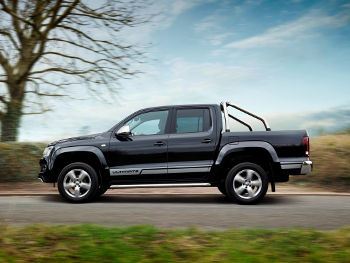
Volkswagen Amarok Ultimate

The new Volkswagen Amarok Ultimate is on sale now, with UK production limited to just 500 vehicles.

Today’s pick-ups occupy the same market space that SUVs did a few years ago — many of the people who buy them are making a fashion choice, not responding to a functional requirement.

To keep these cash-rich, bling-hungry buyers happy, Volkswagen has already launched at least two high specification special edition Amarok pick-ups, the Amarok Edition and the Amarok Dark Label.

The combination of the Volkswagen badge and one of the largest, toughest and most stylish pick-ups on the road is obviously a winning formula, as Volkswagen has just announced a new limited edition Amarok model, modestly named the Amarok Ultimate.

Billed as the highest-specification ever offered on an Amarok, UK supply will be limited to 500 vehicles and prices will start from £29,995 +VAT.

Volkswagen says the Amarok Ultimate is aimed at customers who appreciate the finer things in life — if that’s you, here’s what you’ll get for your money:

  • Bi-xenon headlights
  • 19-inch Aragonit polished alloy wheels
  • Double chrome strips on the radiator grill
  • Distinctive LED daytime running lights, which frame the headlights
  • Heated and electrically-folding wing mirrors with chrome detailing
  • Darkened tail light lenses and a new LED number plate light
  • Alcantara-trimmed seats
  • Leather multifunction steering wheel
  • Heated driver and front passenger seats
  • Satellite navigation
  • Choice of two colours, Reflex Silver or Deep Black, along with ‘Ultimate’ decals.

The Amarok is powered by VW’s range topping 2.0-litre BiTDI 180PS engine, which has two turbos and produces a monster 420Nm of torque at just 1,750rpm. Power is transmitted to the wheels via either a six-speed manual selectable 4MOTION transmission or with the firm’s 8-speed automatic 4MOTION setup.

Unsurprisingly, this truck can handle some serious towing, should you need to — the maximum towing capacity is 3,200kg, meaning that large caravans, vehicle carrier trailers and boats can all be towed comfortably.

It’s hardly subtle, and it’s two preened and pimped for most drivers to want to get it dirty on a regular basis, but there’s no doubt this is a serious pick-up for anyone who needs it, and a serious statement for anyone who just likes the way it looks!

The Amarok Ultimate is on sale now.
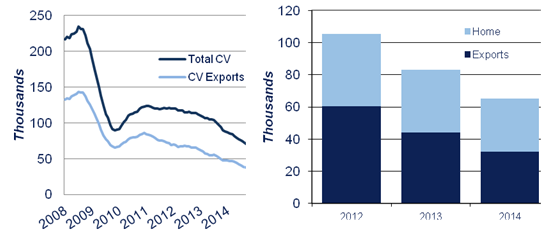
UK CV manufacturing output flat in November: is the long decline over?

The decline in UK commercial vehicle manufacturing has been long and vicious over the last year or so — output fell by 31% in September 2014 compared to September 2013, for example.

There were some signs of hope in October, when the fall in output was just 8.9%, but this month’s figures suggest the decline caused by plant closures and restructuring is finally over: CV manufacturing output fell by just 0.7% in November, according to the latest figures from the Society of Motor Manufacturers and Traders (SMMT).

What’s more, the strong growth in domestic demand for UK-built CVs continued: October saw a rise of 14.6%, which was followed in November by a rise of 12.4%. The figures suggest that only cratering demand in our export markets, mainly the EU, is preventing overall manufacturing output growth:

CV manufacturing Nov-13 Nov-14 % Change YTD-13 YTD-14 % Change
Total 7,121 7,073 -0.7% 82,947 65,054 -21.6%
Home 3,743 4,208 12.4% 39,089 33,054 -15.4%
Export 3,378 2,865 -15.2% 43,788 32,000 -26.9%
% export 47.4% 40.5% 52.8% 49.2%

Data courtesy of SMMT (www.smmt.co.uk)

Mike Hawes, the SMMT’s chief executive, is pleased with the turnaround and believes it will continue into 2015:

“The signs remain positive for UK commercial vehicle production after many months of decline, with output in November almost level. The strong UK market is driving the turnaround, while export markets continue to struggle. We anticipate 2015 to be a better year as new models ramp up and the effects of last year’s restructuring no longer apply.”

Despite this optimism, it’s worth noting two points: firstly, EU demand isn’t showing any sign of picking up. Secondly, look how far output has fallen:

UK CV manufacturing output 2008-2014 (Nov 2014)

UK CV manufacturing output changes (courtesy of SMMT)

Output has fallen by around 70% from its 2008/9 peak: most of that production is unlikely to return. However, I’ve dwelt on this issue enough times before and will try to avoid mentioning it again, if this month’s positive trends continue!

What Van? Awards roundup: Ford 4, Renault 3, but Merc still safest

All-new Ford Transit Courier

The all-new Ford Transit Courier — What Van? Van of the Year 2015

We’ve grown used to seeing Ford’s all-new commercial vehicle range sweep the board at awards ceremonies, but the folks from Dagenham were given a run for their money by the good people from Renault at the What Van? Awards 2015, which was held in London on 16 December.

Ford nudged ahead in extra time to take the overall winner’s trophy with four awards, but Renault managed a very respectable three awards, thanks to the strong impact made on the judges by the new Renault Trafic. Here are some of the highlights:

  • Van of the Year: Ford Transit Courier.
    It’s two in a row for Ford — last year, the firm won the Van of the Year award with the new Transit Custom
  • Small Van: Ford Transit Courier
    Two in a row again — last year, it was the Ford Fiesta Van!
  • Light Van: Ford Transit Connect
  • Medium Van: Renault Trafic/Vauxhall Vivaro
    Renault’s big triumph this year, displacing last year’s winner, the Ford Transit Custom
  • Large Van: Iveco Daily
    The Italian stallion of heavy vans was runner-up last year, but pushed last year’s winner, the Teutonic Sprinter, into second place this year.
  • Pick-up: Ford Ranger
    Number four for Ford, and two years in a row for the very successful (and large) Ranger pick-up
  • 4×4 Van: Mitsubishi Outlander 4Work
    The Outlander 4Work is a 4×4 car that’s been turned into a van (it still has rear passenger doors), making its triumph over the Highly Commended Mercedes-Benz Sprinter 4×4 seem slightly irrelevant — they aren’t really comparable. However, it’s a cool niche, and the Outlander is a good piece of kit.
  • Green Van: Nissan e-NV200
    I shouldn’t think there was much contest in this category — I’ve raved about the e-NV200 this year and it has been a standout success among its peers, gaining widespread plaudits from trial customers and a substantial order from British Gas before it even went on sale. A class act that shows how electric vans will work for urban users — who desperately need a break from poisonous diesels.
  • Innovation: Renault Trafic blind spot visor
    Number two for Renault, thanks to its innovative Wide View Mirror that’s built into the passenger sun visor and helps van drivers see into their blind spot.
  • Renault Twizy on streets of Bruges

    A Renault Twizy I snapped recently in Bruges. The load compartment is at the back — neat urban delivery vehicle.

    Editor’s Choice: Renault Twizy Cargo
    The third and final award for Renault, the awesomely cool one-seater van that is the Twizy. It reminds me of the BMW C1, a roofed-over motorcycle with a car-style seat, but the Twizy is much more practical, as it has four wheels and a more substantial luggage compartment — plus it’s electric. I recently saw one of these on the road for the first time, in Bruges, and was very impressed.

  • Safety: Mercedes-Benz Sprinter
    Five years in a row for the Sprinter, which has won the What Van? Safety award every year since it was introduced in 2010. ESP (1995), driver airbag as standard (2000), crosswind assist (2013) and most recently Rescue Assist QR code stickers. What can you say? The Sprinter’s safety spec has frequently been streets ahead of most other vans, which have tended to lag cars in this department.

So there you have it — van buyers are spoilt for choice at the moment, as almost all of the major models have either been replaced or updated in the last eighteen months.

It’s an embarrassment of riches — who needs cars?

Used van prices flatten out as de-fleet volumes rise

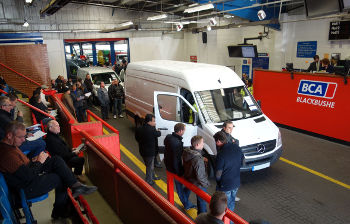
BCA van auction Nov 2014

A BCA van auction in progress

You can prove pretty much anything you want with statistics, but in my view last month’s used van figures from Manheim and BCA suggest that the used van market is flattening out and that used volumes are rising to reflect the 18% rise in new van registrations seen so far this year.

Let me explain why.

BCA: According to BCA, the average used van price was £5,615 last month, the third-highest figure on record. Prices reached an all-time high in August (when I flagged up that the vehicle mix might be changing), since when they’ve averaged lower for each of the three consecutive months.

According to BCA’s monthly figures, average price, mileage, age and sale vs. CAP % have all remained fairly flat over the last three months, suggesting that rising new van registrations are having an impact on the market. Frustratingly, BCA never includes any information about volumes in its monthly used van reports, so it’s not possible to see how, if at all, this is changing.

Manheim: However, Manheim does comment on volume in its monthly reports, and this month’s report makes it clear that volumes are changing — presumably with similar read across to BCA’s auction halls.

According to Manheim, there was “a significant influx of de-fleet volume year-on-year” in November.

In plain English, this means that more vans were de-fleeted and sent to auction in November 2014 than in November 2013. Commenting on November’s figures, James Davis, the firm’s director of commercial vehicles, said:

“It is heartening to see the typical seasonal de-fleet pattern returning this year. Supply continues to track behind demand, so it promises a stable end to the year and a fantastic kick start to 2015, just as we predicted earlier in the year.

Traditionally, the plate changes act as a catalyst for new vehicle purchasing. This then leads to an increase of ex-fleet vehicles coming to market as they are replaced.”

Manheim’s figures were interesting for another reason — they showed a big increase in knackered old large vans coming to the market, to the extent that the average sale price of large panel vans fell by 13.7% in November. According to the firm, nearly half the large panel vans sold during the month had an average age of more than seven years. Similarly, more than half of all small panel vans sold had an average age of eight years.

These figures clearly imply that companies which have delayed fleet replacement cycles are now acting, disposing of well-used old vans and — probably — re-entering the new market, as part of the 18% surge in new van registrations seen so far this year.

I say: I’ve said it before, and I’ll say it again — I’m convinced the used van market has peaked and 2015 will see a fairly stagnant performance, with increased price weakness for any vans that are more than a few years old and are not in decent condition.

Van registrations up 17.1% in November, truck sales slump in Type Approval aftermath

New van registrations rose by 17.1% during November 2014, compared to the same period last year, according to the latest figures from the Society of Motor Manufacturers and Traders (SMMT).

Truck registrations plummeted, falling by 49.6% in the wake of the introduction of the new Type Approval regulations — a topic I discussed last month, when it created an artificial boost in pre-Type Approval sales (in short, operators were registering new trucks in October so they could be fitted with bodies post-registration, thus avoiding the need to comply with the new Type Approval rules which now govern conversions of unregistered vehicles).

Over the year to date, van registrations are up by 18% in 2014, while truck registrations (commercial vehicles over 3.5t) are down by 14%.

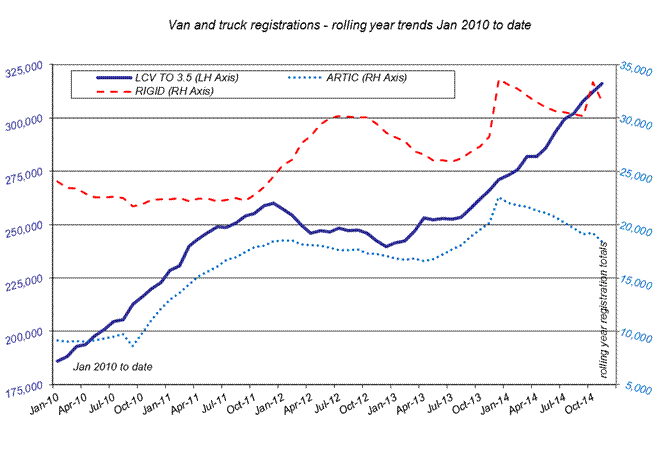
SMMT van and truck registrations November 2014

Van and truck registrations, rolling year changes from Jan 2010 – November 2014 (courtesy of SMMT)

Commenting on the figures, Mike Hawes, SMMT chief executive, said that “buoyant consumer confidence and a rise in home deliveries” were behind the “surging demand for vans”.

The figures suggest he’s correct, with registrations of vans between 2.5t and 3.5t — the size commonly used for home delivery and courier work — rising by 17.1%, or 2,378 units, to 16,084 in November. This increase maintained the 18.8% growth seen in this category for the year to date.

The second biggest category, in volume terms, is vans from 2.0-2.5t. New registrations in this category rose by 31.6% in November, but as total sales registrations were only 4,708, this remains less significant, in terms of numbers, than the larger category.

As I’ve commented before, the UK van market appears to be in rude health, which I take to indicate improved confidence and recovery for businesses of all sizes, as well as being a natural consequence of the financial crisis, during which many companies postponed new vehicle purchases or bought used.

Van hire availability already falling as Christmas approaches

vanrental.co.uk vanIf you need to hire a van between now and Christmas, we’d strongly suggest booking as soon as possible to avoid missing out — or having to pay a higher rate than usual.
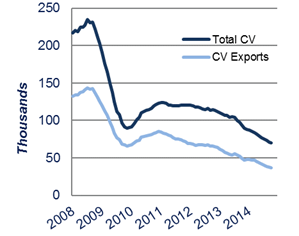
What’s the problem?

In the run-up to Christmas, parcel delivery firms, couriers and much of the transport and retail industry needs more vans than usual, to meet the massive surge in demand associated with Christmas shopping patterns and home delivery.

Many of these extra vans come from daily van hire companies such as Europcar, Hertz and Thrifty, meaning that if you need to rent a van at short notice, you may find you cannot get what you need locally.

Here at vanrental.co.uk, we supply live prices from National, Europcar, Thrifty, Hertz, Sixt and Argus Car Rentals — and we’ve noticed a serious drop in quote availability over the last couple of weeks, along with a rise in certain rental rates.

Don’t leave it too late!

Van hire bookings are almost always made at the last minute: a large proportion of the bookings made through vanrental.co.uk are for hires that take place the same week, often the next day.

Normally this is fine, but as Christmas approaches leaving your booking to the last minute is a big gamble: our advice is to book as soon as possible to avoid disappointment.

Remember, our unique van hire search engine allows you to see live quotes from most of the UK’s biggest van hire companies: we don’t add anything to these prices, and your booking is made directly with the company concerned.

>>> Click here now to get started

Signs of hope from October CV manufacturing figures?

UK CV output graph, 2008-2014

That lost production ain’t never coming back: UK commercial vehicle manufacturing, rolling year total 2008 – 2014 (courtesy of SMMT)

UK commercial vehicle production fell by 31% in September, and by 23% during the first six months of 2014.In that context, October’s 8.9% decline looks pretty encouraging — especially as it masks a 14.6% increase in production for the UK market, compared to the same period last year.

The reason total production declined is that export demand, primarily to the EU, remains weak, and fell by 30.6% last month, taking the year-to-date decline in export production to 27.9%.

The enfeebled state of the eurozone economy is no surprise: it is reassuring, however, to see that UK demand for home-produced vehicles may be picking up. The SMMT figures don’t provide a breakdown, but I’m fairly sure that a significant part of last months’ climb — if not all of it — was due to the introduction of the new Vauxhall Vivaro, which is built at GM’s Luton plant.

This would also explain why the increase wasn’t mirrored in export figures: the Renault Trafic, for example (the same vehicle, badge engineered) is built in one of Renault’s plants in France, and will be the default choice for many French and Iberian buyers.

Here’s how last months’ figures look:

CV manufacturing Oct-13 Oct-14 % Change YTD-13 YTD-14 % Change
Total 7,939 7,235 -8.9% 75,826 57,981 -23.5%
Home 3,816 4,372 14.6% 35,416 28,846 -18.6%
Export 4,123 2,863 -30.6% 40,410 29,135 -27.9%
% export 51.9% 39.6% 53.3% 50.2%

Data courtesy of SMMT (www.smmt.co.uk)

Commenting on the figures, Mike Hawes, SMMT chief executive, said that EU demand remained uncertain, but that UK demand was now expected to stabilise:

“The heavy fall seen in UK commercial vehicle manufacturing over the past year is now levelling off as the effects of last year’s restructuring only apply to year-to-date figures. With new models now being produced in UK plants, production for the home market grew for the first time since June 2013. It remains to be seen if the recent growth in EU demand will continue, but the indications are of greater stability in the months to come.”

There’s a lot of media focus on how UK car production has risen to record levels in recent years, and that’s certainly good news. However, what seems to be less well understood is the catastrophic decline in UK CV production since 2008. Output has fallen from a peak of about 230,000 per year to around 75,000 per year — a 67% decline! In fact, SMMT has stopped including rolling 12-month figures in its monthly updates (e.g. the table above), presumably because they are so depressing.

If you don’t believe me, just take a look at the graph at the top of this article.

Citroën tweaks Berlingo to deliver fuel efficiency boost

The 2014 Citroën BerlingoCitroën has announced that subtle modifications to the Berlingo will increase the popular small van’s fuel efficiency, with the changes taking place from November production onwards.

According to the French firm, the November changes will see the HDi 75 powered Berlingo vans’ combined cycle fuel consumption figure improve to 56.5mpg (previously 55.4mpg) and CO2 emissions reduced to 131g/km from 133g/km.

Similarly, the Berlingo LX e-HDi 90 manual micro-hybrid sees its CO2 emissions reduced to 120g/km from 125g/km and its combined cycle fuel consumption figure improve to 61.4mpg (previously 58.9mpg).

The Berlingo is Citroën’s best-selling van, and the firm is clearly keen to stay on top of the competition. Jeremy Smith, Citroën’s Head of Commercial Vehicles & Business Sector Operations, commented:

“These latest changes will help to maintain the Berlingo’s strong sales performance. In the first three quarters of this year, the Berlingo showed a year-on-year sales growth of 14% to 12,283. We expect that this popular model will deliver one of its best-ever sales results in 2014, reflecting its strong appeal to businesses both large and small.”

The Berlingo range includes a wide range of models and a full choice of drivetrain technologies — full-electric, petrol, diesel and diesel micro-hybrid (perhaps Chivas should have looked outside the Vauxhall stable, which is far more limited).

Berlingos are available with a factory built choice of L1 and L2 panel vans, 5-seat crew vans, enhanced traction vans and platform cabs for special bodywork. The Berlingo panel van is also the only model in its sector to be supplied as standard with Teletrac satellite navigation and Trackstar stolen vehicle tracking.

Used van buyers are “insatiable”, says Manheim’s Davock

Manheim logoUsed van buyers just can’t get enough decent quality vans to meet demand — that’s the conclusion of Manheim’s head of LCV, Matthew Davock, who says:

“”This October we’ve witnessed the highest average van sale price since our records began. There is an insatiable appetite for good quality stock.”

Mr Davock also commented that older, higher mileage vans, which had been fading away from auction entries, are re-emerging in each major segment — especially the key large panel van segment, where 38% of vans over 3 tonnes sold in October had an average age of 87 months and 120,140 miles, while 40% of car-derived vans were more than five years old.

The run-up to Christmas always sees peak demand for large vans, as couriers take on extra staff to meet demand for Christmas deliveries. Manheim believes supplies of used vans may currently be contracting, saying that the volume of vans sold by a representative sample of vendors fell by 13% in October, compared to the same period in 2013.

Record prices

The average price of large panel vans over 3 tonnes rose by £312 to £5,647 in October, compared to September. Average milsage was 99,962, up by 6,437 from September.

A similar trend was seen with small panel vans, where the average value rose to £4,986 in October, 5% higher than in September, despite the average mileage rising by 5,706 to 86,366.

It all adds up to a possible portion of humble pie for me, especially if Mr Davock’s forecast for next year proves to be correct:

“I’m not convinced that van de-fleet volumes will increase over the next 12 months, so this landscape is likely to remain the norm for some time to come.”

Demand for used vans is almost certain to remain strong in the run-up to Christmas — we’ll have to wait until February to see what the New Year brings.

Van registrations climb 18% in October, but rigid truck registrations rise by 122% — here’s why

New van registrations rose by 18.2% to 26,570 units in October, while the truck market staged a dramatic comeback, with new registrations rising by 65.7% to 8,457 units, according to the latest figures from the Society of Motor Manufacturers and Traders (SMMT).

On a rolling 12 month basis, new van registrations are up by 19.1% this year, while truck registrations are now 12.1% higher:

UK van and truck registrations: 2014 and % change on 2013

October % change Year-to-date % change Rolling year % change
Vans 26,570 18.2% 268,641 18.1% 312,237 19.1%
Trucks 8,457 65.7% 35,842 -9.2% 52,603 12.1%
Total 35,027 27.0% 304,483 14.1% 364,840 18.0%

Source: Data courtesy of SMMT

What’s behind the changes?

Van sales have been strong all year, and October’s figures suggest that strength is likely to persist until the end of the year. Underlying economic growth must be one of the factors contributing to this year’s strong performance, but I believe there are others, too, namely:

  • Fleet renewals that were delayed during the recession but can not economically be delayed any further
  • Strong used van prices and improved finance availability means that buying new may make more sense than buying used; I’ve written at length about the massive increase in used prices over the last two years and the poor availability of nearly-new models — although this situation may be starting to change.

As for trucks, sales have declined steadily this year, following a surge of sales ahead of the introduction of Euro 6 emissions rules. The distortion caused by Euro 6 now seems to be dropping out of the figures, although as Mike Hawes, the SMMT’s chief executive, explains, we should be careful not to read too much into one month’s figures:

“October marks the first month of 2014 in which truck registrations have seen positive growth, given the paucity of demand following the introduction of Euro-6. While encouraging, we should treat such a sharp percentage increase with caution, owing to a relatively small total market and new type approval regulations coming into force at the end of the month.”

I’ll come back to Mr Hawes’ comments about type approval in a second, but first, let’s take a look at how these new registrations break down.

What’s selling, what’s not?

As always, there were significant differences in new registrations across the different segments of the van and truck market.

In the van market, the big volume gains were seen in the 2.0-2.5t and 2.5-3.5t segments, where sales rose by 48.2% and 12.5% respectively. The 2.5-3.5t segment is by far the largest in the LCV sector, and accounted for 15,123 of the 26,570 sales in October.

In the truck market, the differences were even more pronounced — and lend support to Mr Hawes’ comments about reserving judgement on this month’s figures. Here’s why: sales of rigid trucks between 6t and 16t rose by 114% in October, compared to the same month last year, while sales of rigids over 16t rose by a massive 174%!

At the same time, sales of 2-axle artics fell by 14.7% and 3-axle artics (standard for most UK work) rose by a more measured 10.4%.

These figures do suggest to me that there is an underlying reason for the sudden surge in truck sales, which may not be repeated next month: I suspect that the type approval deadline triggered a surge of discounted sales of new trucks which would not have been compliant after the introduction of the new rules.

This is why: rigid trucks typically have bodies supplied and fitted by third parties, and so bodybuilding companies which have failed to get type approval for their products will have been keen to push as many out of the door last month as possible. Similarly, truck buyers may be pre-purchasing rigid truck chassis so that they can evade the type approval registrations by having new bodies fitted post registration (a workaround I’ve discussed previously that’s obviously being pursued by some buyers).

We’ll have to wait until next month to find out, but I’d be very surprised if truck registrations are maintained at this level next month, although the outlook for vans should remain similar — especially with pre-Christmas demand from couriers for 3.5t models likely to be strong.