Category Archives: Van News

News and articles about UK vans – especially information relevant to the van hire market. Coverage of new van model launches from all the major manufacturers – Ford, Mercedes, Volkswagen, Peugeot, Fiat and Citroen.

Used van prices up 30% in six months, says Autorola

As I noted recently, used van prices have now passed their pre-recession peak, despite much higher age and mileage. Some of this is due to the improved quality and efficiency of newer vans, which have prompted some fleets to extend their renewal cycles. However, a bigger factor, in my view, is that many small businesses have opted to buy used, for cash, rather than seeking finance to fund the acquisition of new vans.

That may now be changing, as this year has seen a big increase in new van registrations, but the latest figures from remarketing specialists Autorola suggest that demand for used models remains strong: the average price of used vans sold through Autorola’s online remarketing platform has risen by nearly 10%, from £9,605 in Q1 2014 to £10,513 in Q2 2014, an increase of £907 and an all time average high for Autorola.

One caveat: some of this change may be due to the lower average mileage and newer registration plate of vans sold in the second quarter — the average age and mileage of stock in Q2 was 2012/26,377 miles, compared with Q1 (2011/31,927 miles), and bucking the trend seen over the last couple of years.

Each quarter Autorola sells a range of stock from rental companies, utilities, manufacturers and franchised dealers, but currently the 24-30 month old stock is making the strongest money. Neil Frost, Autorola UK’s operations director, explains that the poor condition of older stock is driving demand for a limited supply of newer vans:

“More ex-fleet stock is coming back into the used market at 5-6 years of age with higher mileages and in a tired condition. This has helped increase demand for the newer used stock on our platform.

“SMEs are still buying used vans typically under £10,000 as they continue to grow, but struggle to get finance to buy a new van. With the holiday season nearly upon us and with the economy continuing to thrive it will be interesting to see whether prices stabilise in Q3 2014 or continue to rise.”

It’s too early to say how the second half of 2014 is going to pan out, but I suspect that if new van registrations remain as strong as they are currently, the used market may begin to weaken slightly in 2015, as the balance of supply and demand shifts in favour of used buyers.

Crosswind Assist now standard on more Sprinter models

Crosswind Assist dashboard alert

The Crosswind Assist system uses ESP-controlled braking on individual wheels to counteract the affect of sudden guests of wind and keep the vehicle stable

Mercedes-Benz has increased the number of Sprinter variants to which the firm’s Crosswind Assist system is fitted as standard.

In addition to the Sprinter 3.5t Panel van, the innovative Crosswind Assist is now available as standard for 3.5t Chassis Cab variants.

In addition, the system is also part of the standard specification for the 3.0t Sprinter Panel van, short wheelbase models and super-high roof variants, as well as the firm’s 4×4 Sprinter models.

The system made its debut in the large van segment when the award-winning new Sprinter was launched, last year. The focus was initially on the most common variants, but now the innovative safety system is also part of the standard equipment for many additional variants.

Mercedes says that the system has been retested specifically for each chassis cab variant, because dropside chassis cab variants usually offer a much smaller ‘attack’ surface for side wind gusts than panel vans and luton box bodies.

Crosswind Assist also takes into account parameters such as vehicle speed, vehicle load and steering characteristics, and is one of five new safety systems with which the Sprinter advanced into a completely new dimension of safety technology in the van segment.

Its sensors detect forces acting on the vehicle through side wind gusts – be it on a bridge or when overtaking a truck, and are activated from a speed of 50 mph. Through a brake actuation via ESP at the wheels of the vehicle side facing the wind, a yaw motion develops and counteracts the side wind interference, helping to keep the vehicle travelling in a straight line, rather than weaving around.

Volkswagen Transporter Sportline 60 celebrates six decades of UK sales

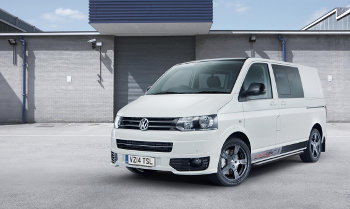
Volkswagen Transporter Sportline 60

The new Volkswagen Transporter Sportline 60

This year marks sixty years since the first Volkswagen Transporter was imported into the UK.

To market the occasion, VW has revamped its Sportline model into a new special edition, the Sportline 60.

The new model replaces the current Sportline and is available in short and long wheelbase forms as either a Kombi or panel van. Distinguished from the rest of the range, the striking exterior features unique 18-inch five-spoke Anthracite alloy wheels, black steel side bars, gloss black door mirror covers and special decals, the Sportline 60 is one of the most stylish T5 Transporters ever offered.

Inside, the Sportline 60 is generously equipped.  Customers are treated to a host of premium creature comforts including an upgraded Kenwood sat-nav infotainment system which features smartphone mirroring functionality, DAB and Bluetooth connectivity. Front and rear parking sensors with camera also come as standard along with new quilted and embossed leather upholstery featuring a special Sportline 60 edition logo.

Also included in the standard specification are a front seat armrest; electrically adjustable and heated door mirrors, electric windows, ABS, climate air conditioning, remote central locking and stereo with CD player.

Like the model it replaces, the new Sportline 60 distinguishes itself from other vans on the road with a number of distinctive styling cues. At the front, colour-coded front bumper and lower spoiler combine with a chrome grille. At the rear a roof spoiler, a colour-coded bumper and unique Sportline 60 badging add to the distinctive look. Available in metallic Reflex Silver or Deep Black as standard. Candy White with a Deep Black roof is available as an option.

The Sportline 60’s purposeful appearance is matched by the power that drives it. This special anniversary model comes with Volkswagen’s top of the range 2.0-litre BiTDI 180 PS engine, offering up to 400 Nm of torque.  Customers can choose between a six-speed manual or seven-speed DSG gearbox. Retail prices start from £29,940 (ex. VAT) for the manual transmission (short wheelbase) and rise to £34,170 (ex. VAT) for the DSG transmission (long wheelbase).

To date, more than 300,000 Transporters have been sold in the UK, with 18,350 sold in 2013 alone. The current Transporter range is one of the broadest in the commercial vehicle sector and comprises of panel van, Kombi, Shuttle, Caravelle and California variants.

Renault confirms launch price for new Master van

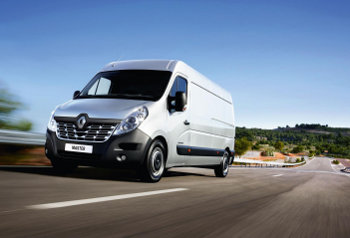
2014 New Renault Master

The new Renault Master

Renault has confirmed the launch price and specification details for the UK version of the new Master large van. Ordering is now open, and the first UK deliveries are expected in September.

In the UK, prices for the New Master will start from £21,120 for the basic panel van models, excluding VAT & OTR charges. Crew Van models will start from £27,000, and while conversion models will start from £23,300.

The initial range will comprise short, medium and long wheelbase panel vans, medium wheelbase crew vans (seven seats), and a large range of medium and long wheelbase conversions including chassis cabs, tippers, dropsides (all in single and double cabs), platform cabs, box vans and Luton models.

Vans will be available in front- or rear-wheel-drive, including a new long wheelbase single rear-wheel drive model aimed at couriers, and four GVW weights: 2,800kg, 3,300kg, 3,500kg or 4500kg.

Panel vans will offer a choice of low, medium or high roof, with load volume of up to 17m3 (panel van), 22m3 (box van).

There will be two trim levels, Business and Business+, and there will be a total of five diesel engines options across the range, including three ENERGY versions, such as the new Twin Turbo dCi 165, which offers fuel economy of up to 40.9 mpg (combined) and CO2 emissions of 180g/km.

Drivers will be able to choose from six-speed manual or Quickshift6 transmission options, and new core equipment includes: DAB radio with CD player, ESC with Grip Xtend, Hill Start Assist and Trailer Swing Assist.

UK order books are open now, first deliveries are expected in September.

Used van prices pass pre-recession peak

Manheim logoUsed van prices have now risen above the peak pre-recession levels seen in 2006, according to auction specialist, Manheim.
The firm extended its usual five-year reporting window to eight years, in order to compare today’s market conditions with those before the financial crisis.

The resulting analysis shows that despite vans being an average of nine months older, with 12,000 more miles on the clock, buyers in auction halls and online in 2014 are having to bid an average of 45%, or £1,500, more than they would back in 2006 to secure them.

Of course, one explanation for this is that cash-strapped businesses have been finding it difficult to get finance and have chosen to buy used, for cash, rather than buy new. New van registrations have been weak for much of the last six years, and are only now beginning to get close to the 2007 level of 300,000+ new vans per year.

The fall in new sales created a corresponding surge in demand for used vans, but Matthew Davock, head of light commercial vehicles at Manheim, says that despite this, the firm didn’t expect used van values to rise so strongly:

“2006 and 2007 were widely acknowledged as the “boom” years in the new and used van markets. When new van registrations collapsed by 50% in 2009 a corresponding used van supply time bomb was set.

So, when combining this with subsequent “bust” and post recessionary recovery and the critical reliance on commercial vehicles by UK Plc, perhaps it is of little surprise to see that the used market has surged. What is so remarkable is that, despite considerable increases in average mileage and age we have witnessed such an inflation of used van values.”

Manheim is now expecting average selling prices to remain broadly stable over the next 12-18 months, as the firm’s head of commercial vehicles, James Davis, explains:

“The only destabilising market factor will be a significant increase in supply over an extended period; yet there are few signs that de-fleet volumes will track this way over the next 12 to 18 months.

Instead I believe it more likely that we’ll see a steady increase due to both economic recovery and new registration growth. This, combined with a corresponding reduction in the number of extended vans, will see average age fall. Given the last 8 years these two may even balance each other out resulting in the average selling price remaining at the current levels.”

I agree with Mr Davis’ logic, but I think it’s also worth considering how many buyers will shift from buying used to buying new — this could accelerate the creation of a supply surplus in the used market and create price weakness slightly earlier than expected.

Van registrations top 1,000 per day in June — monthly total up 33%

More than 1,000 new vans were registered every day in June, according to the latest figures from the SMMT, leaving new registrations up by 33% on the same period last year, at 30,712.

June’s strong performance means that year-to-date van registrations are up by nearly 17% on last year, while rolling year registrations (the last twelve months compared the preceding twelve months) are up by 16%, continuing the strong growth seen already this year.

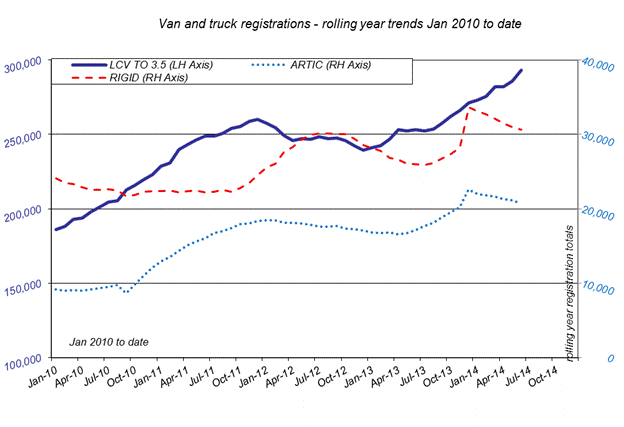
Van and truck registrations -- June 2014

Van and truck registrations rolling year January 2010 – June 2014. Vans are the dark blue line ( graph courtesy of SMMT)

Mike Hawes, the SMMT chief executive, says that the van market has outperformed expectations so far this year:

“The van market has shown another strong performance in June, yielding higher-than-expected growth for the year so far. This has helped the total commercial vehicle market achieve half-year growth of more than 11%, despite a somewhat depressed truck sector.”

Truck sales had their day in the sun last year, ahead of the introduction of Euro 6 legislation, but dealers have paid the price this year, with sales down by 23% so far this year compared to the first six months of 2013.

Which vans are selling?

Drilling down further into the van results, it seems that sales are strongest in the 2.0t – 2.5t and 2.5t – 3.5t sectors, which include models such as the Ford Transit Connect, Ford Transit Custom and Mercedes-Benz Sprinter — traditional fleet workhorses.

Registrations of vans between 2.0t and 2.5t have risen by 36.9% to 27,011 so far this year, while sales of larger models (2.5t – 3.5t) have risen by 19.4%, to 87,598 units.

Volkswagen Transporter celebrates 60 years of UK deliveries (and dreams)

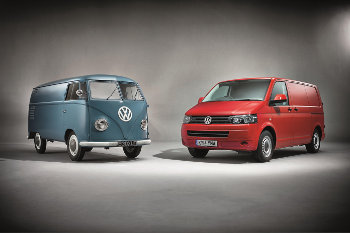
VW Transporter T1 with T5

The original VW Transporter T1 with today’s T5 model

Seven years ago, in 2007, the Volkswagen Transporter celebrated its 60th birthday.

2014 marks the 60th anniversary of the first UK versions of this iconic vehicle, which was launched to UK buyers at the Earls Court Commercial Motor Show in 1954. UK sales in the Transporter T1’s first year totalled just 786, but they’ve risen steadily, and in 2013, VW sold 18,350 Transporter T5 models in the UK.

Although there are other vans that can do the same job as the Transporter, very few — except perhaps the Ford Transit — have ever come close to the Transporter in terms of image and desirability.

Here in the UK, we’ve taken the Transporter to your heart, but the British connection goes back to the van’s very conception, in war-torn post-WWII Germany.

Major Ivan Hirst – a senior British army officer placed in charge of re-commissioning the post-war Volkswagen factory. He ordered the creation of a flat-bed truck – dubbed the Plattenwagen – to move parts around the factory. The innovative truck soon caught the eye of visiting Dutch importer Ben Pon in the mid-1940s, who proposed the idea of a more developed panel van version.

VW Transporter T1, T2 and T3 models

Volkswagen Transporter T1, T2 and T3 models. The T3 was the last rear-engined model.

The idea was welcomed by Volkswagen, but the firm wasn’t able to put it into production until the late 1940s, when it made the journey from drawing board to production line in an astonishingly short 13 months — a gestation period that would be unthinkable today.

Having quickly established its superiority over its rivals, the T1 became the template for light commercial panel vans, pick-ups and microbuses – selling strongly for 17 years.

Such was the brilliance of the original that the T2 that replaced it in 1967 retained much of its underpinnings. Even the boxy third-generation T3 that appeared in 1979 employed the neatly balanced, load-friendly rear engine layout of the original.

Indeed, it wasn’t until the fourth-generation T4 arrived in 1990 that Volkswagen switched to the now familiar front-engine, front-wheel drive layout. And just as the original had done in 1954, the T4 set new standards for refinement, quality and flexibility.

The fifth-generation Transporter T5 appeared in 2003, and raised the bar even higher with an even bigger load area, broader range and a host of advanced new technologies.

New Ford Courier scores 4 stars in Euro NCAP test

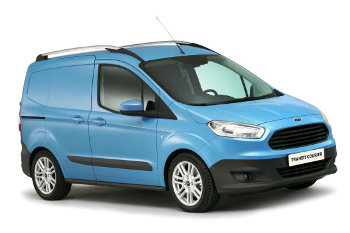
All-new Ford Transit Courier

The new Ford Transit Courier — the passenger version of this model, the Tourneo Courier, has earned a respectable 4-star Euro NCAP safety score.

Despite their size, vans have lagged behind cars in terms of safety for many years, rarely scoring highly in Euro NCAP safety tests in MPV guise (commercial vans aren’t tested).

However, over the last year that’s begun to change, with the passenger-carrying variants of several new van models achieving four or even five-star Euro NCAP test scores.

The latest van-based model to be submitted to Euro NCAP’s demanding test schedule is the Ford Tourneo Courier, the MPV version of the all-new Ford Transit Courier van.

The Tourneo Courier managed a 4-star Euro NCAP score — a strong result where the main weakness was a disappointing 56% score in the ‘safety assist’ category.

This is a reminder that even the newest van models tend to have fewer safety systems that equivalent cars. In the case of the Tourneo Courier, the weak score was due to the lack of any option for autonomous braking (e.g. rear-end collision avoidance) and lane departure warning systems, both of which are becoming common options in new car models.

However, the Courier’s pedestrian safety score was good, at 74%, showing that van manufacturers have made progress in this area — a traditional weakness for commercial vehicles. Similarly, child and adult occupant safety were very strong, with scores of 84% in both categories.

The new Ford Transit Custom earned a five-star score last year in Tourneo guise — this latest result suggests that Ford’s focus on LCV safety is continuing and bodes well for the van market as a whole.

Commercial vehicle production down 32% in May, but is there light at the end of the tunnel?

Will we soon see an end to the restructuring-induced decline in UK commercial vehicle manufacturing? CV output from UK factories fell by a cringe-inducing 32% in May compared to the same period last year, according to the latest SMMT figures, but SMMT chief executive Mike Hawes believes that when last year’s cuts drop out of the monthly figures this summer, we could see a rosier picture:

“UK commercial vehicle output continued to feel the effects of last year’s production restructuring with volumes down 32% in May. There is light at the end of the tunnel, however, as we look forward to the end of this impact in late summer,” said Mike Hawes, SMMT Chief Executive. “The next few months will also see new models rolling off UK assembly lines, which will help boost production numbers.”

Here are the latest UK CV production figures:

CV manufacturing May-13 May-14 % Change YTD-13 YTD-14 % Change
Total 7,560 5,127 -32.2% 40,037 30,917 -22.8%
Home 3,662 2,937 -19.8% 20,227 15,349 -24.1%
Export 3,898 2,190 -43.8% 19,810 15,568 -21.4%
% export 51.6% 42.7% 49.5% 50.4%

Data courtesy of SMMT (www.smmt.co.uk)

It’s certainly true that the introduction of the new Luton-built Vauxhall Vivaro could trigger a surge of sales from patriotic buyers who’ve been holding off replacing their old vans until the new model is available, but what Mr Hawes is really talking about is what the financial industry likes to call ‘rebasing’ — getting used to a new [lower] normal.

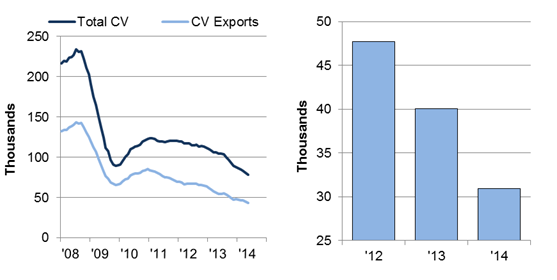
In other words, it’s now structurally impossible for CV manufacturing to rise to the levels seen in 2008, or even 2012. The best we can hope for is that the relentless decline shown on these graphs comes to a halt soon:

UK CV manufacturing May 2014

Rolling year CV output (left) and CV output year-to-date (right), courtesy of SMMT

Will that downward slope flatten out soon?


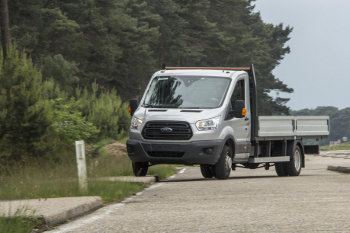
New Ford Transit undergoes torture tests:

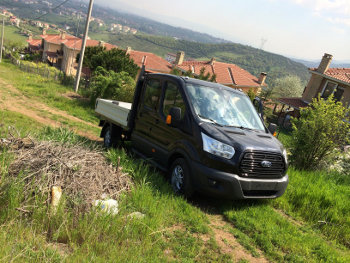
Ford Transit durability testing off road

Testing the new Ford Transit off road — all in a day’s work for the average builder!

Like its small sibling, the Transit Custom, Ford has ensured that the all-new Transit will survive 10 years of the toughest treatment by using an especially punishing accelerated ageing process as part of its development.

Durability tests included the equivalent of driving 11 million kilometres – or 275 round-the-world trips – at state-of-the-art proving grounds and in extreme conditions across the globe where temperatures ranged from +40 to -40 deg C.

“I don’t think many customers would believe what this vehicle has been through,” said David Gregory, Transit chief programme engineer, Ford of Europe. “We inflict the worst possible treatment that a van could endure, and we’re only satisfied when our new vehicle comes through with flying colours – just as the Transit has done.”

As the first Transit to be sold in both Europe and North America, the all-new model was subjected to this testing both at Ford’s facilities in Lommel, Belgium, and in Romeo, Michigan.

At Lommel, the all-new Transit, including van, chassis cab and minibus versions, was put through more than 30 punishing vehicle tests. These included the trailer tow general durability test, conducted at maximum weight with a fully loaded trailer and being driven at top speed non-stop for two months, pounding over rough gravel roads, and through salt- and mud-baths. The prototypes also were tested for corrosion resistance in high-humidity chambers for 12 weeks and put through non-stop figure-of-eight manoeuvres for one month.

Ford Transit durability test kerb impact

Couriers are forced to do this around 100 times per day — but not usually at 37mph!

Engineers have driven the all-new Transit more than 5,000 times over an extreme course of potholes and bumps, and conducted a strength test by driving it at 60 km/h (37 mph) into a 14 cm high kerb.

Ford also tested the Transit prototypes from the Austrian Alps to Death Valley: in Europe, North America, Africa and Asia.

Vehicles faced the 40 deg C heat of Arizona, Dubai and South Africa, the bitter -40 deg C cold in Finland (where it won the annual Arctic Van Test) and Canada, as well as challenging journeys through Europe, the Middle East, Russia, Turkey and the U.S.

Prior to launch, the new model covered more than 300,000 miles of tough real-world use with high-mileage Transit customers. In the test labs, the all-new Transit’s 2.2-litre Duratorq diesel engine was subjected to 46 days of continuous high-load urban driving on specialised rigs, as part of tens of thousands of hours of engine testing.

Component test rigs were used to simulate real-world punishment, replicating the full 10-year vehicle lifecycle in just 30 days.

Ford Transit durability test salt water

There’s nothing like a salt bath to keep your bodywork in good condition

Ford has made more than 100 significant improvements to the Transit as a direct result of its testing regime including the redesign of the side rail on jumbo van models, and strengthening of the rear cross-member on chassis cabs.

“Pushing the van to the limit and beyond helps us to deliver a stronger, more robust product. This translates directly into every-day reliability for the customer, however tough their working environment,” Gregory added.

The all-new two-tonne Transit is the flagship of the completely redesigned and expanded Ford Transit range, and is now on sale in the UK and across Europe alongside the Transit Custom, Transit Connect and Transit Courier models.

Ford’s made a video showing some of the highlights of the testing, take a look below to see the tests as they happened: