Van-based Vito Taxi offers big advantages over traditional black cab

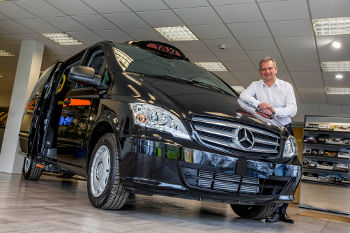
Mercedes-Benz Vito London Taxi

London cabbie Mike Fleischmann has just taken delivery of his second Vito Taxi

The van-based Mercedes-Benz Vito Tax is gaining a growing following amongst the demanding ranks of London’s black cab drivers, thanks to the superior mix of comfort, space, sophistication and fuel consumption it offers in comparison to the classic but dated black cab.

Thanks to its innovative turning rear axle the Vito Taxi conforms to Transport for London Conditions of Fitness and can seat six adults, one more than its traditional competitor.

Standard technical equipment includes the Adaptive ESP stability programme, Parktronic with visual and audible aids, and Speedtronic with cruise control and variable speed limiter.

Mike Fleischmann, who has been driving London cabs for 31 years, is a convinced advocate of the Mercedes-Benz Vito Taxi:

“It’s a ‘chalk and cheese’ comparison,” he enthused. “The Vito is a wonderful, premium quality vehicle and passengers invariably appreciate its comfort and extra space.

“From the cabbie’s point of view, meanwhile, its extra sophistication gives rise to a smoother, more relaxed driving style than you’d employ in an ordinary taxi – no-one drives like a lunatic in a Vito Taxi.

“The fuel consumption is definitely better too, while the after sales back-up is unbelievable; in the event that you’re unlucky enough to suffer a breakdown you make one call and someone comes along to sort you out. Fantastic!”

Vito Taxi owners also benefit from a comprehensive three-year/150,000 mile warranty, service intervals of up to 24,000 miles and free Service24h emergency roadside assistance as standard.

Ambulance service trials solar panels to aid fuel consumption

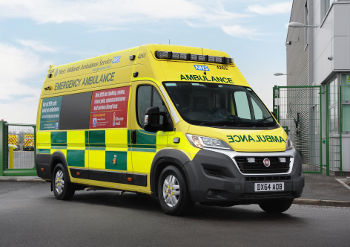
WMAS Fiat Ducato Maxi ambulance

One of WMAS’s new Fiat Ducato Maxi ambulances

Ambulances need a lot of electricity: indeed, with the latest models carrying approximately one mile of electrical wiring and an extensive range of extra electrical equipment, it has long been standard practice to fit uprated alternators to ambulances. This ensures that the electrical load can be met at all times and that battery charge is maintained at healthy levels.

However, alternators don’t magic electricity out of thin air — they are engine-driven, and extra electrical load means extra fuel consumption, especially when idling or running at low speeds.

To try and address this problem and reduce both the carbon footprint and the fuel bills generated by its ambulances, without sacrificing performance, the West Midlands Ambulance Service (WMAS) is about to begin trialling solar panels on five of its newest vehicles.

The trial vehicles are part of a 101-vehicle order for new front-line ambulances, all of which will be based on the Fiat Ducator Maxi panel van, plated at 4,250kg gross vehicle weight.

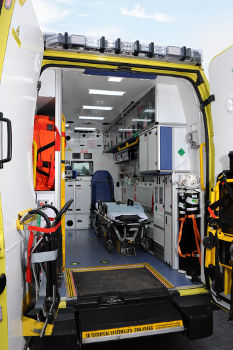
Inside WMAS Fiat Ducato ambulance

Inside one of the new WMAS Fiat Ducato ambulances

Ambulances are fairly heavily loaded at all times, and the use of the Maxi chassis — which has uprated suspension and larger wheel sizes — will help provide a more robust and stable ambulance platform, without sacrificing the cost and maneuverability advantages offered by the choice of a panel van rather than box body.

The vans are long wheelbase, extra-high roof models powered by Fiat’s 3.0-litre 180bhp diesel engine, and have air suspension fitted to further aid ride stability under emergency conditions.

WMAS has been operating the FIAT Ducato in front line ambulance operation for a number of years and by the time the last of the 101 new units are delivered, two thirds of its entire ambulance fleet (240 of 360 vehicles) will be Fiat Ducato based.

According to Tony Page, General Manager Fleet Services with West Midlands Ambulance Service NHS Foundation Trust:

“The Ducato provides the Trust with a platform to build a front line ambulance that provides a good working space for our clinical colleagues to deliver a high level of patient care, the 3.0 diesel engine is more than capable of getting the vehicle and crew to serious incidents in a timely manner, good dealer support and fuel economy are also an important aspect of the FIAT Ducato’s offering.

Early signs with the first 40 units of the latest model Ducato in operation are they are step change improvement for us, feedback from our crews so far has been very positive.”

The choice of the Ducato Maxi is an interesting variation from the more commonly specified 5-tonne Mercedes-Benz Sprinter box body ambulance conversion preferred by many ambulance services — almost without a doubt the Ducato panel van is far cheaper option, so it will be interesting to see how much of a foothold it gains elsewhere in the UK.

Citroën Berlingo updated for 2015

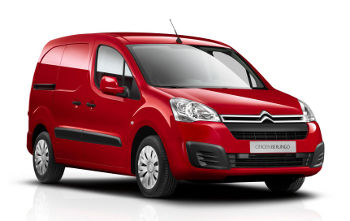
Citroen Berlingo 2015

New 2015 Citroen Berlingo

Citroën has updated its popular Berlingo small van model for 2015.

The new van will be unveiled to the press at the Geneva Motor Show in March 2015, and will include an updated front end, new safety assist systems and an updated in-car touchscreen-based infotainment system.

There’s also an updated range of BlueHDi engines, which use AdBlue to meet the Euro 6 emissions standard. Finally, the new Berlingo range will also include an updated all-electric Berlingo model.

More active assistance

In addition to the safety features available on the current model (hill-start assist, Grip Control, speed limiter and automatic lights), Citroën has upped the ante with a range of new features for 2015, more commonly found on mid-range cars:

  • Active City Brake: an automatic braking system designed to prevent collisions at speeds of up to 30kph (19mph).
  • Front parking sensors: allong with the existing rear parking sensors, these new sensors make it easy to drive right up to a wall or parked vehicle without bumping it…
  • Reversing camera: as an option, the new Berlingo can be equipped with a reversing camera for easier day-to-day parking. When the driver puts the vehicle into reverse, the image from the camera will be displayed on the new 7-inch dashboard touchscreen.

Lower emissions

I’ve had a good rant about the failings of Euro 5 and the loophole-ridden lack of Euro 6 adoption recently, but Euro 6 will be compulsory for vans from September 2015, so van operators won’t be able to avoid the minor cost and hassle of AdBlue for much longer.

The new Berlingo will be powered by a range of Euro 6 engines, badged as BlueHDi models. The 17-litre AdBlue tank will be located in the back of the vehicle and will contain, according to Citroën, enough AdBlue for 20,000km — so I guess many van operators will get it topped up alongside each oil change.

Here are the key figures for the new engine range:

  • BlueHDi 75 manual: 65.7mpg & 113g of CO2
  • BlueHDi 100 manual: 59mpg & 113g of CO2
  • BlueHDi 100 S&S manual: 56mpg & 109g of CO2
  • BlueHDi 100 S&S ETG6 engine: 48mpg & 109g of CO2
  • BlueHDi 120 S&S 6-speed manual: 60mpg & 115g of CO2

The electric Berlingo, of course, has zero tailpipe emissions. It also boasts a range of 170km between charged and offers a power output of 67bhp along with “virtually constant torque” of 200Nm, making it a seriously nippy beast at urban and suburban speeds.

Maximum speed is 110kph, so it’s not a motorway muncher, but as I’ve often written before, urban delivery vans, are, in my view, currently the killer app for electric power — easily the best chance yet to bring electric vehicles into the mainstream and prove their worth.

Touchscreen infotainment

Mobile workers increasingly do everything through their smartphones.

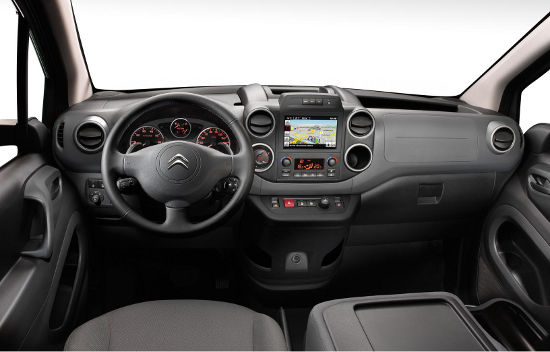
New 2015 Berlingo dashboard with touchscreen

The updated Berlingo dashboard features a 7-inch multifunction touchscreen

The updated dashboard design will include a 7-inch touchscreen with the potential capability (some of it is optional) to provide:

Improved navigation: the driver can view maps in perspective, display speed limits, take account of traffic conditions & select the most fuel-efficient route.

  • Media function: includes radio, audio streaming and connections to portable devices.
  • Hands-free telephone function: Bluetooth, hands-free dialling and double call management.

The Berlingo has sold 2.9 million units since its introduction in 1996 — and I can’t see anything here that will derail its deserved popularity. More of the same is often a winning formula.


UK commercial vehicle manufacturing stabilising, says SMMT

SMMT CV manufacturing Vivaro

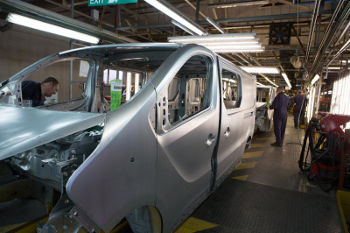
If my eyes don’t deceive me, this is a new Vauxhall Vivaro being built at the firm’s Luton plant (image courtesy of SMMT)

One month ago, I wrote that December’s UK commercial vehicle manufacturing figures “hinted at a return to growth”.

A month later, year-on-year production is still falling, but only marginally — the double-digit percentage declines we saw last year do appear to be history, according to the latest figures from the Society of Motor Manufacturers and Traders (SMMT).

The number of commercial vehicles produced for the domestic market fell by just 3.7% in January, compared to the same period last year.

Although export demand continued to plummet last month, the perilous state of some eurozone economies and the weak euro, mean that there’s not much that UK manufacturers can do to resurrect their European sales: the reality is that anyone buying vehicles in the eurozone is likely to get better value if they buy a vehicle that’s made in the eurozone.

Here are last month’s manufacturing figures — the numbers to look at are those on the ‘Home’ row, which indicate manufacturing for domestic (i.e. UK) sales:

CV manufacturing Jan-14 Jan-15 % Change YTD-14 YTD-15 % Change
Total 6,707 5,443 -18.8% 6,707 5,443 -18.8%
Home 3,471 3,341 -3.7% 3,471 3,341 -3.7%
Export 3,236 2,102 -35.0% 3,236 2,102 -35.0%
% export 48.2% 38.6% 48.2% 38.6%

Data courtesy of SMMT (www.smmt.co.uk)

SMMT chief executive Mike Hawes is determined to paint a positive picture, too:

“The commercial vehicle sector saw manufacturing output decrease year-on-year in January, although there is still confidence in the sector. The home market for commercial vehicles has been strong in recent months and we expect a continued resurgence to help drive growth. Production is expected to ramp up on recently introduced models which will increase output.”

I think it’s fair to say that UK CV manufacturing has now stabilised — hopefully the dire collapse of recent years has now bottomed out.

It would be nice to see the surge in new van registrations feeding through (via the new Vivaro) manufacturing figures, but Vauxhall can’t be expected to prop up the entire UK CV manufacturing sector on its own, so we’ll have to hope that sales momentum continues into the year.

Pick-up news: Nissan Navara, Mitsubishi L200 & Toyota Hilux

This week has seen three manufacturers announce new or updated pick-up models — in fact, given the rate at which blinged-up pick-ups are appearing on the market at the moment, I wonder if we are approaching the peak of this particular fashion?

Anyway, here’s a summary of this week’s new and updated models:

Mitsubishi L200 new 2015 model

The new 2015 Mitsubishi L200

New Mitsubishi L200

The current L200 is one of the longer-running models in the pick-up market, so it’s no big surprise to see that Mitsubishi is planning to introduce a new, 5th generation model, later this year.

The new L200 will make its debut at the International Geneva Motor Show in March, and is due to be launched in Europe in summer 2015.

The new L200 will be powered by an all-new 2.4-litre MIVEC diesel engine which the firm says will deliver a 17% reduction in CO2 emissions and will be controlled with a new 6-speed manual transmission. There’ll also be an automatic option.

Service intervals have been increased, ride quality tweaked and seating improved — apparently — while safety has also been improved with the addition of the usual raft of new safety systems, such as lane departure warning and trailer stability assist.

Nissan Navara Salomon
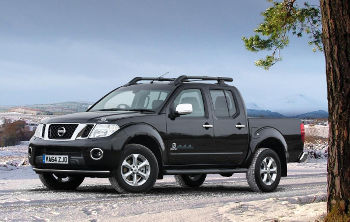
Nissan Navara Salomon Limited Edition

Nissan Navara Salomon Limited Edition

In the absence of a new model, pick-up manufacturers seem to be keen on introducing new blinged-up limited edition specials, targeting the growing lifestyle/fashion contingent who buy these large vehicles for reasons other than practicality…

As its name suggests, the Navara Salomon is targeting the ‘adventure lifestyle’ market.

The Salomon spec is based on the popular Navara Tekna trim and includes styling enhancements such as chrome front bar,  door handles and foglight surrounds. There’s also unique Salomon branding on the front, side and rear of the vehicle which is available in Metallic Black, Twilight Grey, Starburst Silver or Alabaster White.

On the inside, the Navara is boasts Salomon entry guards, a metal plaque, and Salomon floor mats. Assuming you wanted it, all of this extra stuff would normally cost more than £1,300, but the Navara Salomon costs just £750 more than the equivalent Tekna model, giving a saving in the region of £550.

The Navara Salomon is available in UK showrooms now, prices start from £27,845 OTR — and each Navara Salomon retail customer will get a £250 voucher to spend on Salomon gear.
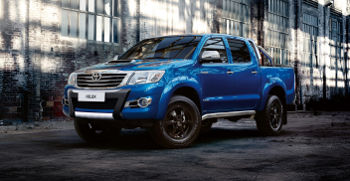
Toyota Hilux Invincible X

Toyota Hilux Invincible X

Toyota Hilux Invincible X

The Hilux is the original — and probably still the best when it comes to really rough stuff. However, buyers of the Invincible X, which includes an unhealthy amount of chrome, and the option of black or two-tone 17″ alloy wheels, are unlikely to be hammering their Hilux pick-ups across rough terrain anytime soon.

Toyota says that the Invincible X is its top-of-the range Hilux model and includes features such as a choice of four leather colourways for the seats, and four 17″ alloy wheel designs.

You can also choose chrome side bars “with or without steps” and select between a “hi-over bar or Style Pack” — the latter option includes “front guard, silver-coloured under-run, aluminium-finish scuff plates, chrome door handles and chrome surrounds for the bonnet air intake and rear lamp clusters”.

This is clearly a trim level that has been designed for people for whom appearances are everything…

As you’d expect, the Hilux Invincible X will be powered by the top available engine option, Toyota’s 169bhp 3.0-litre D4D diesel engine, with a choice of five-speed manual or automatic transmission, permanent four-wheel drive and an auto-disconnecting differential.

The new Hilux Invincible X is available to order now, priced £23,842 for the manual model and £24,842 for the automatic (commercial vehicle on-the-road, not including VAT).

Air-con and cruise control added to Citroën Relay Ready to Run conversions

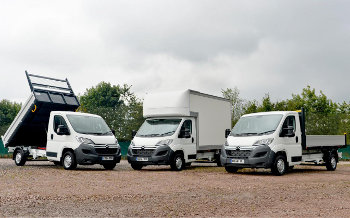
Citroen Relay conversionsCitroën will introduce a new high-specification Enterprise model to its ready-bodied Relay Ready to Run range for 2015. Available from late April onwards, the new models will be debuted at the CV Show in April.
The Enterprise specification of the Relay chassis cab used for Ready to Run conversions will include:

  • Teletrac Smartnav & Trackstar stolen vehicle tracking telematics package
  • Air conditioning
  • Cruise control with variable speed limiter
  • Perimetric alarm
  • 5-inch colour touch screen/DAB digital radio
  • Bluetooth®, audio streaming & SMS
  • MP3 compatible CD player

Not bad, I reckon, especially at Citroën’s traditionally competitive prices.

Euro 6 debut

Citroën will also introduce its first Euro 6 van models at the CV Show.

From July 2015 through to September 2016 there will be a rolling programme to introduce advanced, low emission, highly fuel-efficient BlueHDi Euro 6 compliant engines to the Citroën LCV range.

The firm is introducing a Selective Catalytic Reduction (SCR) solution to meet the new standards, as are most other manufacturers. A particular challenge is meeting Euro 6’s targets for Nitrogen Oxide (NOx) reduction: as I’ve written recently, Euro 5 failed to achieve the targeted NOx reductions in urban use, and NOx is one of the most harmful pollutants in modern diesel emissions.

Citroën’s new Euro 6 diesels will be branded as BlueHDi, but will in due course become the only available option — from September 2015, I believe.

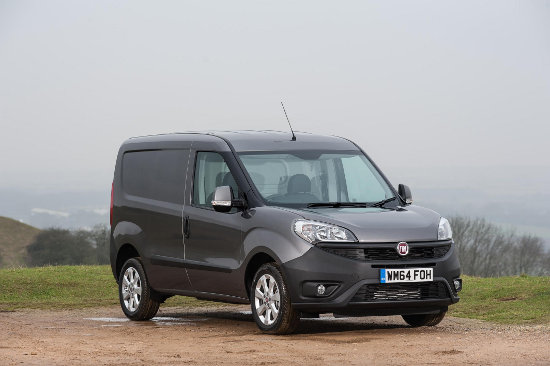
New Fiat Doblò Cargo Breaks Cover At UK Launch

The Fiat Doblò Cargo is a popular model in the fast-growing small van segment, so the new fourth-generation model due to hit UK roads later this year will be an important model for the Italian firm.

First shown at the IAA show in Hanover last September, the received its UK launch this week at a press event in the Midlands. It’s probably fair to say that Fiat has decided not to change a formula that isn’t broken — the new Doblò promises to deliver more of the same in pretty much every department.

2015 Fiat Doblò Cargo van

The 2015 Fiat Doblò Cargo van

Under the bonnet

The new Doblò Cargo will be powered by improved versions of Fiat’s 1.3-litre and 1.6-litre MultiJet II engines, which promise efficiency gains of up to 12% compared to the previous versions, as well as more torque at low revs.

Included in the range will be EcoJet low emission models, which offer a further reduction in fuel consumption and emissions levels thanks to the use of Start&Stop; low rolling-resistance tyres; low-viscosity oil; an ‘intelligent’ alternator; a variable-displacement oil pump and a new aerodynamic pack. Collectively, Fiat says that these changes mean the EcoJet models will be able to deliver a fuel economy figure of up to 64 MPG (4.4 L/100km) and CO2 emissions of just 115 g/km.

As with all new models at the moment, the Doblò’s safety credentials have been enhanced, and the standard specification will include ESC (Electronic Stability Control), ABS brakes with EBD (Electronic Brake force Distribution), ASR (Anti Slip Regulation), HBA (Hydraulic Brake Assist) and Hill-Holder systems that help the driver during hill starts.

In the cab

The cab of the outgoing Doblò is a comfortable and practical workspace, and Fiat has played safe inside the cab, which is largely unchanged.

2015 Fiat Doblò  Cargo interior

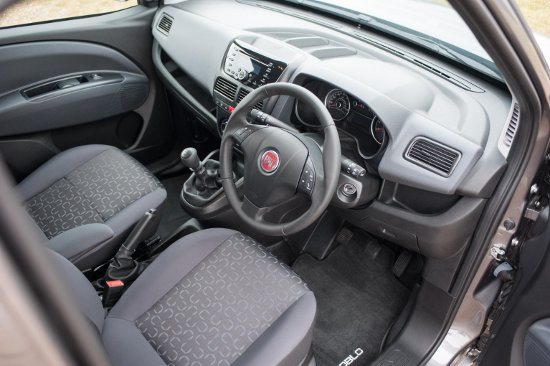
Inside the cabin of the new Fiat Doblò Cargo — largely unchanged from the outgoing model


The firm says that clutch action will be lighter on the new model, the gearstick will be shorter — giving a more positive change — and extra sound-proofing will reduce noise in the cabin by an average of 3dB, a worthwhile improvement.

Load area

Out back, the new Doblò Cargo will come in a choice of two load lengths and two roof heights, with a maximum potential load capacity of 5 cubic metres and/or 1 tonne. The Work Up pick-up/dropside model will also continue to be available. These ‘small’ vans aren’t so small anymore…

Load area of 2015 Fiat Doblò  Cargo

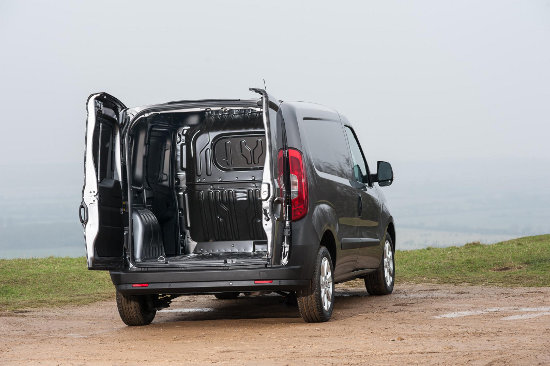
The load area of the standard wheelbase/standard roof height van

Rear doors open to 180 degrees as standard and are designed to be as easy to use as possible when your hands are full — Fiat claims that the rear door and be opened and fully extended using just your little finger!

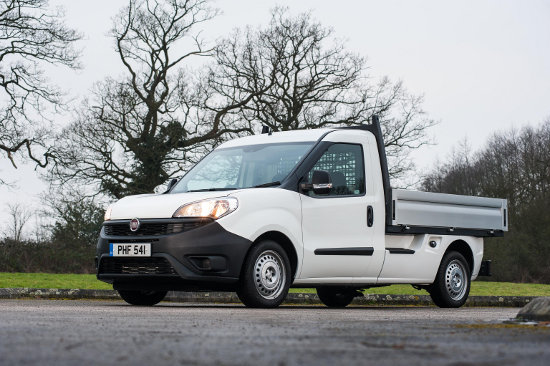
2015 Fiat Doblò  Work Up model

The Fiat Doblò Work Up model will continue to be available.

Luxury levels

Four trim levels will be available, Standard, EcoJet, SX and Tecnico.

Standard features on all FIAT Doblò models include adjustable-level headlamps, a full-size spare wheel, full bulkhead, overhead storage, electric windows, central locking, full wheel trims, side rubbing strips, full-height twin panelled rear doors; offside sliding side door, (plus a nearside sliding side door on Maxi and XL models) and a speed limiter (upon request). The EcoJet version adds smart alternator management, variable displacement oil pump, Start & Stop, low-friction oil, and low-rolling resistance tyres and a new aerodynamic pack.

The SX model adds bulkhead soundproofing and load area PVC lining, as well as front fog lamps; electrically adjustable and heated door mirrors with body-coloured covers; remote control central locking; height adjustable drivers’ seat with lumbar support; in-cushion storage in the passenger seat and an upgraded stereo with MP3 compatibility.

The range-topping Tecnico model includes air conditioning; rear parking sensors, Bluetooth connectivity, Start & Stop; remote steering wheel controls and a dealer-fitted satellite navigation system.

EXCLUSIVE: SAVE up to 10% on SIXT Van Rental [EXPIRED]

If you need to hire a van this week, then we have an exclusive deal for you: SAVE up to 10% on SIXT van rental.

This offer is exclusive to vanrental.co.uk and can only be accessed through our special booking link, below.

Here are the details:

  • Valid from: 16 February 2015
  • Expires: 22 February 2015
  • Booking must be made using the button below:


*** THIS OFFER HAS NOW EXPIRED ***


Terms and conditions may apply: see Sixt website for details.

Used vans get cheaper as auctions flooded with new stock

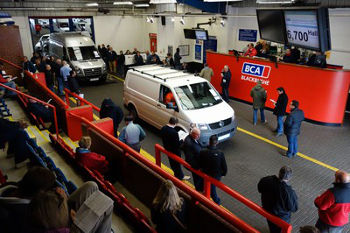
Vans being sold at BCA Blackbushe

Vans being sold at BCA Blackbushe (image courtesy of BCA)

I admit it’s taken a while for my cautious outlook to be validated, but I reckon it’s now happening: used van values fell by 7.0% in January 2015, compared to December 2014, according to British Car Auctions. Prices are now just 2.6% higher than one year ago — only slightly above inflation.

Over at auction peer Manheim, it was a similar story. Although Manheim reported a 2% increase in January 2015 compared with December 2014, there is a reason for this: there was an increase in the percentage of desirable 3-5 year old stock in the vehicle mix in January.

I’ve been predicting this for a while, mainly because of the surging volumes of new van registrations.

The change in vehicle age mix at auction continues a trend first mentioned by Manheim in September 2014, shortly after I’d suggested that the reason used van prices were still rising was that more, younger vans were entering the auction halls, rather than that buyers were paying ever-higher prices for old bangers.

What do the numbers say?

According to BCA, which provides a more detailed breakdown than Manheim, the average price of a van sold at BCA in January was £5,640, down by 7% from £5,870 in December.

Ex-fleet and lease vans — which are usually between three and four years old — fell by 5.5% in January, compared to December, to £6,478, and are now only £24 higher than in January 2014. To me, this suggests that the market is now able to get the volume of vans it needs, and is able to mark down sub-standard stock.

Down in the lower tier of the market — as both auctioneers describe it — the average price paid for part-exchange vans (typically 6-8 years old) in January 2015 was £3,676, a 4.4% fall from December, and only 2% higher than the £3,752 average seen in January 2014.

Quality concerns

As the volume of good quality 3-5 year old stock rises, buyers will be less willing to compromise on quality, specification or condition, and this trend was evident in January, too: both Manheim and BCA made almost identical comments about sub-standard stock becoming increasingly problematical to sell.

Here’s what Duncan Ward, Head of Commercial Vehicles at BCA, said:

“There are also some issues over quality and presentation as vehicles from corporate sources are returning at generally higher ages and mileages than we were seeing a year ago.  It’s a timely warning for vendors that if the quality of stock is declining this will impact on the price performance.”

And here’s what his opposite number, Matthew Davock at Manheim said:

“Typically, when volume is high, the first two areas to feel the strain are damaged stock and duplicated stock – and we’re already seeing signs of this.”

What’s next?

Don’t get me wrong: I’m certainly not suggesting that the used van market is about to collapse: demand is clearly healthy and both Manheim and BCA reported strong selling in January, despite the increased volume of vans.

However, there’s no doubt in my mind that surging demand for new vans — registrations rose by 18.7% last year — and the strengthening economy will combine to tame the wild inflation that’s been seen in the used van market over the last couple of years.

January 2015 and December 2014 may have been extreme cases, but I suspect that the trends seen in January will continue well into 2015, as the market rebalances to reflect new buyers’ greater share of the market.

Bus operators are sabotaging urban air quality through Euro 6 emissions loophole

Car exhaust tailpipe emissionsI recently wrote about the problems caused by Nitrogen Oxides (NOx), a dangerous pollutant from diesel exhaust fumes. NOx emissions have been relatively unaffected by successive UK governments’ obssessions with carbon dioxide emissions, something that has of course been driven by the EU.

The problem should have been addressed by the Euro 5 emissions regulations, which had lower limits for NOx.

Unfortunately, lower limits on paper didn’t seem to translate into lower NOx emissions, according to a report from Transport For London, which says that Euro 5 technology didn’t work to reduce NOx emissions in urban environments*.

In other words, manufacturers designed their engines to get through the Euro 5 approval tests**, but these tests didn’t represent real-life urban driving conditions.

Enter Euro 6

The latest European emissions standard, Euro 6, should go some way to address this problem: in addition to having lower NOx limits, Euro 6 requires emissions to be measured at a range of engine speeds and loads, simulating urban driving.

In fact, according to the Society of Motor Manufacturers and Traders, a London bus fitted with Euro 6 techology emits 95% less NOx than older models. Good news, then?

Well no, or at least not anytime soon. Although Euro 6 was made a requirement for heavy vehicles at the start of 2014, a loophole was provided exempting bus operators from having to buy Euro 6 buses. Unsurprisingly, bus operators have decided to stick with (cheaper) Euro 5 engines, and just 20% of buses registered last year were Euro 6-compliant models.

As we’ve seen before, the government pays lip service to the importance of cutting transport emissions, but does very little to actually implement it, caving in to vested interests at every turn.

*https://consultations.tfl.gov.uk/environment/ultra-low-emission-zone/user_uploads/ulez-supplementary-information—final-291014.pdf

**Update 2016: Or as we now know, some manufacturers simply rigged the test results…